
If you’re collecting miles & points through credit card spending, I always recommend doing what you can to accrue transferable points currencies.
That’s because these points are much more flexible than when you’re earning an individual airline or hotel points currency. You have the ability to transfer these points to all kinds of travel partners, and you’re safeguarded from a devaluation in a specific points currency.

Chase Ultimate Rewards points are one of the most valuable and widely collected points currencies out there, given all the great cards that earn Chase points.
Chase Ultimate Rewards points are easy to earn
There are several credit cards that earn Chase Ultimate Rewards points. Arguably one of the best things about Ultimate Rewards is the portfolio of credit cards that you can create, to maximize both your personal and business credit card spending.
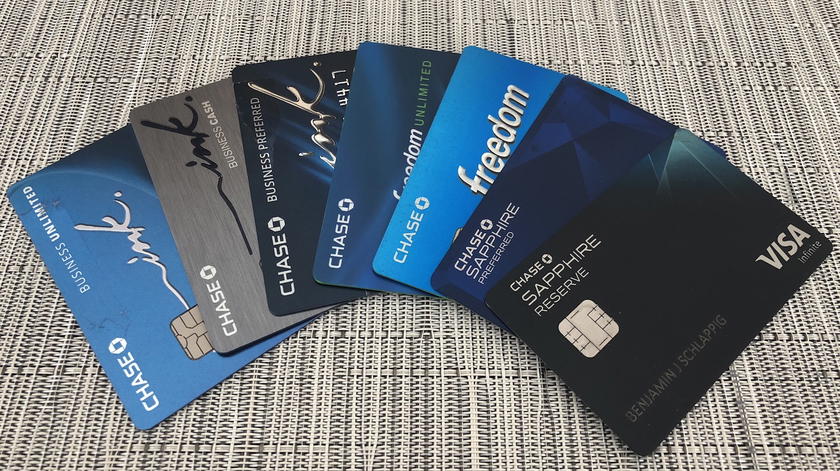
The following three cards directly earn Chase Ultimate Rewards points (I’m also listing their annual fees and rewards structures):
- The $795 annual fee Chase Sapphire Reserve® (review) offers 3x points on dining and 4x points on direct air/hotel bookings
- The $95 annual fee Chase Sapphire Preferred® (review) offers 3x points on dining, online groceries, gas & EV charging, select vacation rentals (including Airbnb, VRBO, and more), and select streaming services, and 2x points on travel
- The $95 annual fee Ink Business Preferred® Credit Card (review) offers 3x points on the first $150,000 spent in combined purchases per account anniversary year on travel, shipping purchases, internet, cable, and phone services, and advertising purchases with social media sites and search engines
Meanwhile the following four cards earn points that can be converted into Ultimate Rewards points at a 1:1 ratio in conjunction with any of the above cards (I’m also listing their annual fees and rewards structures):
- The no annual fee Chase Freedom Unlimited® (review) offers 1.5x points on everyday spending
- The no annual fee Chase Freedom Flex® (review) offers 5x points in rotating quarterly categories on up to $1,500 of spending per quarter (8.5% return)
- The no annual fee Ink Business Unlimited® Credit Card (review) offers 1.5x points on everyday spending
- The no annual fee Ink Business Cash® Credit Card (review) offers 5x points on the first $25,000 spent in combined purchases per account anniversary year at office supply stores, and on internet, cable, and phone services (8.5% return), as well as 2x points on the first $25,000 of combined purchases per account anniversary year at restaurants and gas stations
Personally I have six of the above cards, so points rack up quickly. Read about my Chase credit card strategy here.
How much Chase Ultimate Rewards points are worth
Determining the value of points can be a highly subjective exercise, where people arrive at wildly different numbers. With the increasing popularity of transferable points currencies and the number of points that people rack up, I know many wonder just how much their rewards points are worth.
Personally, I’ve long stated that I value Chase Ultimate Rewards points at roughly 1.7 cents each. I’ve received a lot of questions over the years about how I come up with that valuation, so in this post I wanted to take a closer look at how I arrive at that number.
There’s no correct valuation for points
Let me start by saying that while I believe there’s a right and wrong way to go about valuing points, there’s not actually a widely agreed upon valuation of points.
Just as I say that Ultimate Rewards points are worth 1.7 cents each, some may say that they’re worth 1.25 cents each, while others may say that they’re worth 2.5 cents each. They’re not necessarily any more right or wrong than I am.
In my post listing all my points valuations, I talk a bit more about how I go about valuing points. The simplest way to explain it is that points are worth some amount between your acquisition cost and your redemption value.
Where in that range your valuation falls depends entirely on how you choose to redeem points, and how much you’d otherwise pay for those experiences. With credit card points, the acquisition cost math gets murky, since you have to view that in terms of the opportunity cost of earning those points (for example, how much cash back could you otherwise earn with another credit card?).
With airline miles you’ll typically get the most value out of first and business class redemptions, though transferable points currencies give you a bit more flexibility in terms of the ways you can redeem while optimizing your points.
If you are going to redeem points for a first or business class ticket, personally I think you can only value miles based on how much you’d otherwise be willing to pay for that ticket, rather than how much the ticket costs in cash.
If you redeem 100,000 miles for a ticket that would cost $10,000 in cash, I’d argue that you’re not actually getting 10 cents per mile of value, assuming you wouldn’t have paid that in cash. Instead, the real value you’re getting is how much you would have otherwise been willing to pay for the ticket. At least that’s how I recommend approaching it when valuing points, or else the math gets absurd.
Other people disagree with my logic and would suggest that they are in fact getting 10 cents of value per point in the above scenario. While I understand the logic, and while that might be technically true, I’d ask those people if they’d be willing to buy Ultimate Rewards points for nine cents each in that case (you can’t actually buy them, so this is theoretical, but still…).
So if you want to argue that you’re getting 43 cents of value per Ultimate Rewards points (or something) I’m not going to tell you you’re wrong, though I also think that “valuation” isn’t terribly useful.

Transfer Chase points to an airline or hotel partner
In deciding the value of Chase Ultimate Rewards points, we have to decide the value of the points currencies you can transfer to. Personally, my valuations of these points are roughly as follows:
| Transfer Partner | Value of Points |
|---|---|
| Aer Lingus AerClub | 1.3 cents |
| Air Canada Aeroplan | 1.5 cents |
| Air France-KLM Flying Blue | 1.3 cents |
| British Airways Executive Club | 1.3 cents |
| Emirates Skywards | 1.3 cents |
| Iberia Plus | 1.3 cents |
| JetBlue TrueBlue | 1.3 cents |
| Singapore Airlines KrisFlyer | 1.4 cents |
| Southwest Rapid Rewards | 1.2 cents |
| United MileagePlus | 1.1 cents |
| Virgin Atlantic Flying Club | 1.1 cents |
| IHG One Rewards | 0.5 cents |
| Marriott Bonvoy | 0.7 cents |
| World of Hyatt | 1.5 cents |

How can points be worth more than any individual redemption?
You might be saying to yourself “well wait a second, how can Ultimate Rewards points be worth 1.7 cents each, when the most you value any of the individual redemption opportunities with the Chase Sapphire Reserve® Card is only up to 2 cents (potentially less) per point?”
Some may disagree with my approach here, though let me first say that I intentionally value points conservatively, much more so than many. That’s because every time I decide whether to pay cash or redeem points for something I crunch the numbers, and I don’t want to establish a value where I create an unrealistic expectation of points.
So how can I value Ultimate Rewards points more than any of the individual currencies you can redeem the points for?
There are two aspects to this. First of all, Ultimate Rewards sometimes offers transfer bonuses, which can get you even more value for your points. In some cases, you can get 25-30% extra points when you make a transfer, so taking advantage of this can get you outsized value for your points.
Second of all, one aspect of my valuing points is applying a discount to account for the fact that they’re prone to devaluations:
- If you’re collecting a specific points currency, the value of your points can decrease significantly overnight
- If you’re collecting a transferable points currency, you have a ton more flexibility, and therefore I think it’s only reasonable to apply a mild premium to the points
Simply put, I value an Ultimate Rewards point more than any of the individual redemption options because I’d rather hold onto flexible Ultimate Rewards points than points with a particular partner, and I need to account for that in my valuation.
The valuation of a particular points currency isn’t based on the absolute most value you can get out of those points, but rather is based on an achievable redemption that takes into account the decreasing value of points over time.
That’s to say that I could get more than 1.5 cents of value per World of Hyatt point, but that’s a “conservative” valuation of those points. Therefore it seems logical that I’d value Ultimate Rewards points higher, since those points give me even more redemption options and flexibility. If World of Hyatt (theoretically) had a huge devaluation tomorrow, I’d be much better off having Chase Ultimate Rewards points than World of Hyatt points, so the valuation accounts for that.

What does that mean for Chase cards earning Ultimate Rewards points?
Given my valuation of 1.7 cents per point, what does this mean for the return on spending offered by the major cards earning Ultimate Rewards points?
- The Chase Sapphire Reserve® (review) offers 3x points on dining (5.1% return) and 4x points on direct air/hotel bookings (6.8% return)
- The Chase Sapphire Preferred® (review) offers 3x points on dining, online groceries, gas & EV charging, select vacation rentals (including Airbnb, VRBO, and more), and select streaming services, and 2x points on travel (5.1% and 3.4% return)
- The Ink Business Preferred® Credit Card (review) offers 3x points on the first $150,000 spent in combined purchases per account anniversary year on travel, shipping purchases, internet, cable, and phone services, and advertising purchases with social media sites and search engine (5.1% return)
- The Ink Business Cash® Credit Card (review) offers 5x points on the first $25,000 spent in combined purchases per account anniversary year at office supply stores, and on internet, cable, and phone services (8.5% return), as well as 2x points on the first $25,000 of combined purchases per account anniversary year at restaurants and gas stations (3.4% return)
- The Ink Business Unlimited® Credit Card (review) offers 1.5x points on all business purchases (2.55% return)
- The Chase Freedom Unlimited® (review) offers 1.5x points on everyday spending (2.55% return)
- The Chase Freedom Flex® (review) offers 5x points in rotating quarterly categories on up to $1,500 of spending per quarter (8.5% return)
As you can see, those are some impressive returns. On personal cards, it’s tough to beat the combination of the Sapphire Reserve and Freedom Unlimited, and for business cards both the Ink Preferred and Ink Cash offer some valuable bonus categories.

How you can redeem Chase Ultimate Rewards points
Let’s take a brief look at how you can redeem Chase Ultimate Rewards points, and then we’ll talk about how you should redeem points to maximize value.
Chase Ultimate Rewards points can be transferred to airline and hotel partners. The program has the below partners.
| Airline Partners | Hotel Partners |
|---|---|
| Aer Lingus AerClub | IHG One Rewards |
| Air Canada Aeroplan | Marriott Bonvoy |
| Air France-KLM Flying Blue | World of Hyatt |
| British Airways Executive Club | |
| Emirates Skywards | |
| Iberia Plus | |
| JetBlue TrueBlue | |
| Singapore Airlines KrisFlyer | |
| Southwest Rapid Rewards | |
| United MileagePlus | |
| Virgin Atlantic Flying Club |
The beauty of Chase Ultimate Rewards is that points can also efficiently be redeemed toward the cost of travel purchases, including for flights, hotels, and rental cars. This applies for bookings made through Chase Travel℠, and the maximum value you’ll receive depends on the most premium credit card you have.
There are a variety of other ways to redeem Chase Ultimate Rewards points, though they’re generally going to get you at most one cent of value per point, so this isn’t how I’d recommend redeeming them. Among other things, you can redeem Chase Ultimate Rewards points in the following ways:
- Toward cash, in the form of a direct deposit
- Toward shopping directly with popular retailers
- Toward a gift card with a variety of retailers
The catch is that aside from points transfers or travel booked through the Chase Travel Portal, you’ll get at most one cent of value per Ultimate Rewards point.
How long does it take to transfer Chase Ultimate Rewards points?
Below is a chart with how long it typically takes to transfer Chase Ultimate Rewards points:
| Ultimate Rewards Transfer Partner | Transfer Ratio | Transfer Time |
|---|---|---|
| Aer Lingus Aer Club | 1000 : 1000 | Instant |
| Air Canada Aeroplan | 1000 : 1000 | Instant |
| Air France KLM FlyingBlue | 1000 : 1000 | Instant |
| British Airways Executive Club | 1000 : 1000 | Instant |
| Emirates Skywards | 1000 : 1000 | Instant |
| Iberia Plus | 1000 : 1000 | Instant |
| JetBlue TrueBlue | 1000 : 1000 | Instant |
| Singapore Airlines KrisFlyer | 1000 : 1000 | ~ 1 to 7 days |
| Southwest Rapid Rewards | 1000 : 1000 | Instant |
| United MileagePlus | 1000 : 1000 | Instant |
| Virgin Atlantic Flying Club | 1000 : 1000 | Instant |
| IHG One Rewards | 1000 : 1000 | Instant |
| Marriott Bonvoy | 1000 : 1000 | ~ 1 to 2 days |
| World of Hyatt | 1000 : 1000 | Instant |
As you can see:
- Transfers to 12 partners are typically instant
- Transfers to Marriott Bonvoy and Singapore KrisFlyer are the only ones that aren’t instant; the KrisFlyer transfers are most inconsistent, and sometimes take less than a day, and sometimes take significantly longer
If you have any data points on how long Chase Ultimate Rewards points transfers have taken you, please share them below, so that I can keep the chart as accurate as possible!

Special Handling Required For Ultimate Rewards Points Transfers
Occasionally a points transfer that should be routine gets stopped with this message:
Special handling required. We are unable to process this transfer online. Please call the number on the back of your card for assistance
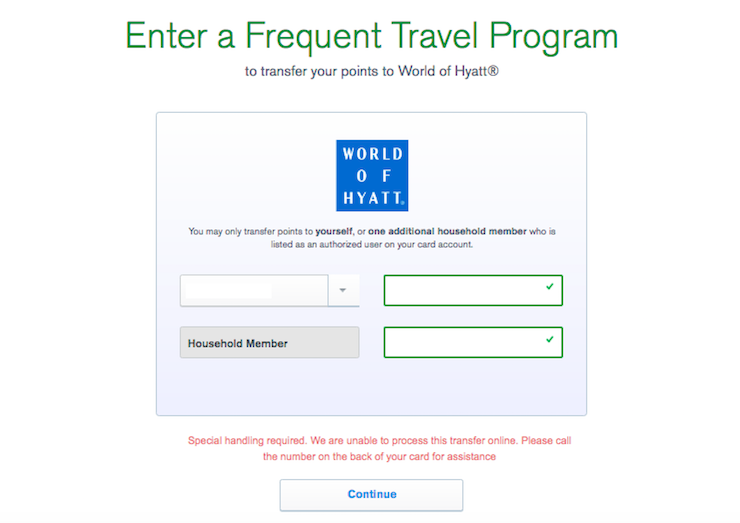
The most likely culprit is a name mismatch between your Chase account and your loyalty account — and I know because it happened to me. I tried to transfer Ultimate Rewards points to World of Hyatt, and got the message above. When I phoned up Chase, the representative offered to process the transfer, but got the same message, and told me I had to contact Hyatt. It occurred to me at that point that my first name on my credit card and World of Hyatt account were slightly different — Ben vs. Benjamin.
The fix turned out to be painless. I phoned up World of Hyatt, and to my surprise, the friendly agent was able to change my name on the spot — it seemed like she got this request all the time. My account was instantly updated, I tried the points transfer again, and it went through.
A few takeaways from that experience: the terms do require the names on both accounts to match exactly, though in practice I’ve often transferred points to accounts with slight differences (Ben vs. Benjamin, Benjamin vs. Benjamin J, etc.) without any issue — so a mismatch doesn’t guarantee a problem, but it’s the first thing to check when you hit this error. And while Hyatt fixed my name in a single call, I imagine doing the same with an airline frequent flyer account (or another hotel program, for that matter) might be more time consuming — so if you’re transferring points for a near-term booking, it’s worth confirming your names match before you need the points.
Can you transfer Chase points to someone else’s Chase account?
Chase lets you pool the points you earn on all cards in your name that accrue Ultimate Rewards points. On top of that, you can move your points to another Chase account of someone in your household. Do note that if you abuse this benefit, Chase may close your account.
Here are the terms associated with that:
You can move your points, but only to another Chase card with Ultimate Rewards belonging to you, or one member of your household. If we suspect that you’ve engaged in fraudulent activity related to your credit card account or Ultimate Rewards, or that you’ve misused Ultimate Rewards in any way (for example by buying or selling points, moving or transferring points with or to an ineligible third party or account, or repeatedly opening or otherwise maintaining credit card accounts for the sole purpose of generating rewards) we may temporarily prohibit you from earning points or using points you’ve already earned. If we believe you’ve engaged in any of these acts, we’ll close your credit card account and you’ll lose all your points.

The best uses of Chase Ultimate Rewards points
There are lots of ways to efficiently redeem Chase Ultimate Rewards points, whether you’re looking to transfer points to a travel partner, or redeem toward the cost of a travel purchase. Below I wanted to share what I consider the best uses of Chase Ultimate Rewards points to be, roughly ranked starting with my favorite.
If transferring to airline partners, it’s important to understand that you’ll generally get the most value redeeming for international flights, especially in business class. Also, if you’re new to redeeming points, check out my top 10 tips for redeeming points, so you can hopefully get the best value.
Transfer to World of Hyatt
World of Hyatt is my single favorite Chase Ultimate Rewards transfer partner, especially as a Hyatt Globalist member (or as someone with access to Guest of Honor bookings). Hyatt has some fantastic hotels, and a free night will cost you anywhere from 3,500 to 45,000 points, depending on the category and whether there’s peak pricing or not.
Many people struggle with redeeming airline miles, given the capacity controls. The beauty of World of Hyatt is that there are no blackout dates, so as long as a standard room is available for sale, you can redeem points for it. It should be really easy to get well over two cents of value per point with World of Hyatt, given all the great uses of these points.

Transfer to Air Canada Aeroplan
Air Canada Aeroplan is probably my single favorite frequent flyer program. Not only does Aeroplan have more airline partners than any other airline loyalty program, but you can also add stopovers to awards for 5,000 points one-way.
If you’re looking to redeem on Star Alliance, or a variety of other airline partners (ranging from Air Mauritius to Gulf Air), booking through Aeroplan is an excellent option. To get the best value and access to most airlines, in general I find Air Canada Aeroplan to be a more compelling transfer partner than United MileagePlus, even though both programs give you access to Star Alliance airlines.
Also keep in mind that if you have the Chase Air Canada Aeroplan® Credit Card (review), you can receive a 10% bonus when you transfer points from Ultimate Rewards to Aeroplan. This applies when transferring 50,000 or more Ultimate Rewards points in one transaction, and you can get a maximum of 25,000 bonus points per year this way.

Redeem for up to 2 cents each toward travel
There’s a huge learning curve to redeeming points efficiently, so there’s something to be said for an easy redemption. One of the best things about Chase Ultimate Rewards is the great rate at which you can redeem points directly toward travel purchases through Chase Travel℠.
If you have the Chase Sapphire Reserve®, then you can redeem for up to 2 cents each toward travel purchases through Chase Travel℠ with Points Boost, while if you have the Chase Sapphire Preferred® or Ink Business Preferred® Credit Card, then you can redeem for up to 1.75 cents each toward travel purchases through Chase Travel℠ with Points Boost. If you have multiple cards, you can redeem all your points at the highest rate available with any card.
The beauty of this is that you don’t have to look for award availability, but rather you can book the flight or hotel you want directly through Chase. While this isn’t how I choose to redeem my Chase points (I consistently get more value with World of Hyatt), I think it’s a great option for many.
That being said, if you can get up to 2 cents of value per point, that’s potentially a great deal if you have the right card combo.
For example, if you have the Chase Freedom Unlimited® in conjunction with the Chase Sapphire Reserve®, you’d be looking at a return of up to 3% toward travel on everyday, non-bonused spending (since the Freedom Unlimited offers 1.5x points on all purchases).

Transfer to Singapore Airlines KrisFlyer
Singapore Airlines restricts most of its first class and business class award space to members of its own KrisFlyer program. So while the airline is in the Star Alliance, don’t expect to be able to snag Singapore Airlines long haul premium cabin awards through other programs.
Fortunately Singapore Airlines KrisFlyer has fair redemption rates, pretty good award availability in business class (and sometimes Suites and first class), and limited surcharges. For example, a one-way business class award on the world’s longest flight will cost you 111,500 miles, while a one-way business class award from New York to Frankfurt or Houston to Manchester will cost you 81,000 miles. You can get even more value by booking a Spontaneous Escapes ticket, which is a monthly discount on select awards.

Transfer to Emirates Skywards
Emirates is regarded as one of the world’s best airlines, and Emirates Skywards is the best way to book most Emirates tickets with miles. This could be useful whether you want to take one of Emirates’ fifth freedom flights (from Newark to Athens or New York to Milan), or whether you’re looking to fly with the airline to Dubai and beyond.
It’s even possible to redeem miles for Emirates first class, though it could take some work. A shower in the sky is a worthwhile reward, though! A first class award between the United States and Europe costs 102,000 Skywards miles one-way, if you can find award availability.

Transfer to Air France-KLM Flying Blue
If you want to fly across the Atlantic in business class, it’s tough to beat Flying Blue, as this is the key to unlocking Air France business class and KLM business class awards. Not only is this great if you’re looking to travel to Amsterdam and Paris, but the two airlines have extensive route networks throughout Europe and beyond. You can even add a stopover to an award at no extra cost.
You can generally expect that transatlantic business class awards will start at 50,000 miles one-way, with mild fuel surcharges (around $200 one-way). You can sometimes get even better pricing if you can book a Flying Blue Promo Rewards offer.

Transfer to British Airways Executive Club
British Airways Executive Club is a useful frequent flyer program, especially for oneworld redemptions. Executive Club has unique distance based award pricing, so it’s a particularly useful points currency if you’re trying to redeem for travel on Alaska or American from or within the United States. Avios can be a great deal for travel to Hawaii and the Caribbean. Avios are also useful for short haul redemptions in other regions, including within Asia and Australia.
Another great thing is that you can transfer rewards between the various “flavors” of Avios, and there’s value to all those programs, like Aer Lingus AerClub, Iberia Plus, and Qatar Airways Privilege Club.

Transfer to JetBlue TrueBlue
JetBlue TrueBlue is a revenue based currency when it comes to redemptions, at least for travel on JetBlue metal. If you transfer Chase points to JetBlue TrueBlue, you can generally expect that each TrueBlue point will get you around 1.5 cents toward the cost of a JetBlue economy ticket. For example, take the below flight from New York to Los Angeles, which costs either $162 or 10,300 points plus $5.60 in taxes.


Another awesome perk of JetBlue TrueBlue is that partner redemptions are now possible, so you can redeem these points for travel in Qatar Airways business class, and that could be a good value.

How not to redeem Chase Ultimate Rewards points
I tend to think that if you feel good about an award redemption then that should be enough. At the same time, I’d generally aim to get more than one cent of value per Chase Ultimate Rewards points, based purely on the easy ways there are to efficiently redeem these points for more value.
I’d highly recommend avoiding all the redemption options that give you at most one cent per point. This would include gift cards with retailers, cash, online shopping, etc.
On top of that, there are two Chase transfer partners I’d recommend avoiding — IHG One Rewards and Marriott Bonvoy. That’s not because there’s not value to be had with IHG One Rewards or Marriott Bonvoy, but rather because I value those individual points currencies at 0.5-0.7 cents each, yet the transfer ratio is still “only” 1:1.
In the same way monetary currencies have different values, travel points currencies also do, so this isn’t a lucrative way to redeem your points.
Furthermore, I’d probably avoid transferring points to Southwest Rapid Rewards. Southwest is of course an incredibly popular airline for domestic travel, and you can transfer points at a 1:1 ratio. However:
- Each Rapid Rewards point gets you around 1.2 cents toward the cost of a ticket on Southwest (you usually need 83 Rapid Rewards points per dollar of airfare)
- You’re better off instead booking Southwest flights through Chase Travel℠, and on top of that you’ll earn Rapid Rewards points for your purchase, so you’ll come out ahead in a vast majority of cases
Chase Ultimate Rewards FAQs
How many airline and hotel partners does Chase Ultimate Rewards have?
As of now, Chase Ultimate Rewards has 14 airline and hotel transfer partners — that includes eleven airline partners and three hotel partners.
Some might argue that Chase really only has 12 partners, since you can transfer points between Aer Lingus, British Airways, and Iberia pretty freely, assuming your accounts meet certain requirements.
Are there fees associated with transferring Chase Ultimate Rewards points?
No, there are no fees associated with transferring Chase Ultimate Rewards points. This is one advantage of Chase Ultimate Rewards over Amex Membership Rewards, since Amex imposes small fees when you transfer points to US airline partners.
Can you transfer Chase points to someone else’s airline or hotel accounts?
You can transfer your Chase Ultimate Rewards points to a loyalty program belonging to you, or one additional household member who is also listed as an authorized user on your card. Once you transfer points to an authorized user, that person will be the only authorized user eligible to receive points transfers.
Should you transfer Chase points to travel partners?
In general, the best use of Chase Ultimate Rewards points is to convert them into airline miles or hotel points. However, you only want to do this once you’ve figured out the award you want to book, have verified availability, and are sure you understand how that program works.
Bottom line
Chase Ultimate Rewards is a popular points currency, and rewards add up quickly with cards like the Chase Sapphire Reserve®, Chase Sapphire Preferred®, and Ink Business Preferred® Credit Card.
Ultimate Rewards points are an incredibly versatile currency. Not only can points be redeemed for up to 2 cents each toward the cost of a travel purchase through Chase Travel℠ with Points Boost, but Chase also has some valuable transfer partners.
Personally World of Hyatt is by far my favorite Chase transfer partner. After that, I appreciate the value of Air Canada Aeroplan. Then there are several other currencies that could be useful, though frankly almost all of my Chase points go to World of Hyatt.
With that in mind, I like to value points conservatively, because I don’t want to create unrealistic expectations, and then have people hoarding points they’ll never get a good value out of.
To those who collect Chase Ultimate Rewards points, what are your favorite uses of the currency?
| Want to learn more about points transfer times? See our series about how long points transfers take with Amex Membership Rewards, Capital One, Chase Ultimate Rewards, and Citi ThankYou. |


Membership is free and takes no more information than commenting as a guest. Earn status points for good contributions, and see fewer ads as your status grows.