
The Sapphire Reserve for Business℠ (learn more) is Chase’s ultra-premium $795 business card, and right now it’s offering a welcome bonus that I value at $3,400. So the “is this card worth it” topic really comes down to two different questions — is it worth applying for and getting in the first place, and is it worth keeping?
The massive welcome bonus makes the answer to the first question easy. Meanwhile, how much value you’d get from the credits, the rewards structure, and the lounge access, will determine the answer to the second question. So let me share how I’d think through the math on the card.

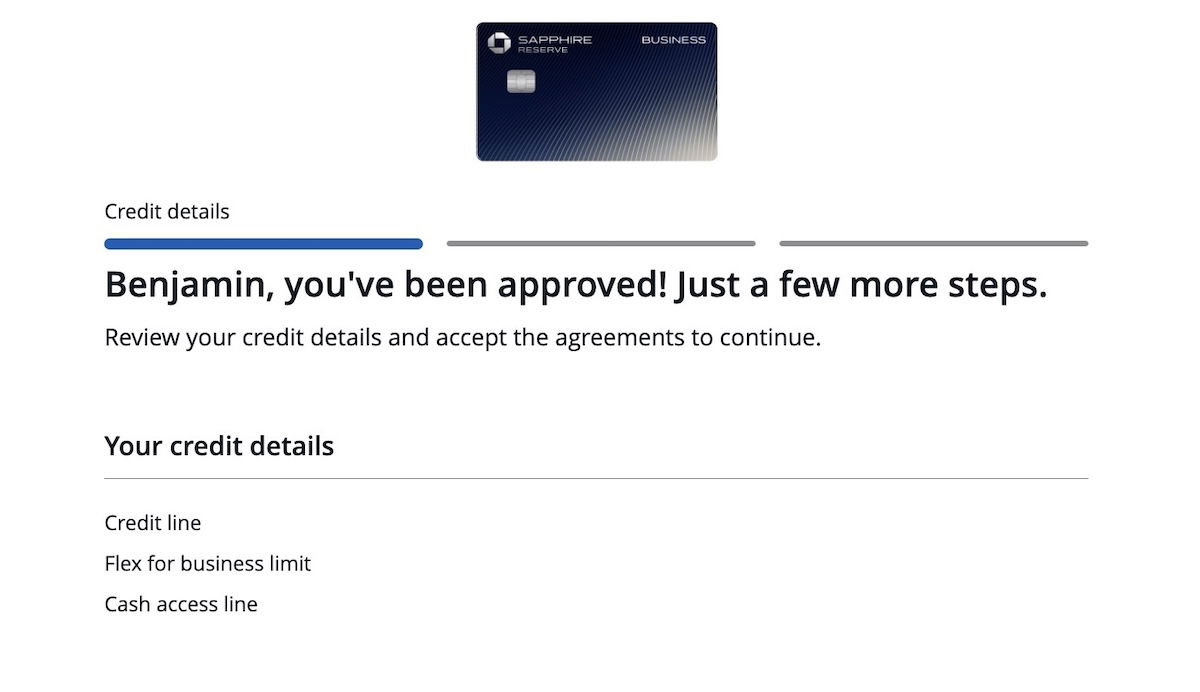
I applied for the Sapphire Reserve Business the week that it opened to new applications, and was instantly approved with a big credit line, even though I already hold several Chase business cards. I’m a huge fan of the personal Sapphire Reserve too, so in the coming months I’ll have to decide whether I keep both or pick just one.
Sapphire Reserve Business at a glance
Before we get into it, here’s the quick version of the Sapphire Reserve Business:
- Annual fee: $795
- Welcome bonus: 200,000 Ultimate Rewards points after spending $30,000 within the first six months, which I value at $3,400
- Effective fee, the way I do the mental math: more like $495, once you bank the easy $300 travel credit
- Earning: up to 8x points, with no caps on the bonus categories
- Best for: people who’ll actually use Chase Sapphire Lounges and who spend in the bonus categories

The card’s welcome bonus is the main reason to apply
Let’s start with the obvious. The Sapphire Reserve Business is offering a limited time welcome bonus of 200,000 Ultimate Rewards points after spending $30,000 within the first six months.
The spending requirement is big, but so is the bonus. I value Ultimate Rewards points at 1.7 cents each, so to me those 200,000 points are worth $3,400. That ranks among the best welcome offers out there. For what it’s worth, this matches the best-ever offer we saw at launch, and it beats the 150,000-point offer that came in between.
I’ve already used points earned with the welcome offer on this card for some great travel experiences, ranging from an Air France 777 business class flight, to a stay at the Park Hyatt Tokyo.
If you’re eligible and you can hit the spend, the bonus alone is a reason to apply. You can pick up the card, bank the points, and take your time deciding whether the perks work for you long term.

Who can get the Sapphire Reserve welcome bonus
The huge welcome bonus on the Sapphire Reserve Business sounds nice, but it’s important to understand who is actually eligible for it, so that you actually earn the points that are part of the offer. The good news is that the rules on this card are quite straightforward.
Bonus eligibility on this card isn’t tied to any other Chase cards you hold. In other words, having the personal Chase Sapphire Reserve® Card (learn more), or a Chase business card like the Ink Business Preferred® Credit Card (learn more), shouldn’t lock you out of the bonus on this card.
Instead, the new cardmember bonus simply isn’t available to you if you have ever had this card. Other than that, you should generally be eligible for this product.
Beyond the bonus terms, Chase business cards can be tricky to get approved for. Chase is known for the 5/24 rule, though that’s no longer consistently enforced, and business cards generally don’t add to your 5/24 count. If you want to maximize your odds of approval, the Ink cards give you a good sense of what to expect.
What I actually put on the Sapphire Reserve Business
A big welcome bonus is a huge incentive to apply, but a card only stays “front of wallet” if I want to spend on it. The Sapphire Reserve Business has a genuinely strong earning structure, with no caps on the bonus categories. Here’s what it earns:
- 8x points on all Chase Travel℠ bookings (flights, hotels, rental cars, and more)
- 5x points on Lyft rides, through September 30, 2027
- 4x points on flights and hotels booked direct
- 3x points on select advertising (social media and search engines) on up to $1 million in spend each anniversary year, starting 11/15/26
- 1x points on everything else
If you use my 1.7-cent valuation, that makes for a very nice return on spending. That 8x points on Chase Travel works out to a 13.6% return, which is about as good as it gets on travel spending, as long as you don’t mind booking through a portal. The 5x points on Lyft is an 8.5% return, the 4x points on direct airfare and hotels is 6.8%, and the 3x points on advertising is 5.1%.
There are also no foreign transaction fees, so this is an excellent card to use abroad, especially on hotels and airfare, where you’re earning bonus points anyway.
Whether this earning structure is right for you really comes down to your spending. If you book travel through Chase Travel, spend directly with airlines and hotels, or run a lot of advertising, this card rewards you well. If your spending is largely focused elsewhere, there are probably better cards for it.

Bonus benefits when you spend $120,000 per year
If you put $120,000 per calendar year on the Sapphire Reserve Business, you unlock a slew of extra perks:
- IHG One Rewards Diamond status, IHG’s top tier status, with perks like breakfast and room upgrades
- World of Hyatt Explorist status, Hyatt’s mid tier status, with perks like room upgrades and late check-out
- Southwest Rapid Rewards A-List status, with perks from priority seating to free checked bags
- A $500 Southwest credit for flights booked via Chase Travel
- A $500 Shops at Chase credit, valid with brands like Baccarat, Bang & Olufsen, Breitling, and Tumi
That $120,000 bar is high, so realistically most cardmembers won’t reach it. But for heavy spenders, this tier adds real value.

Where the Sapphire Reserve Business points go
The Sapphire Reserve Business earns Ultimate Rewards points, which I’d consider to be among the most valuable flexible points currencies out there. Holding a Sapphire Reserve product also lets you move points to transfer partners and pool them across your other Chase cards, which adds real value.
My favorite way to use points is transferring them to a Chase airline or hotel partner, then booking aspirational travel like a five-star hotel or a business class flight. It takes a little homework, so it’s worth learning the tips and tricks of maximizing points. Below are the transfer partners.
You can also redeem through Chase Travel, where points are worth at least one cent each toward travel. Thanks to the Points Boost feature, this card can stretch select flights and luxury hotel stays up to two cents per point. When you can hit that two-cent ceiling, it’s a great use of points without any transfer partner homework, though admittedly redemption options at that level are limited.
One other thing worth calling out is that having the Sapphire Reserve Business unlocks 1:1 points transfers to World of Hyatt, while the lower tier Chase cards now only offer a 4:3 transfer ratio. So if you value Hyatt transfers, that’s a big incentive to have either the personal or business version of the Sapphire Reserve.

Lounge access might be the best part of the card
For a lot of people, lounge access will be the single best reason to carry this card. The Sapphire Reserve Business comes with a Priority Pass™ membership and access to Chase Sapphire Lounges. Just note these perks are for the primary cardmember, not authorized users.
The Priority Pass membership gets you into 1,300+ lounges worldwide, and you can bring two guests at no extra cost. That’s standard premium-card stuff, and it’s useful for just about any traveler.
The Chase Sapphire Lounges are the real advantage with this card, since unlimited access is exclusive to Chase cards. These are among the best lounges in the United States, and the ones at airports like New York LaGuardia and Boston Logan are a real treat. If you regularly fly through an airport with one, that alone can justify the card.

The credits, ranked by how easily I use them
Here’s the part that makes or breaks the $795 Sapphire Reserve Business. The credits are the easiest way to recoup most of the fee, but of course they’re not all created equal. We all have different consumer patterns, so there will almost always be some breakage. Rather than just listing the credits, let me rank them by how easily I’m actually using each one, from good-as-cash down to the ones I’m probably going to forfeit:
- $300 annual travel credit, basically cash — this credits requires no registration, and anything coded as travel gets reimbursed automatically, across as many transactions as you need; I treat this as worth full face value, which is why I think of the card as costing more like $495 per year
- $100 giftcards.com credit, close to cash with one small chore — this offers a $50 credit twice per year on a selection of curated gift cards; you could grab a $50 DoorDash gift card every six months, for example, but the key is that you just have to remember to go through the process
- $500 The Edit hotel credit, valuable on paper, but has a catch — this offers up to $500 per year in value, in the form of a $250 credit twice per year, on a two-night minimum “pay now” stay with The Edit by Chase Travel; just keep in mind this primarily includes luxury hotels, and while you can get additional perks for stays at these properties, you’ll likely still be paying a lot out of pocket
- $120 Lyft credit, easy if you ride — a $10 credit each month through September 30, 2027, on top of the 5x points; the monthly amount is small, but I use Lyft often enough that I value this close to the “headline” amount
- $300 DoorDash credit plus DashPass, which adds up slowly — you get a complimentary DashPass membership, plus up to $25 in monthly credits, split into a $5 restaurant credit and two $10 non-restaurant credits; it’s chopped up enough that it’s hard to get excited, but frequent DoorDash users will save something with it
- $400 ZipRecruiter and $200 Google Workspace credits, both niche — you can receive a $200 ZipRecruiter credit twice per year, and up to $200 in Google Workspace credits per year; if you happen to use these tools, they make the fee much easier to justify, though I suspect most cardmembers won’t use this
A couple of other perks round things out. There’s a Global Entry, TSA PreCheck, or NEXUS credit of up to $120 once every four years, which you just charge to the card. If you already have a membership, you can always use this for someone else — just charge the fee to your card. And separately from the $120,000 spend tier, the card comes with IHG One Rewards Platinum Elite status through December 31, 2027, with no spending required.

Where the Sapphire Reserve Business math breaks down
I want to make sure I’m being balanced, because the $795 fee on the Sapphire Reserve Business is substantial — it’s real money up front, and you only get back down to $495 after the travel credit. Everything past that takes effort.
A few things to keep your eyes open about:
- Several credits are split into semi-annual or monthly chunks, so you have to keep coming back to use them; so if you miss those windows, you’re going to miss out on value (admittedly cards aren’t designed so that cardmembers use every single credit)
- The ZipRecruiter and Google Workspace credits are niche, and if you don’t use those tools, mentally cross off $600 of the marketed value of the credits
- The up to $500 The Edit by Chase Travel hotel credit looks great, but just keep in mind that’s a discount on hotels that are largely quite expensive, and there’s a minimum stay of two nights
- The $120,000 spend tier is out of reach for most people, so don’t talk yourself into the card on those perks, unless you’d reach that spending amount
- If you already carry the personal Sapphire Reserve, a lot of this overlaps, and you may not need both
None of this is a dealbreaker. It just means the card rewards certain types of consumers who are willing and able to do the work, so this isn’t a card you can “set and forget,” while getting outsized value in the long run.

So, is the Sapphire Reserve Business worth it?
Is the Sapphire Reserve Business worth it? Let me share how I think of that. The bonus absolutely makes this card worth applying for, assuming you can reach the minimum spending requirement. The bigger challenge is figuring out the long term value.
I’d say go for it when it comes to applying for the card and possibly keeping it if:
- You can hit the $30,000 spend requirement and want to bank 200,000 points, worth $3,400 by my valuation
- You travel through airports with Chase Sapphire Lounges
- Your spending actually lines up well with the bonus categories, like Chase Travel, direct air and hotel, advertising, and Lyft
- You’ll use the easy credits, especially the $300 travel credit and $100 giftcards.com credit; if you can use any other credits, that’s the icing on the cake
I’d think twice about the long term value of the card if:
- Your spending doesn’t align with the bonus categories
- You already hold the personal Sapphire Reserve and won’t get value out of two overlapping premium cards
- You can’t see yourself using enough credits to get comfortably under that $495 effective fee
- You just want a low-fee business card, in which case the Ink Business Preferred is the move
Two comparisons come up constantly, so let me cover both quickly, rather than re-run all the math.

Sapphire Reserve Business vs. Sapphire Reserve
The Sapphire Reserve Business is built on the same bones as the $795 annual fee personal Chase Sapphire Reserve® Card, so there’s a ton of overlap. Here are the most obvious differences between the cards:
- The personal card earns 3x points on dining, while the business card earns 3x points on select advertising
- The personal card charges $195 per authorized user (with lounge access), while the business card charges $0 per authorized user (without lounge access)
- The credits differ, with the personal card leaning into dining, StubHub and viagogo, and Apple benefits, while the business card leans into ZipRecruiter, Google Workspace, and giftcards.com
- The personal card offers Air Canada Lounge access, while the business card doesn’t
- The personal card unlocks extra perks at $75,000 in annual spending, while the business card’s tier kicks in at $120,000
There’s no universal winner here. It comes down to which return on spending and which credits fit your life. Personally, I lean slightly toward the personal card, since I prefer its bonus categories and credits. But I can see plenty of people having the opposite preference. Of course given the great welcome offers that both cards have, it could be worth giving them both a shot.
Sapphire Reserve Business vs. Ink Business Preferred
If the $795 fee is the sticking point, the Ink Business Preferred® Credit Card (learn more) is the obvious alternative. It has an annual fee of just $95 a year, with a generous welcome bonus, a great rewards structure, and valuable travel protection.
These are really different cards, though. The Ink Business Preferred is a low-cost workhorse with well-rounded bonus categories. The Sapphire Reserve Business is about lounge access and credits. And since they’re not mutually exclusive, plenty of people may decide that both make sense.
Bottom line
The Sapphire Reserve Business is Chase’s ultra-premium business card, and the 200,000-point welcome bonus worth $3,400 (by my valuation) makes it easy to recommend giving it a try. The lounge access and the strong, uncapped earning structure are what keep it interesting after that.
The challenge is the $795 fee. The $300 travel credit knocks that down to about $495 right away, and from there each person will have to decide for themselves how much more value they can get. Some people will easily come out ahead. Others will look at the hoops and decide it’s not their card. Both reactions are fair.
If you ask me, the best strategy is simple: grab the bonus, then spend your first year figuring out whether the perks actually fit how you travel and spend, and justify holding onto it for another year.
What’s your take on the value proposition of the Sapphire Reserve Business?




Membership is free and takes no more information than commenting as a guest. Earn status points for good contributions, and see fewer ads as your status grows.