
I have roughly two dozen credit cards (as one does), though I hold onto them for different reasons.
There are only around a handful of cards that I actually consistently spend a meaningful amount on. Other cards primarily sit in a drawer, and I just use them for the ongoing perks and statement credits they offer, which justify the annual fee. Other cards rotate through my wallet because they earn the best return on a specific category of spending.

In this post, I’d like to talk a bit about my credit card strategy for maximizing rewards, and in particular, the cards that I actually spend the most on, and why. Admittedly this changes over time, which is why I think it’s time for an updated post on the topic.
For each card below, I link to the full “is it worth it” analysis I’ve written — so this post is just intended to be a summary, and then you can learn more by clicking on the links, and crunch the numbers based on your own situation. I’ll also share some alternative cards to consider in each category.
My credit card “wallet” at a glance
Before I share the details, here’s the quick version of which card I use the most for my everyday spending (admittedly the cards I spend the most on reflect my purchase patterns):
- Everyday non-bonused spending: Bilt Palladium Card (Rates & Fees) — 2x points plus 4% Bilt Cash on everything
- Foreign spending: Atmos Rewards Summit Card — 3x points on all foreign purchases, no cap
- Restaurants and U.S. supermarkets: American Express® Gold Card — 4x points at restaurants worldwide (up to $50,000 annually) and 4x points at U.S. supermarkets (up to $25,000 annually), then 1x
- Direct hotel bookings: Chase Sapphire Reserve® Card — 4x points
- Airfare booked directly with airlines: American Express Platinum Card® — 5x points
- Hyatt stays + my $15,000 annual sweet-spot card: World of Hyatt Credit Card — 4x points at Hyatt, plus a second free night certificate after spending $15,000 annually, in addition to elite nights for ongoing spending
Again, those are the cards that I spend the most on. Separately, I hold many cards purely for ongoing perks — free night awards, elite status, lounge memberships — that justify their annual fees without my needing to spend anything on them. I’ll cover those after I talk about the cards that I use for spending.
The rewards credit cards I spend on
When I’m deciding which card to put a purchase on, I always try to choose the card that earns me the most value for a specific transaction. Below are the six cards that end up getting the most of my spending. Each one is the best in my wallet for what it does, but that’s not to say that it’ll be the best card for you, as we all have different spending patterns and rewards goals.
In addition to sharing the cards I use for each of these categories of spending, I’ll also include some good alternatives at the bottom of each section, in case you’re looking for something else, prefer a different points “ecosystem,” etc.
Bilt Palladium Card — for everyday non-bonused spending

The Bilt Palladium Card has a $495 annual fee (Rates & Fees) and is serviced by Cardless. It’s my go-to card for non-bonused spending, because the math on it is hard to beat — it offers 2x points on all eligible purchases, plus 4% back in the form of Bilt Cash.
Bilt Cash can be redeemed in a variety of ways, including to earn points on housing payments (about $4,000 worth of rent or mortgage rewarded per $3,000 in spending) or for spending accelerators that effectively boost you to 3x points on non-housing spending, up to $25,000 per year.
When you add everything up, I’m averaging well over 3x points per dollar spent in non-bonused categories, which is the highest return on everyday spending of any card in my wallet. Bilt Points are also genuinely valuable, and are transferable to Alaska Atmos Rewards, World of Hyatt, and other useful partners.
The one major restriction to be aware of is that tax payments aren’t eligible to earn points, which is an exclusion you won’t find with many major issuers. I do find that to be extremely frustrating, since paying taxes by credit card is a great way to earn rewards.
Full analysis: Is the Bilt Palladium Card worth the $495 annual fee?
Alternative best rewards credit cards for everyday spending: For personal cards, the Citi Double Cash® Card (learn more), Capital One Venture Rewards Credit Card (learn more), and Capital One Venture X Rewards Credit Card (learn more) are good alternatives, while for business cards, The Blue Business® Plus Credit Card from American Express (learn more) and Capital One Venture X Business (learn more) are good alternatives

Atmos™ Rewards Summit Visa Infinite® Credit Card — for foreign spending

The Atmos Rewards Summit Card has a $395 annual fee, and it’s one of those rare cards that’s worth applying for, worth holding, and worth spending on. My absolute favorite bonus category on this card is that it offers 3x points on all foreign purchases, with no cap. This might be the single best bonus category on any card I’ve seen, as we’ve never had a blanket return on foreign spending like this. So it’s my primary card whenever I’m abroad.
There’s another reason I spend heavily on this card, which is that it offers a 100,000-point Global Companion Award when you spend $60,000 in an anniversary year. So while I spend as much on the card abroad as possible, I supplement that with spending domestically. Between the 3x points on foreign purchases and the threshold bonus, the effective return on spending can reach as high as 4.67x points per dollar (I wouldn’t value it quite that high, but that’s the math).
If you’re going for elite status with Atmos Rewards, the card is useful as well, as you earn one status point per $2 spent. What I also appreciate so much is how the card’s annual fee is easily offset by the 25,000-point Global Companion Award, as well as waived partner award booking fees, for those of us who frequently redeem Atmos Rewards points.
Full analysis: Is the Atmos Rewards Summit Card worth the $395 annual fee?
Alternative best rewards credit cards for foreign spending: For personal cards, the Capital One Venture Rewards Credit Card (learn more) and Capital One Venture X Rewards Credit Card (learn more) are good alternatives, while for business cards, the Capital One Venture X Business (learn more) is a good alternative

American Express® Gold Card — for restaurants and U.S. supermarkets
The Amex Gold Card has a annual fee (Rates & Fees), though that can largely be offset with the card’s credits. The reason the card earns a spot in my wallet is because of the bonus categories, which are arguably the most well-rounded in the entire market for any household that eats:
- 4x points at restaurants worldwide (up to $50,000 per calendar year, then 1x points), including takeout and delivery
- 4x points at U.S. supermarkets (up to $25,000 per calendar year, then 1x points)
Between those two categories, my family racks up a lot of points just on food spending… and food is expensive, especially with two little kids in the equation! The 4x points dining category also applies worldwide, so this card is useful for restaurants abroad (though the supermarket category is exclusive to the U.S.). However, I have to admit that I struggle to fully maximize all the card’s benefits, particularly the Dunkin’ credit, so the “real” value depends on how many of those credits you can take full advantage of.
Full analysis: Is the Amex Gold Card worth the annual fee?
Alternative best rewards credit cards for restaurant & supermarket spending: For restaurant spending, the Chase Freedom Unlimited® (learn more), Chase Sapphire Reserve® Card (learn more), Chase Sapphire Preferred® Card (learn more), Citi Strata Premier® Card (learn more), Citi Strata Elite℠ Card (learn more), and Bilt Obsidian Card (learn more) (Rates & Fees) are good alternatives, while for supermarket spending, the Citi Strata Premier® Card (learn more) and Bilt Obsidian Card (learn more) are good alternatives

Chase Sapphire Reserve® Card — for direct hotel bookings

The Chase Sapphire Reserve has a $795 annual fee, and while I mostly hold it for the perks (the lounge access, the travel credits, hotel credits, dining credits, the Apple Music subscription, etc.), there’s one spending category where I really appreciate this card, which is 4x points on direct hotel bookings.
Hotels are a big spending category for me, and 4x Ultimate Rewards points on those bookings is among the best returns available on a category that’s hard to earn a bonus on elsewhere.
Admittedly the importance of this bonus category largely reflects that I spend a lot on hotels. Others will appreciate that the card also offers 3x points on dining, but dining isn’t where I use it — that’s what the Amex Gold is for. And it offers 5x points on Lyft rides through September 30, 2027, which is useful as well, but isn’t a huge category for me. The hotel bonus category alone, paired with the credits and lounge access, are what justify the card for me.
Full analysis: Is the Chase Sapphire Reserve worth the annual fee?
Alternative best rewards credit cards for hotel spending: For hotel spending, the Citi Strata Premier® Card (learn more) and Ink Business Preferred® Credit Card (learn more) are good alternatives

American Express Platinum Card® — for airfare
The Amex Platinum Card has an annual fee (Rates & Fees). Like the Sapphire Reserve, this is primarily a card that I hold for the perks (the lounge access, the credits that I max out with minimal effort, and the hotel and rental car status).
But it has one bonus category where it’s unambiguously the best card available. I’m talking about the Amex Platinum’s 5x points on airfare booked directly with airlines, on up to $500,000 in flight purchases per calendar year.
I value Membership Rewards points at 1.7 cents each, so that’s an 8.5% return on airfare spending. That’s better than any other airfare earning card I’ve seen. I spend meaningfully on airfare, and the card also offers solid travel protection on top of the earning rate, so using this card is a no-brainer for me.
Full analysis: Is the Amex Platinum Card worth the annual fee?
Alternative best rewards credit cards for airfare spending: For airfare spending, the Chase Sapphire Reserve® Card (learn more), Sapphire Reserve for Business℠ (learn more), Ink Business Preferred® Credit Card (learn more), and Citi Strata Premier® Card (learn more), are good alternatives

World of Hyatt Credit Card — $15,000 of spending for the second free night
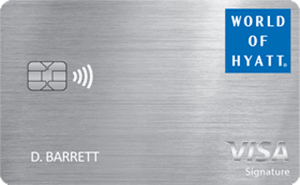
The World of Hyatt Credit Card has a $95 annual fee, and it’s a bit of an oddball in my wallet. While the card isn’t the best earner in any single category among my cards, I still put $15,000 of spending on it each year. That’s because the $15,000 threshold unlocks a second Category 1-4 free night certificate plus six additional elite nights toward status, and I’ve consistently redeemed those free night awards at hotels retailing for well over $200 per night. Effectively that’s better than two points per dollar on otherwise unbonused spending.
I’ve held this card since 2018 and hit $15,000 every year for exactly this reason. Beyond the spending sweet spot, the card’s $95 annual fee is already justified through the anniversary free night alone, plus Discoverist status and five elite nights toward status with no spending required.
Full analysis: Is the World of Hyatt Credit Card worth it?
Alternative best rewards credit cards for threshold bonuses: There are lots of great cards that can be worthwhile for large purchases, based on the bonuses they offer for reaching certain spending thresholds, whether that’s elite status, free night or companion certificates, etc.

The cards I hold but don’t regularly spend on
The above are the cards that get a meaningful amount of spending from me. However, there are also many cards that I’m happy to pay an annual fee on without actually putting much spending on. The concept here is straightforward, as each offers ongoing benefits that more than cover the annual fee. This could include everything from an annual free night award, to elite status, to credits, to lounge access.
Spending meaningfully on these cards would be a waste based on my own goals, because better options exist for that, but holding them still makes sense. Here are some of those cards:
- The Hilton Honors American Express Aspire Card (learn more) has a $550 annual fee (Rates & Fees) but offers benefits that more than justify it, including an annual free night award, up to $400 per year in Hilton resort credits, Honors Diamond Elite status, and much more.
- The Marriott Bonvoy Brilliant® American Express® Card (learn more) has a $650 annual fee (Rates & Fees) and is worth it for up to $300 in dining statement credits per calendar year ($25 monthly at restaurants worldwide), Bonvoy Platinum Elite status and 25 elite nights for having the card, and a free night award valid at properties costing up to 85,000 points per night
- The IHG One Rewards Premier Credit Card (learn more) has a $150 annual fee and offers an anniversary free night certificate, IHG One Rewards Gold status, and a fourth night free on award redemptions
- The Citi® / AAdvantage® Executive World Legend Mastercard® (learn more) has a $695 annual fee and is justified by its perks on its own, including an Admirals Club membership and up to 40,000 bonus Loyalty Points per year with no spending requirement
To me, the perks on these cards more than justify the annual fee on an ongoing basis, so they stay in the drawer, get used for the credits and statuses, and don’t see much purchase spending. That’s a perfectly valid card-management strategy, and one that I think is underused.

What credit cards aren’t prioritized in my wallet, and why
Just as useful as knowing the cards that I carry (either for spending or for the perks) is understanding the cards that I typically don’t carry. Here are some strategies I typically avoid, with an explanation for why:
- Most “everyday spending” 2% cashback credit cards — while earning a return equivalent to 2% on credit card spending is the minimum “gold standard,” personally I prefer earning transferable points, since those allow me to get more outsized value; any card like this would replace the Bilt Palladium in my wallet for non-bonused spending, but the Bilt math (2x points plus 4% Bilt Cash that translates into housing rewards or 3x accelerators) consistently beats them for me
- Most single airline co-brand credit cards — I have a few co-branded airline credit cards that I hold for the perks that they offer (whether it’s lounge access, priority perks, etc.), and some I even spend on for elite status; however, as a general rule of thumb, I don’t hold onto airline credit cards in the long run, and definitely don’t spend much on them, given that the bonus categories typically aren’t exciting
- Hotel co-brand credit cards for chains I don’t stay at regularly. I hold the Hilton Honors Aspire Card, Marriott Bonvoy Brilliant Card, IHG Premier Card, and World of Hyatt Card, which are four hotel cards aligned with chains I genuinely use; however, beyond that I don’t typically get many hotel cards, since it’s an area where I try to manage the annual fees that I pay
I also have several cards that I pick up for the great welcome offers that they have. I’ll always give the cards a try, and then after a year I decide whether the card is offering value for me, and whether it’s worth keeping, especially if there’s an annual fee.
Bottom line
I’d like to think I have a pretty well-tuned credit card setup. Across the six cards I spend most on, I’m earning anywhere from 2x to 5x points per dollar in their best categories, and when you average it all out, I’m earning well over 3x points per dollar on my overall spending — a return I’d value at over 5%. To recap:
- My favorite card for everyday non-bonused spending is the Bilt Palladium Card (for the 2x points and 4% Bilt Cash)
- The Atmos Rewards Summit Card is unbeatable for foreign spending (3x points, no cap), plus the $60,000 spend threshold unlocks a 100,000-point Global Companion Award
- The Amex Gold Card gets all of my food spending — restaurants and U.S. supermarkets
- The Chase Sapphire Reserve gets my direct hotel bookings, and the Amex Platinum Card gets my airfare spending
- I deliberately spend at least $15,000 on the World of Hyatt Credit Card every year for the second Category 1-4 free night certificate and six additional elite nights toward status
- Several cards (Hilton Aspire, Marriott Bonvoy Brilliant, IHG Premier, Citi AAdvantage Executive) stay in the drawer purely for the ongoing perks, which more than justify the annual fees on their own
Anyway, that’s a (relatively) brief summary of my setup, though the linked “worth it” posts have the more detailed math on how I make those cards work.
What are the primary credit cards you use for spending? Has your setup evolved recently, and which card has surprised you most — for better or worse?
The following links will direct you to the rates and fees for mentioned American Express Cards. These include: American Express® Gold Card (Rates & Fees), American Express Platinum Card® (Rates & Fees), Marriott Bonvoy Brilliant® American Express® Card (Rates & Fees), and Hilton Honors American Express Aspire Card (Rates & Fees).




Thats a lot of spending!
Now what’s Ford’s strategy and how well does he stick to it? :)
@ Alec -- Hah, Ford's strategy is that he closely follows my instructions on which cards to use. Because he knows that what irritates me more than most things is when the right card isn't used!
…. :-)
The nagging wife syndrome ….
Sorry Ben, your comment did make me laugh.
Luxury Card Gold for personal spending
Amex Plum Card for business spending
Founders Card for benefits.
Found the retard
I see what you're doing here.
Trying to sneak in ads for the almost useless founders cards.
You're spending so much on annual fees!
$650+$99+$595+$99+$495+$395+$325+$795+$895+$95=$4443
I keep it much simpler:
Amex Hilton Aspire $550 (net zero after the Hilton free night, resort credit, and airfare credit)
Capital One Venture X $395 (2x daily earn and net zero after $300 travel credit + annual 10k points)
Chase Sapphire Reserve $795 (4x air/hotel, 3x restaurant). AC MLL and Priority Pass guest
@ Edward -- I agree it's a lot in annual fees, but I do make the math work, or else I don't hold onto the cards. Yes, it can take a bit of work to use all the perks, but in the end I get outsized value.
Benefits exceed annual fees, it's really very simple.
I'm curious, who do you bank with?! Checking, savings, investments, etc.,
@ Mike O. -- I primarily use Chase, but also have a Citi account. For example, I have my IRA with Citi, so that I earn Citigold, which gets some extra perks (even if the interface and service aren't always that great).
Great, I have Chase too! Do you Sapphire Checking, Private Client, or just the lowest tier which is Total Checking?
What about a BofA account for the extra 10% on your Atmos Summit? I opened a savings account with them just for that 10% bump.
Why is your monthly spend on average?
Why not?
Thanks for the post! Would love to see another update on all the cards in your wallet (think the last was from 2024).
Also, assume you didn’t get rid of the Citi Prestige, but is there a reason that’s no longer your go-to for dining? (Maybe because you’d transfer those points to AA and you’re already earning enough on the AAdvantage biz card.)
I’d also be interested in a separate post on how...
Thanks for the post! Would love to see another update on all the cards in your wallet (think the last was from 2024).
Also, assume you didn’t get rid of the Citi Prestige, but is there a reason that’s no longer your go-to for dining? (Maybe because you’d transfer those points to AA and you’re already earning enough on the AAdvantage biz card.)
I’d also be interested in a separate post on how you and Ford coordinate on which cards you hold and spend on, especially since you both work in the travel space.
@ Aaron -- Thanks! Will work on an updated post on the cards in my wallet. To be honest, I'm transitioning away from the Citi Prestige to the Amex Gold. It has served me well, but I think it's of limited value to me at this point:
-- I also have the Citi Strata Elite, which offers 6x points on dining on Citi Nights, and frankly Fridays and Saturdays is when we dine out...
@ Aaron -- Thanks! Will work on an updated post on the cards in my wallet. To be honest, I'm transitioning away from the Citi Prestige to the Amex Gold. It has served me well, but I think it's of limited value to me at this point:
-- I also have the Citi Strata Elite, which offers 6x points on dining on Citi Nights, and frankly Fridays and Saturdays is when we dine out the most anyway
-- Previously I didn't have a great card for groceries, so I find that the Amex Gold combination of 4x points on dining and groceries would net me more in the end than just 5x points on dining
-- The Citi Prestige Card isn't that costly to hold onto, but I still struggle to justify it when dining is the only category in which I'm spending on the card
All dining on my Citi Prestige. Love the 5x and the diversified (from Amex and Chase) Citi points. When Citi changes that spending category, it'll be a sad day in our household.
Ben:
1. Your are CitiGold and grandfathered to a discounted annual fee. So I can see it not costing that much to hold on to.
2. 4th night free still has some value if you can use it
3. 5x points on online travel agencies can come in handy. A lot of sites code as OTA’s like booking.com, Expedia.com etc. This is a pretty nice category bonus.
Prestige is my "go to" on airfare and dining at 5X on both. Once it goes away, I will shift to airfare to my AMEX Platinum, but, for me, Citi TY are more valuable than AMEX MR. I should add that it's NOT because of AA transfers; it's for EVA. I travel primarily to Asia, and have found AA miles fairly useless the past year or so. EVA has great availability for its own program...
Prestige is my "go to" on airfare and dining at 5X on both. Once it goes away, I will shift to airfare to my AMEX Platinum, but, for me, Citi TY are more valuable than AMEX MR. I should add that it's NOT because of AA transfers; it's for EVA. I travel primarily to Asia, and have found AA miles fairly useless the past year or so. EVA has great availability for its own program members, so that's where I earmark most of my Citi TY to go (and my Cap One, although the .75:1 transfer ratio is much worse).
110% with him on the $15k Hyatt spend, but I also shoot for $15k on my Hilton Surpass to add another uncapped FNC there.
I also am curious if Lucky kept his prestige. Each year I keep debating if it’s worth keeping, 5x dining and $250 easy travel credit make me renew though.
Citi Prestige for dining and airfare
Amex Gold for groceries
Chase Ink Plus for office supply stores to buy Visa GC’s for spend at Costco and non-bonused spend
BILT Palladium for non-bonused spend if I can’t use VGC’s
Us Bank Smartly for 4% cash back
No AA Executive card for AA purchases?
@ Christian -- Nope, I still use the Amex Platinum Card for American flight purchases.
Curious on the Atmos spend for international travel. What does usually go on there if hotels, dining expenses go on the other cards you mentioned that get you better returns in those specific categories?
@ Kbulo -- It's an excellent question, because you're right, dining and hotels covers many expenses abroad. The short answer is that I also put some dining and hotel expenses on the card, to the extent that it allows me to reach the spending threshold to earn the 100,000-point Global Companion Award.
Also, for what it's worth, I have a friend who is an authorized user on my card (long story) who spends most of...
@ Kbulo -- It's an excellent question, because you're right, dining and hotels covers many expenses abroad. The short answer is that I also put some dining and hotel expenses on the card, to the extent that it allows me to reach the spending threshold to earn the 100,000-point Global Companion Award.
Also, for what it's worth, I have a friend who is an authorized user on my card (long story) who spends most of his time abroad. Previously I had him as an authorized user on my Venture X, and now I have him as an authorized user on my Atmos Summit.
BofA for everyday spending (3% cash back; simple). AmEx P and CSR for travel, lounge access. United Club for United, will probably drop or downgrade this year.
can you share how can one get 3% everyday spending? the current Preferred Rewards Platinum Honors (or Diamond) would get 2.625%, which is about to get nerfed in May 2026 to 2.25%…
Diamond Honours + slight roundup.
:)
To a bear of very little brain …. the rational behind this obsession is unfathomable, sorry Ben, I just don’t get it. Is the hassle really worth the time you must spend on financial administration?
@ AeroB13a -- Perhaps not in terms of the time invested, but it is also a hobby!
Be careful. The use of the word Hobby could be troublesome with the IRS. May I suggest you Google. Hobby loss rules
Thank you for your response Ben. Your hobby (money matters) is a subject which never interested me at your age. Even now as I could never spend what I have, therefore, I allow the subject to pass me by with little thought. I did try to become informed by reading your cards and points articles, but failed miserably to gain your enthusiasm for the subject.
Anyway, thanks again for indulging me …. :-)
Aren’t you a know it all?
I agree with Ben. Playing the "credit card "game" represents a hobby or an indulgence. The amount of savings/perks is barely a rounding error of our net worth. Ultimately, the joy that comes from "free" stuff is, even at my age, rather satisfying.
CSP for hotel and restaurants
Amex Blue Cash Preferred for groceries and streaming
Amex Plat for airfare, lounge
Costco for gas
BofA for online shopping (3% cashback)
CFU for everyday spend
Comenity for sales tax free electronics and photography equipment
Delta Amex Platinum for companion certificate
Hyatt, Marriott for free night certificate
Thank you for sharing. You mentioned Comenity for sales tax free electronics and photo. Can you provide more detail about this card? Where is this card issued, card costs, some more redemption details, etc. Thank you so much
It is basically store card - B&H Photo Video. It is internationally acclaimed (mainly photography) retail store (in NYC) with equally great website for online shopping. They introduced Payboo credit card once states started charging sales tax for online shopping. During checkout, if you elect to pay using this card, you are offered 2 options:
1. Instant sales tax refund (paying $0 sales tax on your order; no rebate coupons, gift cards etc BS)
It is basically store card - B&H Photo Video. It is internationally acclaimed (mainly photography) retail store (in NYC) with equally great website for online shopping. They introduced Payboo credit card once states started charging sales tax for online shopping. During checkout, if you elect to pay using this card, you are offered 2 options:
1. Instant sales tax refund (paying $0 sales tax on your order; no rebate coupons, gift cards etc BS)
2. Between 6 to 12 month interest free payment plan. But you pay sales tax on this option
The card does not have any fees. For me this card saves me 6% on every transaction. I mainly use it for photography equipment. For more details: https://www.bhphotovideo.com/credit-cards
Yep - saved me a few kilobucks last year..
US Bank Altitude Reserve for 3x mobile pay
Hyatt for 4x Hyatt spend
Alaska Atmos Summit for 3x foreign spend and Alaska Air tickets
Chase unlimited for 1.5x everything else
Plus any new card minimum spending requirement. I mostly fly Alaska (except for international award tickets) and stay at Hyatt.
Whoa. Rico flexed USBAR on us. Do you think eventually and suddenly one day, in not so distant future, USB will announce transfer partners? At least the basic 5?
Surprised you spend $15k on the Hyatt card to get a category 4 free night and don’t spend $15k on the Hilton surpass card for a free night at any Hilton/waldorf/slh etc. The latter is worth several times more than Hyatt cat 4 free night
@ Nick -- I agree that spending $15K on the Hilton Surpass would be more worthwhile. The reason I don't do that is because I'm maxed out on Amex cards, as you can only have five credit cards from the issuer. So I'd need to cancel another card in order to be able to have that, and I do get good value from the Hilton Aspire Card.
@ bo -- For what it's worth, that's just factually not correct. But sorry if that gets in the way of your narrative.
But Amex is not paying him as much to pump the Hilton card as Chase is to pump the Hyatt card
Really? You spend $4100 on annual fees that every year on cards that have overlapping benefits and Bilt is your “everyday” card!?!? Feels more like this is Just an add for all the cards.
@ Eric -- I know the amount spent in annual fees is high, but the cards largely offer perks that more than offset that. For example, with the Amex Platinum, I do get value from the $600 in hotel credits, $200 in airline fee credits, $200 in Uber credits, etc.
So yeah, while it can be a bit annoying to keep track of the perks, I don't keep a card if I'm not getting more...
@ Eric -- I know the amount spent in annual fees is high, but the cards largely offer perks that more than offset that. For example, with the Amex Platinum, I do get value from the $600 in hotel credits, $200 in airline fee credits, $200 in Uber credits, etc.
So yeah, while it can be a bit annoying to keep track of the perks, I don't keep a card if I'm not getting more value for it than I'm paying. In a way, card annual fees are almost like pre-paying for certain perks.
One accepts that we all have different priorities and preferences, however, does your methodology not restrict your choices? One must feel compelled to make various choices simply to capitalise on your “Perks” …. Yes?
I use MSR card #1, and sometimes MSR card #2.
Since you’re based in Asia, Alaska Summit 3x on all foreign transactions might be useful for you, if you’d be able to even use those miles.
According to some sources, a typical U.S. consumer carries about $6,500 – $6,600 in outstanding credit card balances.
The average household balance is between $9,000 – $11,000.
For comparison the average. UK adult owes roughly £1,327 – £1,350, while the household debt is about £2,495 – £2,612.
I am amazed by these comparable figures.
Yeah, some of us get paid well :)
Just look at everything Yanks spend their money on. Cars, luxury goods, luxury holidays, etc. They love everything super-posh. And post it on social media. Is there really a need to have a BMW, Mercedes, Prada, or Louis Vuitton when you are making minimum wage?!
BMW = Basic Marin Wheels.
I think that this list mostly is paid because there are many credit cards with a good return that are not listed and are hardly ever listed on this website. Furthermore there are several cards which have high annual fees and it is becoming increasingly harder to justify vs downgrade (Reserve v Sapphire for example) and there are surprisingly several cards which are airline or hotel focused and unless you’re charging their brand the points...
I think that this list mostly is paid because there are many credit cards with a good return that are not listed and are hardly ever listed on this website. Furthermore there are several cards which have high annual fees and it is becoming increasingly harder to justify vs downgrade (Reserve v Sapphire for example) and there are surprisingly several cards which are airline or hotel focused and unless you’re charging their brand the points are not transferable. Many of the perks do overlap as others commented and some have a preference - priority pass Chase v Amex for example…..ultimately people need to figure out what works for them based on their lifestyle and habits and the amount of time they want to put into this ..,
Correct observation, No annual fee cards do not exist in this blog universe.
Ben, to what programs have you transferred your Amex points?
@ Tom -- My two most common programs are Air Canada Aeroplan and Air France-KLM Flying Blue, which covers many of my long haul redemptions.
Good. No excise taxes for foreign carriers. Sucks to ever need to transfer to Delta or jetBlue then get hit with a fee by Amex, unlike Chase, Citi, etc. who do not do that.
How much is that in annual credit card fees? $5,000
Yes. And just using the two defined spend categories (60,000 and 15,000) per year plus food expenses plus air travel expenses that are not specified, it is easy to be nosy and glean that Ben must be generating minimum over 100k per year. Everyone should be so Lucky as to be able to turn a hobby/passion into this much cash.
The value his business provides far exceeds $100k in my mind so I sure hope the free market compensates his business far beyond that.
What card do the taxes go on?
The Capital One Venture X card that he failed to mention?
Do you mean the Capital One Venture X card that he listed as third alternative to Bilt Palladium?
I ask because I've had a different strategy each of the last three years. Three years ago I knocked out a free night with the Hilton surpass (or maybe Aspire while it was offered), once a welcome offer on an Amex business platinum, and this year most of the way to the Atmos Summit 100k cert (net of what I expected to spend on the card internationally at 3x).
Ben - How are you using your Bilt cash (and how do you plan to)? Sounds like you're just using it for rewards on your mortgage and points accelerators? Thanks!
@ LP -- Great question. Yeah, I've been using it for housing payments and spending accelerators, but beyond that, I'm struggling a bit. My balance keeps getting bigger, and it'll expire at the end of the year. It's easy to redeem small amounts, like for Lyft credits, but I really need to figure out what I'm going to do with the rest of it.
@ Ben - Thanks! I'd love to see a post (or two!) as we get closer to the end of the year about your plans.
I'm also running into the same problem, in that I'm earning more BC than I'm spending. Outside of points accelerators (which I've already exhausted) and mortgage payment bonuses, I've been trying to burn the $10 Lyft (I pretty much will always take at least 1 ride a month) and $10 Grubhub (which I can combine with the AMEX Gold dining credit) credit each month. Also starting to do the Walgreens credit.
I may start burning...
I'm also running into the same problem, in that I'm earning more BC than I'm spending. Outside of points accelerators (which I've already exhausted) and mortgage payment bonuses, I've been trying to burn the $10 Lyft (I pretty much will always take at least 1 ride a month) and $10 Grubhub (which I can combine with the AMEX Gold dining credit) credit each month. Also starting to do the Walgreens credit.
I may start burning more $100 hotel credits (I've booked one w/ the $200 semi-annual, and one more so far on its own), and then maybe use the Blacklane credit when it becomes available. I wouldn't mind using the Blade credit (I'll be in NYC in September), but I will have a checked bag and I can't figure out if it's worth it to do luggage storage at JFK to make use.
For real. A glut of Bilt Cash, and they still haven’t made high-value redemptions like Blacklane or Blade live yet… feels scammy.
Annual fee question...this is just out of curiosity and by no means intent on throwing shade at anyone. Can travel bloggers write off the annual fees on their taxes? If so, that's great for them, just asking as so many people gripe about the annual fees bloggers spend. Thanks in advance.
Not sure I get the rationale of spending on the Hyatt card… If you put that $15k on Bilt instead, you effectively get incremental 15k Hyatt points - much more flexible than an FNA that has an expiration date, can’t be topped up… and most Cat 4 properties are 12-18k anyway… yeah you get extra 6 elite nights but you’re already a Lifetime Globalist …
@ Voian -- I hear you, and it's the elite nights that are the tiebreaker for me. I am indeed lifetime Globalist, but by also qualifying for Globalist on annual basis, I get double the Milestone Rewards perks.
Let me put it this way. Let's say I would otherwise spend 40 nights per year at Hyatts. So let's say I spend $50,000 per year on the card to earn 20 more elite nights.
For that,...
@ Voian -- I hear you, and it's the elite nights that are the tiebreaker for me. I am indeed lifetime Globalist, but by also qualifying for Globalist on annual basis, I get double the Milestone Rewards perks.
Let me put it this way. Let's say I would otherwise spend 40 nights per year at Hyatts. So let's say I spend $50,000 per year on the card to earn 20 more elite nights.
For that, I'd earn 50K Hyatt points, a Category 1-7 free night award, four Suite Upgrade Awards, two Guest of Honor awards (which, at a minimum, earn me two elite nights when I gift them), etc. To me, that's incrementally worth it. But I understand everyone's math is different.
I Just spent $25000 plus on my Hyatt Business Card this statement period to get to my Globalist status (not yet, need 10 more Nights).would I have been better off spending on the Regular Hyatt cc By Chase? Because Ben spent 15,000 on the regular Hyatt cc.
Here's a perk up for the Hyatt xhopping block.
Agree, my thoughts as well. If I spend $15K on my Hyatt card, it's 15,000 WOH points plus a certificate worth 15,000 points, so 30,000 points in total. If I put the same spend $15K spend on my Palladium (and yes, I've already used up my 5 points accelerators), I get 30,000 Bilt points that don't expire in 12 months and can that are transferrable not only to Hyatt, but other partners. Also, isn't the free night award now less valuable following Hyatt's devaluation?
Not a single Citi Thank You points card? Not even the Citi Prestige card with 5x on restaurants? I call bullshit.
I continue to believe the Citi Strata Premier ($95 AF, or ~$0 if you use the $100 travel coupon on $500 spend) paired with the Citi DoubleCash ($0 AF) is the right 1-2 spending combo for most people.
Citi and Capital One must just not be paying for referrals.
Throw-in Strata, Custom Cash (RIP), and Strata Elite (Oh, how I wish I still had a Prestige), at least for year 1 SUB, credits, etc. plus AA transfers, Citi actually rocks my socks. Bah!
I will say that while I too put my airfare on the Amex Platinum, I was reminded through personal experience recently that the card does not have Bag Delay insurance - you have to buy it separately. That could be a factor for folks to perhaps put their airfare spend on the CSR. Or can of course get annual travel insurance.
Most premium credit card travel insurance coverage is so limited as to not be reliable; way too many limitations and caveats. (Oh, the delay, yeah, had to be 10+ hours. Sowie.)(Oh, you only booked a one-way, had to be roundtrip. Sowie.)(Oh, you booked your flight and hotel with different cards. Sowie.) Comprehensive policies are better, but do cost extra. Live and learn. Wish your bag situation went better. (Sowie?)
What card do you use for rental car spending? What card gets the biggest points multiplier?
(I am required to take the insurance for a family discount program, but it is so heavily discounted that I’m paying less than I would anywhere else.)
One of my biggest gripes about the CSR changes is that they reduced rental cars from the general 3x travel category to 1x. *boo hiss* Chase does generally have quality rental car insurance protection, so it’s a shame.
Well, crap. As I said, I’m in the odd situation that I don’t need their rental car insurance. Does Citi Strata Premier give 3X points on rental cars, or am I reduced to a 2x card?
I carry several cards, after I earn the awrds mile/points, most of them I cancel within a year , when the 2nd year fees are due! Never carry any balance, all is paid as soon as the charge shows up on log in.
IS THIS GOOD STRATEGY!
Thanks, Vijay.
Wells Fargo's Autograph Journey gives 5 points/$ spent at hotels.
Ben, do you still have a Flying Blue credit card?
Here is my setup, I only carry 2 physical cards.
Wallet:
1-BofA CCR Visa - Dining (5.25% cb) - Physical
2-Bofa Travel Rewards Visa - Worldwide non-bonus spend (2.625% cb) - Physical
3-Paypal Debit - Groceries (5% cb) - Phone
Other cards:
4-BofA CCR Mastercard - Online Shopping + Gas (5.25% cb)
5-Amex Platinum (Airfare, 5% cb)
Woah, ^this guy^ BofA’s!
If you’re still earning that 75% bonus (5.25 is 3 base + 2.25 bonus), you’ve either got an exception or over $1M with BofA/Merrill (for the new ‘Premier’ category. Recently, $100K+ only gets 50% (3 + 1.5 = 4.5) for ‘Preferred’ which was formerly ‘Platinum Honors’
Corect. i consolidated from other brokerages to meet the new threshold. Also for existing customers new tiers will not kick in until some time next year?
@Ben - Why would you spend $15k on the WoH card to earn a FNC worth 15k WoH points? When by your own account you're able to earn 45k or 3x Bilt points for the same spend and potentially transfer 45k points to your WoH account!? What am I missing here?
With Bilt Cash redeemed, the Bilt Palladium can earn 3X on up to $25k. After that, it's 2X. It might well be that Ben already has $25k (or more) committed to his Bilt card. So, it's a matter of where to put this *next* $15k of spending. And, as 1990 is suggesting, the trade-off might be 2X Bilt transferred to Hyatt versus 1X Hyatt plus a FNC. While it's easy to boil things down to...
With Bilt Cash redeemed, the Bilt Palladium can earn 3X on up to $25k. After that, it's 2X. It might well be that Ben already has $25k (or more) committed to his Bilt card. So, it's a matter of where to put this *next* $15k of spending. And, as 1990 is suggesting, the trade-off might be 2X Bilt transferred to Hyatt versus 1X Hyatt plus a FNC. While it's easy to boil things down to pure dollar amounts, Ben might have subjective reasons for his choice. Many do the same with Hilton cards.
You’re not wrong, but let’s at least acknowledge the *complexity* of the BILT strategy: First, you’d need their $495 AF card (Palladium), vs. Chase WoH $95AF.
Second, standard spend is 2x on Palladium; 3x requires earning and redeeming $600 in Bilt Cash to redeem 3 of 5 Accelerators (for that extra +1 to 3x), and to time each of those perfectly (because it’s not as ‘clean’ as spending a lump sum of $15K; you’d need...
You’re not wrong, but let’s at least acknowledge the *complexity* of the BILT strategy: First, you’d need their $495 AF card (Palladium), vs. Chase WoH $95AF.
Second, standard spend is 2x on Palladium; 3x requires earning and redeeming $600 in Bilt Cash to redeem 3 of 5 Accelerators (for that extra +1 to 3x), and to time each of those perfectly (because it’s not as ‘clean’ as spending a lump sum of $15K; you’d need to do $5K at a time, reset the Accelerator, etc.) So, there is an ‘opportunity cost’ and these details matter. It’s also why some just give up on BILT.
Even at mere 2x spend, transferring 30K to Hyatt may be better than a a mere Cat 1-4 certificate, that can hardly be used anywhere worthwhile (maybe worth $200 at best). But, let’s not forget, if you spend $15K on WoH you’d also earn 15K points minimum, if just 1x category, plus the Cat 1-4 cert. Finally, there’s also sign-up bonuses to consider (for each card). And, status earning potential (BILT and Hyatt). Folks, am I missing anything here?
Great points. One thing that I would add is the WOH card earns 2 ENC for every $5000 of spending. So, Ben would be looking at 6 ENCs. While Ben has Lifetime Globalist, he can still earn milestone awards. And, depending on his earned ENCs, these 6 extra might put him at the next milestone. Add the value of that milestone award to the mix.
Bilt Palldium is a card I have debated for forever, but ultimately for me the extra 25,000 miles a year for the 3x using the accelerator vs 2x all spend on a Citi DC or C1VX or BPP is not worth the fee. These days with CSE getting 6x gift cards via Door Dash, I basically get nearly 6x on anything with a gift card. 90 percent of my expense are Amazon these days so...
Bilt Palldium is a card I have debated for forever, but ultimately for me the extra 25,000 miles a year for the 3x using the accelerator vs 2x all spend on a Citi DC or C1VX or BPP is not worth the fee. These days with CSE getting 6x gift cards via Door Dash, I basically get nearly 6x on anything with a gift card. 90 percent of my expense are Amazon these days so 6x on Amazon on the CSE is just too hard to pass up for me. For many the BP makes sense but the CSE with its 6x Citi nights that gets 6x gift cards via Citi nights is just phenomenal.
I share your enthusiasm but just a word of caution. Gift card purchases on Door Dash appear as "Door Dash Gift Card" on your credit card statement. The significance is that banks can distinguish. As such, banks might disallow "dining" categorization on Door Dash gift card purchases. Simply be aware and think about a Plan B if it comes to pass.
In this "What's in your wallet" topic, it is brought to you by...j/k
Over the last few years, I see my spending was moving away from Chase to Citi or Capital One. I don't have AmEx cards except the Hilton Aspire and Marriott card. With that, my most used or spent credit cards with annual fee are:
(1) Capital One Venture X - for everyday spent earning 2X points, resulting in usage of Citi Double...
In this "What's in your wallet" topic, it is brought to you by...j/k
Over the last few years, I see my spending was moving away from Chase to Citi or Capital One. I don't have AmEx cards except the Hilton Aspire and Marriott card. With that, my most used or spent credit cards with annual fee are:
(1) Capital One Venture X - for everyday spent earning 2X points, resulting in usage of Citi Double Cash or Chase Freedom Unlimited way down. Also, the points earning on Capital One is much "cleaner" and straight forward, they award you points as soon as the charge became official while the others only award points at the end of each statement period only. Plus other perks like Priority Pass membership and Capital One Lounge access, among others.
(2) Citi Strata Premium - go to card for 3X categories such as groceries, gas, restaurants, etc.
(3) BoA Atmos Summitt - go to for foreign transactions (3X). In the past, I charged a restaurant expense on another card for 3X earning, only to find out later that the "restaurant" wasn't categorized as restaurant by the credit card so that I only earned 1X (happened a number of times). This card eliminate that problem as all foreign transactions are 3X, and there's no debate on where I made the purchases. Since I have been banking with BoA for 20+ years, I also earn extra relationship points using this card.
(4) Citi Strata Elite - like the Admiral club passes (4) each year, $200 to spend on AA, 6X on restaurants on Fri and Sat Night (somewhat challenging to use it when traveling in a different time zone); also a good deal to add an authorize user as he/she also get Priority Pass benefit and access to Priceless dining by Mastercard.
(5) Chase Sapphire Preferred - I used to have both Preferred and Reserved when they first came out (I heard they didn't allow having both back then, but I did have both for awhile), but I got rid of the Reserved on their first attempt to raise the annual fee. The Preferred card still gives good value and keep my Chase points alive. I have other Chase no annual fee cards like Chase Freedom (rotating categories) and Freedom Unlimited but not using them as much.
You don't find the insurance coverage on flights booked with Amex platinum to be inferior? I book oneways as I believe you do Ben, which arent insured on Amex Platinum right? So an incremental 2-3% return on the platinum vs other cards (CSR, Summit, Ritz) is negligible on most of the flights I book. Especially on flights where I'm paying $5.60 or similiar.
I followed your link and got approval for the Palladium card two days ago. I have $500 BILT cash and selected "Flexible BILT cash" instead of "Housing-only reward" option. How come I don't see the "unlock point for housing payment" option in my BILT account? Is it because I haven't made any housing payments yet? Very important question: I set up ACH on my HOA and mortgage portals for Oct 1, but do I need...
I followed your link and got approval for the Palladium card two days ago. I have $500 BILT cash and selected "Flexible BILT cash" instead of "Housing-only reward" option. How come I don't see the "unlock point for housing payment" option in my BILT account? Is it because I haven't made any housing payments yet? Very important question: I set up ACH on my HOA and mortgage portals for Oct 1, but do I need to unlock the point PRIOR to the mortgage and HOA hit on Oct 1?
Out of curiosity, I’ve noticed that you not infrequently redeem Hilton or Marriott Bonvoy points for stays, beyond the free night (happened to be looking back at your review of Miramonti Boutique in Italy — 125K points per night). Since these programs in particular have pretty high numbers of points required per night … if you don’t regularly spend on these cards how do you earn enough? Are you transferring into these programs?