

While there are lots of excellent business credit cards out there, I’d argue that Chase’s portfolio of business cards — including the Ink Business Preferred® Credit Card, Ink Business Cash® Credit Card, Ink Business Unlimited® Credit Card, and Sapphire Reserve for Business℠ — are among the most compelling. I say that from firsthand experience, as I have all four of the cards, and they have exceptional welcome bonuses, great rewards structures, and valuable perks.
In this post, I’d like to cover the basics of these cards, especially given the incredibly compelling welcome offers that are currently available. If you’re eligible for any of these cards and haven’t yet applied, you’re leaving a lot of rewards on the table! Why are the cards worth having, and how can you maximize your odds of getting approved when applying?
Link: Learn more about the Ink Business Preferred® Credit Card, Ink Business Cash® Credit Card, Ink Business Unlimited® Credit Card, or Sapphire Reserve for Business℠
Chase Ink business credit cards overview & comparison
Let’s start by covering the details of Chase Ink & Sapphire business credit cards, including the welcome bonuses, the rewards structures, the perks, and more. As I view it, these cards are mostly complements rather than substitutes, given that only two of the cards have annual fees (at very different price points), and each card has its own strengths.
These cards also have consistently great welcome bonuses, so applying for multiple cards can be a great way to earn lots of points with a reasonable spending amount, which can fuel some great travel opportunities. For what it’s worth, I value Ultimate Rewards points at 1.7 cents each. A little later I’ll cover the different value of the points on the cards, but if you take the right strategy, you can pool points across cards.
Note that in this post I won’t be covering the Ink Business Premier® Credit Card (learn more). While this is a potentially useful card, it exclusively earns cash back, so it isn’t a travel rewards card, unlike the rest of the cards in the portfolio.
Before I get into each card in more detail, let me share a quick Chase business card comparison chart, so you can compare the cards at a glance.
Feature | Ink Business Preferred | Ink Business Cash | Ink Business Unlimited | Sapphire Reserve for Business |
|---|---|---|---|---|
Annual fee | $95 | $0 | $0 | $795 |
Welcome bonus | 100,000 Ultimate Rewards points | 75,000 points | 75,000 points | 200,000 Ultimate Rewards points |
Spending requirement | $8,000 in first three months | $6,000 in first three months | $6,000 in first three months | $30,000 in first six months |
Best for | Travel, advertising, shipping & business services | Office supplies, phone/internet, restaurants & gas | Simple, flat-rate rewards on everyday business spending | Premium travel rewards & luxury benefits |
Bonus rewards | 3x points on travel, shipping, internet, cable, phone services, and advertising through social media and search engines | 5x points at office supply stores, and on internet, cable, and phone services; 2x at restaurants and gas stations | 1.5x points on all business purchases | 8x points on Chase Travel℠ bookings; 4x points on direct airfare and hotel bookings; 3x points on select advertising |
Bonus category spending cap | 3x points on up to $150,000 in combined qualifying purchases per account year | 5x/2x points categories on up to $25,000 in combined purchases per account year | No limit on 1.5x points earnings | 3x points on social media & search engine advertising on up to $1 million in spend each anniversary year, starting 11/15/26 |
Transferable Chase Ultimate Rewards points | Yes, with reduced World of Hyatt transfer ratio | Yes, when paired with an eligible premium Chase card | Yes, when paired with an eligible premium Chase card | Yes, with best transfer ratios |
Cell phone protection | Yes | No | No | Yes |
Rental car coverage | Primary CDW coverage | Primary CDW coverage | Primary CDW coverage | Primary CDW coverage |
Airport lounge access | No | No | No | Yes — Chase Sapphire Lounges & Priority Pass |
Annual travel credit | No | No | No | Up to $300 |
Annual hotel credit | No | No | No | Up to $500 |
Main advantage | Strong combination of welcome bonus, 3x points categories, protections, and low annual fee | High earning rates with no annual fee | Simple 1.5x points everywhere earning with no annual fee | Premium travel benefits and the largest welcome bonus |
Main drawback | $95 annual fee without credits or lounge access | Not very rewarding for everyday spending | 1.5x is less rewarding than Ink Cash in its bonus categories | High $795 annual fee and $30,000 spending requirement |
Ink Business Preferred Card benefits, bonus, and fees
Here are the key details of the Ink Business Preferred Card:
- The Ink Preferred has a $95 annual fee, with no additional cost to add authorized users or employee cards
- The Ink Preferred has a big welcome offer of 100,000 Ultimate Rewards bonus points after spending $8,000 within the first three months, which I value at $1,700
- The Ink Preferred has a generous rewards structure, as it offers 3x points (which I value at a 5.1% return) on travel, shipping purchases, internet, cable, phone services, and advertising purchases made with social media sites and search engines, on up to $150,000 in combined purchases per cardmember year (based on your card anniversary, unrelated to the calendar year)
- The Ink Preferred has no foreign transaction fees, so it’s a great card to use for purchases abroad
- The Ink Preferred offers cell phone protection of up to $1,000 per claim against covered theft or damage; you can have a maximum of three claims in a 12-month period, and there’s a $100 deductible per claim
- The Ink Preferred offers rental car protection in the form of primary collision damage waiver (CDW) coverage; it’s primary globally when renting for business purposes, while it’s primary internationally for personal rentals, and secondary in the United States for personal rentals
- The Ink Preferred offers trip cancellation and interruption coverage, of up to $500 per covered traveler and $10,000 per trip, plus extended warranty protection, for up to a year on eligible purchases
- Having the Ink Preferred gives you full access to the Chase Ultimate Rewards ecosystem, including the ability to transfer points to travel partners (though World of Hyatt transfers with the card are only 4:3)
Read a full review of the Ink Business Preferred Card.

Ink Business Cash Card benefits, bonus, and fees
Here are the key details of the Ink Business Cash Card:
- The Ink Cash has no annual fee, with no additional cost to add authorized users or employee cards
- The Ink Cash has a great welcome bonus of 75,000 bonus points after spending $6,000 within the first three months, which I value at $750-$1,275 (depending on the combination of cards you have)
- The Ink Cash offers 0% Intro APR on Purchases for 12 months (and then a variable of 16.74% - 24.74%), so it could be a good option if you could benefit from financing a charge
- The Ink Cash has a lucrative rewards structure, as it offers 5x points (which I value at an 8.5% return) on office supply stores, internet, cable, and phones services, and 2x points (which I value at a 3.4% return) on restaurants and gas stations, on up to $25,000 in combined purchases per cardmember year; note the card has 3% foreign transaction fees, so isn’t ideal for purchases abroad
- The Ink Cash has 3% foreign transaction fees, so it isn’t a card I’d use for purchases abroad
- The Ink Cash offers valuable perks, like rental car protection and extended warranty protection
- The Ink Cash only offers the ability to transfer points to Chase Ultimate Rewards travel partners in conjunction with another card
Read a full review of the Ink Business Cash Card.

Ink Business Unlimited Card benefits, bonus, and fees
Here are the key details of the Ink Business Unlimited Card:
- The Ink Unlimited has no annual fee, with no additional cost to add authorized users or employee cards
- The Ink Unlimited has a great welcome bonus of 75,000 bonus points after spending $6,000 within the first three months, which I value at $750-$1,275 (depending on the combination of cards you have)
- The Ink Unlimited offers 0% Intro APR on Purchases for up to 12 months (and then a variable of 16.74% - 24.74%), so it could be a good option if you could benefit from financing a charge
- The Ink Unlimited has a solid rewards structure, as it offers a flat 1.5x points (which I value at a 2.25% return) on all business purchases, with no limits
- The Ink Unlimited has 3% foreign transaction fees, so it isn’t a card I’d use for purchases abroad
- It offers valuable perks, like rental car protection and extended warranty protection
- The card only offers the ability to transfer points to Chase Ultimate Rewards travel partners in conjunction with another card
Read a full review of the Ink Business Unlimited Card.

Sapphire Reserve Business Card benefits, bonus, and fees
While not part of the Ink portfolio, the Sapphire Reserve Business Card is also a Chase business card that earns Ultimate Rewards points, and which could prove to be worthwhile:
- The Sapphire Reserve Business has a $795 annual fee, with no additional cost to add authorized users or employee cards
- The Sapphire Reserve Business has a massive limited time welcome bonus of 200,000 Ultimate Rewards bonus points after spending $30,000 within the first six months
- The Sapphire Reserve Business has a lucrative rewards structure, as it offers 8x points (which I value at a 13.6% return) on Chase Travel℠ bookings, 4x points (which I value at a 6.8% return) on direct airfare and hotel bookings, and 3x points (which I value at a 5.1% return) on select advertising purchases
- The Sapphire Reserve Business has no foreign transaction fees, so it’s a great card to use for purchases abroad
- The Sapphire Reserve Business offers valuable lounge access, including Chase Sapphire Lounge access and a Priority Pass™ membership
- The Sapphire Reserve Business offers a variety of credits that can help offset the annual fee, including up to $300 in annual travel credits, up to $500 in annual hotel credits, and more
Read a full review of the Sapphire Reserve Business Card.

How to maximize the value of Chase Ultimate Rewards points
The value of the points you earn with Chase Ink & Sapphire business credit cards varies based on which cards in the portfolio you have.
Assuming you have the Sapphire Reserve Business or Ink Business Preferred Card, then all the points you earn on these cards could be converted into airline miles or hotel points, using one of the Chase Ultimate Rewards transfer partners. In other words, having at least one of those two cards makes the points you earn on the Ink Business Cash Card or Ink Business Unlimited Card more valuable.
One thing worth highlighting is that only the Chase Sapphire Reserve — both personal and business — offers 1:1 transfers to World of Hyatt, while the Ink Preferred and Sapphire Preferred offer only a 4:3 transfer ratio.
Airline Partners | Hotel Partners |
|---|---|
IHG One Rewards | |
If you don’t have the Ink Business Preferred Card, Sapphire Reserve Business Card, Sapphire Reserve Card, or Sapphire Preferred Card, then points earned on the Ink Cash Card and Ink Unlimited Card can only be redeemed for a penny each, which isn’t nearly as good. The key to maximizing value is to build up a portfolio of Chase cards.
Ultimate Rewards points can be transferred to over a dozen loyalty programs. There’s so much value to be had maximizing those programs, especially for redemptions at luxury hotels, and for premium cabin flights.

What makes Ultimate Rewards points even better is that you can also redeem them at an efficient rate toward a travel purchase through Chase Travel, especially when using the Points Boost feature.
The way this works is that you get an increased value for your points with certain redemptions, and the more premium the card, the better the value you get. So you’d get the most value with this if you had the Sapphire Reserve (personal or business), for example, and then you’ll find that you can redeem points for up to two cents each toward certain travel experience.
My Chase Ink business card experience & strategy
The above is a rundown of the basics of the cards, but let me share my firsthand experience, as I actually have all four of these cards — the Sapphire Reserve Business, Ink Business Preferred Card, Ink Business Cash Card, and Ink Business Unlimited Card.
I’ve had the three Ink Business cards for years, while I got the Sapphire Reserve Business in 2025, when it launched. I’ll share tips about applying for and getting approved for these cards in the next section, but first let me talk a bit about how I actually use these cards, how I’d recommend approaching them, etc.
How I use four Chase Ink & Sapphire business cards
As mentioned above, I tend to think Chase’s portfolio of business cards are complements rather than substitutes, for the most part:
- The Ink Business Cash Card and Ink Business Unlimited Card have no annual fee, so they cost me nothing to hold onto, and I use the cards to maximize my return on spending; I use the Ink Cash for the useful 5x points categories (particularly for my cell phone spending), while I use the Ink Unlimited for my everyday business spending within the Chase ecosystem, so that I earn 1.5x points on those purchases
- The Ink Business Preferred Card is probably the best value business card when factoring in the annual fee, return on spending, and perks, so it’s sort of my “staple” Ultimate Rewards business card; I use it for the bonus categories, for the rental car coverage, and more
- I picked up the Sapphire Reserve Business last year, and am still trying to figure out its long term place in my wallet; I actually think the card is independently quite valuable, but I also have the personal version of the Chase Sapphire Reserve, and there’s quite a bit of overlap there
Bigger picture, the single greatest thing about this collection of cards is the number of Ultimate Rewards redemptions that the points can unlock. Between the massive welcome bonuses and the great return on spending, I’ve booked so many amazing trips with these points, ranging from flying Air France business class across the Atlantic for 60K points, to staying at the Park Hyatt Tokyo for 35K points.

What strategy I’d take if starting over with these cards
If you’re completely new to Chase business cards, what’s the best strategy to take? Under the current rules, you can pick up three of these four cards over time (while earning the welcome bonuses), so the question comes down to how many cards you’re willing to apply for, and the best order in which to do so.
As I think through this, I’d generally consider which welcome bonuses are the best, and on top of that, which cards you’d get the most immediate value from. Here’s my thought process:
- The Sapphire Reserve Business has an absolutely massive welcome bonus, so if you can complete that spending and even remotely break even on that card on the first year, I’d absolutely consider picking that up first, since earning 200K points in one go is pretty incredible
- I’d then decide on the Ink Business Cash Card vs. Ink Business Unlimited Card, as both cards have no annual fee, and you can only earn the bonus on one; get the Ink Cash if you can get more value from the 5x points categories, while get the Ink Unlimited if the 1.5x points on everyday spending would be more useful for you
- The Ink Business Preferred Card is an incredible and well-rounded hub card, so I’d absolutely pick that up, though it’s the card I would currently prioritize least, when comparing the welcome bonuses
Chase Ink business card application & approval tips
With the above out of the way, let’s talk about some of the logistics of applying for and being approved for Chase Ink & Sapphire business credit cards. The great thing is that you’re potentially eligible for the welcome bonuses on multiple of these cards.
Who is eligible for Chase business credit cards?
Eligibility for a small business credit card is easier than you might think. You don’t need to have a big company, and don’t even need to be incorporated. Even a small side business with limited business revenue makes you eligible for a business credit card, even if you’re just selling things on eBay, do some consulting on the side, have a rental property, or do freelancing, for example.
It goes without saying that you should always fill out credit card applications truthfully. I’ve written in the past about how to apply for Chase business cards as a sole proprietorship.
What are restrictions on applying for Chase business cards?
Chase’s general restrictions on applying for cards are as follows:
- There’s no hard limit on how many Chase credit cards you can be approved for, but rather there’s often a maximum amount of credit the bank is willing to extend you, in which case you may be asked to switch around your credit limits on some cards in order to facilitate an approval
- While you can typically be approved for up to two Chase cards in a 30 day period, that doesn’t usually work when both are business cards; you typically want to wait at least 30 days between business credit card applications to be on the safe side, though there are mixed reports (some people don’t have to wait that long, others have to wait longer)
- Chase has the 5/24 rule, whereby you typically won’t be approved for a Chase card if you’ve opened five or more new card accounts in the past 24 months; however, note that this no longer seems to consistently be enforced
- Regarding the 5/24 rule, the good news is that when you’re approved for a Chase business credit card, that application shouldn’t count as a further card toward the 5/24 limit, given that it won’t show up on your personal credit report
Can you earn the bonuses on multiple Chase business cards?
When it comes to eligibility for the welcome bonuses on Chase Ink & Sapphire business credit cards:
- Each card has a “once in a lifetime” rule, meaning you’re generally only eligible for the bonus on each card once
- Each card is considered separately for the purposes of earning the bonus, with the exception of the Ink Cash and Ink Unlimited, where you have to choose one card for earning the bonus
- In other words, you can apply for the Sapphire Reserve Business, Ink Preferred, and then either the Ink Cash or Ink Unlimited
How should you fill out Chase business card applications?
Those who already have business credit cards are probably familiar with the application process, but for those who aren’t, here’s what you need to know. It can be intimidating to apply for your first business credit card, though even if you’re a small business or sole proprietor, you should be eligible.
When applying for a Chase business credit card, you’ll be asked the following questions, in addition to the typical personal questions about your income, Social Security Number, etc.:
- Legal name of business
- Business mailing address & phone number
- Type of business
- Tax identification number
- Number of employees
- Annual business revenue/sales
- Years in business
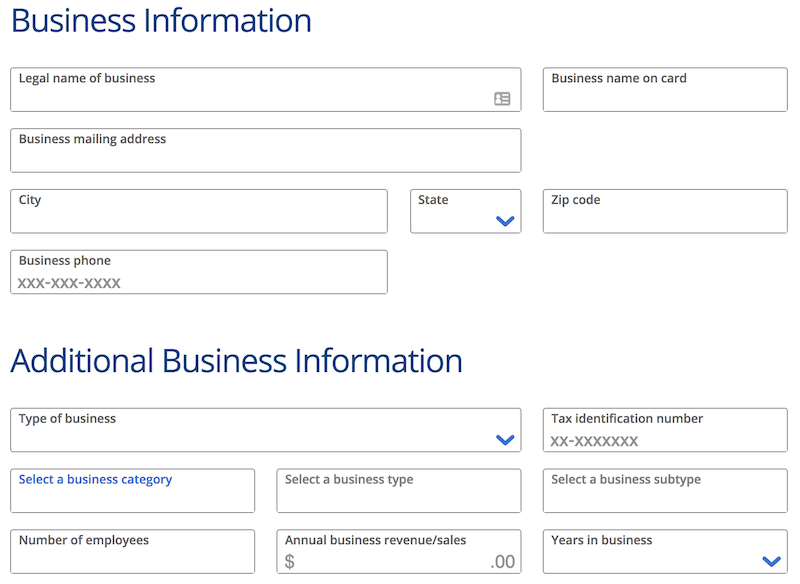
If you’re a sole proprietor, how should you approach this? First of all, and most importantly, answer everything truthfully. I think the concern that a lot of people have is that they think they need an incorporated business, a separate office, etc., in order to be considered for a business card. That’s not the case:
- You can use your name as the legal name of your business
- The business mailing address and phone number can be the same as your personal address and phone number
- If you’re a sole proprietorship, you can select that as your type of business
- For the tax identification number, you can put your Social Security Number
- For number of employees, saying just one is perfectly fine
- For your annual business revenue, be honest about what it is
- For years in business, there’s no shame in saying that it’s new, that it has been one to two years, etc.
How hard is to get approved for a Chase business card?
When it comes to getting approved for business credit cards, Chase certainly isn’t the easiest issuer. In general I find American Express business cards to be easiest to be approved for. However, getting approved for Chase business cards isn’t as tough as some people assume, at least if you have excellent credit.
In my experience instant approvals on Chase business cards aren’t that common, so don’t be worried if the approval doesn’t come through right away. You’ll often get a pending decision response, and then eventually (hopefully) an approval.
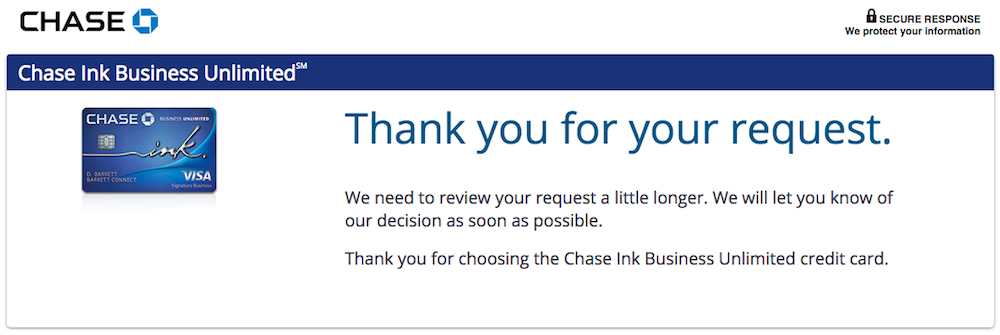
Still, sometimes instant approvals do come through, and it’s always exciting when that happens. Just don’t be surprised if it doesn’t.
How does the 5/24 rule impact Chase business credit cards?
Chase has what’s known as the 5/24 rule, whereby you typically won’t be approved for a Chase card if you’ve opened five or more new card accounts in the past 24 months (however, there are increasingly reports that this is no longer enforced).
One exception is most business cards, including select cards issued by American Express, Bank of America, Barclays, Capital One, Chase, and Citi, generally won’t count as an additional card toward that limit, because they won’t be shown on your personal credit report.
One positive thing is that while Chase business cards may be subjected to the 5/24 rule, when you’re approved for them, they don’t count as a further card toward that limit.
In other words, if you’ve opened four new accounts in the past 24 months and then apply for a Chase business card, you’ll still be at four cards. If you then apply for another Chase business card, you’ll still be at four cards.
What credit score do you need for a Chase business card approval?
There’s no set credit score you need to get approved for a Chase business card, as there are so many factors that determine if you get approved for a card. Personally, I’d aim to have a personal credit score of at least 700 before applying, and ideally, 740. But you could have a lower credit score than that and be approved, or you could have a higher credit score than that and be rejected.
Can you be approved for all Chase branded business cards?
If your goal is to be approved for the Sapphire Reserve Business and two of the three Ink Business cards (since you have to choose between the bonus on the Ink Cash and Ink Unlimited), your best strategy is “slow and steady,” as they say. I’d recommend applying for the cards a bit over 30 days apart, at the absolute fastest. If you apply for the first card on day one, apply for the second card on day 35 (or so), and then the last card on day 70 (or so). Or maybe wait even longer between applications.
If it were me, I’d definitely recommend making the Sapphire Reserve Business Card or Ink Business Preferred Card first, since they’re the all-around most lucrative, and have great welcome offers.
Then you have to decide whether the Ink Business Cash Card or Ink Business Unlimited Card is a better option for you as the second card to apply for. If it were me, I’d probably apply for the Ink Business Unlimited Card, given that it offers 1.5x points on all business purchases, so it nicely balances the 3x points categories on the Ink Business Preferred Card.
I’d note that while this is how it’s supposed to work, Chase also sometimes has limits on how much credit can be extended to someone, so it’s totally possible that Chase will approve you for two of these, but not the third. Everyone’s situation will vary.
Chase Ink business card frequently asked questions
Bottom line
Chase has some fantastic credit cards, and in particular, the issuer has great business credit cards. The lineup of Chase Ink & Sapphire business credit cards have some phenomenal bonuses, and between the Ink Business Preferred Card, Ink Business Cash Card, Ink Business Unlimited Card, and Sapphire Reserve Business Card, you could potentially earn bonuses hundreds of thousands of Ultimate Rewards points. That’s huge.
Not only do the cards have great initial bonuses, but they have excellent bonus categories, ranging from 1.5x points on all purchases, to 3-5x points in select categories.
Applying for business credit cards in general can be intimidating for new businesses, though I recommend giving it a try using the above tips, and you’ll probably be pleasantly surprised by the results.
Do you have any Chase business cards? If so, what was your experience getting approved for them?



Membership is free and takes no more information than commenting as a guest. Earn status points for good contributions, and see fewer ads as your status grows.
There are currently no responses to this story.
Be the first to respond.