VantageSolo: Future Of Narrow Body Business Class?

Over the coming years we should expect to see smaller planes on longer routes. We’ve already seen many airlines retire 747s and replace them with 787s and A350s.

The introduction of the A321XLR in 2023 will be even more drastic, as it will be able to operate nonstop flights of up to 10 hours.
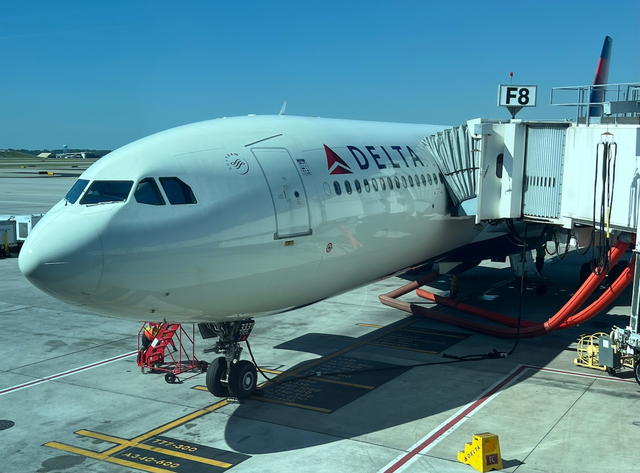
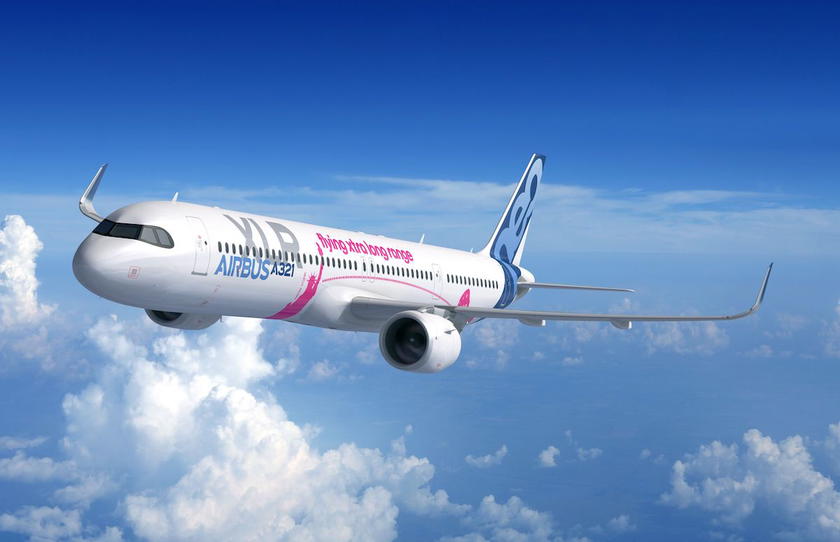
Airbus A321XLR

Passengers will value the convenience of nonstop flights in markets that weren’t previously financially viable, but what does this mean for the onboard experience?

The state of narrow body flat bed business class

At this point I’d say the swankiest business class product you’ll find on a narrow body plane is JetBlue Mint, which was introduced back in 2013.
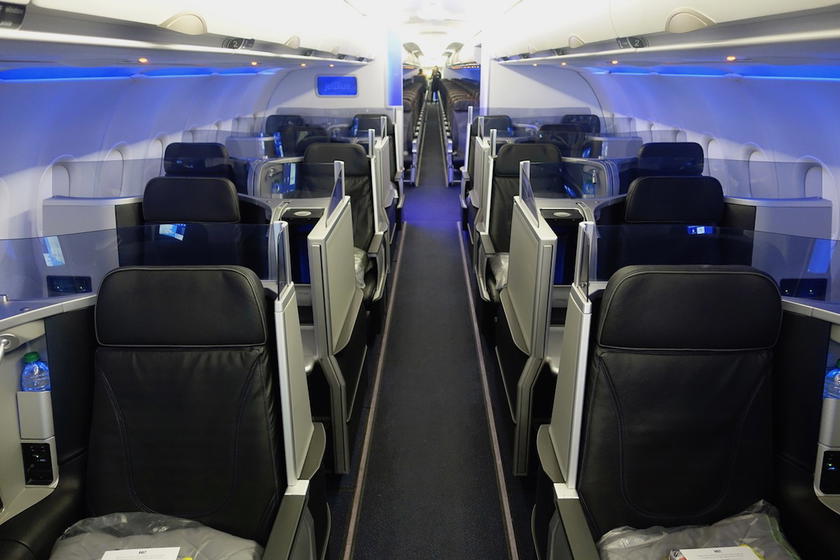
JetBlue A321 business class

This is a staggered configuration, though what makes it unique is that the “throne” seats (which are the solo seats in every other row) have doors. JetBlue was the first airline in the world to introduce doors in business class.
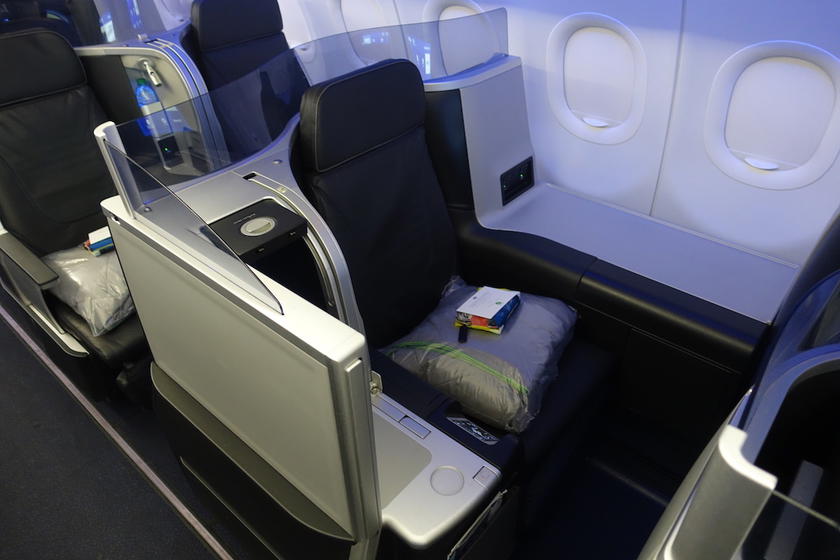

JetBlue A321 business class

Since 2013 we’ve seen several other airlines introduce flat beds in business class on narrow body aircraft, though nothing has surpassed, let alone matched, JetBlue Mint. Airlines like Aer Lingus and TAP Air Portugal are using the same staggered configuration on the A321LR, though it’s a more basic version of the seat, as there are no doors.
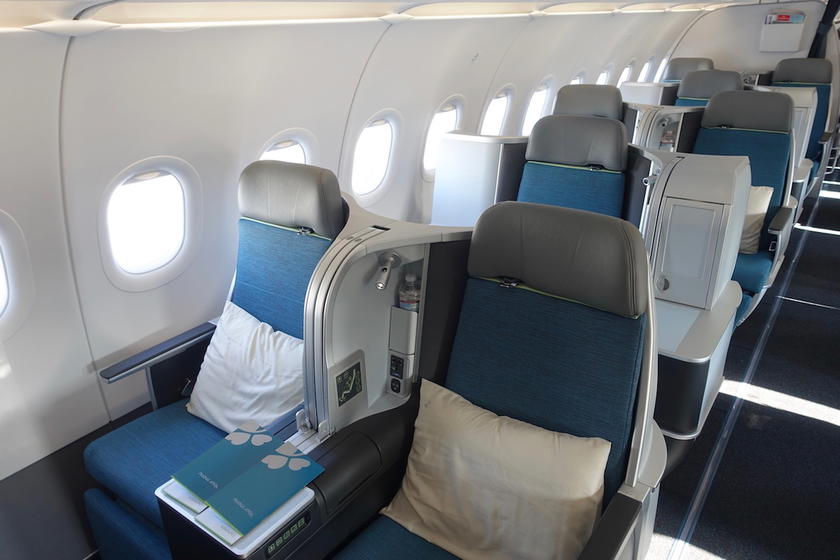
Aer Lingus A321LR business class
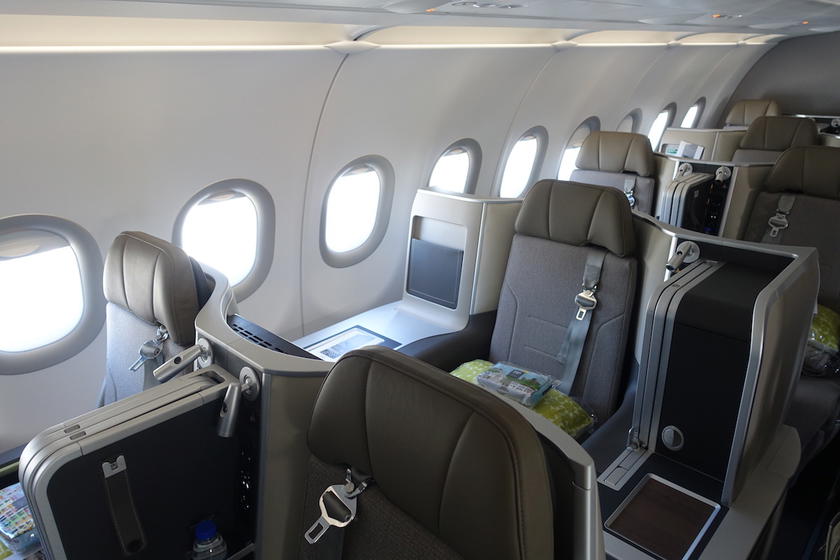

TAP Air Portugal A321LR business class

American does have some A321Ts with reverse herringbone seats, though these are marketed as first class, and not business class.
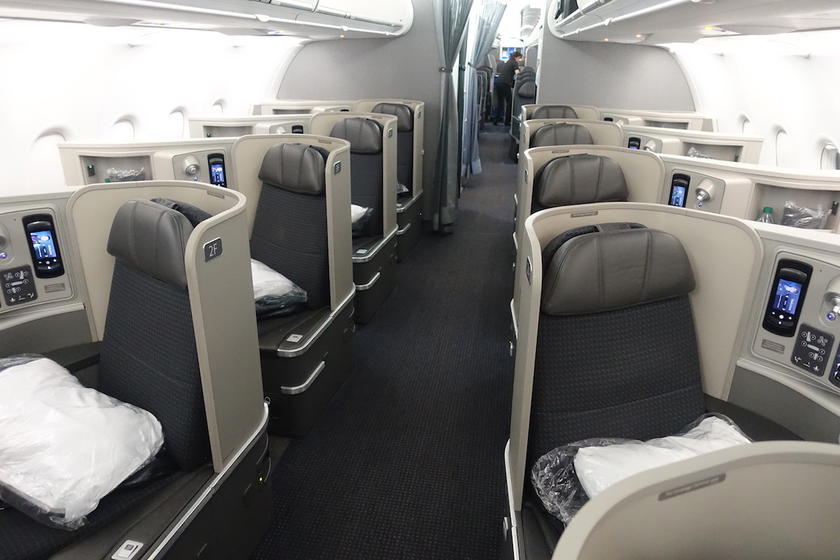
American A321T first class

Direct aisle access seats are coming

With several full service airlines having ordered narrow body planes with the intention of using them for long haul flights, there’s no doubt we’ll see some improvements when it comes to business class seats.

For example:

As I said above, airlines and seat manufacturers have had a long time to raise the bar since JetBlue Mint was introduced in 2013, though despite that, as of now there’s only a single product I know of that’s promising flat bed business class with direct aisle access on narrow bodies.

Specifically, that’s Thompson Aero’s VantageSolo seat. Thompson Aero is the same seat manufacturer that makes all of the staggered seats mentioned above (including on JetBlue, Aer Lingus, and TAP Air Portugal), so this is their evolution of the product.

Basics of Thompson’s VantageSolo seat

I’ve written about this seat in passing in the past, though some new pictures were recently released of the seats, so I wanted to look at this product in a bit more detail.

The VantageSolo seat essentially offers a herringbone configuration, as seats are in a 1-1 configuration facing the aisle.

Yes, on the surface that’s a step backwards for business class. Many airlines introduced herringbone seats nearly two decades ago, and they’re now rather unpopular with passengers.
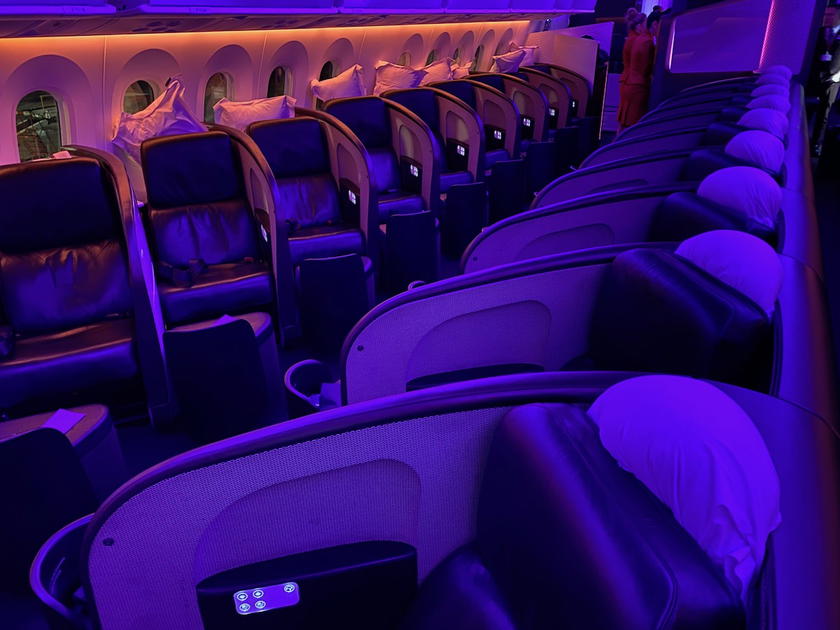
Virgin Atlantic herringbone business class

However, by looking at renderings of these VantageSolo seats, you’ll notice that many of the downsides of traditional herringbone seats have been addressed.
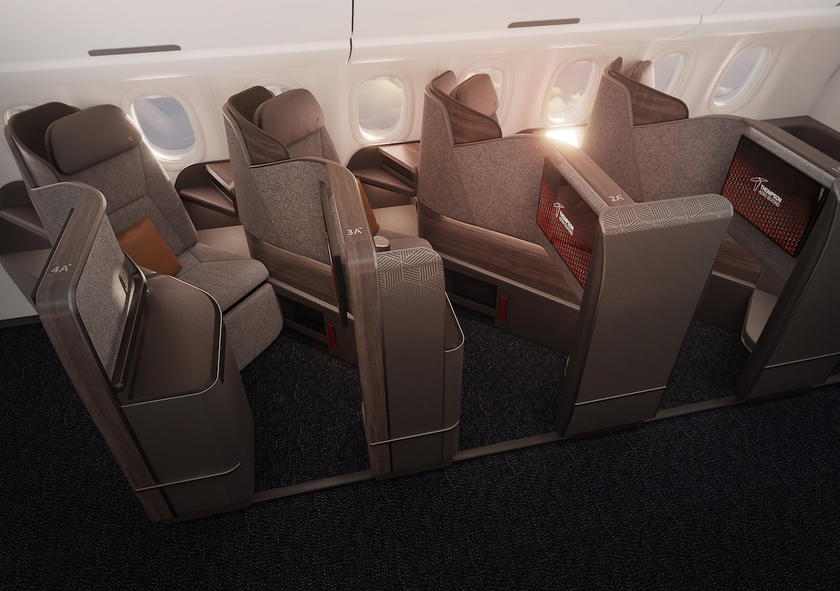
Thompson Aero VantageSolo seats


Thompson Aero VantageSolo seats

Yes, the seats face away from the windows, and that’s not ideal. Otherwise there are some considerable improvements compared to past herringbone seats, though:

  • The seats have storage space, as there’s a large counter by the aisle, and another one towards the back of the seat
  • The extra storage is made possible because the seats feature footwells (though rather large ones, by the look of it), rather than just offering exposed ottomans, which make the counter space possible without taking up additional space
  • The seats can be reclined into bed mode, rather than having to “flip” them over
  • The seats have significantly more privacy, both with a privacy shield around the back of the seat, and with additional privacy at the aisle
  • It even seems like these seats could feature doors, though we’ll see if any airlines end up doing that

Lastly I think it’s worth sharing the below rendering — note the particularly spacious seat in the first row!
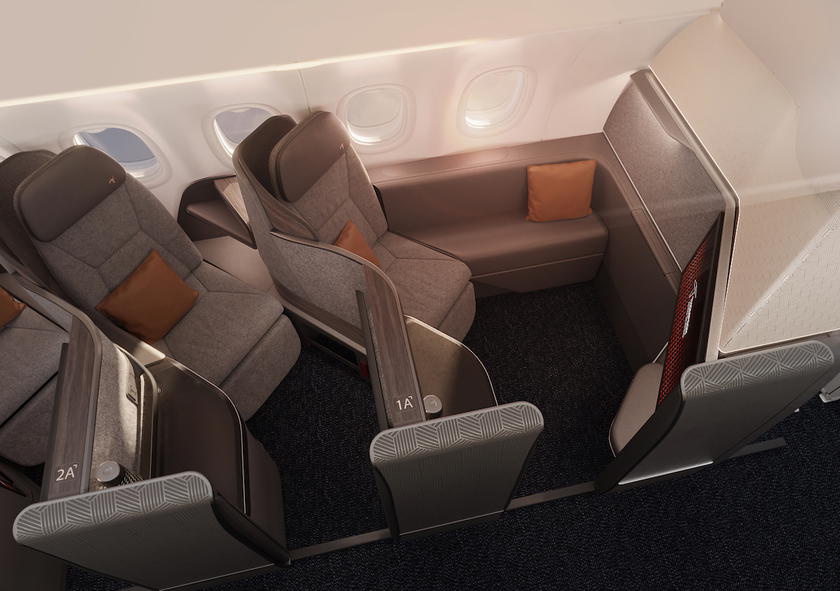

Thompson Aero VantageSolo seats

I guess we could see airlines introduce some sort of “premium” business class and charge extra to assign that seat.

More realistically, though, I doubt airlines will actually choose to have that seat. Rather than offering all that extra space to the passenger in row one, they’ll likely put a closet in the space that would otherwise be dedicated to that extra portion of the seat.

Bottom line

It seems like the VantageSolo seat is the frontrunner for fully flat direct aisle access business class on narrow body planes. Thompson is a well known and reliable seat manufacturer that has the ability to produce seats in large quantities, and that’s something airlines will value.

Ultimately I’d say I feel lukewarm towards this seat. I don’t love facing away from the windows, but I do appreciate that this at least addresses some of the other issues with herringbone seats.

While we’ve been hearing about the VantageSolo seat for a few years now, there’s always a chance that another seat manufacturer introduces a competing seat that’s even better. After all, ANA introduced their new business class with virtually no advance notice.

What do you make of the VantageSolo seat?

Conversations (22)
The comments on this page have not been provided, reviewed, approved or otherwise endorsed by any advertiser, and it is not an advertiser's responsibility to ensure posts and/or questions are answered.
Comment as a member

Membership is free and takes no more information than commenting as a guest. Earn status points for good contributions, and see fewer ads as your status grows.

Type your response here.

If you'd like to participate in the discussion, please adhere to our commenting guidelines. Anyone can comment, and your email address will not be published. Register to save your unique username and earn special OMAAT reputation perks!

  1. Loading comments…
Recent Comments
The latest from the OMAAT community.

The comments on this page have not been provided, reviewed, approved or otherwise endorsed by any advertiser, and it is not an advertiser's responsibility to ensure posts and/or questions are answered.

Leo Diamond

Don't see the point, why not use Apex Suites instead, Apex save even more space, direct aisle, also no side sitting and swing PE, still the small storage issue unsolved for Apex

0
‼ 0
Max Guest

if we think about how biz seats have evolved, it all make sense. and the key drive is to cram more seats in, with the cabin width as the key boundary condition. the evolution all started with wide body (twin-isle). in early days, the configuration was 2-2-2. fully flat ones are great for passengers, but they take too much space--in particular, huge foot space. so for airlines, that's wasteful. angled ones, by sticking the foot space of the seat behind underneath the seat in the front, partially solve the issue. but passengers dislike them. but that's not the only issue. These 2-2-2 seats are TOO wide, and leave wide isles. just recall the old UA 2-4-2 seats, and one would realize how wide and "wasteful" the 2-2-2 ones are. to use the space more efficiently, many airlines go 2-3-2, and some even 2-4-2; but passengers want direct isle access. so there comes the first important invention, the herringbone. by "tilting" the seat orientation, they can fill the cabin width more efficiently, without leaving wide isles (nor wide seats). but one key issue is within each seat how space is used. in early herringbone seats (like Virgin Atlantic), each seat takes all the space above its footprint on the floor--which means the designer never thought about space-duplexing (assigning space in different heights to different seats, but rather dividing each seat using simple vertical walls), resulting in disadvantages such as lack of arm-space, lack of storage space, while the space above each ottoman is totally wasted. also since passengers have to enter the seat from the END of the seat (foot side), the ottomans are small, in order to leave the opening for seat entrance. not to mention the privacy issue that everyone is facing the isle. to address some of the disadvantages, the next important invention is the reverse herringbone. the seats are now facing away the isle. but the key difference is that, now passengers are entering the seat space from the SIDE of each seat. therefore, the reverse herringbone seat are LESS "tilted" than the herringbone ones (if you think about the entrance to each seat), which means they are more "forward facing". If you think about it--most wide body planes can fit 4 "columns" of reverse herringbone seats (1-2-1), but only 3 "columns" of reverse herringbone seats (1-1-1). of course there are evolution in reverse herringbone seats. early cirrus ones are more like the herringbone ones, with vertical walls dividing between seats, wasting the triangular volume above ottoman (and one has to flip the TV screen out). super diamond ones take the idea of space-duplexing, giving that volume to the seat in front, creating a good arm space. then there comes ultra long-range narrow body planes. one key problem is that their cabin width is MORE than half of the wide body ones (just think about the configuration in coach). Therefore, using reverse herringbone (1-2-1 in wide body) would be inefficient: one cannot fit 1-1-1 in, but 1-1 would leave extra room wasted (just think AA 321T--it has wide isles in F, and seats are far from window), because of cabin width. But one just cannot further "tilt" reverse herringbone seats to fill the area--the seat entrance would be blocked (unless passengers climb over their seat cushion). For the same reason Polaris seats would not be efficient on narrow body planes. if they go 2-2 (keeping direct isle access), they use exactly half of the cabin width as in wide body ones, leaving unused cabin width. Other solutions, like staggered ones, do not offer direct isle access to each seat (though great for people traveling together). So the designers finally come back to herringbone seats. they are more "tilted" than reverse herringbone seats, so they can better use up the cabin width. And to address the disadvantages in the old design, two key improvements are made. first, space-duplexing give each seat an enclosed ottoman (so passenger's feet are no longer exposed to the isle), while giving the neighboring seat some desk space. second, bending the dividing wall to create an seat entrance a bit from the side (rather than forcing people to climb over their ottoman). it's interesting to think about how the seat design has evolved, as if we are reading into the minds of the seat designers. I guess if all these make sense to you, by adding a few pictures and illustrations (like cabin floor map for different planes) you are welcome to revise and use this comment as another post (ok with me).

0
‼ 0
David Gittins Guest

Why the fixation on doors? It’s a common theme through many of your posts. Sorry, even as a 150k miles pa traveler, I don’t see it as anything more than a slightly incremental tweak to an existing interior design.

0
‼ 0
Ben Holz Gold

@Marco Duprè the issue is that airlines will be using small planes on long routes (in case you missed the point of this article) ;)

0
‼ 0
Dangerous Dave Guest

To be fair the foot wells on these things do look wider than NZ’s ones. I am only 5’11 and already too tall for NZ J seats. Footwell is super cramped and I’m forced to sleep with feet at a weird location. Feel bad for all those big rugby dudes who are 6’4!

0
‼ 0

Save posts to read later

Saving posts is a member feature. Become an OMAAT member to build a reading list you can come back to from any device.

Become a member
Meet Ben Schlappig, OMAAT Founder
5,883,136 Miles Traveled

43,914,800 Words Written

47,187 Posts Published