
In recent months, we’ve seen Airbus’ newest narrow body plane, the A321XLR, enter service. Airlines have ordered hundreds of these planes, and many industry executives view the aircraft as being a game changer.
I wanted to put the A321XLR to the test in terms of passenger experience, so I recently took a quick trip to try this jet on the two airlines operating it so far — I flew to Europe in Aer Lingus’ A321XLR business class, and returned to the United States in Iberia’s A321XLR business class.
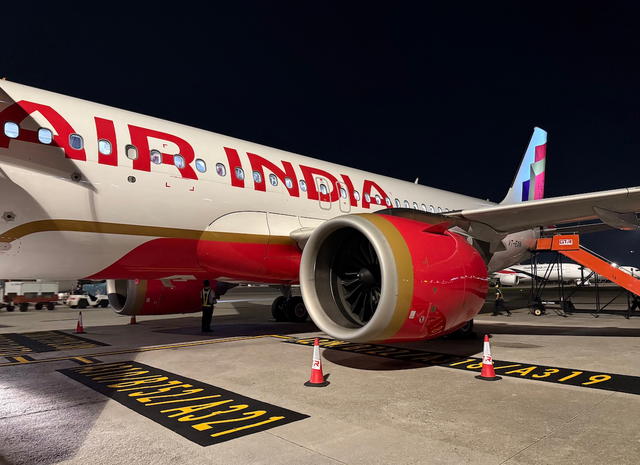
In this post, I’d like to share my general takeaway from flying on this aircraft, from a passenger experience perspective. Should travelers be delighted by the potential routes this plane opens up, or dread flying narrow body aircraft on long haul flights? Let’s start with some background, and then I’ll share my take…
What is the Airbus A321XLR, exactly?
In 2019, Airbus formally launched the A321XLR, which is the longest range narrow body jet in production. This aircraft is based on the A321 family of aircraft, but features more range.
Essentially, we’ve seen Airbus go from the A321ceo, to the A321neo, to the A321LR, to the A321XLR, with each jet offering incremental range, (that’s obviously very attractive to airlines). From the A321ceo to A321neo, better fuel efficiency (thanks to new engines) increased the range of the jet.
Then the A321LR came with extra fuel tanks, and the A321XLR came with even more fuel capacity. Officially, the A321XLR has a range of up to 4,700 nautical miles (5,400 statue miles), which is a long way to fly on a relatively small plane.
Now, it’s worth emphasizing that no A321XLR will actually be scheduled on a flight of that distance. Flights require fuel reserves, and there are headwinds or tailwinds on most routes, further limiting the total distance that can be flown.
Realistically speaking, you can expect that A321XLRs will consistently operate routes of under 4,500 statute miles, and more often than not, of under 4,000 statute miles. That’s true not just because of the absolute range, but also because airlines don’t have proper crew rest facilities on these planes (aside from blocking business class seats), so that limits how far airlines will want to fly these planes.
The plane officially entered service in late 2024, with Iberia being the launch customer, followed by Aer Lingus. Here in the United States, both American and United have 50 of these jets on order, while our friendly neighbors to the north (Air Canada) has 30 of these on order.
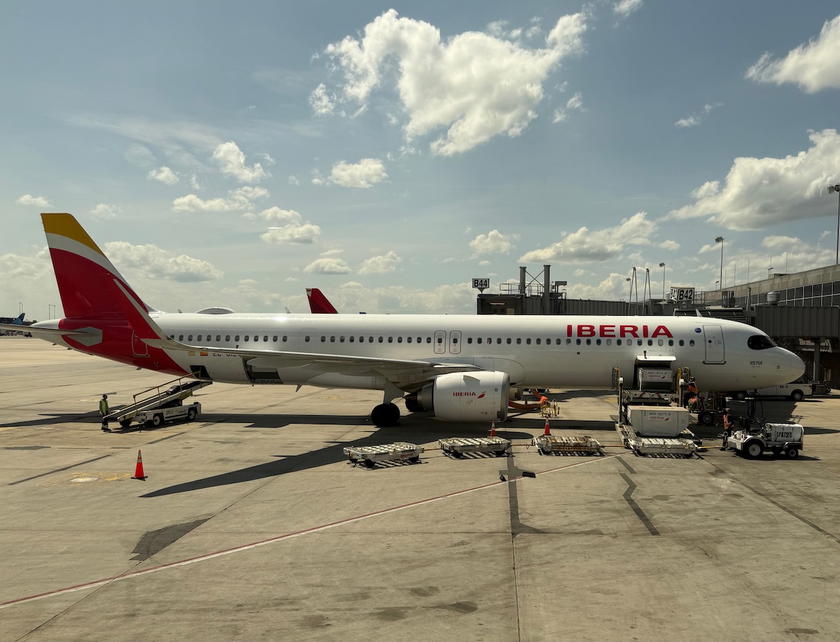
Why the Airbus A321XLR is sort of anti-climactic
The introduction of the Airbus A321XLR is kind of anti-climactic, for a couple of reasons. For one, it’s not like the A321XLR has materially more range than the A321LR. The plane can maybe fly an extra 20-30 minutes, but from a passenger experience perspective, that’s not going to be a game changer.
My point is simply that long haul travel on A321-family aircraft is nothing new. La Compagnie’s A321neos have been flying since 2019, and JetBlue’s A321LRs have been crossing the Atlantic since 2021. If you’ve flown a product like that, then the A321XLR experience will be familiar.
What’s changing is that we’re about to see a lot more narrow body planes flying across the Atlantic. The reason is simply because many airlines weren’t quite onboard with the A321LR, as the range was right on the cusp of what they needed, and it didn’t provide much flexibility for growth to more markets.
The A321XLR, meanwhile, has all kinds of valuable use cases for airlines, and that’s why we’re seeing carriers like American and United picking up so many of these aircraft. Just as an example, below is what 4,000 nautical miles of range looks like from Newark, as that’s well within the plane’s comfortable operating range.

But this also gets at the other reason why the A321XLR is sort of anti-climactic — many airlines won’t even be using the full range of the plane.
For example, both American and United plan to partly use their A321XLRs for coast-to-coast service, replacing many of the existing planes. So the aircraft will have long haul cabin configurations, but will largely be used for transcon-length flights. Heck, Qantas is even acquiring A321XLRs specifically for regional fleet renewal, and the planes will have standard domestic configurations, without flat beds.
In theory, the selling point of the A321XLR is that it can open up some long and thin routes, which couldn’t be profitably operated by wide body aircraft. However, it’s questionable to what extent airlines will actually use the plane that way, rather than just downsizing aircraft, or increasing frequencies.
For example, Aer Lingus is doing a great job with using the A321LR/XLR in the way it was intended, flying to places like Cleveland, Indianapolis, Nashville, etc. I hope we see more of that, but I wouldn’t necessarily count on that being the primary use of the aircraft.
Just as an example, when SAS took delivery of its A321LRs, it added transatlantic flights from Aalborg and Gothenburg. However, those routes ended up being cut, and instead, they’re being flown from Copenhagen to places like Boston, Washington, and Toronto, I’d say that’s a bit less exciting.
My experience flying the Airbus A321XLR
Having taken two recent transatlantic flights on the A321XLR, what were my takeaways? As you’d expect, most people prefer to fly bigger planes rather than smaller planes, so most of the observations that people will have about the A321XLR will be negative (in comparison to flying a wide body).
I don’t want to say it was anything terrible, but all the little shortcomings really do add up, in my opinion. Here are some of the things that stood out to me:
- Boarding is just so much less pleasant, especially if you’re in business class, as everyone boards through the forward door and down a single aisle; boarding actually takes longer than on most wide body aircraft
- I feel really bad for the crews working A321XLRs, as the galley space is absolutely tiny, so there’s barely space for them to operate, let alone any privacy from passengers
- The business class lavatory situation is a bit of a mess; not only is the lavatory tiny, but it’s one lavatory that’s shared with all business class passengers and the pilots, and there was so often a wait to use it
- Business class has come a long way over the years, but there’s simply no denying that narrow body planes represent a regression for the quality of premium products, given the importance of every inch of the plane being used efficiently
- There’s just nowhere to practically stretch your legs on a long haul flight when flying the A321XLR, short of standing in the aisle, which also isn’t ideal
- I see staffing getting a bit challenging on the A321XLR, as it seems airlines are struggling with whether to staff business class with one or two flight attendants, and I suspect service will be a bit slower than on other aircraft, on average
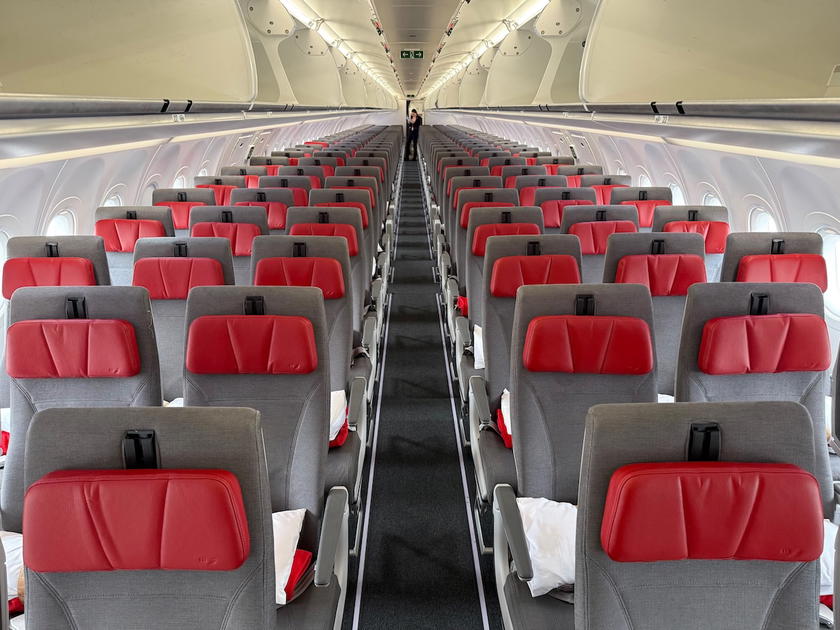
- With the A321XLR having the Airspace cabins with the larger overhead bins, the cabin feels especially tight, since those bins hang down pretty low
- On a narrow body aircraft, you just feel everything a bit more, from turbulence, to the floor shaking when people walk by
- You don’t necessarily notice this, but the A321XLR is nearly 10% slower than some wide body aircraft, so flights on the plane do take longer
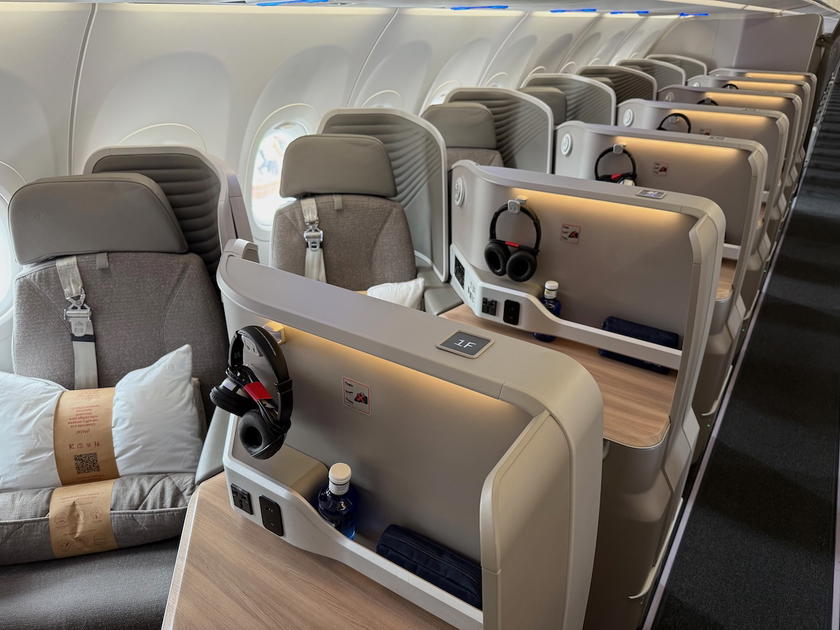
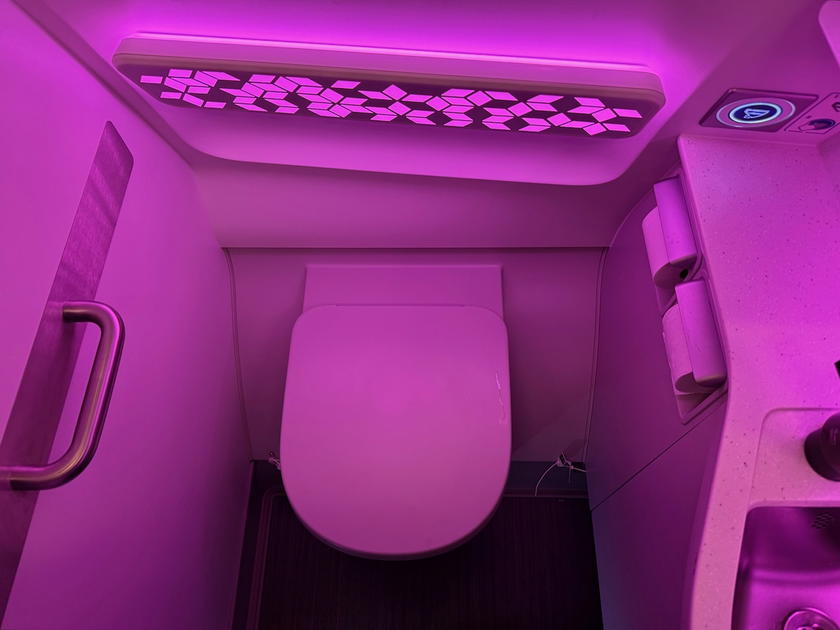
Now, in fairness, not everything about the A321XLR is bad. In comparison to other narrow body jets, it’s a very pleasant ride. Furthermore, simply by virtue of this being a new aircraft, you can expect these planes to have all the latest and greatest tech, assuming airline customers elect to offer it. We’re talking Wi-Fi, good charging options, bluetooth audio, and more.
Bottom line
I just had the chance to fly the two airlines that are operating the new Airbus A321XLR so far. This is the longest range narrow body in production, and we’re going to see a lot more of these in service over the coming years.
I’ve gotta be honest, given the option, I definitely prefer a wide body aircraft to a narrow body aircraft. The cabins just feel more spacious, the lavatory situation is better, and for the most part, there’s more potential for a great hard product. That’s not to say that I’d avoid the A321XLR at all costs, but it’s definitely not something I’d seek out, unless the schedule or price were better.
Of course it’s important to mention that it also depends on the route we’re talking about. For example, when American and United soon start flying A321XLRs on transcontinental flights, I’d absolutely hop on one of those.
What’s your take on the Airbus A321XLR, and your desire to fly it on a long haul sector?


Membership is free and takes no more information than commenting as a guest. Earn status points for good contributions, and see fewer ads as your status grows.