
Earlier this year, Etihad Airways’ CEO revealed that the airline had significant growth plans, after spending the past several years shrinking. He has now shared more details about what this will look like. Can the airline grow a bit more sustainably than it did a decade ago?
Details of Etihad’s huge growth aspirations
Antonoaldo Neves is Etihad’s new CEO as of late 2022, and he’s determined to grow the airline in a sustainable way, in what he describes as the Journey 2030 vision. Long story short, Etihad hopes to double its fleet and triple its passenger numbers over the next seven years, by the end of the decade:
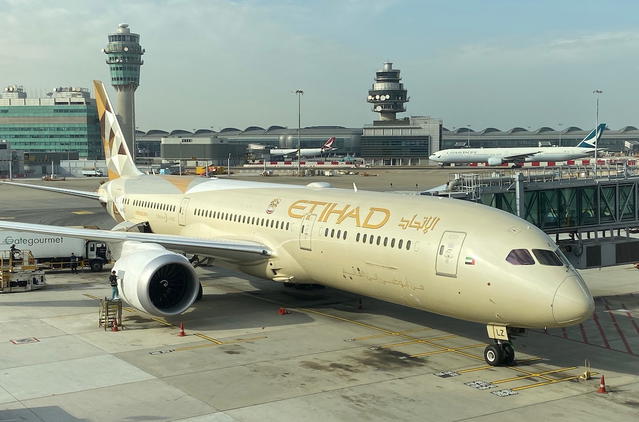
- Etihad hopes to carry 33 million passengers annually by 2030; for context, Etihad will carry 13 million passengers in 2023, a 30% increase from 2022, and the airline hopes to return to peak 2017 passenger numbers by late 2024 or early 2025
- Etihad hopes to have a fleet of over 160 aircraft by 2030; Etihad currently has a fleet of 80 aircraft
- Etihad hopes to serve over 125 destinations by 2030; Etihad currently serves 77 destinations
Etihad’s growth will be primarily focused on connecting short and medium haul destinations in the GCC, India, and Asia, with long haul destinations in Europe and North America. The airline wants to introduce new destinations, provide more options, and increase frequencies to key international markets.
Another important part of this mission is providing substantial economic benefit for Abu Dhabi, with the goal of attracting 10 million point-to-point travelers to the UAE’s capital by 2030, in order to catalyze economic growth, create jobs, and solidify Abu Dhabi’s position as a global travel hub.
Here’s how Neves describes his vision for the airline:
“As we mark Etihad’s 20th anniversary, we are excited about what’s next. Journey 2030 is the guiding plan that propels Etihad into the future. Etihad has solidified its global presence and successfully navigated challenges. Now, with strong shareholder support and a strategic plan in place, the airline is poised for sustainable, profitable growth.”
“Our mandate is clear: to deliver extraordinary customer service and sustainable profitability, as the foundation for Etihad’s contribution to Abu Dhabi’s aspirations.”
“Twenty years ago, the leaders of the UAE launched a remarkable airline which has established a global reputation. Our rich past is the perfect starting point for our next chapter. Journey 2030 will ensure we continue to delight our customers, our people and our nation in the years to come and be the airline everyone wants to fly.”
With Abu Dhabi Airport’s new Terminal A finally open, the airline is at least much better positioned as a global hub in terms of capacity and passenger experience.
My take on Etihad’s sustainable growth plans
The business models of Gulf carriers is kind of complicated, since the goal of maximizing shareholder value works a bit differently than at publicly traded airlines. Their primary motive is to put their respective “homes” on the map, and to turn them into global hubs. For example, if Emirates didn’t exist, Dubai wouldn’t be nearly as significant as it is today. But by making it one of the largest connecting hubs in the world, it really makes the destination much more relevant to global travelers.
Beyond that, though, the governments of these countries (or regions, as the case may be) don’t necessarily want to light money on fire, and might have a change of heart over time. That’s exactly what we’ve seen at Etihad. Going back a decade, Etihad’s plan was to take on Emirates and grow massively, trying to turn Abu Dhabi into a hub that could compete with Dubai.
But that caused billions of dollars in losses, and there were no signs of that changing. So the government had enough, and then eventually basically turned the airline into a shell of its former self. Under the leadership of the most recent former CEO, Tony Douglas, the airline underwent an impressive turnaround, and became profitable (admittedly “profitability” works a bit differently in the Middle East, when the same parties own the airport, airline, etc.).
On the surface it might seem that Etihad is heading down the same path it was on a decade ago, but Neves is pretty explicit in saying that the growth has to be profitable and sustainable. On some level, though, I have to wonder how realistic these growth plans are, since I think the “big three” Gulf carriers are increasingly facing some headwinds, as competition adapts:
- Air India is completely being reinvented and is growing, and that cuts into the traffic that the Gulf carriers rely on
- We’re seeing the launch of Riyadh Air, which will likely take over a lot of Saudi Arabia traffic
- We’re increasingly seeing ultra long haul aircraft operating point-to-point routes that allow passengers to skip the traditional transit hub; for example, Qantas will fly nonstop from Sydney and Melbourne to London starting in 2025 or 2026
That’s not to say Etihad is in trouble, or anything, but is there really room for the airline to double in size, and to do so in a profitable way? As there’s more and more competition, there’s also downward pressure on fares. I’m very curious to see how this plays out. I think Neves has done a good job so far at Etihad, but doubling to tripling the size of the airline in seven years is quite a tall order.
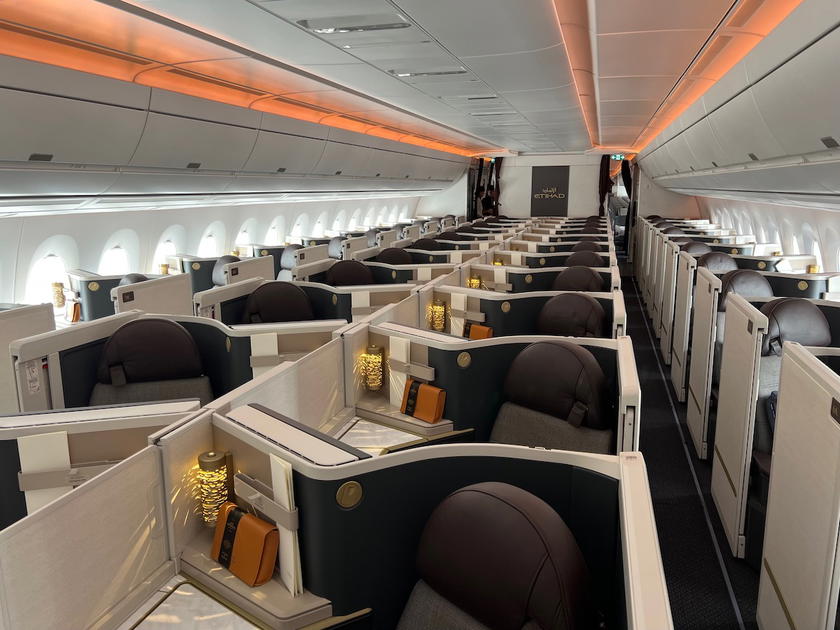
Personally I’m really happy to see the direction that Etihad has taken. Based on my recent Etihad experiences, the airline really has its groove back, and offers a great passenger experience without being too over-the-top.
Bottom line
After spending years shrinking, Etihad once again plans to grow, with the goal of expanding the airline to 160+ aircraft, serving 33 million passengers, and flying to 125+ destinations. So while I think the airline is in a great spot, I can’t help but wonder if the current plans are a bit overly optimistic.
What do you make of Etihad’s growth plans?


Membership is free and takes no more information than commenting as a guest. Earn status points for good contributions, and see fewer ads as your status grows.