
As I mentioned previously, over the coming days and weeks you’ll see the occasional post from a fellow reader who has applied to write for OMAAT on an ongoing basis. It’s possible that posts will still be in the publication queue after we’ve announced our decision, so we’ll be publishing these anonymously. We hope you enjoy the different perspectives!
I love planning vacations for my family. We’re always talking about our next trip. But, with a family of 4, it takes a lot of points and miles to travel affordably and in style. We prefer to travel in business class, enjoy higher-end hotels, and with two teenagers often need two hotel rooms.

I’ve found that with some careful planning (and the help of miles and points), it’s possible for our family to take lengthy and extremely nice vacations for a fraction of the cost. Our upcoming trip to Asia is a great example of this, and I thought it might be helpful to walk through how we’re spending under $4,000 for a two-week luxury trip for four.
Planning ahead
There are several things you need to do months before your journey begins. Some of the most important are:
- Make sure you’re maximizing your earning potential on everyday purchases
- Have a strategy for meeting your mile/point needs for the trip
- Prepare to book flights 8-10 months before you want to travel
- Be flexible, whether it’s the routing, days of travel, or cities to visit
- Apply for credit cards you need to complete your itinerary

Earning potential with everyday spend
If you are serious about wanting to explore the world in style and do it affordably it starts with maximizing your everyday spend. Credit card sign-up bonuses are nice, and we absolutely leverage those as well. But our everyday spend does a lot to build our balances each year. You need to know what credit card gives you the most earning potential for your situation.
Our monthly household budget is $10,000, and we charge everything we can on our credit cards. On average, we charge $9,000 a month on all cards.
Here’s what credit cards we use on an average month and how many points we earn, including additional points from monthly portal shopping and AmEx offers:
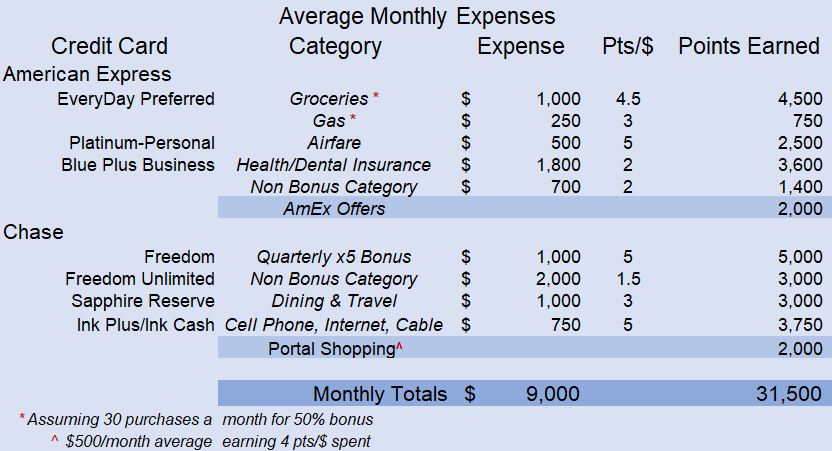
As you can see, we earn 31,500 points a month on average for our $9,000 in credit card spend. That’s over 378,000 points in a year! Assuming each point is worth 1.7 cents, we’re getting a 5.95% return worth $6,426 in one year, just by maximizing our everyday spend.

Have a strategy for meeting your mile/point needs for the trip
Maximizing everyday spend is especially important for families, because you need so many points for international trips. But, you also need to think about:
- Where do you want to visit?
- What kind of miles/points do you have available for an award booking?
When planning any trip, the first question I ask is; “Where do we want to go?” I like to think of the destination as a region and not just “I want to go to Dublin, or Singapore.”
After we decide what region we want to visit, I take inventory of my miles/points I have on-hand. Knowing where you can transfer/use your points & miles will help in getting the best flights available. If the points/miles are not in place, you need to earn them before you can really start planning.

Ideally book flights 8-10 months before you want to travel
Once you have decided on a region of travel, you will want to start searching for award flights. You need to start looking 8-10 months in advance. Obviously, this requires that points/miles be available for the flights. Hotel points can be generated later.
For our Asia trip, we had 300K American miles (mainly from flying partner airlines) and 200K Alaska miles (from previous credit card sign-ups) to use for the flights.
I started searching for flights in October for a trip to Southeast Asia this coming summer. Two cities we hoped to visit were Singapore and Ho Chi Minh City, but we were flexible to fly into any city in SE Asia.
I found 4 business class seats on Japan Airlines available in early July from JFK to Tokyo connecting to Singapore. American had award availability from Raleigh (where we live) to JFK to complete the outbound flights. The cost was 70K AA miles + $25 per person.

For our return, I scooped up four business class seats on Cathay Pacific from Ho Chi Minh City to Boston (via Hong Kong) for 50K Alaska miles + $100 per person. To get home from Boston I booked a Southwest flight to Raleigh for 6K Southwest points + $5 per person.
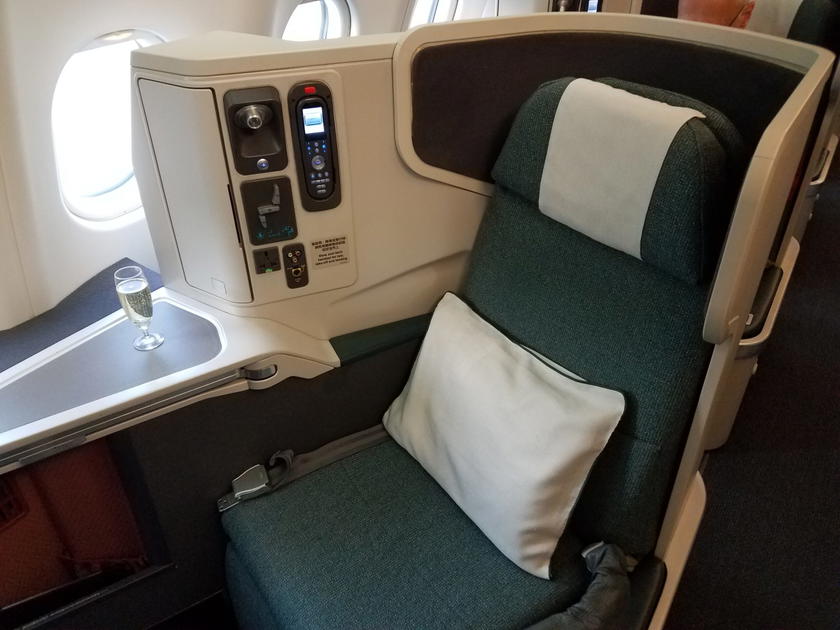
Being able to redeem 50-70K miles for 18-20 hours in business class is a fantastic deal. If you plan far enough in advance, Japan Airlines and Cathay Pacific (as well as others) have great award availability, but in many cases it’s not too expensive to change to a better itinerary if something opens up later on.

Be flexible in your routing, days of travel, and cities to visit
Being flexible in your routing and travel days will help achieve a workable itinerary. Also, having the ability to adjust the cities you visit and the order in which you visit them will facilitate the planning process.
With our upcoming trip we fly into Singapore and home from Ho Chi Minh City. But where to spend our 12 days in-between?
I looked at visiting Malaysia. There’s a great Grand Hyatt in Kuala Lumpur. There is a new Ritz Carlton on Langkawi island for only 40K Marriott points/night. I also considered Siem Reap, Cambodia. My son and I were in Siem Reap in 2016 — it’s incredible. But the logistics were complicated and expensive.
We ultimately decided to spend 3 days in Singapore, then fly to Vietnam for 9 days, visiting 3 cities.

Apply for credit cards you need to complete your itinerary
With flights booked and an itinerary outlined, the next thing to do is book the hotels. With teenage kids we prefer 2 rooms — many international hotels have a maximum of 3 persons per room anyway. And, of course, I want to use points wherever possible to keep our out-of-pocket low.
The Conrad Singapore (where I’ve stayed before, and enjoyed the location and breakfast) is 60,000 Hilton Honors points per night/room. We wanted to spend three nights in Singapore, and for two rooms we’d potentially need 360,000 Hilton Honors points to fully cover the stay.

Fortunately, I already had 100K Hilton points available. My wife and I then applied for the following cards to cover the balance, including one that gave us two free weekend nights:

Our next stop is Danang, Vietnam. We have 2 suites booked at the Hyatt Regency for 20K Hyatt points per night/room. The rooms come with Club access which will help the wallet.

Hyatt Regency Danang. Photo courtesy of Hyatt
To cover the costs of this stay, I applied for The Hyatt Credit Card which earned me 40K points. To cover the balance, we transferred 80K Chase Ultimate Rewards points which we earned over 5 months of everyday spend.

While visiting Hue, Vietnam we will be enjoying The Scarlett Boutique Hotel. We’re paying $60 per night/room.

Lastly, in Ho Chi Minh City, we have reserved 3 nights at the InterContinental Saigon for 35K IHG points per night/room. We’re both using our free night certificates from our IHG One Rewards Premier Credit Card, along with 70K IHG points we earned in the last year from promotions/stays.

Success! Two weeks in Asia for a family of four, mostly on miles and points.
Below is our itinerary with our actual costs and the “retail” costs if we were paying cash rather than using miles and points.
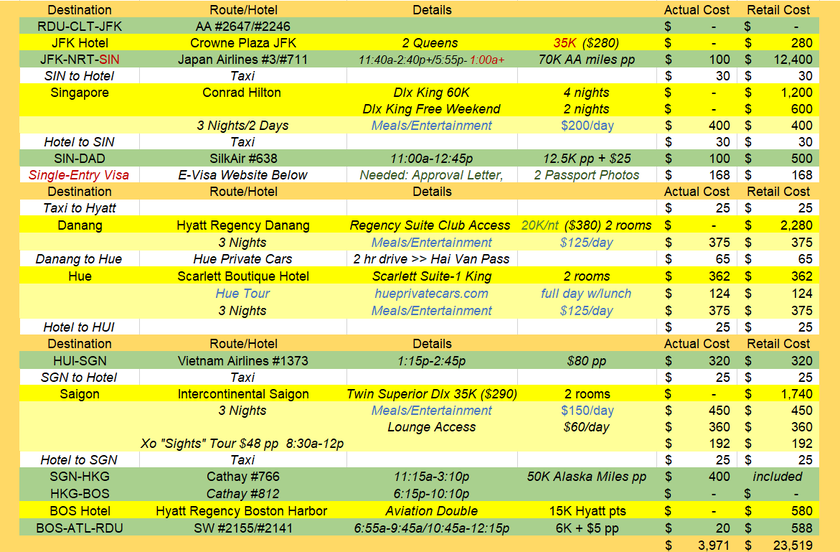
Again, our budget is just under $4,000. If we were to pay for a trip like this it would cost over $23,000. I know it’s a lot of miles and points, but the reason you earn them is to burn them, and it allows us to take some incredible vacations that would never be practical otherwise.
Bottom line, with the proper planning and flexibility, anyone can take a great trip at a fraction of the cost. Even a family of four can fly in the front of the plane, stay at beautiful hotels, and do it affordably.
Who else travels with family-in-tow? How do you use miles to keep things affordable?
As a reminder, this post was guest-written by a fellow reader. Feedback is appreciated, but please keep the comments kind and constructive.


Membership is free and takes no more information than commenting as a guest. Earn status points for good contributions, and see fewer ads as your status grows.