
Okay, maybe “need” is a strong word, because roughly 99% of the time you’re not going to need to know this information in order to book award tickets. But there were a lot of questions earlier in the week about how I was able to get a Kenya Airways award issued that Ben (and multiple agents) had struggled to ticket.
While I’d like to claim that I’m just magical or insert the “good at stuff and things” Bitmoji, this is stuff anyone can finesse with a bit of practice. So it sounds like it might be helpful if I go though a bit of my process, and share what I know about how airline reservations systems work.

At least from this end of the phone line.
Keep in mind I haven’t seen the airline systems in person, as I’ve never worked for an airline, but will do my best to explain things as they’ve been described to me over the years. Which is fine — most of us will never see these systems, so knowing that they exist and a bit of how they work is what’s relevant, even if the specifics aren’t perfect.
Reservations systems have multiple access points
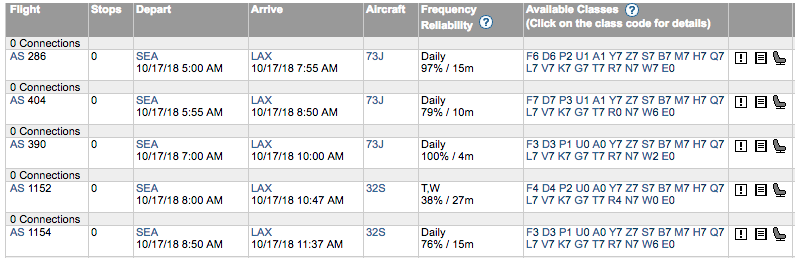
Airlines load inventory into their distribution systems, which gives specific details as to the flight timing, aircraft, seating, and so forth, along with all the fare buckets for that flight. When you’re looking at the Flight Availability tab of ExpertFlyer, for example, you can see a lot of those details:
But there’s more to building a reservation than just inventory — minimum connections have to be checked, taxes and fees need to be calculated, secure flight information has to be collected, and so forth. And airlines have a few different ways of handling this.
Web interface
You’re likely all familiar with this, because this is what you use to book a flight! The website is coded to allow access to query award inventory, create a reservation, and send the itinerary to be priced by whatever computer systems do that, ultimately providing you with a ticketed reservation.
Technology can be amazing.
But just because the web interface doesn’t allow a routing, doesn’t mean a flight isn’t bookable. The American website, for example, doesn’t show all partners, and doesn’t suggest longer connections, but you can easily book both over the phone with an agent.
Default agent interface
Increasingly, this seems to essentially be a different skin for the same web-based interface that customers are using.
The functionality may or may not be different than what customers have access to, which is why for some airlines (¡Hola, Avianca!) there isn’t anything that can be accomplished over the phone that you can’t do yourself online.
Other airlines give their agents more functionality. Hence why American agents can see partners that aren’t otherwise available online, or create reservations with longer connections, or piece together multiple segments.
As I understand it, for the most part these systems also auto-price reservations nowadays, just like the customer interface. So it’s much easier for agents, and saves time — usually you won’t have to wait on the line for a reservation to go to the pricing desk (I think I spent all 90% of my waking hours in 2013 waiting for the US Airways pricing desk to come up with a final price) — the computer will just calculate the price and you’ll be able to provide payment.
The “other” system
Most airlines have some sort of protocol for giving agents “direct access” to the reservations systems. For years these would likely have been the primary/default method for an agent to build a reservation, but over time they’ve been phased out for the more efficient and user-friendly interfaces.
The problem, fundamentally, is that for the most part are not agents are not trained on how to use these legacy systems, and haven’t been for years. They aren’t intuitive to use and often require a lot of manual entry. Think mono-chrome displays and lines of plain-text — these can be very basic.
And of course, in order to enter something manually, you also need to know what codes need to be entered, or at least where to look them up, which is often a challenge.
It’s rare that airline agents need to use this system (especially when you consider what a small percentage of people are calling to get awards booked versus whatever other things they need agents to help with), so you can’t assume that anyone you talk to is able or interested in dealing with it.
What is a long sell?
Essentially, when you’re long selling an award, you’re not using any of the computerized shortcuts for searching award space. You’re doing it the “long” way.
So rather than asking the distribution systems of the partner airline:
“Hey, do you have any award space between New York and Nairobi?”
A long sell specifically asks:
“I need one seat on this specific flight on this exact date in this designated fare code, can I have it yes or no?”
And then (ideally) the partner systems respond with “confirmed” or “not confirmed”.
If the partner hasn’t previously decided to make inventory available in that fare bucket, they aren’t going to suddenly make it available just because someone asked.
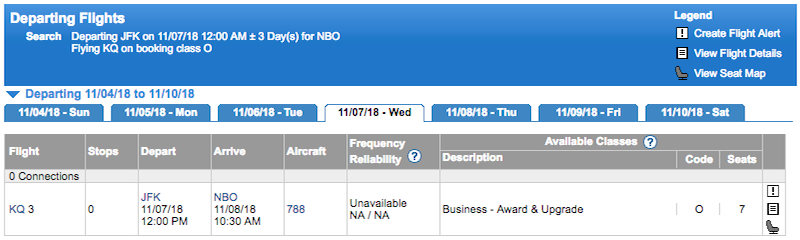
But in a situation like this, where an airline has loaded inventory in a certain fare class, long selling the space can be an option when the default search tools don’t return availability for whatever reason.
I think it’s important to note that unlike the old days, long-selling award space doesn’t avoid the computers that calculate the cost of an award or the taxes and fees. For some carriers it used to be the case that a reservation created or modified in a direct access system had to be manually priced, but now it seems that at many airlines that allow their agents direct access, agents can also go back and forth between the two systems.
So in those cases, a reservation can be built in their normal system, a segment added in direct access, then they can go back to the default system to calculate the final fare. This is why it sometimes works to create a reservation yourself for one segment of an itinerary, and then call in to get the additional segments added — it’s easier for some reason when the reservation has already been created.
Even if they can’t go back and forth, there are various backend checks in place, so you’re really not asking anyone to break rules, or trying to “get away with something.” Just encouraging agents to query award inventory in a different way.
And the partner can always say “no”, or the ticketing carrier can decide the segment in question isn’t allowed by their routing rules, or any other number of restrictions could keep the segment from being confirmed.
So this is a thing to try, not a guaranteed way to get award space you shouldn’t be able to have for whatever reason.
Tips for a successful long sell
It’s important to keep in mind that nowadays there usually aren’t any policies against long selling. There are often memos and such encouraging using the default interface, but I can’t think of any carriers off the top of my head that are expressly prohibiting their agents from directly accessing the reservation system.
And there is almost always a computer validating the fare and taxes, so it’s not like back in the U.S. Airways days where someone in Phoenix using a Cold War-era map was manually calculating the price of things, so you’re not asking anyone to break rules.
The downside of this is that there isn’t as much recourse to “computer says no” anymore, but you also shouldn’t feel like you’re getting away with something if you need to use this approach.
Of course, if an agent says “we’ve been told we can’t do that”, it’s best to thank them, and potentially move on and try to find another agent who interpreted that instruction differently.
Get yourself a chatty agent
This may not be strictly necessary, but I find it helps. The ideal reservations agent in this case either works for Aeroplan (they will usually long sell by default when necessary, without you even needing to ask them to), or likes to chat and think out loud.
Why does this help? Because if they want to talk as they’re working, you get more data points as to what they are doing, and if they are actually trying different things.
The worst kind of agents for this situation are the stoic silent types, and the ones who like to put you on hold while they work. Are they checking space? Are they getting errors? Did they set the phone down and go for a coffee?
You have no idea.
Be delightful
Not to generalize, but my experience over the years suggests that most airline agents have horrible work environments. The jobs themselves might be good overall, but the nature of how travel is sold and managed these days means the majority of people calling in are either frustrated, or don’t know how to use the internet. It has to be exhausting.
So, you can improve your odds of the agent even wanting to help you research by being exceptionally pleasant.
Think like, the-first-time-you-met-your-significant-other’s-parents levels of being pleasantly delightful and you should be good.
Know what you need, without being a know-it-all
This is a hard line to straddle. You need to be as specific as possible, without doing so in a way that annoys the agent (see above). I’ve written previously about how to talk to phone agents, so won’t rehash that here.
But you will want to make sure you have collected the following details:
- The flight number, including airline prefix
- Exact arrival and departure times
- Exact award inventory details, including the relevant fare code
You can’t just expect that an agent is going to use a system that is difficult and non-standard just for fun. Don’t bother with this if you don’t know inventory is available.
Long-selling Kenya Airways with Delta
So as an example, once I had found my chatty Delta agent, my approach was something like this:
“I’m trying to get this award ticket issued for my boss, and it’s on Kenya Airways, which I feel like is hard to work with? They don’t seem to show up on the website, and I think last time we booked a flight on them the agent had to go into some other system and manually access stuff?”
She thought about it for a moment, then responded with:
“Hmm, I don’t think I’ve booked them before, let me look it up.”
If you find an agent who is willing to look stuff up, you’ve likely already won. I suspect that none of the agents Ben spoke to looked at the instructions, because when my agent did she murmured “oh, it says it can be done in direct access, so that shouldn’t be too bad.”
We then went through the specific details of the flights, and she entered them into her system.
“It came back Confirmed, but this is odd…you asked for business class, right? It confirmed in economy, let me try again.”
“Okay, so KQ3, in O class…now we wait…economy again!”
And as much as Ben taking a Kenya Airways flight in economy would make for good Internet, it seemed worthwhile to keep at it.
“Sorry, I don’t know why it’s returning X rather than O. Let me try something else.”
Now, I don’t know exactly what she tried (and neither I nor you really need to), but the point here is that she was obviously familiar with the system, or looking at a set of instructions while doing this. Either will work.
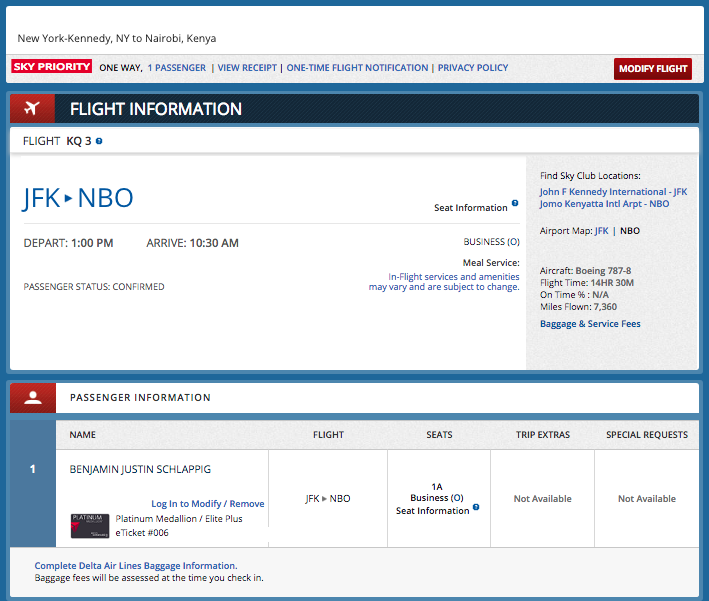
A few moments later, Kenya Airways confirmed the space, this time in business class! The system quickly calculated the mileage requirement and taxes, and the ticket was issued within minutes.
Easy peasy.
She was able to give me the Kenya Airways confirmation number, so I was able to verify that everything was correct in their systems as well (which you should aways do!), and everything was good to go.
Bottom line
It doesn’t always go this well, but this is ideally what the process would look like should you ever need to ask an agent to long sell award space for you. Which, you may never need to do. But at least now you should have a high-level overview of what is potentially involved.
And again — I am describing these systems without having seen them, so if you have more direct experiences feel free to share any additional details that you think might help folks. 🙂
What other questions do you have about this process?


Membership is free and takes no more information than commenting as a guest. Earn status points for good contributions, and see fewer ads as your status grows.