

Starlux Airlines is Taiwan’s newest global airline. While it launched operations in early 2020, the airline has really ramped up its network in the past few years, including increasingly flying across the Pacific.
In terms of service to the United States, the airline currently flies from Taipei (TPE) to Los Angeles (LAX), Ontario (ONT), Phoenix (PHX), San Francisco (SFO), and Seattle (SEA). The airline operates long haul service with its Airbus A350s, which feature a first class product.
Nowadays there aren’t many new airlines introducing an international first class product, so it’s cool to see Starlux offering this. However, the airline is taking an unconventional approach to this cabin. When the airline first launched long haul flights, I wrote about how the carrier’s first class strategy didn’t make much sense to me.
I want to address this topic once again, because years later, it still doesn’t make much sense to me, and I can’t figure out the economic justification for this strategy, especially with how few seats are selling!
Really I’m just writing about this because I desperately want to review Starlux first class, but can’t bring myself to pay the sticker price (to be clear, that’s not a request for a free flight, but instead, a request for the cabin to become a bit more accessible!). 😉
In this post:
Starlux Airlines’ modest A350 first class seats
Starlux Airlines offers special first & business class products on its Airbus A350s, which are primarily used for long haul flights (though also used on some intra-Asia flights). Starlux is the only airline in Taiwan to offer first class.
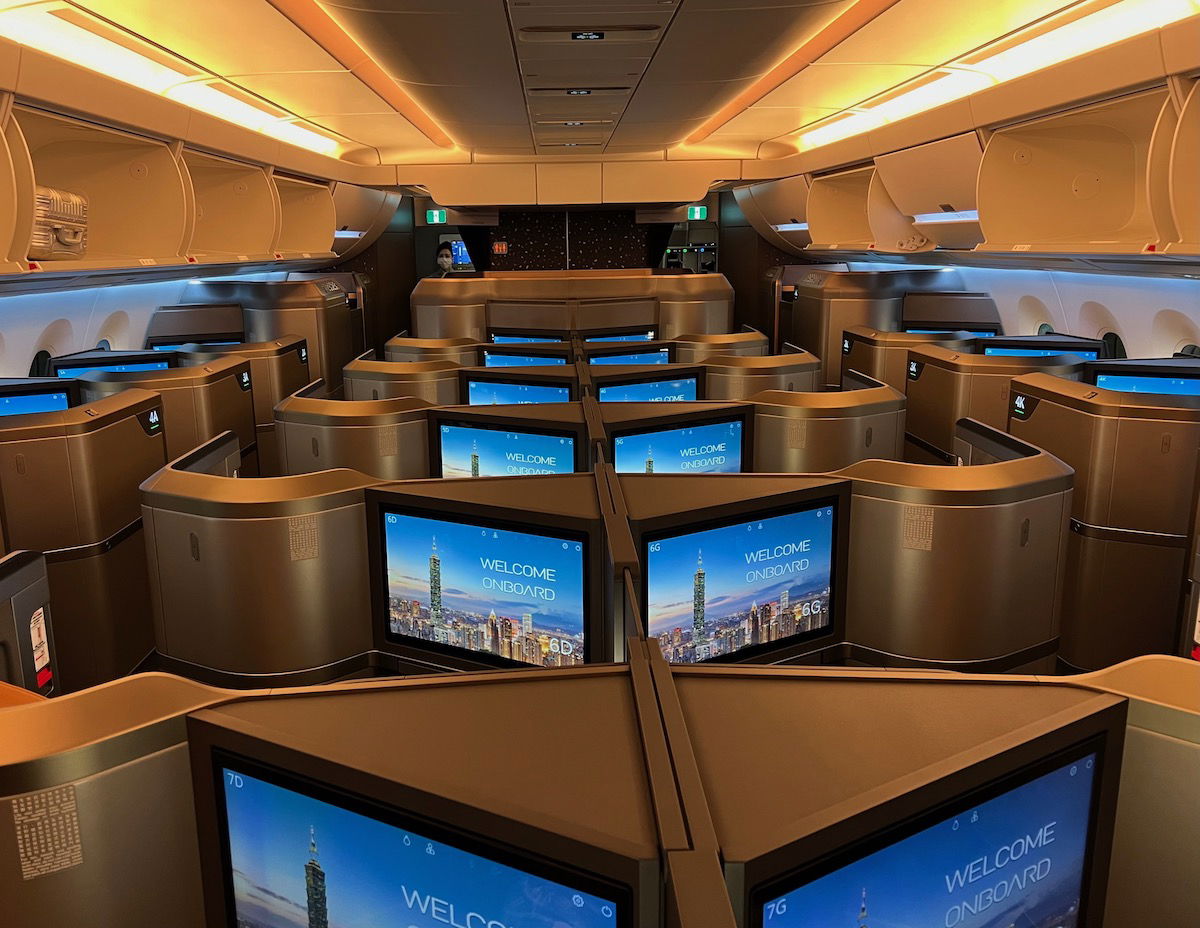
Starlux’s A350 first class cabin consists of just four seats, in a 1-2-1 configuration. Arguably it’s not even a separate cabin, as it’s simply the first row of business class, and there’s no curtain between first class and business class. The airline is known for incredible quality, so in that sense, many people were surprised that the airline didn’t go more over-the-top with its first class.
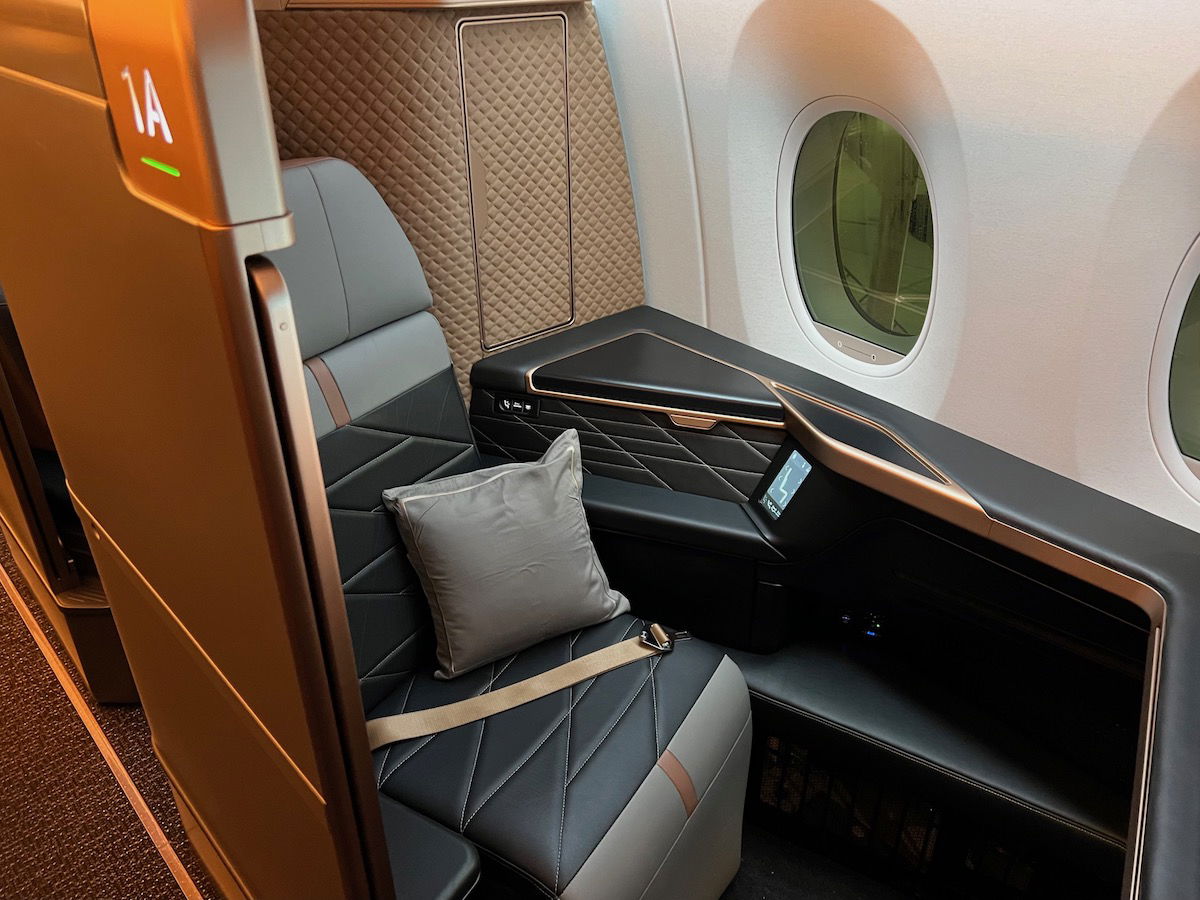
Based on the hard product, this almost seems like some of the “business class plus” seats we’ve seen introduced in recent years, like the United Polaris Studio, American Flagship Suite Preferred, etc. More than anything else, it efficiently utilizes the space at the bulkhead.
The seat has some useful features, like 60-inch doors and privacy partitions, 32-inch 4K screens with bluetooth audio, zero-gravity seat settings, and personal wardrobes for storing luggage. However, there’s no denying that the airline didn’t set out to create the world’s best first class hard product.
First and business class is exclusively between doors one and two, and on the A350-900, the airline managed to fit 30 seats in this space (four first class seats and 26 business class seats). As a point of comparison, Qatar Airways’ A350-900s with reverse herringbone seats have just 24 seats in that space (though there is a little bar at the back of the cabin).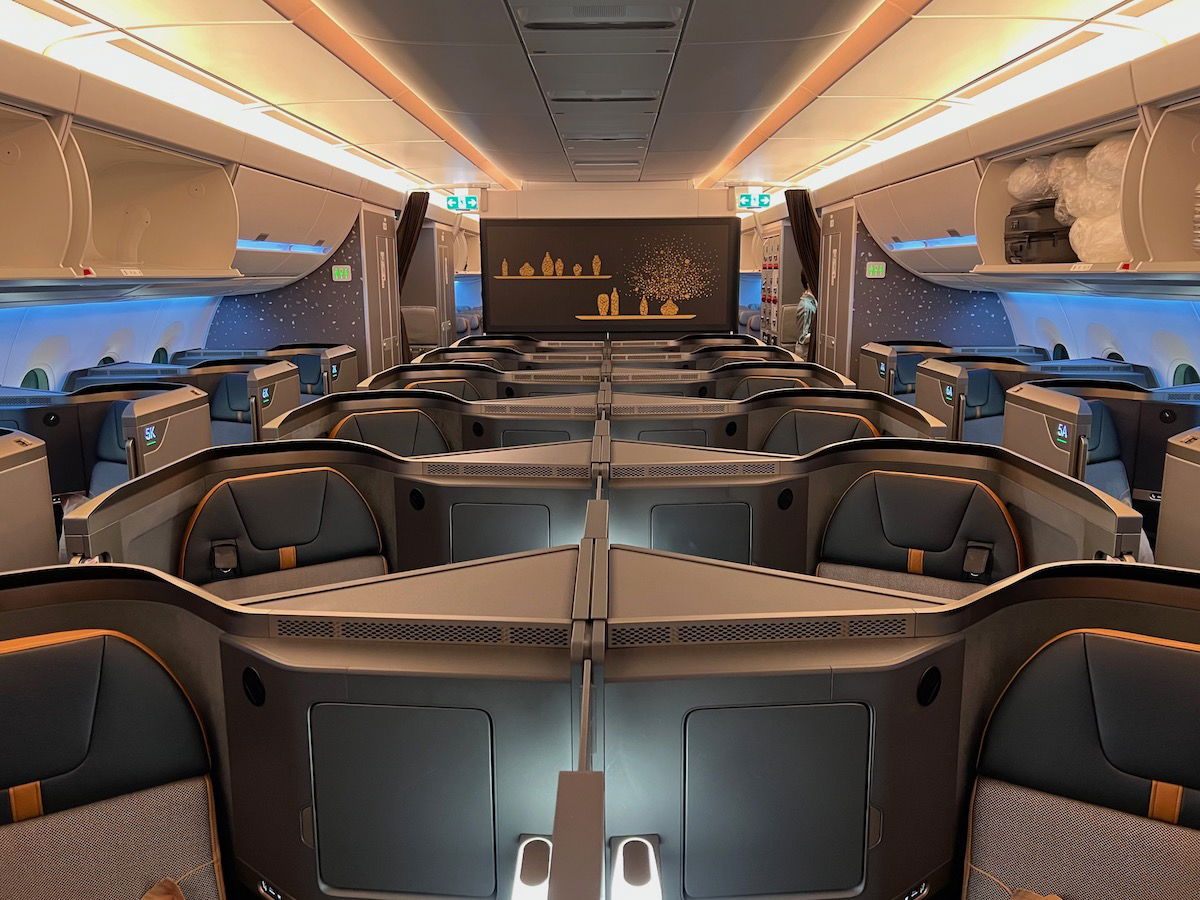
To be clear, I don’t think there’s anything wrong with introducing a first class product that’s incrementally better than business class, though you’d also hope that the price reflects that.
Starlux Airlines nicely invests in first class service
Starlux Airlines is known for its great soft product in all cabins, and that also extends to first class on the A350:
- In Taipei, Starlux first class passengers receive chauffeur service to and from the airport (TPE), plus receive access to the Huan Yu VIP Terminal
- In Los Angeles, Starlux first class passengers are able to use PS, the private suite that offers chauffeur service to and from the plane, allowing you to skip the terminal altogether; if you’re traveling alone you have access to The Salon (a shared space), while if you’re traveling with someone, you have access to The Suite (a private space)
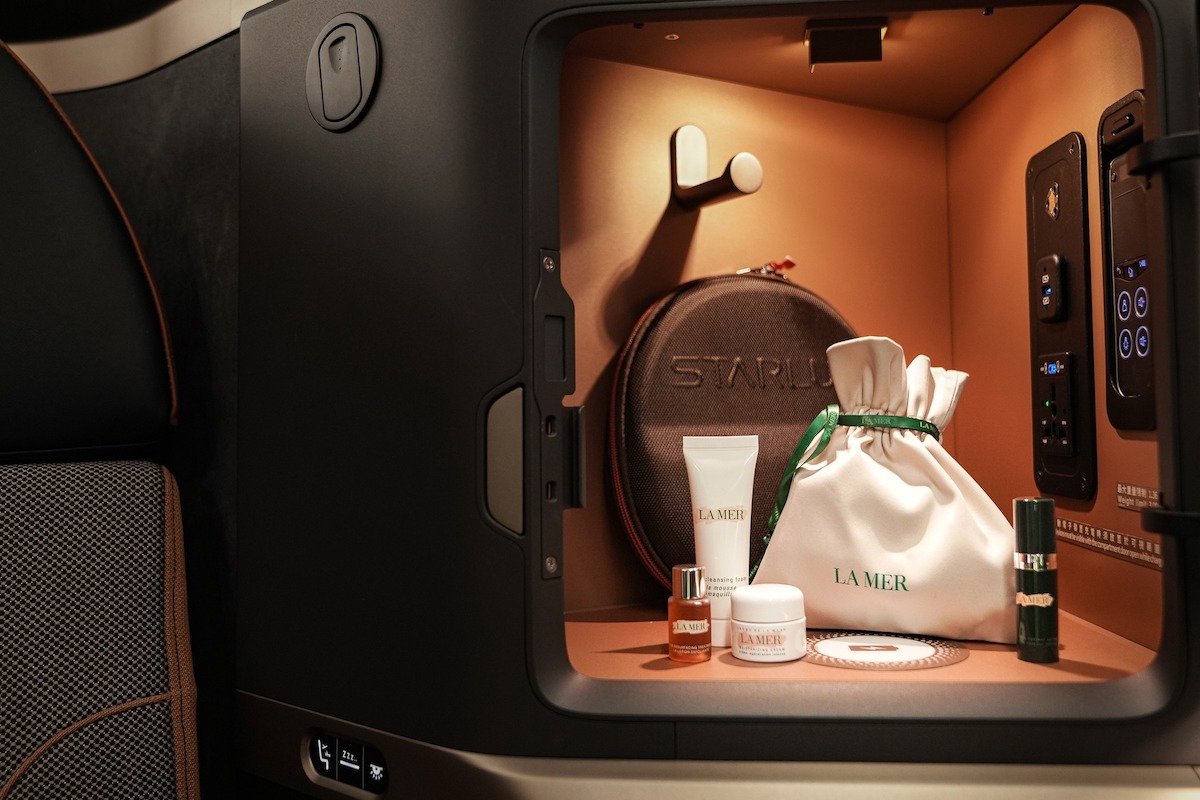
- Starlux has a great first class inflight service on long haul flights, with caviar, La Mer gifts, and more
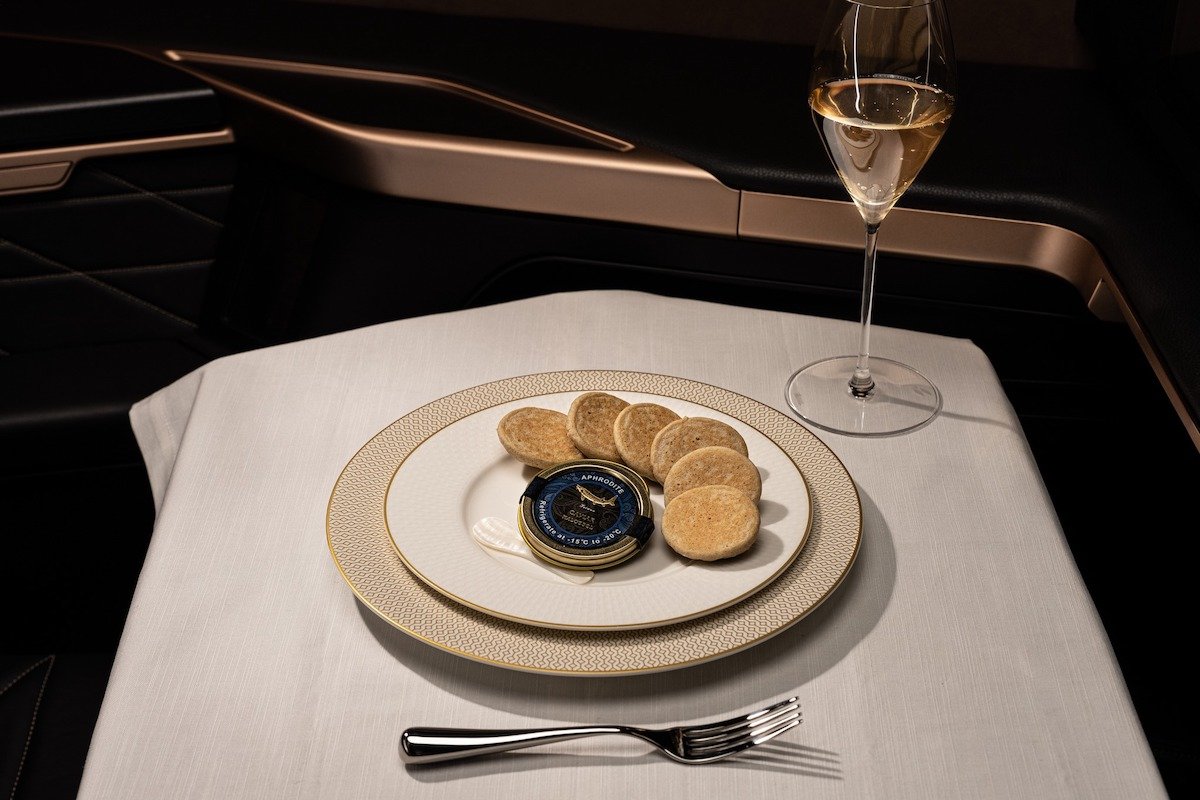
Starlux is definitely investing in its first class soft product both in the air and on the ground. Whether that makes up for the lack of separation from business class is more open to debate, though.
Starlux Airlines first class pricing is steep
When we first saw Starlux Airlines’ first class product, many of us assumed it would come at a reasonable premium over business class, since it’s not even in a fully separate cabin. That didn’t turn out to be the case, though. Ever since the product was launched, Starlux has maintained the same steep pricing for first class, typically around triple the price of business class.

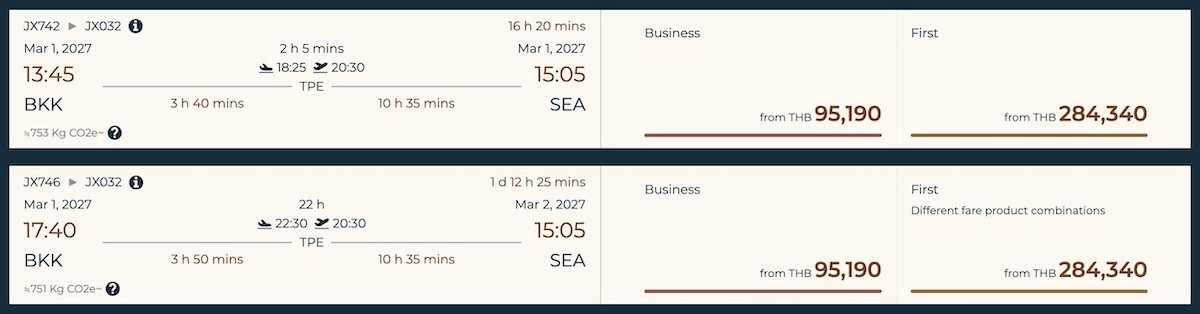
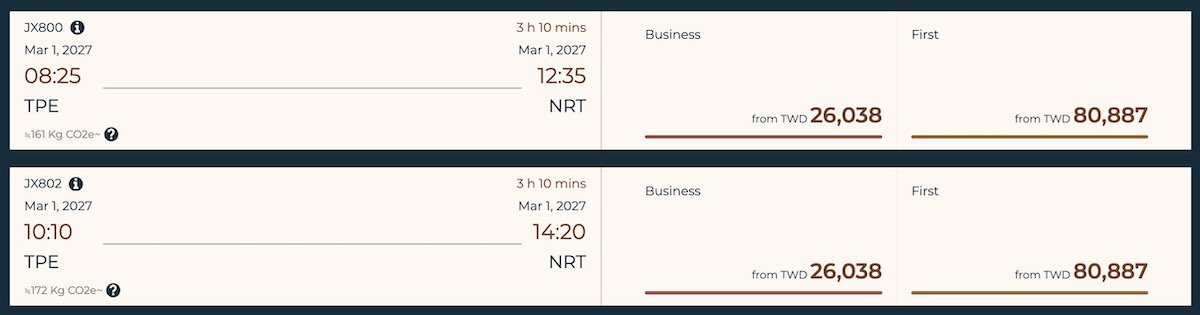
You won’t find a one-way transpacific first class fare that’s priced under $8,000 (at least not one that I’ve found). I should mention that Starlux also offers first class on some flights within Asia, and there you’ll typically find that the cabin is priced around $2,500 one-way. While this includes the full first class ground experience, the onboard soft product on these flights is scaled back considerably.
Admittedly lots of airlines have very high sticker prices for first class, but then there are ways to get a much better deal. However, most of those don’t apply here:
- Starlux Airlines offers limited opportunities to redeem miles for first class; it’s bookable through Starlux COSMILE, but I can’t imagine many people have huge balances with the program
- Fares aren’t considerably cheaper if connecting, as is often the case with other airlines
- I can’t imagine Starlux Airlines has many corporate contracts offering huge discounts to travelers, since the carrier doesn’t exactly have a global route network yet
- Many airlines will sell buy-ups to first class; though Starlux’s buy-up costs are ridiculously high; for example, at check-in you can typically buy a business class to first class upgrade across the Pacific for $5,000, which is basically the fare difference, and it doesn’t include the full soft product
At these fares, I can’t imagine Starlux will be able to consistently fill any substantial number of seats. Even with just four seats, you’re not going to regularly find people willing to pay these kinds of fares, in my opinion. Furthermore, while Taipei is an amazing city, it’s not Hong Kong or Singapore in terms of pricing power for tickets (quite to the contrary, people often originate travel in Taipei to get cheaper premium fares).
Is Starlux Airlines selling first class seats?
I’m completely open to the possibility that I just have no clue what I’m talking about, don’t understand first class demand levels in Taiwan, etc. Fortunately with the airline just having four first class seats in the cabin, it’s easy to look at how many seats have actually been sold.
I just quickly pulled up inventory for an upcoming six-week period, between April 12 and May 24, 2026. How many seats have been sold on the various US routes? Let’s look at a couple of markets, as an example:
- From Taipei to San Francisco, five of the 168 seats have been sold, representing a 3.0% load factor
- From San Francisco to Taipei, two of the 168 seats have been sold, representing a 1.2% load factor
- From Taipei to Seattle, four of the 168 seats have been sold, representing a 2.4% load factor
- From Seattle to Taipei, zero of the 168 seats have been sold, representing a 0% load factor
Admittedly some people book first class very last minute, but that’s… still not a lot of seats to sell. And I think when you haven’t sold a single seat on a route for the upcoming six weeks, something is fundamentally wrong with the monetization system, assuming the goal is actually to maximize revenue. Which brings me to my next point…
This product seems like it could be better monetized
It doesn’t seem like Starlux Airlines is having much luck selling its first class. Starlux’s transpacific business class product is very good, but first class is priced roughly three times as much, all while not even offering a fully separate cabin.
This cabin ultimately comes at a fairly limited opportunity cost, given that the airline has a total of 30 seats between doors one and two, consisting of first and business class. Other airlines fit the same number of business class seats into that space.
If Starlux wanted to maximize revenue, it seems like selling upgrades to first class would be the best way to do that. These transpacific flights are quite long, so say the airline tries to charge somewhere in the range of $1,000-1,500 to upgrade a business class ticket to first class, without the extra ground services. I’m sure that’s something that some people would take advantage of, and it certainly seems better than consistently letting those seats go out empty.
For that matter, maybe these should just be rebranded as a business class “plus” product, with the same business class service, but better seats.
It seems to me like Starlux’s CEO likes the idea of having a proper first class cabin, and it’s a point of pride. I totally respect that. But it also seems really unusual for an airline to leave incremental revenue opportunities on the table, the way that Starlux is doing, since I know the goal is for the airline to be as profitable as possible.
This brings me to my age-old Starlux conundrum
As I mentioned in the introduction to the post, I do have my motive for discussing Starlux first class. Starlux is one of only two airlines in the world I haven’t flown in first class, with the other being Air Côte d’Ivoire. I’m a bit of a completionist by nature, so I’d really like to review this experience.
However, I just can’t bring myself to actually book a ticket, one way or another:
- I guess the most “reasonable” option would be to book an intra-Asia flight, which gives you the full ground experience, and it only costs a fraction as much as a long haul flight; however, the soft product seems to be significantly scaled back, so I feel like it doesn’t give the full experience
- If I book a transpacific ticket with cash, it’ll literally be the most expensive first class ticket I’ve ever booked, even more than The Residence on Etihad’s A380 back in the day; I hate the idea of spending so much on a flight, only to expect that I’ll be disappointed (in terms of cost vs. experience)
I guess the thing is that I keep expecting that Starlux will eventually come to its senses and better monetize first class. I don’t want to spend a fortune on a Starlux first class ticket, only to then a week later have partner award tickets be upgradable for a reasonable sum of money (wouldn’t that be nice?). Heck, maybe Starlux will at least get into the business of selling miles, and then those miles can be purchased at a reasonable cost, and redeemed for first class.
I’m almost impressed by the degree to which Starlux ensures no one gets a good deal on a first class ticket. Even on the airlines known for having among the higher premium cabin pricing, I’ve always been able to get a deal by just strategically positioning myself and being patient.
So if anyone has any ideas for how to get a deal on a Starlux first class ticket, please let me know. I just have a hard time believing that there’s not something I’m missing!
Bottom line
Starlux Airlines has been nicely growing its transpacific network for some time, and it now operates five routes between Taipei and the United States. Starlux has an intimate first class cabin on its Airbus A350s, with just four seats. Oddly it’s not even separated from business class, but is just the first row of the cabin.
While the hard product probably won’t blow anyone away, the soft product seems to be very good, both in the air and on the ground. Then again, the carrier’s business class inflight product is very good as well.
It seems to me like Starlux is struggling to actually sell its first class seats, and I feel like the airline could pursue a better strategy to monetize the cabin. I continue to be puzzled by the approach the carrier is taking, as it has been this way for years now, and last I checked, the airline is intended to be for-profit, rather than a prestige project.
What do you make of Starlux Airlines’ first class strategy?




No need to write a review of a flight no one will ever take/no one ever takes. Save your money for something else.
Starlux Airlines offers first-class service within Asia on routes like Tokyo and Singapore, with tickets priced around USD 4,000–4,200.
The funny part? You used to get access to both the Galactic Lounge and Huan Yu VIP Terminal—but now it’s a “pick one” situation.
Cost-cutting move? Let’s just say… luxury now comes with a side of decision-making.
When it comes to corporate clients, this airline isn’t exactly in the same league as EVA Air or China Airlines
Some day, their network will expand to Cairo, and those fares will be reasonable. Oh what a conundrum you’ll be in…
Your calculation on load factor represents a certain vision of monetization of aircraft real estate. It's also interesting you don't report load factors to/from LAX.
Now if business class is never full, the airline isn't really losing money on first class, apart from the soft product fixed costs (amenities Lounge catering) that must cost something to be "on" all the time. When business class is getting full its fare increases and the trade up...
Your calculation on load factor represents a certain vision of monetization of aircraft real estate. It's also interesting you don't report load factors to/from LAX.
Now if business class is never full, the airline isn't really losing money on first class, apart from the soft product fixed costs (amenities Lounge catering) that must cost something to be "on" all the time. When business class is getting full its fare increases and the trade up price of first starts to make sense.
If they engineered the soft product well to have mostly variable costs and very little fixed costs, and they rarely sell out (not mile out or upgrade out) business class, it does not look like bad business to me.
Is it possible they are just overselling business class and filling these seats with full fare biz pax when no F seats are sold?
It would only take selling 1 F seat per flight to make their strategy worth it.
Starlux Airlines is widely considered a "revenge" project by founder K.W. Chang following his rather humiliating ousting from EVA Air, his family’s company, after his father's death. Having F class may be a part of the revenge, to show that his airline can go for it, but EVA won't...
@Tim Dumdum Ci and BR both had first class many years ago but they discontinued it. JX is not the first airline from Taiwan to offer first.
Dumdum is correct.
It's entire existence is a middle finger to the family.
His late father realize his half siblings are incompetent and left the groupbto him just to get taken away.
It's his way of saying I can still do better with an empty F cabin that you brothers can't even keep.
It’d be pretty typical for Starlux First class to be cancelled before you get the chance to fly it
On a recent Starlux Biz class award flight, the flight attendant told me that all business class passengers were not permitted to use the front restroom because there was a passenger in first class (she was in Seat 1A).
I think that was the only time I have seen someone is in first on my Starlux flights.
Hi Ben.
The main reason starlux has first class (an interview with the CEO) is due to the CEO wanted to have first class catering / amenities etc, and apparently according to him, it is not possible to get the top notch stuff without first class, no matter how good your biz product is.
So I am guessing he is using part of the stuff he get from first class and use it for biz class passengers. Just a guess, not sure if that make sense
I flew BKK-TPE-SFO on Starlux last month. My first leg was in first, the latter in business. This was booked by Qatar, replacing my original itinerary through Doha when those flights were cancelled.
Three of the four seats were occupied - two by my son and me, the third a buy up from Coach.
Stellar crew, far more efficient and friendly than the business leg. Outstanding offerings in food and drink, though we...
I flew BKK-TPE-SFO on Starlux last month. My first leg was in first, the latter in business. This was booked by Qatar, replacing my original itinerary through Doha when those flights were cancelled.
Three of the four seats were occupied - two by my son and me, the third a buy up from Coach.
Stellar crew, far more efficient and friendly than the business leg. Outstanding offerings in food and drink, though we didn’t partake much as this was a late flight. What I remember most was the Loro Piana blanket that I desperately wanted to fall into my carry on bag, but no such luck.
Our departure from BKK was from the new terminal, a trek from check in but not horrible. The lounge was fine but not memorable.
I did love the buggy pick up in Taipei, but I may be an outlier here - I do not love the Galactic Lounge. I think it’s kind of goofy, really.
It was interesting, flying our first leg in F, then business home. Even though there’s little difference in appearance between the two classes, there is. All was better on the first flight in terms of food, drink, service, amenities. It’s a pity it’s so expensive to upgrade. Not going to happen with me, but I wish it would.
"Our departure from BKK was from the new terminal" --- What are you talking about ? The new SAT terminal is steps to the train and you are there.... If you go any of the older connected landside gates, you have to walk and walk and walk
I also agree with you about the Galactic Lounge. It’s not particularly competitive—adequate for a domestic lounge, but not for long-haul business class. The lower level lacks natural light and can only be accessed via a long staircase, which is quite dicey when trying to carry carry-on luggage, especially as there is no lift.
The hard product in business class is fantastic but the soft product is very inconsistent (both food and service). On...
I also agree with you about the Galactic Lounge. It’s not particularly competitive—adequate for a domestic lounge, but not for long-haul business class. The lower level lacks natural light and can only be accessed via a long staircase, which is quite dicey when trying to carry carry-on luggage, especially as there is no lift.
The hard product in business class is fantastic but the soft product is very inconsistent (both food and service). On two of the flights I took, the crew were merely on par with what I would expect from a US carrier.
In b4 broke ass Yolo tells you to “lol just buy it”
Lol just buy it
My guess - this is intentional and not supposed to be monetized. I suspect these seats are typically for the Govt officials/elite wealthy/Starlux Owner/C suite people and the cabin is there to keep them separate from the corporate plebs.
They could also be utilized as crew rests for pilots when (most of the time) unoccupied, assuming they don't have enough crew rest installed above.
As crew rest. LOL. Like the (male) pursers on Saudia?