
The “big three” US carriers make a large percentage of profits from their loyalty programs, and in particular, their lucrative co-brand credit card agreements. As part of this, we’re increasingly seeing airlines offer ways to earn elite status through credit card spending.
American Express and Delta have a portfolio of co-branded credit cards, and under the current program, it’s possible to earn SkyMiles Medallion elite status either partly or entirely through credit card spending. This is an area where Delta has followed American, as the AAdvantage’s Loyalty Points system lets you earn AAdvantage elite status with credit card spending.

In this post, I want to take a closer look at how credit card spending counts toward status, and talk about whether it’s worth it.
Delta SkyMiles Medallion status requirements
Delta SkyMiles has four published Medallion elite tiers (in addition to Delta 360), with the following annual qualification requirements, all based on how many Medallion Qualifying Dollars (MQDs) you rack up:
- Delta Silver Medallion elite status requires 5,000 MQDs
- Delta Gold Medallion elite status requires 10,000 MQDs
- Delta Platinum Medallion elite status requires 15,000 MQDs
- Delta Diamond Medallion elite status requires 28,000 MQDs
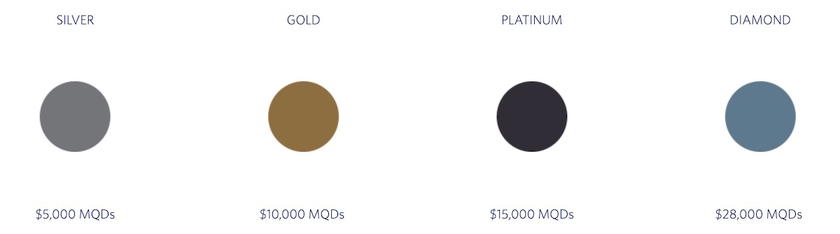
Nowadays MQDs are the only metric by which members qualify for status. It doesn’t matter how many miles or segments you earn, but rather MQDs are what matter. The primary way to earn MQDs is supposed to be through flying, and you earn one MQD per dollar spent on airfare, before taxes and fees. However, you can also earn MQDs with credit cards.

How credit card spending counts toward Delta elite status
It’s possible to earn Delta SkyMiles MQDs with Delta’s four most premium credit cards. The earnings rates depend on which card you have, as follows:
- The Delta SkyMiles® Platinum American Express Card (review) and Delta SkyMiles® Platinum Business American Express Card (review) earn one MQD for every $20 spent
- The Delta SkyMiles® Reserve American Express Card (review) and Delta SkyMiles® Reserve Business American Express Card (review) earn one MQD for every $10 spent
There’s no limit to how many MQDs you can earn with these cards. Obviously there’s a significant advantage to using the Delta Reserve Card rather than the Delta Platinum Card, since the earnings rates toward status are double as good.
In addition to the rewards for ongoing spending, you also get a headstart each year, in the form of an MQD boost just for being a cardmember. For each of the above cards you have, you receive 2,500 MQDs toward status. You could potentially earn that boost on each of the four cards, for up to 10,000 MQDs.
Just to do the basic math, assuming you have just one card (and get a headstart of 2,500 MQDs), you could earn Silver Medallion status with $25,000-50,000 in credit card spending, or Diamond Medallion status with $255,000-510,000 in spending. Those numbers go down a bit if you have multiple cards.

Opportunity cost of Delta credit card spending
Is there merit to spending $25,000 to $255,000 per year on a Delta credit card to qualify for one of these status tiers? Let me crunch some numbers, based on my valuation of points:
- Delta SkyMiles are worth 1.1 cents each
- Points with the major transferable currencies are worth 1.7 cents each
Assuming you’re spending in a non-bonused category (which would generally have the lowest opportunity cost, compared to dining, groceries, or gas, for example):
- You could be earning 1x Delta SkyMiles per dollar spent, which I value at a 1.1% return
- You could be earning up to 2x transferable points on some other cards, which I value at a 3.4% return
Specifically, you could earn 2x transferable points with the following cards:
- The Capital One Venture X Rewards Credit Card (review) offers 2x Capital One miles per dollar spent, with no caps
- The Capital One Venture Rewards Credit Card (review) offers 2x Capital One miles per dollar spent, with no caps
- The Capital One Venture X Business (review) offers 2x Capital One miles per dollar spent, with no caps
- The Citi Double Cash® Card (review) offers 2x ThankYou points per dollar spent, in conjunction with the Citi Strata Premier® Card (review)
- The Blue Business® Plus Credit Card from American Express (review) offers 2x Membership Rewards points on the first $50,000 spent every calendar year (and then 1x points)
Now, people may have different valuations of points currencies, and that’s fine, as you can adjust the math accordingly. But by my math, the opportunity cost of using a co-branded Delta credit card is ~2.3%.
In other words, spending $255,000 on a Delta credit card (which would outright earn you Diamond status, factoring in the headstart) would “cost” you $5,865, not factoring in annual fees.
Even those who mostly earn Delta status through credit card spending are probably at least partly earning status through actually flying, and are using some sort of a hybrid approach. After all, Delta even counts award flights toward elite status. For example, redeeming 250,000 SkyMiles per year would net you 2,500 MQDs.

Is it worth pursuing Delta elite status this way?
Now that we’ve covered the amount of effort that it takes to earn Delta SkyMiles elite status through credit card spending, I think the logical question is whether it’s worth it. For example, if you go for Diamond status, what are the benefits, really?
- You get unlimited complimentary first class upgrades within North America; the catch is that Delta sells a vast majority of first class seats, so actually getting upgraded isn’t easy
- There are some lounge access perks, though nowadays there are many ways to access to Delta Sky Club®
- You get SkyTeam Elite Plus status, which gets you recognition across the SkyTeam alliance
- You can take advantage of the Delta Choice Benefits program, whereby you can unlock additional perks, like confirmed upgrades, which is where upgrade value really comes in handy
Personally I’d struggle to make the math work on the value proposition of this. The exception is if you’re a frequent Delta flyer, and you make it most of the way to status without credit card spending, and simply use cards to top off MQD total. If you usually find a way to fly in a premium cabin, there aren’t many incremental perks to having elite status, really.
Bottom line
Nowadays Delta SkyMiles Medallion status is earned based on how many MQDs members rack up. You can earn one MQD per dollar spent with Delta, or one MQD per $10-20 spent on select Delta credit cards. On top of that, you get a headstart of 2,500 MQDs each year just for having an eligible card. This means it’s possible to earn Diamond status exclusively through credit card spending, if you put at least $255,000 of spending on the card.
If you want to earn Delta SkyMiles Medallion status, then the Delta SkyMiles® Reserve American Express Card and Delta SkyMiles® Reserve Business American Express Card are the cards you should be considering.
Now, whether it’s worth it or not is a different story. Personally I think there’s less value to airline elite status than in the past, and I’d only consider doing this if you’ve crunched the numbers and are sure the math works out.
What’s your take on spending to earn Delta SkyMiles Medallion status?


Membership is free and takes no more information than commenting as a guest. Earn status points for good contributions, and see fewer ads as your status grows.