Boeing 737 MAX 10 Launches With Little Fanfare

Usually an aircraft manufacturer debuting a new plane type is big news, though that’s not the case for Boeing today.

Boeing Launches The 737 MAX 10

Boeing has today very quietly debuted the brand new 737 MAX 10 at their facility in Renton, Washington. While these kinds of events are usually full of media, in this case it seemed to be more of an employee event, intended to highlight their accomplishments and recognize the efforts of teams that went into the production of this plane.
Mark Jenks, Boeing’s VP and GM of the 737 program, had the following to say:

“Today is not just about a new airplane. It’s about the people who design, build and support it. This team’s relentless focus on safety and quality shows the commitment we have to our airline customers and every person who flies on a Boeing airplane.”

The Boeing 737 MAX 10 currently has more than 550 orders from more than 20 airlines around the globe, though go figure the plane can’t actually fly.

What Is The Boeing 737 MAX 10?

The Boeing 737 MAX 10 is the third and largest variant of the 737 MAX family, following the debut of the 737 MAX 8 and 737 MAX 9.

Just to compare the stats of the 737 MAX variants:
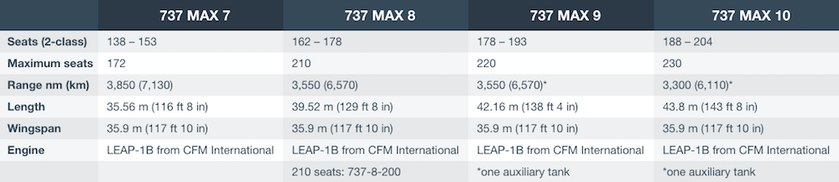
As you can see, the 737 MAX 10 is the highest capacity but also the shortest range variant of the MAX family. The plane can seat up to 230 people and has a range of up to 3,300 nautical miles. Boeing claims that the plane has the lowest seat-mile cost of any single-aisle airplane ever produced.

United is the biggest customer of the 737 MAX 10, with 100 of the planes on order. Flydubai, Lion Air, and VietJet Air, all have more than 50 of the planes on order as well.

It was created as a response to the Airbus A321neo. The catch is that unlike with the A321neo, there are no longer range versions than the MAX 10. Airbus has continued to build on the A321neo, with the introduction of the A321LR, and then in a few years the introduction of the A321XLR. There’s no such evolution expected with the 737 MAX 10.

Bottom Line

Boeing has formally launched the 737 MAX 10, which is the largest and shortest range variant of the 737 MAX 10. Unfortunately the plane can’t enter commercial service yet, and it’s anyone’s guess when that will actually happen (Boeing is aiming for early next year).

though the plane can’t actually enter commercial service for now. It’s anyone’s guess when the 737 MAX will be back in the skies (they’re aiming for early next year).

A lot of people worked very hard on this plane, though obviously it’s kind of sad to have a launch happen like this…

Conversations (65)
The comments on this page have not been provided, reviewed, approved or otherwise endorsed by any advertiser, and it is not an advertiser's responsibility to ensure posts and/or questions are answered.
Comment as a member

Membership is free and takes no more information than commenting as a guest. Earn status points for good contributions, and see fewer ads as your status grows.

Type your response here.

If you'd like to participate in the discussion, please adhere to our commenting guidelines. Anyone can comment, and your email address will not be published. Register to save your unique username and earn special OMAAT reputation perks!

  1. Loading comments…
Recent Comments
The latest from the OMAAT community.

The comments on this page have not been provided, reviewed, approved or otherwise endorsed by any advertiser, and it is not an advertiser's responsibility to ensure posts and/or questions are answered.

BillC Gold

@Jupiter -- "…and Boeing did not think it appropriate to alert all MAX operators about the MCAS malfunction incidences? Maybe their engineers overestimated their abilities?" -- I think that the entire Boeing internal blame goes toward the 737-MAX program management chain, since there were many instances where Engineering <i>did</i> alert and complain about how certain aspects of the MCAS system architecture and implementation were inadequately considerate of failure/recovery scenarios ... but program management over-ruled those complaints, and that ultimately resulted in the unfortunate crashes. Apparently this type of situation happens much too often -- when GE designed the nuclear reactors for Japan's Fukushima nuclear power plant, something like 5 design engineers actually quit in protest over how their management was disregarding safety concerns with the design that ended up failing and creating the nuclear crises at Fukushima after their huge earthquake and ensuing tsunami flooding!

0
‼ 0
Jupiter Guest

...and Boeing did not think it appropriate to alert all MAX operators about the MCAS malfunction incidences? Maybe their engineers overestimated their abilities?

0
‼ 0
BillC Gold

@Pogonation -- "I find your comments interesting. However in order to give credibility to your posts I would like to know which university you went to (the best in the world one), and the names of the 8 high tech engineering companies you set up." -- Well ... you can Google what the top engineering school in the world has been for decades running (hint -- it's located in the eastern half of USA) ... as for your statement about my having "set up" 8 high tech engineering companies, please go back and read my post again, as to what I <i>actually</i> said ... unfortunately, I'm not at liberty to discuss most of those startups (some of which I <i>did</i> found), but just to give you an idea, one of those where I was a key player participated in the IBM-compatible PC arena ... I'm not really interested to self-doxx here, so this is all that I can reveal!

0
‼ 0
Pogonation Guest

@BillC I have enjoyed reading through all your posts. I am personally in the party that won’t be happy flying the new MAX until they have been flying a decent number of frames for 1-2 years. I find your comments interesting. However in order to give credibility to your posts I would like to know which university you went to (the best in the world one), and the names of the 8 high tech engineering companies you set up.

0
‼ 0
BillC Gold

@Owen -- "So yall instead target their geopolitics of the not being part of the 1st-world being Southeast Asia and Africa?" -- Who ever said that Boeing did <i>not</i> share any blame? In its initial production version of MCAS, Boeing screwed up the <i>Implementation</i> of a long validated and practiced <i>Concept</i> of using software within the aircraft system's control feedback loop ... Boeing also neglected to use the full hardware potentials present in the product (eg, relying on just one AOA sensor at a time when two were available, etc) ... these are all well-known issues and are being "fixed" in order for re-certification to take place ... Additionally, Boeing did make a bad presumption about requiring MCAS to be exposed to pilots, since it was trying to forego requirements to re-qualify pilots for the MAX beyond the NG series. Airbus had successfully accomplished this "common cockpit" concept, but Boeing screwed up their efforts on the MAX ... As for the cockpit crews, did you read my prior post about this? The Final Investigation Report on the Lion Air crash dished out plenty of blame to go around (Boeing and FAA included) -- but it also focused on the fact that the co-pilot had inadequate flight experience to properly help the pilot handle such an anomalous situation that resulted in a (very unfortunate) crash ... it reported that, when the pilot handed control of the aircraft to the co-pilot, in order to attend to another matter, the co-pilot had <i>no idea</i> of what to do in order to properly sustain the anomalous flight behavior on his own ... furthermore, the same issue of training and experience was also found with the co-pilot on the Ethiopian Air crash ... It turns out that SE Asia and Africa suffer from shortages of sufficiently experienced airline pilots and some airlines, therefore, will put co-pilots into revenue flights with inadequate training and experience, unlike in other regions such as Australia, North Asia, North America, Europe, etc. Just compare the minimum number of flying hours' experience required to qualify as co-pilot in SE Asia and Africa vs. those other regions to see the contrasts! Just from an operational standpoint, while there have been several anomalous behavior with MCAS over its almost two years of revenue operations before the two crashes, all previous incidents were able to successfully recover, presumably because those co-pilots were able to properly assist in their recovery efforts (among many other reasons)! So it's <i>not</i> that anyone is intentionally stereotyping SE Asia and Africa, but the past circumstances were what they were ...

0
‼ 0

Save posts to read later

Saving posts is a member feature. Become an OMAAT member to build a reading list you can come back to from any device.

Become a member
Meet Ben Schlappig, OMAAT Founder
5,883,136 Miles Traveled

43,914,800 Words Written

47,187 Posts Published