Airbus’ Surprising Plan For Operating World’s Longest Flight

A couple of months ago there were rumors of Airbus developing the A350-1000ULR, though it looks like the aircraft manufacturer has a different plan.

Airbus & Boeing Competing For “Project Sunrise”

Qantas wants to launch the world’s longest flights, nonstop from Melbourne and Sydney to London and New York. This is known as “Project Sunrise,” and they’ve asked both Airbus and Boeing to submit their proposals for planes that could operate these 10,000+ mile flights nonstop.
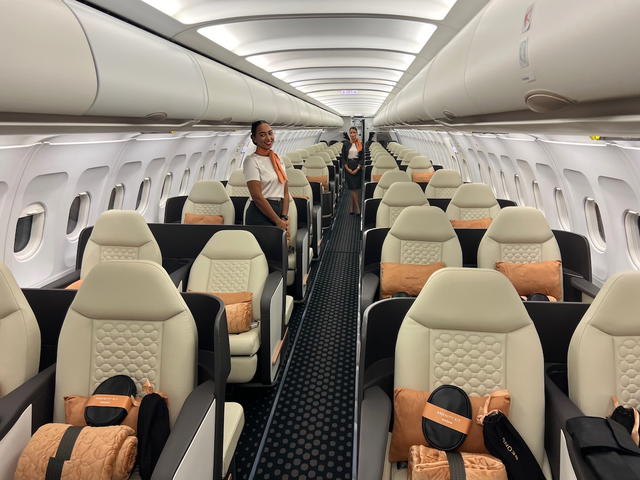
Currently the world’s longest range aircraft is the A350-900ULR. This plane is exclusively operated by Singapore Airlines, on their routes from Singapore to Newark, Los Angeles, and San Francisco.

Based on what we’ve known up until now:

  • Airbus’ proposal would involve some sort of a modified version of the A350
  • Boeing’s proposal would involve some sort of a modified version of the 777X

Airbus had even confirmed over the summer that they had a concept capable of meeting Qantas’ needs, and a bit after that there were rumors that they had developed an A350-1000ULR. This would essentially be the standard size of the A350-1000, but it would have a higher takeoff weight and more fuel tanks, just as Airbus did with the A350-900ULR.

Well, it would appear that this is no longer their plan.

Airbus To Improve The A350-1000

Runway Girl Network is reporting that Airbus’ latest proposal to Qantas for their Project Sunrise flights will be… the A350-1000. That’s right, not the A350-1000ULR, or anything else, but rather the standard A350-1000.

How is that possible? Well, over the lifetime of an aircraft it’s normal for improvements to be made that can improve the efficiency of it.

By making minor improvements, Airbus thinks they can increase the range of the A350-1000 from 8,000nm to 8,700nm by 2022.  This is for a configuration that seats about 375 people.

This additional range would be possible thanks to an increased maximum takeoff weight, which would create an incredibly versatile aircraft — the extra weight could be used either to increase the cargo capacity, or could be used to increase fuel. There wouldn’t need to be any extra fuel tanks.

Is That Enough, Though?

It’s pretty impressive that Airbus plans to increase the range of the A350-1000 by 700nm, which will make this an even more spectacular plane. However, is that enough to meet Qantas’ needs?

Some Project Sunrise flights would cover a distance of 10,500+ miles, which is 9,100+ nautical miles. As you can tell, that’s above the range of the plane. You also have to factor in the headwinds that they will face on westbound flights (from New York to Sydney and from Sydney to London).

The catch is that the 8,700nm range is based on 375 seats, and Qantas will likely have a much more premium-heavy configuration. So with fewer passengers the plane would also have increased range. That being said, would the increase in range from that be significant enough to mean that the plane could fly nonstop in headwinds without a major payload restriction?

It makes you wonder just how sparse of a configuration Qantas will choose. For example, Qantas’ 787-9s have just 236 seats, while other airlines, like Air Canada have 298 seats on their 787-9s (and Air Canada also has a three cabin configuration — some airlines, like TUI, have 345 seats).
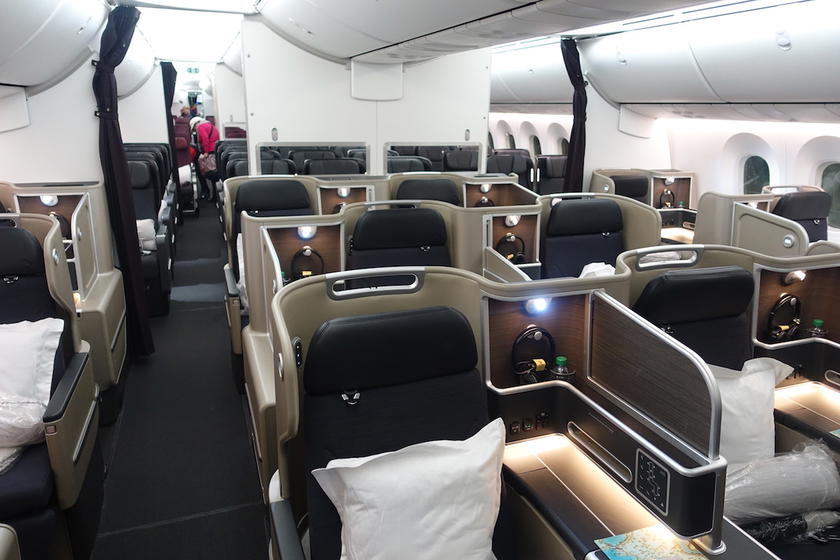
Qantas’ 787 business class

If Qantas “only” puts 280-300 seats on the A350-1000, would that add enough range to make these routes feasible?

Bottom Line

I’m even more curious than before to see how the Airbus and Boeing Project Sunrise proposals go. While the proposed improvements to the A350-1000 sure are impressive, it’s questionable if the plane would fully meet Qantas’ demands, even with a less dense configuration.

That being said, one huge benefit of this would be how versatile the plane could be — it could efficiently fly from Sydney to New York, and could also efficiently operate shorter flights in premium markets (whether to Hong Kong or Tokyo or Singapore) with incredible cargo capacity.

Generally if you’re creating a ULR aircraft with extra fuel tanks there’s an opportunity cost to that on shorter flights, but that wouldn’t be the case here.

Conversations (27)
The comments on this page have not been provided, reviewed, approved or otherwise endorsed by any advertiser, and it is not an advertiser's responsibility to ensure posts and/or questions are answered.
Comment as a member

Membership is free and takes no more information than commenting as a guest. Earn status points for good contributions, and see fewer ads as your status grows.

Type your response here.

If you'd like to participate in the discussion, please adhere to our commenting guidelines. Anyone can comment, and your email address will not be published. Register to save your unique username and earn special OMAAT reputation perks!

  1. Loading comments…
Recent Comments
The latest from the OMAAT community.

The comments on this page have not been provided, reviewed, approved or otherwise endorsed by any advertiser, and it is not an advertiser's responsibility to ensure posts and/or questions are answered.

Nate Dogg Guest

@ Eskimo I actually explained the fuel consumption figures that have come back from both Qatar and Cathay using their A35K's. Airbus themselves sent the A35K on a round the World tour to get route proving figures also. As you can see, allowing a 135kg allowance per pax doesn't mean that is fully used. It is allowing for every pax at 95kg, baggage, food and beverages and sanitary water. That is never going to be the case so the weight and baggage of the 2 crews on board is accepted into this allowance. You need to remember also that the construction of the A350 also allows a higher cruise altitude. There is less likely to be strong headwinds but just in case, there is 12T of 'unused' fuel factored into this as well as the unused 6T of the MTOW allowance. So in any instance if Airbus decided to put a 5T additional fuel tank in the hold, they would get an extra hour in the air. With no headwinds, a 300 pax A35K at 321T MTOW actually has legs to do 22hrs with no aggro. Are we going to assume that every pax is using up their 135kg allowance and that the aircraft is going to get hammered by headwinds adding 3hrs to the trip? It is very highly unlikely. Airbus have a track record of under selling the capabilities of their aircraft and Boeing over selling. People are now going to see why Boeing have announced a delay to the 777-8. Nothing to do with the engine aggro. It is technically obsolete before it has been built when up against the 321T A35K. That is why Airbus are basically just offering the stock standard A35K to Qantas. It does the job that Qantas asked under Project Sunrise and Airbus massively understated its capabilities.

0
‼ 0
Eskimo Guest

@Nate Dogg Quite insightful. Again like I said, the problem is only actual operations can confirm those numbers and there are no actual ultra long haul operations yet. Same happen to the 787 when they first operate, Boeing oversold its efficiency. TBH, if you go look at the 'numbers' for the heavier A340-500. It could have easily be flying 250+ pax SYD-JFK. Oh and apparently your A350 is flying in a planet with no winds, and it doesn't need any crew, !!!! :)

0
‼ 0
dalo Guest

I'm impressed! Thanks for providing this information.

0
‼ 0
Nate Dogg Guest

From my own understanding of what Alan Joyce has asked of Airbus, he wanted 300 seats. The current stock standard A350-1000 has a "given" range of 16100km / 10000 miles. The mods in the pipeline are a 5T MTOW jump from 316T to 321T. At initial stages of flight the A35K is burning 6.4T fuel per hour and at the latter stages of a flight of almost max range, the aircraft would be some 100T+ lighter and thus burning about 4.4T per hour. The tanks already have a 124.5T capacity for fuel. By having 300 pax on board they calculate the assumed pax weight, baggage, food and sanitary water provision at around 135kg per passenger. This is effectively knocking 10T off the passenger load. The operating weight empty is 155T. If you add 300 pax and assume 135kg per pax allowance, you arrive at 40.5T giving a zero fuel weight of 190.5T. That allows for a max fuel load of 124.5T and arriving at 315T. With 124.5T of fuel, the A35K flies further than everyone actually realises. If you allowed 120T of that fuel for a journey and are burning 6.4T per hour in early flight and 4.4 T at the end, that averages at 5.4T per hour over the flight. So to fly for 20hrs that aircraft will burn 108T. The A35k will quite easily cover LHR-SYD in about 19hrs. And that is before you factor the unused 12T of fuel (without the 4.5T fuel reserve) and the 6T of unused MTOW. The figures show a 300 pax A35K in current config with 321T MTOW will absolutely nail the route with enough in reserve to cover an extra 2 hrs of headwinds and with 5T of cargo thrown in. That is why Airbus don't really need to call it a ULR. It ALREADY IS A ULR!!!

0
‼ 0
David S Gold

Do not forget that any direct JFK service would also mean the end of the LAX-JFK connector (QF11) and the costs that were involved in running that nightmare. Qantas was able to reduce some fuel and staffing costs by using the 787 but it is pretty clear that premium passengers are willing to pay for direct one airline service to New York. The NYSE express will happen. If AJ can return the long range economy configuation to 34" pitch, he may just be able to convince the leisure market to pay extra to sit in the back of this bus.

0
‼ 0

Save posts to read later

Saving posts is a member feature. Become an OMAAT member to build a reading list you can come back to from any device.

Become a member
Meet Ben Schlappig, OMAAT Founder
5,883,136 Miles Traveled

43,914,800 Words Written

47,187 Posts Published