
Earlier I wrote about how Qatar Airways added a new $100 per segment surcharge for those booked in their excellent Qsuites business class product. Unfortunately it looks like that’s not the only new or increased surcharge we should expect from Qatar Airways in the near future.
Increased fuel surcharges coming to Qatar Airways?
Business Traveller had an interview with Qatar Airways’ CEO, Akbar Al Baker, in Doha this week. During this he made some interesting comments regarding fuel surcharges:
The surcharges, which were introduced as the price of oil rose from $30 per barrel up to a peak of up to $147, added several hundred pounds to the cost of long haul tickets. Now, according to the Chief Executive Officer of the Qatar Airways Group, Akbar Al Baker, they will soon make an unwelcome reappearance when booking flights.
Al Baker said that “As the oil price rises, we will start imposing a fuel surcharge like we used to do when it was high before.”
He defended the practice, pointing out that “When the oil price went through the roof our ticket prices only went nominally up with the surcharge for the fuel. The fuel prices went from 50 to 120 dollars but the ticket prices didn’t go up by two and a half times.”
First let’s do some fact checking here, and then we’ll talk a bit about his defense of the practice.
Qatar Airways *does* impose fuel surcharges
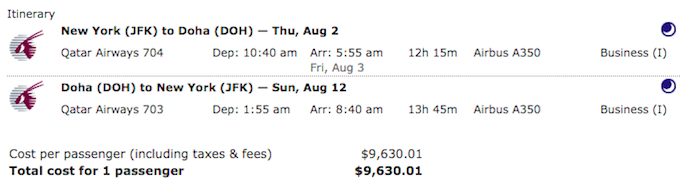
I’m not sure if Al Baker is confused, or what, but Qatar Airways does already impose significant fuel surcharges on the cost of tickets, and they have for as long as I can remember. For example, take the below ticket between New York and Doha in business class:
There’s over $1,200 in fuel surcharges on that ticket:
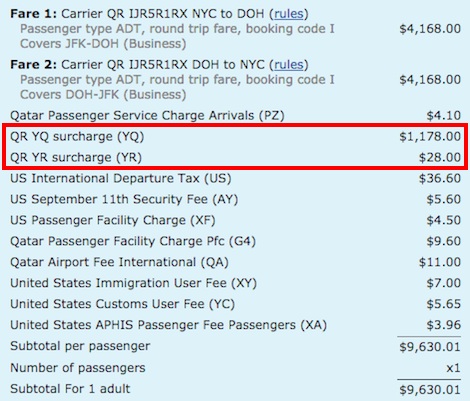
I’m not sure if Al Baker is confused about how fares are structured at his airline, or if he’s suggesting that surcharges will go up even more, but regardless, something isn’t right here.
The incorrect defense of fuel surcharges
What irks me is the way that airline executives defend these fuel surcharges, and it’s not just Al Baker who does that. Let’s look at his justification:
“When the oil price went through the roof our ticket prices only went nominally up with the surcharge for the fuel. The fuel prices went from 50 to 120 dollars but the ticket prices didn’t go up by two and a half times.”
To me there’s just so much wrong with this:
- In 2015, when oil was $30 per barrel, airlines were still adding fuel surcharges, in many cases of over $1,000 roundtrip per ticket; is something really a surcharge at that point?
- Al Baker suggests that when oil went from $50 to $120 per barrel, ticket prices didn’t increase two and a half fold; well of course they didn’t, because on the most basic level fuel accounts for about a third of airline operating costs, so using that logic the increase should only be about a third of that
- Why limit this surcharge to fuel; US airlines have given employees big pay raises, so shouldn’t there be a pilot surcharge, flight attendant surcharge, Biscoff surcharge, etc.?
I’m no economist, but the biggest issue here is that airline executives aren’t honest about how the airline business model works when they justify these fees. The price of airfare has never, ever reflected the cost of providing the service. That’s why the airline industry has had periods of extreme profitability, and periods of extreme unprofitability.
The price of airfare is based on supply and demand, and airlines have a really convoluted way of deciding how much to charge in airfare. It’s the reason that one person sitting on a plane could have paid $100 for their ticket, and the person sitting next to them could have paid $1,000 for their ticket.
Airlines aren’t like other businesses, where you expect that most customers will pay roughly the same.
To suggest that airlines are able to adjust the cost of airfare based on the costs incurred completely undermines the competitive nature and the extreme price discrimination in the airline industry. If the demand for air travel were inelastic then I’d buy into their logic, but virtually any study shows that’s not the case. At all.
No doubt there’s a rough upper and lower limit to airfare pricing. If all airlines are losing a ton of money, airlines will go out of business, supply will decrease, and prices will increase. Conversely, if all airlines are making a killing, supply will increase, and prices will decrease.
When oil prices went up from $50 per barrel to $120 per barrel and ticket prices only increased marginally (as Al Baker says) that wasn’t out of the goodness of airlines’ hearts, but rather because that’s how supply and demand in the airline industry works.
So economists/people with fancy degrees/airline executives, please tell me what I’m missing!


Membership is free and takes no more information than commenting as a guest. Earn status points for good contributions, and see fewer ads as your status grows.