
Update: Saudi Arabia opened its airspace to Qatar Airways in early 2021.
Qatar Airways is seeking $5 billion in compensation from nearby countries, following an International Court of Justice (ICJ) ruling that has positive implications for the airline.

Basics of the blockade against Qatar Airways
The Qatar blockade began in June 2017. With this, Bahrain, Egypt, Saudi Arabia, and the United Arab Emirates, introduced a land, sea, and air embargo on Qatar. This has had a major impact on Qatar Airways, since the airline has been restricted from using airspace of nearby countries.
If you’ve flown Qatar Airways in recent years and have looked at the map for your flight, you may have noticed that your routing wasn’t all that direct.
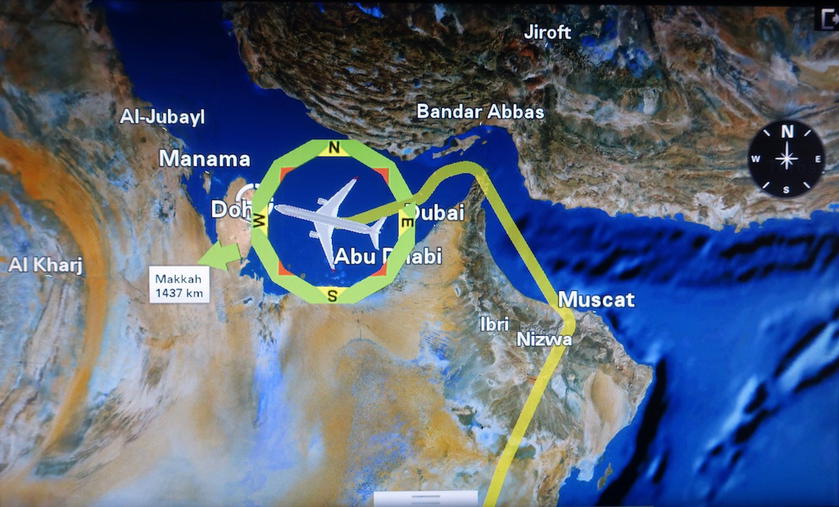 Map for a recent flight from Cape Town to Doha
Qatar Airways has been trying to battle the legality of the blockade basically since it started. While countries have the right to cut off trade and close borders with one another, under the Convention of International Civil Aviation, they don’t have the right to restrict airspace in the way that has been done.
The airline recently won a big victory in this regard, as the United Nations’ Court of Justice ruled that the ICAO has the jurisdiction to prevent these kinds of blockades.
While the ICJ didn’t explicitly rule in Qatar Airways’ favor, the idea is that this paves the path for these flight rights to be restored.
Qatar Airways seeks $5 billion in damages
Qatar Airways is wasting no time. Following the ICJ’s ruling, the airline has launched an international investment arbitration against Bahrain, Egypt, Saudi Arabia, and the United Arab Emirates, in which it is seeking at least $5 billion in compensation.
The arbitration seeks redress for the blockading states’ actions to remove Qatar Airways from their markets and to forbid the airline from flying over their airspace. It’s argued that the airline has made substantial investments in the four blockading countries over the past three decades, and that this blockade has undone all of that effort.
The airline is seeking full compensation for damages in four investment arbitrations, brought under three treaties, including:
- The OIC Investment Agreement
- The Arab Investment Agreement
- The bilateral investment treaty between Egypt and Qatar
The Notices of Arbitration claim that by imposing these measures, the blockading countries have violated their obligations under the agreements, including by expropriating and failing to adequately protect and secure Qatar Airways’ investments, discriminating against Qatar Airways, and failing to provide fair and equitable treatment to the airline and its investments.
As Qatar Airways CEO, Akbar Al Baker, describes this:
“The decision by the blockading states to prevent Qatar Airways from operating in their countries and flying over their airspace is a clear breach of civil aviation conventions and several binding agreements they are signatories to. After more than three years of efforts to resolve the crisis amicably through dialogue yielded no results, we have taken the decision to issue Notices of Arbitration and pursue all legal remedies to protect our rights and secure full compensation for the violations. The blockading states must be held accountable for their illegal actions in the aviation sector, which includes a failure to comply with their obligations under bilateral agreements, multilateral agreements and international law.”
 Qatar Airways is seeking compensation from four countries
Bottom line
It’s understandable that Qatar Airways is going all out in getting its air rights restored for the countries involved in the blockade. One would think that Qatar Airways’ focus would be on the restoration of air rights rather than filing a lawsuit, but I guess the airline hopes that one action may lead to the other.
Qatar Airways does by all accounts seem to be in the right here when it comes to the legality of the blockade. That doesn’t necessarily mean the countries involved in the blockade will give in, though. I would imagine damages over the blockade are an even more complex issue.
This will be an interesting situation to watch…


Membership is free and takes no more information than commenting as a guest. Earn status points for good contributions, and see fewer ads as your status grows.