
In the spring of 2021, Greece opened to tourists from around the world, which has been an exciting development for many travelers. I had an amazing trip to Greece earlier this summer.
All passengers traveling to Greece have to complete a passenger locator form (PLF) prior to arrival, so in this post I wanted to share how that works — how complicated is the form to complete, and what’s the experience like when you land in Greece? I originally published this guide back in May, but wanted to update it to reflect the current process as much as possible, since some things have changed.

Who is allowed to visit Greece?
As of May 2021, Greece has more or less opened to visitors from around the world. To enter, visitors need to provide proof of either a negative coronavirus test, vaccination, or recovery from coronavirus:
- The coronavirus test requirement is that you need to be tested no more than 72 hours before travel if you get a PCR test, or no more than 48 hours before travel if you get a rapid antigen test; this test is mandatory for all travelers over the age of 12
- Alternatively you can provide proof that you tested positive for coronavirus anywhere from 30 to 180 days ago; this can be proven by bringing a positive test result from within that time period
- You can bypass the testing or recovery requirement if you’re fully vaccinated, which is defined as having received your last recommended dose at least 14 days ago; eligible vaccines include Pfizer BioNtech, Moderna, Astra Zeneca/Oxford, Novavax, Johnson + Johnson/Janssen, Sinovac Biotech, Gamaleya (Sputnik), Cansino Biologics, and Sinopharm
Of course be sure to check Greece’s official government website, as entry restrictions could change again.
How does Greece’s passenger locator form work?
All passengers traveling to Greece need to complete a passenger locator form prior to travel. This form must be submitted no later than 11:59PM (local time in Greece) the day before arrival.
The good news is that this form is pretty straightforward, as completing the whole form took me about 10 minutes. I’d argue the process is significantly easier than the UK passenger locator form. One awesome thing is that if you’re traveling as a group, you can have one person complete the form, and then they can add additional people to the form, which can save a lot of time.
Now let’s go through the actual passenger locator form process. First you’ll want to register an account, which involves entering your email address and then choosing a password.

Then you’ll be asked to agree to a few things, including that you’ve read Greece’s coronavirus protocols, that you’ll be honest, and that you’ll submit only one form per family and household.

You’ll then want to clarify that you’re traveling to Greece (unless you’re a Greek citizen or permanent resident, in which case you also have to complete the form when leaving the country).

You’ll then be asked to share details of how you’ll be getting to Greece.

If you’re flying, you’ll have to share your flight details, including any connections within Greece.


You’ll then be asked whether you’ll be presenting proof of vaccination, a negative coronavirus test, or proof of recovery from coronavirus, in order to enter the country.

Since I selected the vaccination option, I was asked in which country I got vaccinated, and which vaccine I got.

Then I was asked a variety of personal details, including my name, sex, age, and passport information.


Next I was asked for my address in Greece — you’re supposed to list all the places you’ll be staying for the first 14 days you’re in the country.


You’ll also have to provide emergency contact information.

Lastly you’ll have the option to add travel companions to your passenger locator form — first you’ll have the option to add family members, and then you’ll have the option to add non-family travel companions. I’m really happy Greece has this option, since it means you only need to complete one form per group.
Oddly you don’t actually have to include the vaccination details of additional travelers — I’m not sure if that’s intentional or not, but you’re not missing anything, and you shouldn’t have issues entering the country when doing it this way.


And that’s it — at that point you’ll be brought to a page where you can view your submitted passenger locator form.

You’ll receive an email immediately confirming that you submitted this. Shortly thereafter you should receive an email containing the QR code for your arrival. The email has the following subject line:
Important: your PLF document for your upcoming trip to Greece
A few months back the QR code would only be sent at midnight in Greece on the day you were scheduled to arrive, but that has been changed, and it’s now sent earlier. That’s great, since it’s one less thing to worry about at the last minute.
What happens when you land in Greece?
What’s the arrivals experience like when you arrive in Greece? I was prepared for complete chaos, not for any specific reason, but rather because I was planning for the worst and hoping for the best. Fortunately that fear was unfounded.
We landed at Athens International Airport (ATH), and upon arrival we followed the signage towards immigration. I guess the country has deployed firefighters to help with the entry process.
All passengers had to get in a line, where firefighters scanned QR codes and checked vaccine cards (we showed our CDC cards, and that did the trick). That was it — the entire process took under a minute.
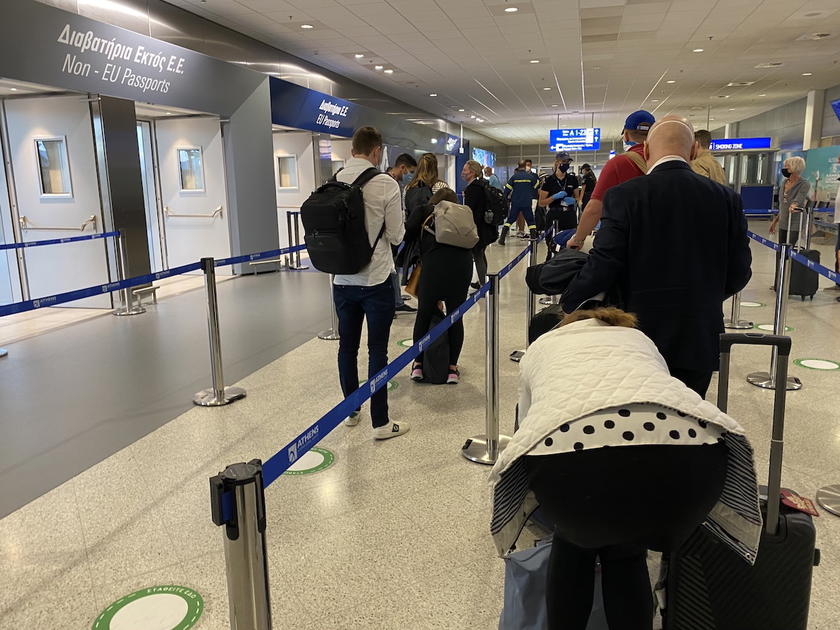
From there we just got in the standard immigration queues, which maybe took about 15 minutes to get through. The immigration officers didn’t ask for our vaccine cards or QR codes.
For what it’s worth, I’ve heard similar experiences from people who have entered the country since then. While wait times vary based on the time of day and day of week, for the most part it seems to be a pretty straightforward process.
Bottom line
Everyone traveling to Greece needs to complete a passenger locator form prior to travel, which needs to be submitted at least the day before arrival. The good news is that this form is easy enough to complete, and you can even just use one form for an entire group traveling together.
The arrivals process in Greece was seamless for us — firefighters checked our QR code and CDC cards, and then we just went into the normal immigration queue. Greece seems to have done a great job managing the arrivals process.
If you’ve entered Greece since the country reopened to tourists, what was your experience like?


Membership is free and takes no more information than commenting as a guest. Earn status points for good contributions, and see fewer ads as your status grows.