Other Carriers Can’t Compete With Gulf Airlines Under The Current System — Here’s Why

I’ve written extensively about the battle going on between the “big three” US carriers (American, Delta, and United) and the “big three” Middle Eastern carriers (Emirates, Etihad, and Qatar) regarding the Open Skies agreement.

This debate might seem insignificant to some, but the liberalization of international air service is in consumers’ best interests, and this has the potential to change that trend.
I’ve been doing some research on the issue, and I finally understand the position of the US airlines, and even side with them. Previously I saw where the Gulf carriers were coming from, but the US airlines haven’t done a great job of communicating their position other than “crying foul.” Now that I have a bit more insight as to the stance of the US airlines, their grievances make perfect sense to me.

I think we’ll see a lot more information made public in the near future which puts this into perspective.

Here are my thoughts:

What are Open Skies agreements?

To figure out whether something needs to be changed, it first makes sense to understand what’s at stake.

For decades airlines have been working towards removing the “red tape” required to start new routes, by eliminating government intervention as much as possible. Here’s how the US Department of State describes Open Skies agreements (bolding mine):

Open Skies agreements have vastly expanded international passenger and cargo flights to and from the United States, promoting increased travel and trade, enhancing productivity, and spurring high-quality job opportunities and economic growth.  Open Skies agreements do this by eliminating government interference in the commercial decisions of air carriers about routes, capacity, and pricing, freeing carriers to provide more affordable, convenient, and efficient air service for consumers.

America’s Open Skies policy has gone hand-in-hand with airline globalization.  By allowing air carriers unlimited market access to our partners’ markets and the right to fly to all intermediate and beyond points, Open Skies agreements provide maximum operational flexibility for airline alliances.

It’s clear that a cornerstone of these Open Skies agreements is the “elimination of government interference in the commercial decisions” of airlines.

But lots of airlines are government owned — why single out three airlines?

The next logical question here is “why single out Emirates, Etihad, and Qatar?” If the problem comes as a result of airlines being government owned, then why not go after the smaller government owned airlines, like Oman Air, etc.?

This is the area that’s challenging, because I do think it’s tough to figure out where to draw the line. And in general I’m opposed to making regulations centered around arbitrary metrics.

But there are many things that make Gulf carriers especially unique, including:

  • Of government owned airlines, Emirates, Etihad, and Qatar are growing disproportionately compared to their respective populations and GDP growth. In a few years these carriers will have more widebody aircraft than all US airlines combined, despite the fact that the UAE and Qatar have a population that’s less than 4% that of the US.
  • Emirates, Etihad, and Qatar airlines aren’t playing fair. It’s one thing to have a government owned airline that’s losing money, but the behavior of the Middle Eastern airlines is destructive. Their long term business model is basically to run competing airlines out of markets as much as possible, and at any cost, even if they lose billions of dollars doing it.
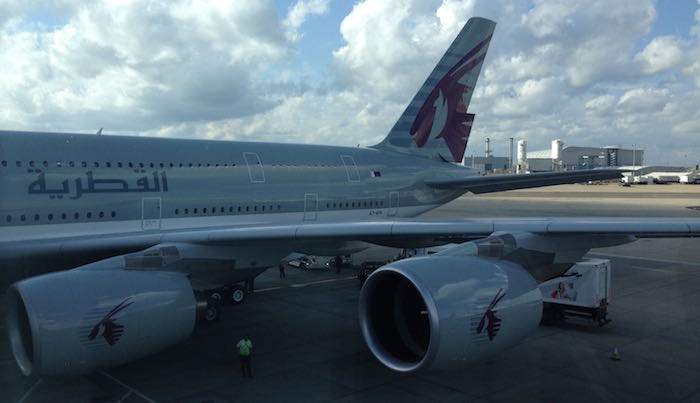
Qatar-Airways-A380-First-Class-113
Qatar Airways A380 at London Heathrow

What dirty tricks do Middle Eastern airlines use?

Let’s be clear about what makes the advantage of the Middle Eastern carriers “unfair.” It’s not that they have lower staffing costs because of where they’re located. Or that they have lower oil costs because of where they’re located.

Rather it’s that they have access to virtually unlimited interest-free capital, and that every aspect of the Gulf carriers operations and supply chain is interconnected. Collusion between the Middle Eastern carriers and their governments allows for zero transparency, which has the result, if not the intention, of giving Etihad, Emirates, and Qatar an unfair advantage.

For example, Emirates Airline’s President, Sheikh Ahmed bin Saeed Al Maktoum, is also President of Dubai Civil Aviation Authority, Chairman of Dubai Airports, and President of dnata. That would be like Doug Parker being CEO of American Airlines, head of the FAA, and President of DFW, ORD, LAX, JFK, and MIA Airports.

If that doesn’t present a conflict of interest — especially for a company that isn’t financially motivated — then I don’t know what does. It’s my understanding that Dubai Airport’s landing fees are less than the cost of providing them. How can an airport justify losing money with every plane that lands?

Because Dubai Airports knows subsidizing landing fees benefits Emirates most. And when you’re in charge of the airline, the airport, and even the civil aviation authority, it’s all just an accounting exercise anyway, right?

Here’s another one. Whenever you fly through an airport there’s a passenger facility surcharge. Basically some component of the ticket cost goes to the airport for having used the terminal.

Virtually all airports charge this to both passengers originating and connecting at an airport (they can differ based on whether you’re originating or connecting, but every passenger is charged at least something).
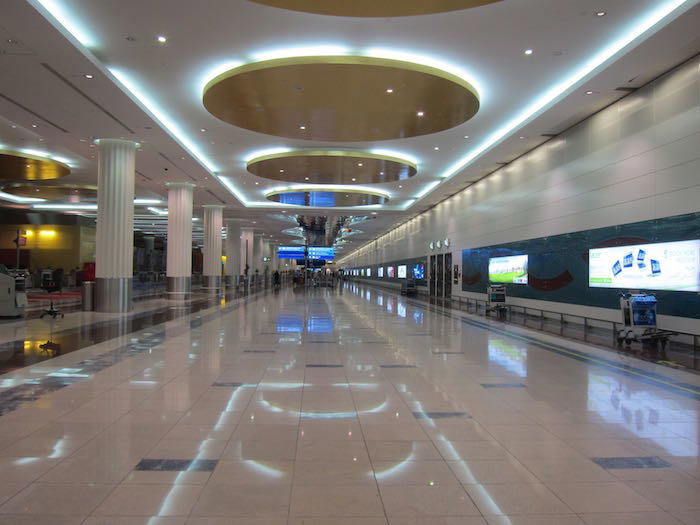
Emirates-First-Class-Lounge-Dubai-05
Dubai International Airport

However, at the airports in Abu Dhabi, Doha, and Dubai, that’s not the case. Only passengers originating or terminating in those cities are charged a facility fee.

Why? Because a vast majority of passengers traveling on Emirates, Etihad, and Qatar are connecting, while a vast majority of passengers on other airlines flying to those airports are originating or terminating there (in other words, you’re not flying Lufthansa in order to connect in Dubai, much like you’re not flying Emirates to connect in Frankfurt).

For example, between Singapore and New York (via Dubai) you don’t pay any sort of Dubai passenger service charges:
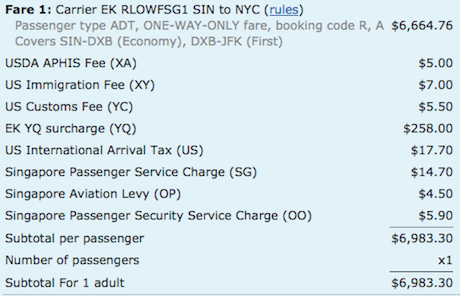
Dubai-Airport-Fees

While if originating/terminating in Dubai, you pay ~$20 in passenger service charges:
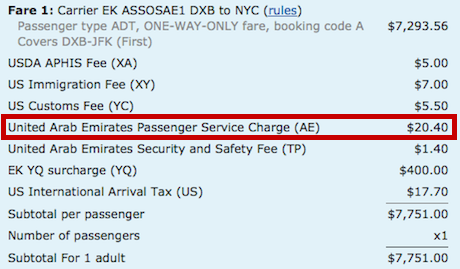
Dubai-Airport-Fees-1

Even though they don’t care about making a profit, Emirates, Etihad, and Qatar are literally having foreign carriers subsidize operations at their own hubs.
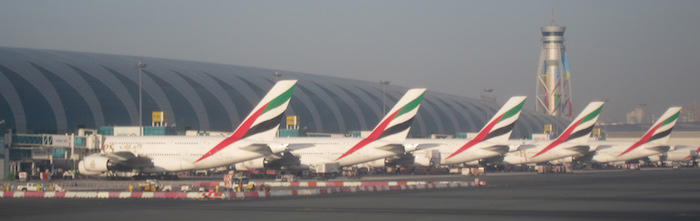
Emirates-Dubai
Line-up of Emirates’ massive A380 fleet at Dubai Airport

And then there’s the $4 billion fuel hedge loss that Emirates faced, which suddenly “disappeared” and was taken care of by the government. But we’ll save that for another time.

The two sides need to pick representatives to argue this

It’s actually sort of refreshing to see the “big three” US carriers and “big three” Middle Eastern carriers collaborating with one another for once. It’s a nice change of pace from the usual bickering that usually happens amongst the respective sides.

This is such a serious issue, yet unfortunately it seems we’ve heard the most from the two least eloquent people on both sides:

  • Delta’s CEO, Richard Anderson, somehow managed to make this a debate on Islamaphobia by bringing up 9/11, which is just preposterous and counter-productive
  • Qatar’s CEO, Akbar Al Baker, has zero credibility, and unless he’s chiming in on Bravo’s new “Real Housewives of Doha” show, really shouldn’t be given a mic

If the two sides knew what was best for them, they’d let Doug Parker make the argument for the US carriers (he’s well spoken and relatable), and Tim Clark make the argument for the Middle Eastern carriers (he’s one of the brightest guys in the industry).
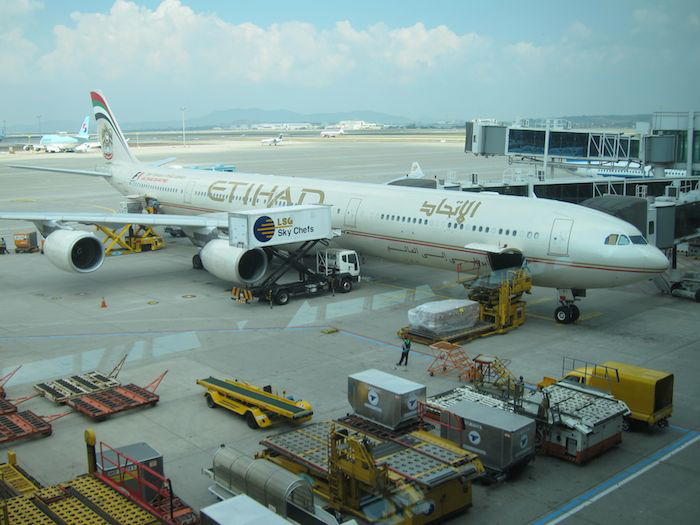
Korean-Air-Lounge-Incheon-47
Etihad A340 at Seoul Incheon Airport

“The US airlines should just compete”

The Middle Eastern carriers love telling the US carriers that they should just compete and shut up. But what does that even mean? “Hey, you guys should get with the program and lose as much money as we do?”

The truth is that other airlines simply can’t compete with Gulf carriers under this system.

This isn’t about service. This isn’t about airplanes. This isn’t about routes. This isn’t specifically about the fact that the airlines are government owned.

This is about the fact that Emirates, Etihad, and Qatar are not at all motivated by profits.

So to those agreeing the US airlines should “just compete,” how?! It’s one thing if the Middle Eastern carriers were making money and saying “try competing.” But when these airlines are losing billions of dollars and saying “compete with us,” what does that even really mean? Compete with the service at the expense of your shareholders?

Etihad-A380-First-Apartment-25
Bedrooms on planes are nice, but are they profitable?

What’s the solution?

This is the tricky part. I don’t know what the solution is. Where do you draw the line and what should be done? Should the “big three” Middle Eastern carriers just be excluded from Open Skies? Should they be forced to “unbundle” their cost structure so that they’re actually paying “fair” amounts for the services they’re receiving?

I don’t know the answer, but I do know that what they’re doing is quite the opposite of the “elimination of government interference,” which is the very purpose of Open Skies.

Bottom line

Open Skies is intended to eliminate government intervention and “free” markets. And there’s no arguing that the Middle Eastern airlines aren’t operating within the spirit of the agreement.

To be clear, life isn’t fair.

We’ll never be able to reconcile the differences in staffing costs, passenger facility costs, etc. And that’s something I think the US airlines are fine with.

But when every aspect of an operation is being run in order to generate a loss and increase market share for the purposes of developing a country rather than an airline, then Emirates, Etihad, and Qatar really aren’t playing within the spirit of Open Skies.

Where do you stand in the Open Skies debate?

Conversations (146)
The comments on this page have not been provided, reviewed, approved or otherwise endorsed by any advertiser, and it is not an advertiser's responsibility to ensure posts and/or questions are answered.
Comment as a member

Membership is free and takes no more information than commenting as a guest. Earn status points for good contributions, and see fewer ads as your status grows.

Type your response here.

If you'd like to participate in the discussion, please adhere to our commenting guidelines. Anyone can comment, and your email address will not be published. Register to save your unique username and earn special OMAAT reputation perks!

  1. Loading comments…
Recent Comments
The latest from the OMAAT community.

The comments on this page have not been provided, reviewed, approved or otherwise endorsed by any advertiser, and it is not an advertiser's responsibility to ensure posts and/or questions are answered.

Prabuddha Guest

US Airlines get a massive subsidy from the US taxpayers in the form of the USAF the largest air force in the world which trains massive amounts of US pilots. If we want a level playing field mandate that the big 3 cant recruit ex USAF and have to build their own training pipeline and watch costs explode. This subsidy is much bigger than any cheap oil or landing fees that the ME3 receive.

0
‼ 0
Tim Page Guest

Couple of things here: Bottom Line Up Front: Nope. We should not unravel Open Skies just because US Airlines are 10 years behind the curve and failed to act with the market power and time advantages that they once had. 1. The ME3 lose heaps of money. When I was at QR, every single route except EWR-GVA (since discontinued) even when one conducts the analysis with only the purely variable costs lost money--lots of money. Therefore the economic decision of every single QR flight, except EWR/GVA, was: "offload the pax to OA and leave the plane in DOH". Yep. Crazy. Truth! Anecdotally, the most egregious flight I ever witnessed flown was an A340 DOH/IAH with only 10 PAX on the ex-DOH leg and only 17 pax on ex-IAH. This happened, and happens, every single day!! That's a snapshot of the revenue side of the house. Oh and on the cost side, here is a nice nugget: There is no JetA refinery in Qatar and since the Qataris don't get on well with Saudis (diplomatic relations were only reestablished eight years ago in 2008) who have JetA facilities, QR gets its jet fuel in a, ah, well, a, let's just say, a sub-optimal, and a bit-more-than-just-environmentally-unfriendly-and-uber-expensive manner: The crude that Qatar Petroleum "sells" to QR is loaded on to a tanker in the Qatari Port of Ras Laffan, then shipped to Malaysia, there it is refined, and then it is shipped back to DOH to be stored and put onto a QR flgiht. So once i figured out those two data points, I knew that even the fact that QR paid its FA's only $800 US/month that they could never, ever turn a profit with those revenue numbers and "creatively awful" supply chain cost decisions. Hint: US Carriers--a good talking point might be the environmental disaster that these carriers are at their very core. The "terrorist" angle of attack (sorry about the pun!) that Richard offered up was myopic, insulting, racist, unnecessary, bigoted, wrong, and an epic miss. The save her tho' to restart these talks is the the "T-man". Baker moved the QR North America offices to Trump Tower back in 2007 (i think, maybe 2008) and has kept the picture of him and now President Trump promiently displayed in his office. Baker likes the guy and more importantly: he respects him. Lots of ways to win here, but the junk talking points that the US carriers are serving up, all while I still get to watch overt corporate welfare for airlines programs to be fully "ok" stateside (e.g. the ridiculous, and insanely overt transfer of government dollars directly to the airline industry that we call the "Essential" Air Services Program, not to mention the 9/11 bailouts. Please for the love of all that is holy, at least have enough integrity to support the death of that program before you come back begging to me for help!). Anyway, bottom line here the ME3 carries do lose heaps of money. But they don't care. The are simply using their unique economic advantage of "unconstrained access to capital" to win. That's not what we are used to, but it is how they win in the airline industry, the ocean shipping industry, the financial services industry, on and on. Simply put, money is not a constraint there. That is their strategic advantage. I see no problem with them deploying that advantage to thump US carriers on price and product. They've doing this for at least 20 years in other industries. Why are we so obtuse and always so far behind in the airline industry? 2. Why is this such a big deal now? Ten years ago QR in 2007 had $50BB+ USD of aircraft on order. Where did you think that they were gonna fly them? I mean, seriously. No action from any US carrier then. Nothing! Crickets So typical of a generally poorly managed industry. These guys have been champing at the bit to own this market for 20 years. They just had to wait a bit until the demand came back after 9/11 to fully go green. Then just moved India and China in front of North America. There was a 10 year pause in the planned deployment of those aircraft to North American markets. That was "our" time to plan and react. Not now when they are established ,entrenched, and can kick pretty much any other airline's butt in both product and price. Now you want me to have the government intervene at the expense of "our" cargo airline and aircraft manufacturing industries? I don't think. At least not with your lame talking points. There is plenty of ways for the US PAX Airlines to win here, but your talking points aren't even close to winners. Happy to help you but I don't work for free and I don't really like playin' catch-up after we've wasted 10 years. I for now I continue to always book away from North American carriers, just like everyone else. Our behavior, like the ME3, is totally rationale: we are just doing that which benefits us most. No different than we did back in the day at DL, NW, CO, US or whereever. The "We compete aggressively and fairly" comment that we all learn in airline PR school to regurgitate holds here too. ME3 is competing aggressively with the advantages that they have. Just because the US carriers decided to "lose by default" with inactivity, doesn't mean I, as a now-consumer, have to pay the price of a poorer product at a higher price. No thanks!

0
‼ 0
Tom Member

Well I see that some people here don´t agree with this article, and I have to back them up. I was reading quite a few articles you have wrote about your travels and I would say that (except Lufthansa which is the best airline ever :) ) middle eastern carriers offer much better travel experience than US ones. But this was something I knew even before. While i.e. Qatar airways, even in economy class which us mortals use, make their best to make you feel comfortable in any way possible, at Delta they will tell you that your extra meal order was too late, despite the fact that you selected it at time of the booking one month ago. And then you can enjoy your transatlantic flight on an empty stomach. One thing that needs to be understood is that Gulf carriers are driving the economy of their countries, and once they ran out of oil and gas, they will have to have some kind of income. And with that kind of climate they will not plant tomatoes :) So their approach to aviation business is very smart in long therms. On the other hand American and Delta still stubbornly operate a huge number of MD-80 series. In terms of fuel MD-80 is circa 45 percent more expensive (fuel per seat per NM). Most other serious airlines have phased out this type long ago. All in all I would say that the energy US carriers use in accusing others of being unfair would be better used in thinking how to make their product more competitive. I understand that it is hard for them, since they were world leading airlines, and often setting standards in the industry, but this is not the way to go.

0
‼ 0
Deb Guest

The government of Dubai doesn't own Emirates! Sheikh Ahmed does who is Sheikh Mohammed uncle. Yes closely related

0
‼ 0
Phiroze Cama Guest

To: Ben Schlappig (aka Lucky). It says that you travel 400,000 miles each year, which is approximately a 1000 hours in the skies, or 42 days in the air each year. Maybe you suffer from oxygen deprivation. All your facts and figures, as presented by you on the ME 3 Airlines are totally distorted and wrong. If Delta, United and American are paying you to write such inaccurate articles, or are giving you free flights, then that is a different issue. Suggest that you visit the UAE and request Emirates Airlines to allow you to inspect their Books of Accounts, since the inception of the Airline to date. After your inspection, comment on the "Subsidies". Further, the "Open Skies Policy" has not been adopted only by the USA, it is Universal. Every major Country, has an Open Skies Policy. Suggest that you do a deep and intensive study, by reading the posts on this subject, on LinkedIn and studying the reply of Sir Tim Clark's reply of 200 plus pages, to the US Govt. on the 55 page protest letter by United, Delta and American. Also study the "Rules & Regulations" as contained in the "Open Skies Policy". It would benefit you, to find out from the US Dept. of Commerce and of Labor, as to how many jobs have been created for the American citizens by the ME 3 Airlines, and the contribution to the US Economy and GDP. Also re-read the views as posted by my fellow members on this topic, as above. Visit a lawyer or an Accountant and find out the real meaning of Chapter II and the meaning of "Subsidies". Lastly, bear in mind that each Airline, wherever they may be, are in for the long term and for making profits.

0
‼ 0

Save posts to read later

Saving posts is a member feature. Become an OMAAT member to build a reading list you can come back to from any device.

Become a member
Meet Ben Schlappig, OMAAT Founder
5,883,136 Miles Traveled

43,914,800 Words Written

47,187 Posts Published