
The United States Federal Trade Commission (FTC) has this week announced a final Junk Fees Rule. This impacts both live-event ticketing and short-term lodging, though I’ll be focused on the latter, given that this blog is about the travel industry. This bipartisan legislation was introduced back in 2022, and is now finally being implemented.
Hotels will have to disclose mandatory fees upfront
Thanks to the Junk Fees Rule, hotels and other vacation rentals will have to display pricing that includes all mandatory fees in a timely, transparent, and truthful way, from the start of the price comparison process.
So, what exactly does the rule say? The first thing to understand is that it doesn’t prevent any business from adding fees to the cost of a short-term lodging stay, but rather it just requires clear disclosure:
The final rule targets specific and widespread unfair and deceptive pricing practices in the sale of short-term lodging, while preserving flexibility for businesses. It does not prohibit any type or amount of fee, nor does it prohibit any specific pricing strategies. Rather, it simply requires that businesses that advertise their pricing tell consumers the whole truth up-front about prices and fees.
Here’s the explanation of the new regulation:
The Junk Fees Rule requires that businesses clearly and conspicuously disclose the true total price inclusive of all mandatory fees whenever they offer, display, or advertise any price of short-term lodging. Businesses cannot misrepresent any fee or charge in any offer, display, or ad for short-term lodging.
In addition, the rule requires businesses to display the total price more prominently than most other pricing information. This means that the most prominent price in an ad needs to be the all-in total price — truthful itemization and breakdowns are fine but should not overshadow what consumers want to know: the real total.
Finally, the rule requires businesses that exclude allowable fees up front to clearly and conspicuously disclose the nature, purpose, identity, and amount of those fees before consumers consent to pay.
The FTC claims that the new Junk Fees Rule will save consumers up to 53 million hours per year of wasted time spent searching online, equivalent to more than $11 billion over the next decade.
Here’s how FTC Chair Lina M. Khan describes this development:
“People deserve to know up-front what they’re being asked to pay—without worrying that they’ll later be saddled with mysterious fees that they haven’t budgeted for and can’t avoid. The FTC’s rule will put an end to junk fees around live event tickets, hotels, and vacation rentals, saving Americans billions of dollars and millions of hours in wasted time. I urge enforcers to continue cracking down on these unlawful fees and encourage state and federal policymakers to build on this success with legislation that bans unfair and deceptive junk fees across the economy.”

This is a long overdue & positive change
Resort and destination fees are among the most frustrating fees in the hotel industry. The concept of hotels charging these fees has become increasingly common in recent years, and this is frustrating for consumers:
- With this practice, hotels generally bundle some amenities for a fixed nightly fee, in order to generate more revenue
- One of the primary motivations for these fees is to initially make the rate seem lower than it actually is; some hotels have a bad habit of “drip pricing,” whereby the cost of a hotel stay increases as you go through the booking process
- There are some other motivations for these kinds of fees, including online travel agencies not getting commissions on that portion of the rate, and in some areas there are tax benefits to this as well
As you’d expect, I’m a huge fan of this change in regulations — back in 2021, I wrote a post about how it’s time for hotels to be required to display all-in pricing, and I’m happy to see this finally happening.
Let’s be clear, though — these new regulations won’t require hotels to actually eliminate resort or destination fees, but rather they’ll require them to simply be more prominently displayed. But still, that’s a huge step in the right direction, and eliminates one of the primary motivations for having these fees.
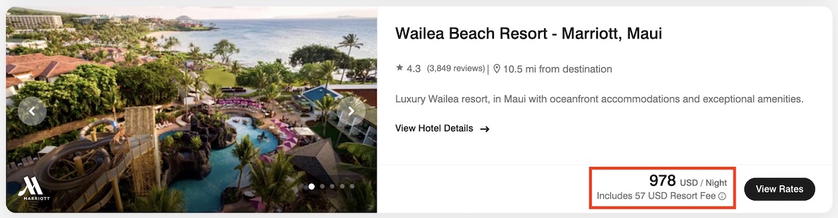
Keep in mind that some of the major hotel groups have already started displaying pricing inclusive of resort fees. For example, Marriott started doing this in 2023. This followed a 2021 settlement with the Attorney General of Pennsylvania, as Marriott was facing lawsuits over its practice of not properly disclosing extra fees.
Bottom line
New legislation will require short-term lodging operators, including hotels, to clearly disclose all mandatory fees at the start of the booking process.
We’ve seen resort and destination fees spread like wildfire over the years, and one major motivation has been that hotels have been able to display low prices upfront, and then tack on extra fees as the booking process goes on.
I’m thrilled to see this new regulation being implemented, and I don’t think any reasonable person (well, outside of a paid industry lobbyist) would argue that this isn’t in the best interest of consumers. To be clear, this doesn’t mean these fees are going anywhere, but at least we’ll know the details at the beginning, and it does eliminate one of the incentives that hotels have to charge these fees.
What do you make of this new ban on hidden junk fees?


Membership is free and takes no more information than commenting as a guest. Earn status points for good contributions, and see fewer ads as your status grows.