Why Bhutan’s Insanely High Tourist Fee Is A Good Thing

I’ve spent the past several days in Bhutan, and can’t begin to say how magical I find this country to be. From the friendly people to the clean air to the incredible natural beauty to the peaceful vibe, it’s a unique place. I don’t necessarily want to claim it’s my favorite place ever, though it’s one-of-a-kind for sure. I’ve never been anywhere like Bhutan.
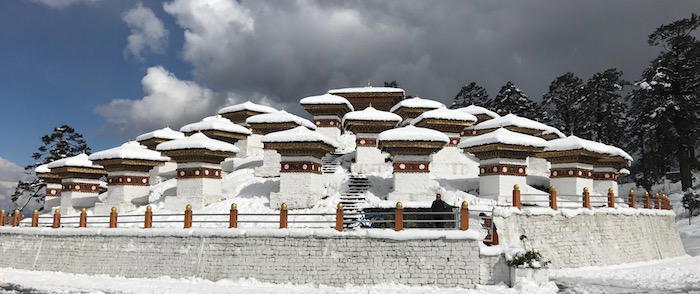
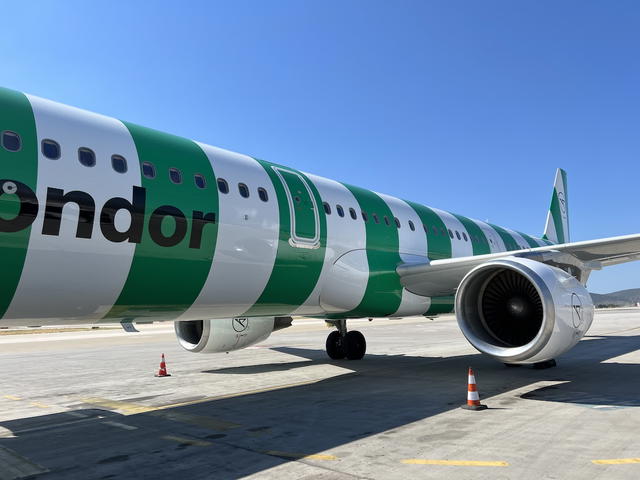
Bhutan-3

When I first considered booking a trip to Bhutan, I had second thoughts:

  • Bhutan is difficult to get to, as there are only a couple of airlines that fly there, they don’t belong to alliances, and tickets are quite expensive (a roundtrip flight from Kathmandu to Paro costs about ~$400 roundtrip, even though the flight is just 45 minutes in each direction)
  • Bhutan has an insanely high tourist tax, or visitor fee, or whatever you’d like to refer to it as

As most foreigners do, I arranged my Bhutanese visa through a tour operator in the country. For two people for five days, that meant I had to wire them $1,730 in advance. For what?!? That’s ridiculous… or so I thought.

How expensive is a visa for Bhutan usually?

Bhutan isn’t cheap, and at a minimum you’re going to pay $200-250 per person per day. However, this isn’t simply a visa, but rather covers the cost of just about everything during your stay. Per Bhutan’s tourism website, it covers:

  • A minimum of 3 star accommodation (4 & 5 star may require an additional premium).
  • All meals
  • A licensed Bhutanese tour guide for the extent of your stay
  • All internal transport
  • Camping equipment and haulage for trekking tours
  • All internal taxes and charges
  • A sustainable tourism royalty of $65 (this royalty goes towards free education, free healthcare, poverty alleviation, along with the building of infrastructure)

The pricing then varies by season:

  • USD $200 per person per night for the months of January, February, June, July, August, and December.
  • USD $250 per person per night for the months of March, April, May, September, October, and November.

So I actually think that’s not too bad when you consider that it includes just about everything, though that’s still more than most backpackers spend when traveling, by a long shot.
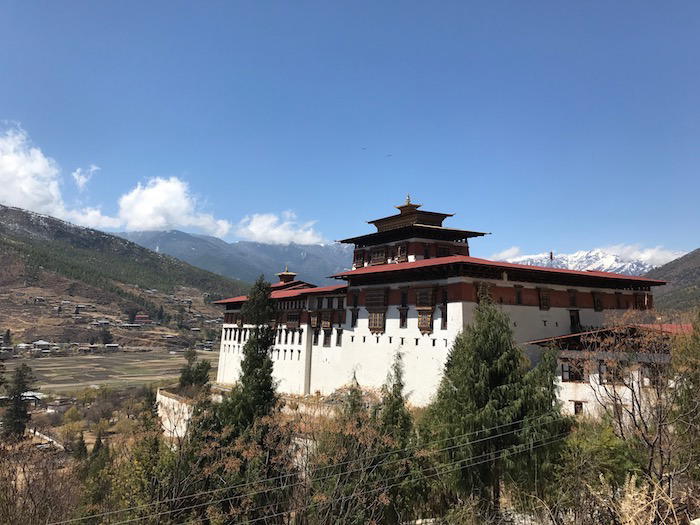
Bhutan

How much was our visa?

We wanted to choose our own hotel, so didn’t do the “minimum daily package.” Instead we booked our own hotel, and they connected us to their preferred tour company.

For us the fee was $165 per person per night, plus a $40 one-time visa fee. This is a bit cheaper than the usual “minimum daily package,” since it didn’t include meals or accommodation. Instead our fee included the following:

  • Roundtrip airport transfer
  • Daily sightseeing with an English-speaking guide
  • All applicable government taxes
  • All museum and monument fees
  • The $65 tourism royalty, which goes towards free education, healthcare, infrastructure, and more

So for the two of us staying for five nights, we paid a total of $1,730 between the $165 per person per day tourist fee, plus the one-time visa fee.

Bhutan-Tourist-Fee

Our experience with our tour company

I suck at planning in advance. So when I landed I knew the tour company would take us to our hotel, and then figured we could decide what we’d do once we arrived.

So I was quite surprised when we were picked up at the airport in a nice SUV by our guide and driver, who would be with us for the entire five days. They had an exact itinerary prepared for us for the entire trip, which was incredible. Our guide was knowledgable and friendly, and the driver was actually his brother (they work for the same tour company).

I was impressed by how well organized everything was. Despite them having an exact schedule for us, we could modify it as we wanted. We could sightsee for four hours a day, or 14 hours a day — whatever we preferred. And because it snowed in Bhutan during our trip (which is extremely rare), we had to modify our trip, since many roads were closed.

I’ll have a lot more about our time in Bhutan when I write the full trip report (I don’t usually write much about the destination, but I’ll make an exception here), but suffice to say I was very pleasantly surprised. The tour company wasn’t just a government agency there to take our money, but they were invested in making sure our entire experience was as good as possible.
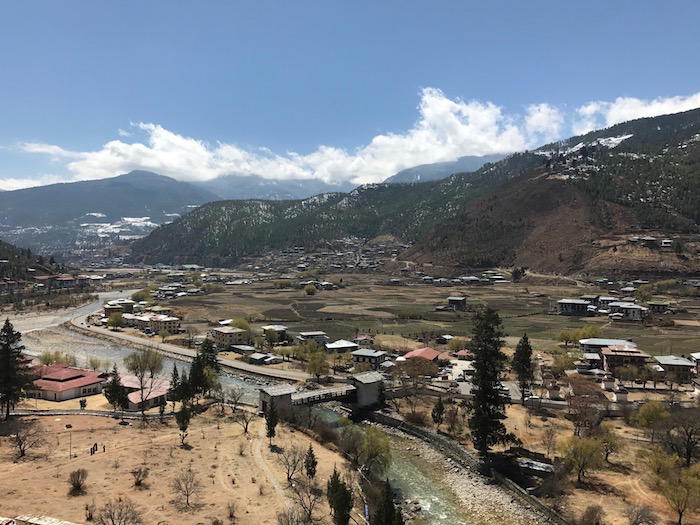
Bhutan-1

Why Bhutan’s crazy high tourist fees are a good thing

Obviously I would have rather not paid $1,730 for the privilege of visiting, though I actually think Bhutan’s system is a net positive. What makes Bhutan so incredibly special is how unspoiled it is, and also how friendly the people are. It’s the only carbon negative country in the world, they have free education and healthcare, etc. Tourism is also so limited that you’re never fighting crowds to get anywhere, which adds to how special it is.

So let’s go through this for a second:

  • I feel good about Bhutan’s $65 per person per day royalty fee, which they’re putting back into their people; sure, it would be nice if everyone visited for free, but I doubt people would be so friendly towards tourists, I doubt the country would be as unspoiled, and I doubt the people would be as happy
  • If you can get over that, our real “out of pocket” for the tourist fee was $200 for both of us per day; for that we got driven everywhere we wanted to go (sometimes five hours of driving per day), admission to all the incredible sights, a knowledgable English speaking guide, etc.

That’s certainly not cheap, though it’s not all that much more than what you’d otherwise pay for arranging a reputable guide and driver with car somewhere else.

For example, the previous day in Kathmandu we paid $50 alone in entrance fees to UNESCO sites for the two of us. That’s a massive amount of money for Nepal. Meanwhile Bhutan has an endless number of sites that would no doubt charge an entrance fee in other countries, though that’s included in the tourism fee.

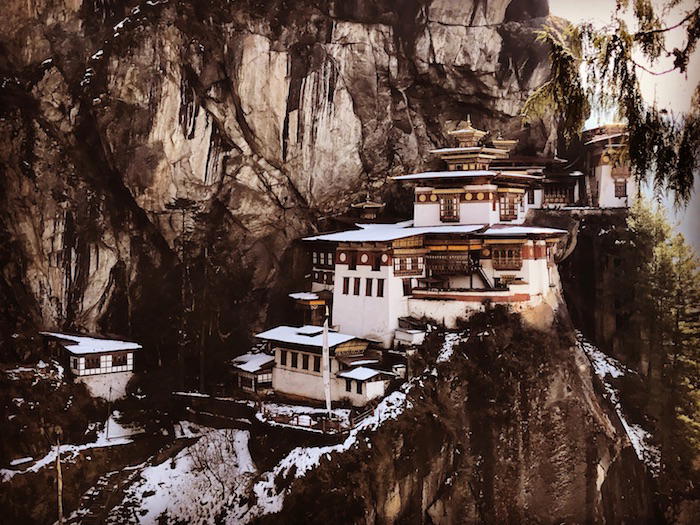
But most importantly, Bhutan just wouldn’t be the same if it were overcrowded with tourists. Earlier today we went to the Tiger’s Nest (Bhutan’s most famous attraction), and basically had it to ourselves. It was surreal.
Bhutan-Tigers-Nest

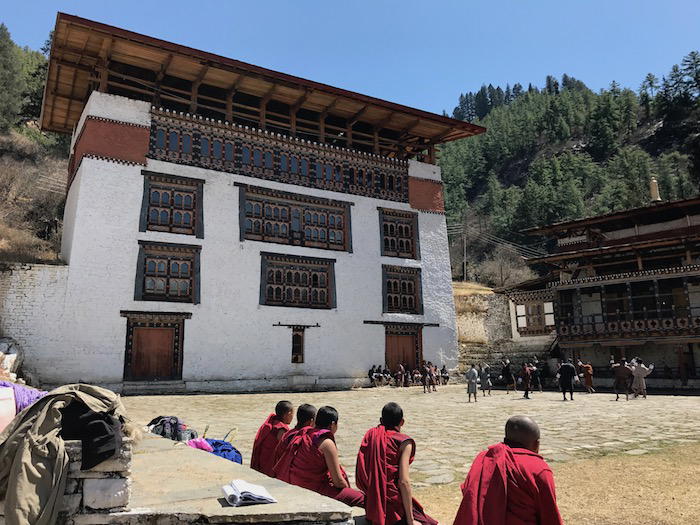
Lastly, I also appreciate that every tourist is essentially required to have a guide. Bhutan is (obviously) a Buddhist country, and many of the sites you visit as a tourist are active religious sites, with customs that are not always obvious to someone who isn’t familiar with the local culture (where it’s okay to take pictures, where you need to take your shoes off, where it’s okay to enter, etc.)

Getting so much access to temples, etc., simply wouldn’t be practical without tourists having a guide.
Bhutan-2

Bottom line

Bhutan has the highest tourist fee of anywhere in the world. Of course I’d rather not pay that, but at the same time I don’t think Bhutan would be as special as it is without this restriction on tourism. The country wouldn’t feel as untouched, and we certainly wouldn’t have access to all the things we do.

You’re definitely paying a premium compared to other countries, though I actually don’t think it’s that bad when you consider everything you’re getting, especially if you feel good about the $65 per person government royalty.

I went into this trip wondering whether the tourism fee was worth it. After being in Bhutan, I can appreciate why they have it, and can’t recommend the place enough, if you can afford it.

If you’ve visited Bhutan, what are your thoughts on the tourist fee?

Conversations (59)
The comments on this page have not been provided, reviewed, approved or otherwise endorsed by any advertiser, and it is not an advertiser's responsibility to ensure posts and/or questions are answered.
Comment as a member

Membership is free and takes no more information than commenting as a guest. Earn status points for good contributions, and see fewer ads as your status grows.

Type your response here.

If you'd like to participate in the discussion, please adhere to our commenting guidelines. Anyone can comment, and your email address will not be published. Register to save your unique username and earn special OMAAT reputation perks!

  1. Loading comments…
Recent Comments
The latest from the OMAAT community.

The comments on this page have not been provided, reviewed, approved or otherwise endorsed by any advertiser, and it is not an advertiser's responsibility to ensure posts and/or questions are answered.

Lidia Guest

I have been to both countries and concur that it is a good thing to spend time there. We get a close up view (albeit restricted), we live first hand some of the unintended consequences of dictatorships (extreme low crime), and in the case of the DPRK some fenomenal artistic talent (even if achieved by force), and we do get to plant some little seeds in the hearts of those we (rightfully, I think) view as terribly oppressed. I was born and raised in a dictatorship and I remember how nice it was to see people from other countries, their smiles, their seemingly carefree lives. So, go.

0
‼ 0
Jason Guest

People are missing the big takeaway here. Funds had to be wired, which means no credit card points!

0
‼ 0
marc Guest

Unlike Jon, I believe more people should visit the Bhutans and North Koreas of this world. The amount of money generated by tourism is negligible but it is truly the only way that the local people get a bit of a view of the outside world. I know one of my guide's in North Korea was very impressed when my viewpoints did not always match those of the majority Americans. She actually learned that we are indeed all not the same in our own countries. At least it's a start.

0
‼ 0
Jon Guest

+ Steven M Although I have been to a huge swath of countries in Asia and love to explore new places, I will not go to Bhutan until I am clear on who benefits from the "insanely high tourist fee" that is supposedly good!!? I spent a summer about 15 years ago working with Bhutanese refugees in Nepal. They had horrible stories of what they had faced while in Bhutan not to mention how hard it was to have their land stolen, be expelled by force, have families broken apart, and to live in refugee camps. Those Bhutanese were definitely not the happiest people on the planet and in fact the suicide rate in refugees placed in the US is about double of the normal population. According to Obama white house, out of the over 100k (1/6th Bhutanese) who became refugees, the US has provided asylum for about 85% of those who have been gotten out of the camps. https://obamawhitehouse.archives.gov/blog/2016/03/11/bhutanese-refugees-find-home-america I like Kostya's comparison of Bhutan to North Korea. Probably the difference is that while political opponents in North Korea might be sent to work camps within the country, the Bhutanese had their property taken and were forcibly expelled outside the country.

0
‼ 0
Kostya Guest

WORD OF CAUTION: I visited and trekked in Bhutan in 2015. I was helping look for a local partner to offer a cultural/trekking package to clients who had already trekked in Nepal. I agree with much of what Lucky writes - beautiful country, friendly people, uncrowded, unique, and the fee is a steal for the services you receive (The two of us were outfitted with a driver, 2 guides, 3 porters, and 7 mules!). HOWEVER, there are many aspects of the tourist experience that would make me think twice before returning. 1) You are forced to check your religion at the door. Are you a Christian? It's against the law to speak about it. 2) The tour companies can be very frustrating. They have their list of approved tourist destinations and it is a battle to get them to deviate from the list. It sounds like Lucky had a tour guide who would go with the flow, but they can be very rigid. The rigidness is for good reason - if a tourist is seriously injured in Bhutan, the guide can go to jail for life. 3) Much of what the guides tell you is government propaganda, half-truths, or just inaccurate. In fact, the guides are less about serving the tourists than serving the government - controlling the message and supervising foreigners. For example they will say that it is illegal to drink alcohol or smoke in public. What they really mean is it illegal to do so in front of tourists. I was able to visit a karaoke bar on night where I saw a drunken fight between smokers outside the bar. They will tell you that a temple was built in the 8th century, when in fact it was built 17 years ago. One of my guides even told me that they lie to tourists if the tourist wants to do something inconvenient. "We tell them the mountain pass is impassable due to snow." (This may have happened to Lucky.) The guides constantly recite the line about Gross National Happiness over Gross Domestic Product. When you dig deeper, you learn that their desire for material goods is every bit as strong as the West's. Whether it was a tin roof to replace the traditional thatch, or a new television, the Bhutanese are excited about wealth. Another common line from the guides is their magnanimous King gave them democracy. When you dig deeper, you learn that the "democracy" does whatever the king tells it to do, and the king is revered as something of a deity. Yet another propaganda line the guides will tell you is about living in harmony with their environment. During my trek, I saw virgin forests being cut to build roads into the mountains. There were no environmental control devices. The bulldozers simply pushed the dirt and rock over the hill into the freshwater streams below, out of sight of most tourists. These roads were being built by poor Indian laborers, whom the Bhutanese scorned, and who lived in squalid conditions. 4) Just like the claims about their country are often specious, the buildings are sometimes just for show. I finished my trek early, but the tour company said I had to camp another night because there were no available hotel rooms. I called BS (every hotel I visited was empty) and insisted they find a hotel room. Sure enough, I was put in a beautiful big hotel where I was the only guest. (The tour company would have made more money if I camped.) The hardwood floor broke when I stepped on it. The showers were only equipped for 5 minutes of hot water. By this point in my visit, this sort of thing did not surprise me. Much of what you see as a tourist is "for show" with little substance to back it up. In sum, many aspects of Bhutan are like North Korea. The people are isolated from the outside world. Their beliefs and culture are shaped by royal propaganda. Tourists have very little opportunity to dig deeper into the "real" Bhutan without the supervision of a guide. It can feel like visiting the twilight zone. TL;DR I don't regret visiting and I would encourage anyone to visit once, but I would just encourage tourists to not come under the spell of the Shangri-la on the surface, which leads to ignoring the "real" Bhutan.

0
‼ 0

Save posts to read later

Saving posts is a member feature. Become an OMAAT member to build a reading list you can come back to from any device.

Become a member
Meet Ben Schlappig, OMAAT Founder
5,883,136 Miles Traveled

43,914,800 Words Written

47,187 Posts Published

Keep Exploring OMAAT