
Well here’s the latest never-ending drama in the airline industry…
American and Delta battled over LAX to Beijing
Last March, Delta announced that they planned to operate daily nonstop flights between Los Angeles and Beijing as of December 16, 2016. Exactly two weeks later, American announced that they planned to operate daily nonstop flights between Los Angeles and Beijing as of December 16, 2016.

Obviously the announcements coming just days apart is no coincidence. As it turns out, there was only one slot available for Beijing, so when Delta requested permission to fly the route, American quickly followed. I doubt the route would have been on American’s immediate radar, but when they saw that Delta was going to operate it, they wanted to make sure they got it instead. After all, American is trying to turn LAX into their Pacific gateway.
So over the following months the airlines had to make their case to the Department of Transportation about why they should be allowed to operate the route. In the end the DOT decided to grant the route authority to American, arguing that it would be American’s first flight from the west coast to Beijing, while Delta already operates a flight from Seattle to Beijing.
Seems simple enough, right? American was granted the authority, so should be able to launch the flight? Nope, not so fast.
China won’t give American any slots for Beijing
American has filed with the DOT, claiming that the Chinese aviation authorities are refusing to issue American a slot to operate a flight from Los Angeles to Beijing. They’re not even giving them an undesirable slot. In other words, the U.S. has granted American the right to operate the route per the bilateral agreement between the countries, but China doesn’t want to let the flight land in Beijing. Per the filing:
On January 18, 2017, the CAAC rejected American’s request for slots at Beijing Capital International Airport for nonstop service to Los Angeles. The CAAC did not, as it had done in the past, even offer American slots at commercially non-viable times, such as between midnight and sunrise when few passengers want to takeoff or land. Even though American was recently awarded the US-China frequencies and necessary exemption authority from the Department to inaugurate Los Angeles-Beijing service, American cannot serve this route without slots in Beijing. To date, the CAAC has refused to provide any slots to allow American to exercise its bilaterally conferred rights.
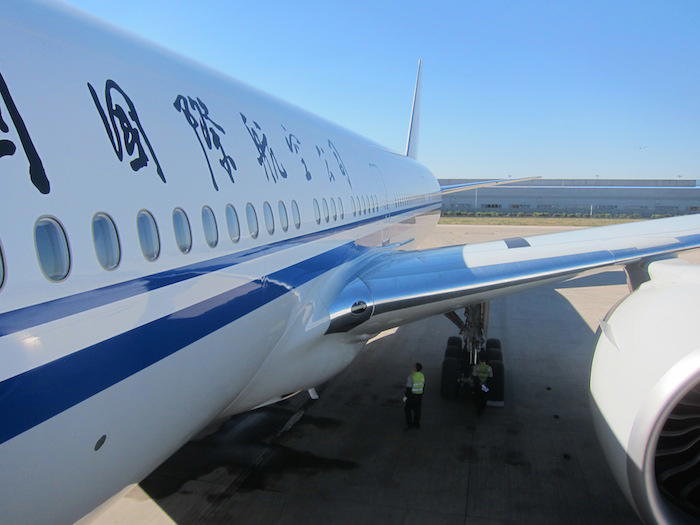
One could certainly argue that China is trying to protect their own carrier here. Air China operates up to 3x daily flights between Los Angeles and Beijing, and has no competition. Given that the airline is largely government owned, I can certainly see why they’d think there’s foul play involved.

American wants the DOT to take away Air China’s Houston to Beijing flight
Since technically American doesn’t really have a way of petitioning the CAAC, they’re instead petitioning the DOT to take action in an indirect way. Air China has filed for renewal on their Beijing to Houston flight, and American is asking the DOT to take these operating rights away, on the grounds of China not playing fair. Per the filing:
American objects to the application of Air China for renewal of its exemption authority to operate scheduled service between Beijing, People’s Republic of China, and Houston, Texas. American recognizes that Air China has timely filed for renewal of its authority and does not take issue with any aspect of Air China’s operation of this service; rather, American bases its objection on the failure of the Civil Aviation Administration of China to make commercially viable slots at Chinese airports available to American and other US carriers on a reciprocal basis.
As American recently explained in a similar proceeding, US carriers are often unable to obtain commercially viable slots at airports in mainland China that are necessary to operate US-China services. Chinese carriers, by contrast, hold large slot portfolios at Chinese airports that they use for their own US-China services, and they face no comparable limitations at US airports. This disparity provides Chinese carriers with a significant competitive advantage in serving US-China routes, and deprives the United States of the full level of US carrier-operated services authorized by the U.S.-China Civil Air Transport Agreement, as amended.
Bottom line
On some level it seems like there’s some foul play here. While American isn’t technically entitled to a landing slot in Beijing, that’s not the sprit of the bilateral agreement, given that they’ve been granted the authority to operate the route by the DOT. With major Chinese airports being more strictly slot controlled than U.S. airports, the U.S. carriers certainly have a harder time expanding to major Chinese airports in the way they want.
It’ll be interesting to see whether their approach of asking the DOT not to renew Air China’s Houston route works, though.


Membership is free and takes no more information than commenting as a guest. Earn status points for good contributions, and see fewer ads as your status grows.