
In May 2023, Thai Airways announced a sensible change to subsidiary Thai Smile, which I’d consider to be good for consumers. At the time, we didn’t know the timeline for this change, though there’s now an update…
Thai Smile has been merged into Thai Airways
Thai Smile was a low cost carrier that was a wholly owned subsidiary of Thai Airways. The airline launched operations in 2012, and had a fleet of 20 Airbus A320s. The airline operated a variety of regional routes, including within Thailand, as well as to China, India, Vietnam, etc. For that matter, Thai Airways had handed over its entire domestic network to Thai Smile, so Thai Airways didn’t operate any domestic flights for years.
As of January 1, 2024, the Thai Smile brand has been completely discontinued. Thai Smile has now been merged into the Thai Airways mainline fleet, marking the end of the road for the company’s low cost carrier. All staff, including pilots and flight attendants, have also been offered jobs at Thai Airways.
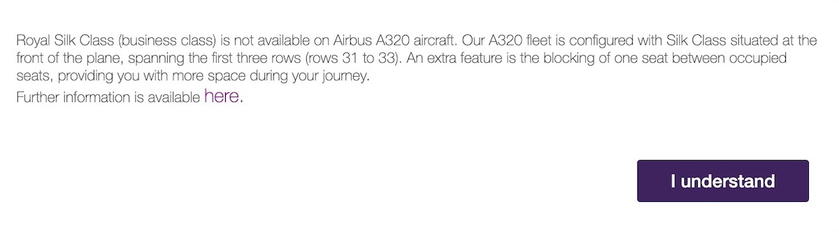
Thai Airways hasn’t changed any of the cabin products on former Thai Smile aircraft, as the airline historically offered economy and premium economy. Thai Smile’s premium product offered economy seats with blocked middles.
Thai Airways is now marketing this product as business class. However, during the booking process, there’s now a specific prompt you have to agree to, understanding the product being offered. This is because the airline has been investigated by authorities over false advertising related to this product.
It remains to be seen if Thai Airways will eventually reconfigure former Thai Smile jets with new interiors, or if this is how things will remain.
If you ask me, this change makes perfect sense. Yes, there were some cost savings for paying staff working for the low cost carrier a bit less. But aside from that:
- It’s less efficient to have a separate Air Operator Certificate, requiring operations to be managed independently
- Thai Airways’ mainline fleet otherwise only consists of wide body jets, so the airline now has a lot more flexibility with narrow body jets in its fleet; the airline can fly the planes with the right capacity to the right destinations
- Many frequent flyers avoided Thai Smile, given that the airline didn’t offer the same perks as Thai Airways, both in terms of passenger experience and frequent flyer reciprocity (this change is especially great for Star Alliance Gold members, who now get full perks on these flights)
This follows the industry trend, and is logical
Thai Airways isn’t the first airline to merge a subsidiary back into its mainline fleet:
- We’ve seen Singapore Airlines integrate subsidiary SilkAir into its mainline fleet, meaning Singapore Airlines now flies Boeing 737s
- We’ve seen Cathay Pacific integrate subsidiary Cathay Dragon into its mainline fleet, meaning Cathay Pacific now flies more A330s as well as A321s
Now, in fairness, SilkAir and Cathay Dragon both weren’t explicitly low cost carriers in terms of their passenger experience, but they did offer some cost saving advantages over their mainline counterparts in terms of labor.
Why are these subsidiary concepts failing, or at least no longer found to be worthwhile? Well, going back over a decade, ultra low cost carriers weren’t nearly as prevalent and competitive in Asia. So there was some merit to full service airlines setting up low cost units.
What has changed is that ultra low cost carriers are now fiercely competitive, and these subsidiaries really can’t compete on cost with those airlines. So they’re kind of offering the worst of both worlds — they can’t compete with ultra low cost carriers on cost, and they can’t compete with full service airlines on product.
At this point the synergies from eliminating these subsidiaries outweigh any benefits they may offer airlines. And I’d say that’s good for consumers, especially for frequent flyers and those looking to earn and redeem points.
Bottom line
Thai Smile has been merged back into the Thai Airways mainline fleet, just over a decade after the concept launched. This allows Thai Airways to once again have A320s (or any narrow body aircraft, for that matter) in its mainline fleet, which is a positive development.
It’s interesting to see how Thai Airways is now the third major Asian carrier to eliminate a subsidiary in recent years.
What do you make of Thai Smile being integrated back into Thai Airways?


Membership is free and takes no more information than commenting as a guest. Earn status points for good contributions, and see fewer ads as your status grows.