
A reader asked if I’m going to do a story on the American AAdvantage devaluation, and how American has seemingly raised saver level long haul business class award costs. Indeed, there hasn’t been much direct talk of this online, but I think that’s because this is a bit nuanced. Let me explain…
The slow & quiet devaluation of AAdvantage awards
OMAAT reader Sel, D., asked the following:
No article on AA deval? You mentioned TATL is now 75k. Japan looks like 92k and South America maybe 95k? I don’t think any bloggers have written about this. Looks like the days of 57.5k are gone. This is pretty massive.
So, has AAdvantage increased the cost of business class awards? Kind of, very gradually, so let me explain. Over two years ago, in April 2023, American AAdvantage announced that it would adopt dynamic award pricing for its own flights.
So while American still has a published award chart for travel on partner airlines with consistent pricing (unlike Delta SkyMiles and United MileagePlus), the program now simply lists “starting at” costs for its own flights. Below is the AAdvantage award chart for travel on American.
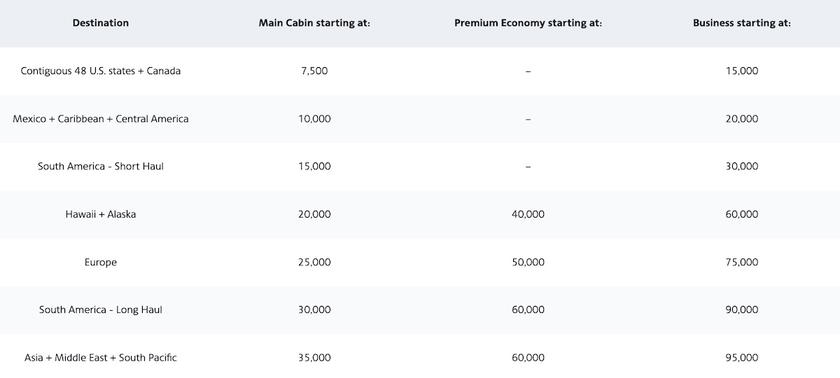
What made this interesting is that when the chart was published, the “starting at” award costs didn’t actually reflect the lowest costs. Quite to the contrary, American still consistently had much lower award pricing than what was listed. Underpromising and overdelivering is a rare thing to see from a US airline, so it was hard to know what to make of that.
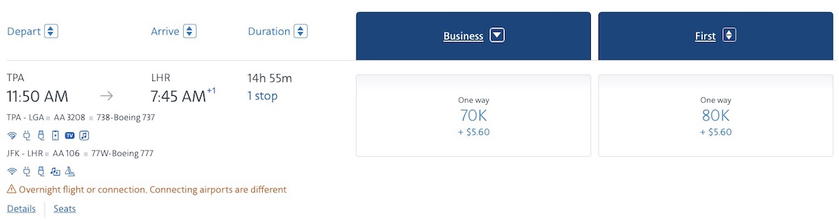
Part of the reason for this trend is that American increasingly uses married segment logic for award pricing, meaning that a Tampa to Miami to London award may cost less than just a Miami to London award (much like on revenue tickets, nonstop flights often cost more than itineraries with connections).
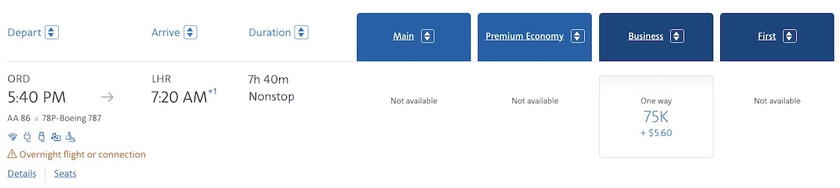
However, as time has gone on, the published pricing has increasingly reflected the actual pricing that American is charging. For example, as is pointed out above, 75,000 miles is increasingly the regular saver level one-way saver business class award cost between the United States and Europe, compared to the old cost of 57,500 miles.
The thing is, that’s still not consistently the case. For example, when adding an itinerary that includes multiple flights on American, I still see awards costing 70,000 miles.
And if you’re able to add a connecting flight on a partner airline, then the partner award chart applies. So that same American business class award from Chicago to London that costs 75,000 miles, would instead cost 57,500 miles if you just add a segment from London to Munich.
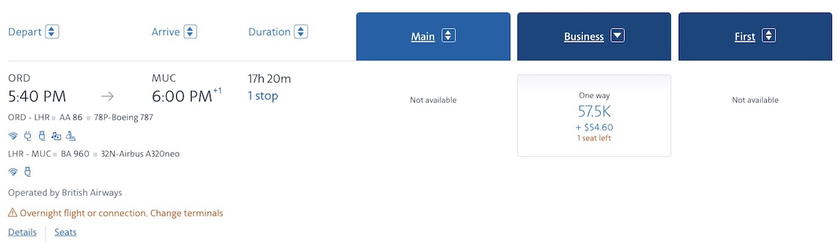
Yeah, we are definitely seeing a slight creep in award costs, closer to what American promised back in 2023. However, adding a segment on a partner airline gets you the lower saver level award cost, and there are still opportunities to get slightly lower pricing by adding connections.
Obviously when airlines introduce dynamic award pricing, it can be much harder to establish pricing trends, since the pricing creep can be very slow.
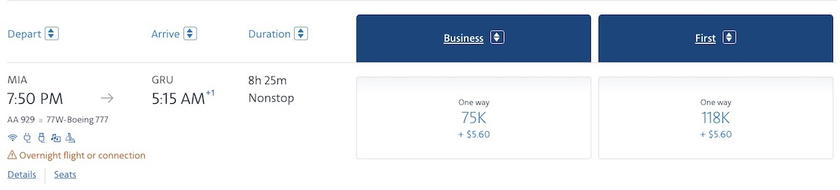
Broadly speaking, when there’s saver level business class award availability on American from the United States to South America, it’s now typically starting at 75,000 miles, compared to the old 62,500 miles.
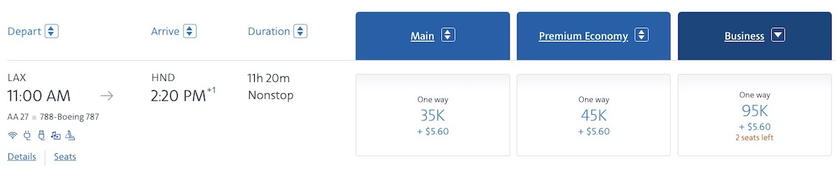
When there’s saver level business class award availability on American from the United States to Asia, it’s now typically starting at 95,000 miles, compared to the old 62,500 miles.
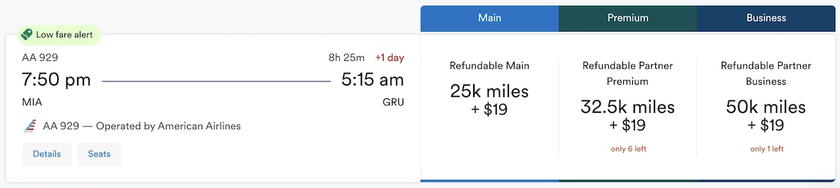
Let me emphasize that this applies to awards that are exclusively on American metal, and when booking through AAdvantage. There are still much better deals to be had through other programs.
I still find AAdvantage miles to be hugely valuable
Admittedly AAdvantage miles aren’t as useful as they were a decade ago, but then again, which mileage currency is? Ugh, I do miss the days of readily available Cathay Pacific first class awards between the United States and Asia for 67,500 AAdvantage miles… I digress. As miles & points have become more mainstream, it has also become much more difficult to get outsized value.
Anyway, despite the business class pricing creep we’ve seen with AAdvantage for American flights, I still find the program to be hugely valuable, and I redeem a lot of AAdvantage miles:
- American AAdvantage actually has some industry leading partner award cost pricing, unlike Delta SkyMiles and United MileagePlus
- American still opens up a fair amount of saver level premium cabin award space, on both short haul and long haul flights, at least compared to competitors (I often book these with Alaska Mileage Plan miles)
- While partner airlines have increasingly restricted award space to AAdvantage, availability continues to be excellent outside the United States, including on Etihad and Qatar

Anyway, at least up until this point, I’ve genuinely felt that AAdvantage leadership puts effort into making the program lucrative, including for those who seek outsized value for premium cabin travel. I can’t the same for MileagePlus or SkyMiles, which seem to take their members for granted a bit more, at least on the redemption front.
Bottom line
In 2023, AAdvantage introduced dynamic award pricing for travel on American, with new “starting at” rates for award costs. Increasingly, those minimum costs reflect what’s being charged, at least more than they did initially.
Yes, typically one-way American business class awards from the US to Europe now start at 75,000 miles, while one-way business class awards from the US to Asia now start at 95,000 miles. That pricing isn’t consistent, though, and you can get lower award costs with connections, especially on partner airlines.
What’s your take on the evolution of AAdvantage award pricing?


Membership is free and takes no more information than commenting as a guest. Earn status points for good contributions, and see fewer ads as your status grows.