
A Tokyo-bound American Airlines flight had to divert due to an onboard medical emergency. However, the airport the airline decided to divert to might surprise some people.
American’s Los Angeles to Tokyo flight diverts to Seattle
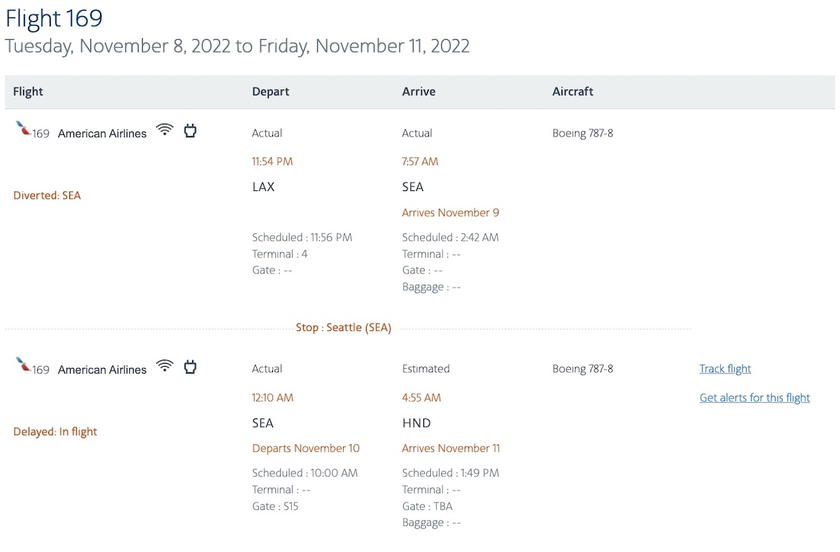
On Tuesday, November 8, 2022, American Airlines flight AA169 was scheduled to fly from Los Angeles (LAX) to Tokyo Haneda (HND). The flight was supposed to depart at 11:56PM and arrive at 5:05AM two days later. It was operated by a roughly two-year-old Boeing 787-8 with the registration code N870AX.
The flight departed more or less on time, and took off from LAX at 12:15AM local time. The 787 initially flew up the California coast, and then flew a bit more off the coast, over the Pacific Ocean. Around 4hr40min after departure, after having just passed Kodiak, Alaska, a passenger onboard had a medical emergency.
The crew made the decision to divert. However, the emergency presumably wasn’t life threatening, as the flight didn’t divert to Anchorage, which was only 250 miles away. Instead the Boeing 787 returned to the lower 48, and flew to Seattle. From there it took just under three hours for the plane to land in Seattle.
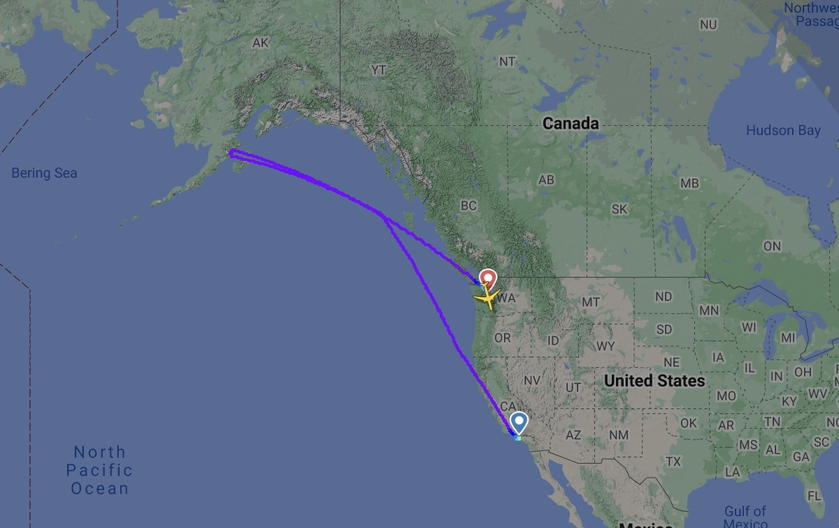
In the end, passengers had a 7.5+ hour flight from Los Angeles to Seattle, landing there shortly before 8AM.
People often wonder why flights don’t divert to the nearest airport in situations like this. When an emergency isn’t life threatening, diversion decisions often consider logistics and not just the closest airport. I assume that American’s operations department decided the airline would be better equipped to have customer service representatives available, find accommodations for passengers, find a new crew, etc., at an airport like Seattle rather than Anchorage.
I will say, I do wonder what kind of a medical emergency can wait for three hours, but can’t wait for seven hours (roughly the distance remaining to Tokyo). For that matter, it seems somewhat risky to return to the lower 48 and fly past Canada. If the emergency became more serious and a diversion to Canada was needed, the immigration logistics would have become much more complicated.

The flight will get to Tokyo 24 hours late
American now had a planeload full of Tokyo-bound passengers, and a crew that had timed out. While American was planning on growing in Seattle, the airline doesn’t have a crew base there, so finding a replacement crew would take some effort.
Furthermore, while Haneda Airport doesn’t formally have a curfew, in practice the airport has virtually no flights between 12AM and 4:30AM, so I imagine that was a consideration in terms of staffing. Furthermore, with many passengers presumably connecting beyond Tokyo, it made sense to still arrive at a time that’s good for connections, so that as few people as possible got stuck.
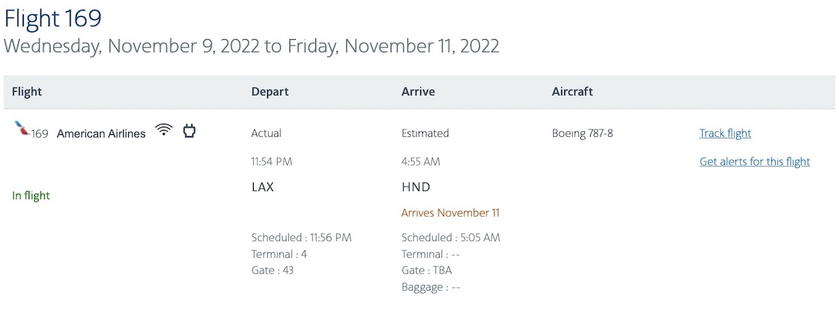
In the end, the decision was made to reschedule the Seattle to Tokyo Haneda flight for early the following morning. As mentioned above, passengers arrived in Seattle shortly before 8AM, and ended up taking off shortly before 2AM the following morning. The flight is now enroute to Tokyo Haneda, and should land shortly before 5AM, 24 hours behind schedule.
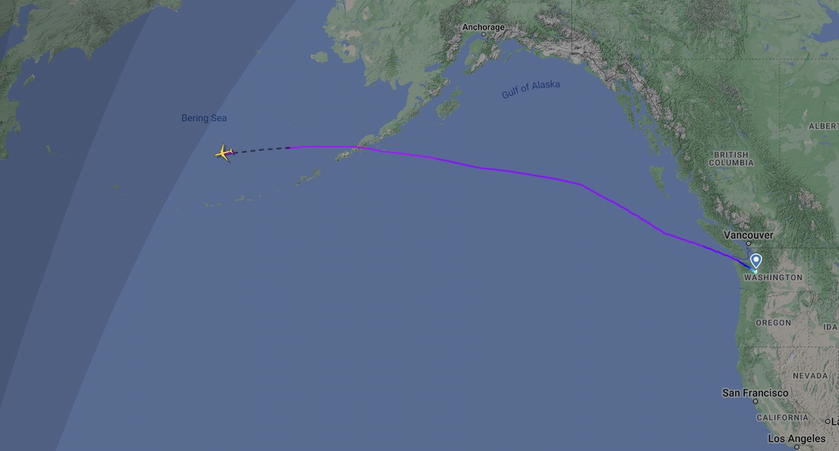
Funny enough the November 8 and November 9 AA169 services are currently scheduled to land in Tokyo at exactly the same time.
Bottom line
Passengers on Tuesday’s late night American Airlines flight from Los Angeles to Tokyo were in for quite an adventure. An onboard medical emergency over Alaska caused the flight to divert to Seattle, and the plane was in the air for around 7.5 hours.
Unfortunately once in Seattle the crew timed out (as you’d expect), so passengers were accommodated in hotels, and ended up departing around 2AM the following morning. The flight will get to Tokyo almost exactly 24 hours behind schedule, at the same time as the next day’s Los Angeles to Tokyo flight.
What do you make of this American Airlines diversion?


Membership is free and takes no more information than commenting as a guest. Earn status points for good contributions, and see fewer ads as your status grows.