
I have roughly two dozen credit cards (as one does), though I hold onto them for different reasons.
There are only around a handful of cards that I actually consistently spend a meaningful amount on. Other cards primarily sit in a drawer, and I just use them for the ongoing perks and statement credits they offer, which justify the annual fee. Other cards rotate through my wallet because they earn the best return on a specific category of spending.

In this post, I’d like to talk a bit about my credit card strategy for maximizing rewards, and in particular, the cards that I actually spend the most on, and why. Admittedly this changes over time, which is why I think it’s time for an updated post on the topic.
For each card below, I link to the full “is it worth it” analysis I’ve written — so this post is just intended to be a summary, and then you can learn more by clicking on the links, and crunch the numbers based on your own situation. I’ll also share some alternative cards to consider in each category.
My credit card “wallet” at a glance
Before I share the details, here’s the quick version of which card I use the most for my everyday spending (admittedly the cards I spend the most on reflect my purchase patterns):
- Everyday non-bonused spending: Bilt Palladium Card (Rates & Fees) — 2x points plus 4% Bilt Cash on everything
- Foreign spending: Atmos Rewards Summit Card — 3x points on all foreign purchases, no cap
- Restaurants and U.S. supermarkets: American Express® Gold Card — 4x points at restaurants worldwide (up to $50,000 annually) and 4x points at U.S. supermarkets (up to $25,000 annually), then 1x
- Direct hotel bookings: Chase Sapphire Reserve® Card — 4x points
- Airfare booked directly with airlines: American Express Platinum Card® — 5x points
- Hyatt stays + my $15,000 annual sweet-spot card: World of Hyatt Credit Card — 4x points at Hyatt, plus a second free night certificate after spending $15,000 annually, in addition to elite nights for ongoing spending
Again, those are the cards that I spend the most on. Separately, I hold many cards purely for ongoing perks — free night awards, elite status, lounge memberships — that justify their annual fees without my needing to spend anything on them. I’ll cover those after I talk about the cards that I use for spending.
The rewards credit cards I spend on
When I’m deciding which card to put a purchase on, I always try to choose the card that earns me the most value for a specific transaction. Below are the six cards that end up getting the most of my spending. Each one is the best in my wallet for what it does, but that’s not to say that it’ll be the best card for you, as we all have different spending patterns and rewards goals.
In addition to sharing the cards I use for each of these categories of spending, I’ll also include some good alternatives at the bottom of each section, in case you’re looking for something else, prefer a different points “ecosystem,” etc.
Bilt Palladium Card — for everyday non-bonused spending

The Bilt Palladium Card has a $495 annual fee (Rates & Fees) and is serviced by Cardless. It’s my go-to card for non-bonused spending, because the math on it is hard to beat — it offers 2x points on all eligible purchases, plus 4% back in the form of Bilt Cash.
Bilt Cash can be redeemed in a variety of ways, including to earn points on housing payments (about $4,000 worth of rent or mortgage rewarded per $3,000 in spending) or for spending accelerators that effectively boost you to 3x points on non-housing spending, up to $25,000 per year.
When you add everything up, I’m averaging well over 3x points per dollar spent in non-bonused categories, which is the highest return on everyday spending of any card in my wallet. Bilt Points are also genuinely valuable, and are transferable to Alaska Atmos Rewards, World of Hyatt, and other useful partners.
The one major restriction to be aware of is that tax payments aren’t eligible to earn points, which is an exclusion you won’t find with many major issuers. I do find that to be extremely frustrating, since paying taxes by credit card is a great way to earn rewards.
Full analysis: Is the Bilt Palladium Card worth the $495 annual fee?
Alternative best rewards credit cards for everyday spending: For personal cards, the Citi Double Cash® Card (learn more), Capital One Venture Rewards Credit Card (learn more), and Capital One Venture X Rewards Credit Card (learn more) are good alternatives, while for business cards, The Blue Business® Plus Credit Card from American Express (learn more) and Capital One Venture X Business (learn more) are good alternatives

Atmos™ Rewards Summit Visa Infinite® Credit Card — for foreign spending

The Atmos Rewards Summit Card has a $395 annual fee, and it’s one of those rare cards that’s worth applying for, worth holding, and worth spending on. My absolute favorite bonus category on this card is that it offers 3x points on all foreign purchases, with no cap. This might be the single best bonus category on any card I’ve seen, as we’ve never had a blanket return on foreign spending like this. So it’s my primary card whenever I’m abroad.
There’s another reason I spend heavily on this card, which is that it offers a 100,000-point Global Companion Award when you spend $60,000 in an anniversary year. So while I spend as much on the card abroad as possible, I supplement that with spending domestically. Between the 3x points on foreign purchases and the threshold bonus, the effective return on spending can reach as high as 4.67x points per dollar (I wouldn’t value it quite that high, but that’s the math).
If you’re going for elite status with Atmos Rewards, the card is useful as well, as you earn one status point per $2 spent. What I also appreciate so much is how the card’s annual fee is easily offset by the 25,000-point Global Companion Award, as well as waived partner award booking fees, for those of us who frequently redeem Atmos Rewards points.
Full analysis: Is the Atmos Rewards Summit Card worth the $395 annual fee?
Alternative best rewards credit cards for foreign spending: For personal cards, the Capital One Venture Rewards Credit Card (learn more) and Capital One Venture X Rewards Credit Card (learn more) are good alternatives, while for business cards, the Capital One Venture X Business (learn more) is a good alternative

American Express® Gold Card — for restaurants and U.S. supermarkets
The Amex Gold Card has a $325 annual fee (Rates & Fees), though that can largely be offset with the card’s credits. The reason the card earns a spot in my wallet is because of the bonus categories, which are arguably the most well-rounded in the entire market for any household that eats:
- 4x points at restaurants worldwide (up to $50,000 per calendar year, then 1x points), including takeout and delivery
- 4x points at U.S. supermarkets (up to $25,000 per calendar year, then 1x points)
Between those two categories, my family racks up a lot of points just on food spending… and food is expensive, especially with two little kids in the equation! The 4x points dining category also applies worldwide, so this card is useful for restaurants abroad (though the supermarket category is exclusive to the U.S.). However, I have to admit that I struggle to fully maximize all the card’s benefits, particularly the Dunkin’ credit, so the “real” value depends on how many of those credits you can take full advantage of.
Full analysis: Is the Amex Gold Card worth the annual fee?
Alternative best rewards credit cards for restaurant & supermarket spending: For restaurant spending, the Chase Freedom Unlimited® (learn more), Chase Sapphire Reserve® Card (learn more), Chase Sapphire Preferred® Card (learn more), Citi Strata Premier® Card (learn more), Citi Strata Elite℠ Card (learn more), and Bilt Obsidian Card (learn more) (Rates & Fees) are good alternatives, while for supermarket spending, the Citi Strata Premier® Card (learn more) and Bilt Obsidian Card (learn more) are good alternatives

Chase Sapphire Reserve® Card — for direct hotel bookings

The Chase Sapphire Reserve has a $795 annual fee, and while I mostly hold it for the perks (the lounge access, the travel credits, hotel credits, dining credits, the Apple Music subscription, etc.), there’s one spending category where I really appreciate this card, which is 4x points on direct hotel bookings.
Hotels are a big spending category for me, and 4x Ultimate Rewards points on those bookings is among the best returns available on a category that’s hard to earn a bonus on elsewhere.
Admittedly the importance of this bonus category largely reflects that I spend a lot on hotels. Others will appreciate that the card also offers 3x points on dining, but dining isn’t where I use it — that’s what the Amex Gold is for. And it offers 5x points on Lyft rides through September 30, 2027, which is useful as well, but isn’t a huge category for me. The hotel bonus category alone, paired with the credits and lounge access, are what justify the card for me.
Full analysis: Is the Chase Sapphire Reserve worth the annual fee?
Alternative best rewards credit cards for hotel spending: For hotel spending, the Citi Strata Premier® Card (learn more) and Ink Business Preferred® Credit Card (learn more) are good alternatives

American Express Platinum Card® — for airfare

The Amex Platinum Card has an $895 annual fee (Rates & Fees). Like the Sapphire Reserve, this is primarily a card that I hold for the perks (the lounge access, the credits that I max out with minimal effort, and the hotel and rental car status).
But it has one bonus category where it’s unambiguously the best card available. I’m talking about the Amex Platinum’s 5x points on airfare booked directly with airlines, on up to $500,000 in flight purchases per calendar year.
I value Membership Rewards points at 1.7 cents each, so that’s an 8.5% return on airfare spending. That’s better than any other airfare earning card I’ve seen. I spend meaningfully on airfare, and the card also offers solid travel protection on top of the earning rate, so using this card is a no-brainer for me.
Full analysis: Is the Amex Platinum Card worth the annual fee?
Alternative best rewards credit cards for airfare spending: For airfare spending, the Chase Sapphire Reserve® Card (learn more), Sapphire Reserve for Business℠ (learn more), Ink Business Preferred® Credit Card (learn more), and Citi Strata Premier® Card (learn more), are good alternatives

World of Hyatt Credit Card — $15,000 of spending for the second free night
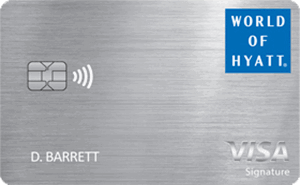
The World of Hyatt Credit Card has a $95 annual fee, and it’s a bit of an oddball in my wallet. While the card isn’t the best earner in any single category among my cards, I still put $15,000 of spending on it each year. That’s because the $15,000 threshold unlocks a second Category 1-4 free night certificate plus six additional elite nights toward status, and I’ve consistently redeemed those free night awards at hotels retailing for well over $200 per night. Effectively that’s better than two points per dollar on otherwise unbonused spending.
I’ve held this card since 2018 and hit $15,000 every year for exactly this reason. Beyond the spending sweet spot, the card’s $95 annual fee is already justified through the anniversary free night alone, plus Discoverist status and five elite nights toward status with no spending required.
Full analysis: Is the World of Hyatt Credit Card worth it?
Alternative best rewards credit cards for threshold bonuses: There are lots of great cards that can be worthwhile for large purchases, based on the bonuses they offer for reaching certain spending thresholds, whether that’s elite status, free night or companion certificates, etc.

The cards I hold but don’t regularly spend on
The above are the cards that get a meaningful amount of spending from me. However, there are also many cards that I’m happy to pay an annual fee on without actually putting much spending on. The concept here is straightforward, as each offers ongoing benefits that more than cover the annual fee. This could include everything from an annual free night award, to elite status, to credits, to lounge access.
Spending meaningfully on these cards would be a waste based on my own goals, because better options exist for that, but holding them still makes sense. Here are some of those cards:
- The Hilton Honors American Express Aspire Card (learn more) has a $550 annual fee (Rates & Fees) but offers benefits that more than justify it, including an annual free night award, up to $400 per year in Hilton resort credits, Honors Diamond Elite status, and much more.
- The Marriott Bonvoy Brilliant® American Express® Card (learn more) has a $650 annual fee (Rates & Fees) and is worth it for up to $300 in dining statement credits per calendar year ($25 monthly at restaurants worldwide), Bonvoy Platinum Elite status and 25 elite nights for having the card, and a free night award valid at properties costing up to 85,000 points per night
- The IHG One Rewards Premier Credit Card (learn more) has a $150 annual fee and offers an anniversary free night certificate, IHG One Rewards Gold status, and a fourth night free on award redemptions
- The Citi® / AAdvantage® Executive World Legend Mastercard® (learn more) has a $695 annual fee and is justified by its perks on its own, including an Admirals Club membership and up to 40,000 bonus Loyalty Points per year with no spending requirement
To me, the perks on these cards more than justify the annual fee on an ongoing basis, so they stay in the drawer, get used for the credits and statuses, and don’t see much purchase spending. That’s a perfectly valid card-management strategy, and one that I think is underused.

What credit cards aren’t prioritized in my wallet, and why
Just as useful as knowing the cards that I carry (either for spending or for the perks) is understanding the cards that I typically don’t carry. Here are some strategies I typically avoid, with an explanation for why:
- Most “everyday spending” 2% cashback credit cards — while earning a return equivalent to 2% on credit card spending is the minimum “gold standard,” personally I prefer earning transferable points, since those allow me to get more outsized value; any card like this would replace the Bilt Palladium in my wallet for non-bonused spending, but the Bilt math (2x points plus 4% Bilt Cash that translates into housing rewards or 3x accelerators) consistently beats them for me
- Most single airline co-brand credit cards — I have a few co-branded airline credit cards that I hold for the perks that they offer (whether it’s lounge access, priority perks, etc.), and some I even spend on for elite status; however, as a general rule of thumb, I don’t hold onto airline credit cards in the long run, and definitely don’t spend much on them, given that the bonus categories typically aren’t exciting
- Hotel co-brand credit cards for chains I don’t stay at regularly. I hold the Hilton Honors Aspire Card, Marriott Bonvoy Brilliant Card, IHG Premier Card, and World of Hyatt Card, which are four hotel cards aligned with chains I genuinely use; however, beyond that I don’t typically get many hotel cards, since it’s an area where I try to manage the annual fees that I pay
I also have several cards that I pick up for the great welcome offers that they have. I’ll always give the cards a try, and then after a year I decide whether the card is offering value for me, and whether it’s worth keeping, especially if there’s an annual fee.
Bottom line
I’d like to think I have a pretty well-tuned credit card setup. Across the six cards I spend most on, I’m earning anywhere from 2x to 5x points per dollar in their best categories, and when you average it all out, I’m earning well over 3x points per dollar on my overall spending — a return I’d value at over 5%. To recap:
- My favorite card for everyday non-bonused spending is the Bilt Palladium Card (for the 2x points and 4% Bilt Cash)
- The Atmos Rewards Summit Card is unbeatable for foreign spending (3x points, no cap), plus the $60,000 spend threshold unlocks a 100,000-point Global Companion Award
- The Amex Gold Card gets all of my food spending — restaurants and U.S. supermarkets
- The Chase Sapphire Reserve gets my direct hotel bookings, and the Amex Platinum Card gets my airfare spending
- I deliberately spend at least $15,000 on the World of Hyatt Credit Card every year for the second Category 1-4 free night certificate and six additional elite nights toward status
- Several cards (Hilton Aspire, Marriott Bonvoy Brilliant, IHG Premier, Citi AAdvantage Executive) stay in the drawer purely for the ongoing perks, which more than justify the annual fees on their own
Anyway, that’s a (relatively) brief summary of my setup, though the linked “worth it” posts have the more detailed math on how I make those cards work.
What are the primary credit cards you use for spending? Has your setup evolved recently, and which card has surprised you most — for better or worse?
The following links will direct you to the rates and fees for mentioned American Express Cards. These include: American Express® Gold Card (Rates & Fees), American Express Platinum Card® (Rates & Fees), Marriott Bonvoy Brilliant® American Express® Card (Rates & Fees), and Hilton Honors American Express Aspire Card (Rates & Fees).


Membership is free and takes no more information than commenting as a guest. Earn status points for good contributions, and see fewer ads as your status grows.