
Delta is currently making a huge push to expand across the Pacific, claiming it wants to beat United there. It’s a region in which Delta has been weak in recent years, at least when it comes to serving anything beyond Seoul Incheon (ICN), the hub for joint venture partner Korean Air.
A few months ago, I took a look at the data of how poorly Delta is performing across the Pacific, following the “big three” carriers reporting their Q2 2026 earnings. With all three of the airlines having now reported their Q3 2026 earnings, I’d like to take a look at the latest. Are things getting better or worse for Delta?
The math on Delta’s expansion isn’t pretty right now
With American, Delta, and United, having all reported their Q3 2026 earnings, I think it’s interesting to look at how all airlines did across the Pacific in the quarter, at least directionally. I’m not doing this to pick on Delta (I swear), and I’ll explain more later. But first let’s look at the actual math, and thanks to JonNYC for bringing this up.
I’d like to compare performance across the Pacific in the last two quarters between American, Delta, and United. Just to define the terms here:
- Yield is the passenger revenue divided by the number of revenue passenger miles flown, so it reflects what people are actually paying to fly, and doesn’t account for empty seats
- PRASM is the passenger revenue per available seat mile, and you calculate that by taking the total passenger revenue and dividing it by the number of seat miles, so it factors in empty seats
- ASMs refers to available seat miles, meaning the total number of miles flown by a plane multiplied by the number of available seats
- Load factor refers to the percentage of seats actually filled on flights
Below is a comparison of Q3 2026 year-over-year Pacific performance for American, Delta, and United.
| Q3 2026 details | American | Delta | United |
|---|---|---|---|
| Yield | +14.8% | +7% | +10.8% |
| PRASM | +11.3% | +5% | +10.9% |
| Capacity (ASMs) | +6.6% | +8% | +5.0% |
| Load factor | −2.6 points | −2.0 points | +0.1 points |
As you can see, there’s a major outlier here. To put this into basic terms:
- American saw the biggest increase in the average fare paid, with a significant increase in revenue per available seat, despite a decrease in load factor; yield growth more than double outpaced capacity growth, which is excellent
- Delta saw a bigger increase in capacity than in yield and revenue per available seat mile, despite fares being up so much across the board
- United had very balanced growth across the Pacific, adding a modest amount of capacity, while being the only airline to see load factor go up, and also commanding higher fares
As you can see, Delta was the outlier here, and was the only airline where capacity growth exceeded yield growth.
Below is the chart for Q2 2026. As you can see, Delta was also the negative outlier then, but the situation has gotten even worse since then.
| Q2 2026 details | American | Delta | United |
|---|---|---|---|
| Yield | +17.3% | +7% | +10.9% |
| PRASM | +15.1% | +7% | +14.0% |
| Capacity (ASMs) | +8.2% | +8% | +4.1% |
| Load factor | −1.7 points | −1.0 points | +2.3 points |
What can we make of Delta’s issues across the Pacific?
Please hear me out, because I’m not writing this to rag on Delta. Quite the contrary, I’m happy to see an airline growing across the Pacific and trying to compete with United.
Airline data is fascinating because it’s both endless and insightful, but it doesn’t tell the full story, given the complexity of airline revenue performance. When I look at airline data, what I find most interesting is directional trends among competitors.
Delta is a very well-run airline, all things considered, and has been the most profitable US carrier for many years now. In most areas, Delta outperforms competitors. So it’s really interesting to see one region where Delta has now lagged both United and American in two consecutive quarters.
I have to imagine these two quarters weren’t exceptions, and that Delta’s performance will keep getting worse before it improves, as the airline continues to add new routes. Now, that’s largely fair enough, because it takes time for growth to become profitable. I think I have two takeaways here.
First, I can rationalize why American has sort of given up on Asia, and has such a minimal presence:
- It’s really hard to make money as a US airline flying across the Pacific unless you have the perfect hub and have other advantages, like being the established player
- American actually seems to be doing well in Asia for the limited number of routes that it operates
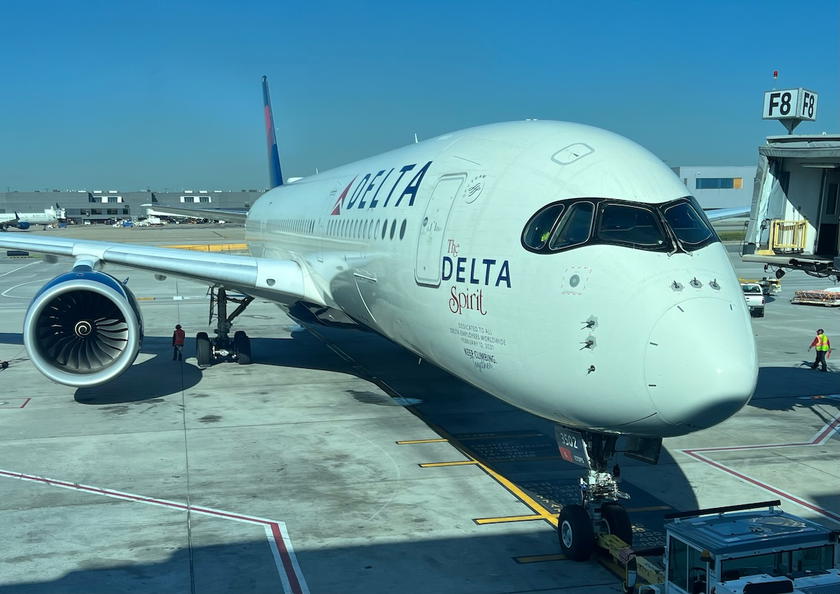
Second, one wonders if Delta will just struggle as it continues to grow, or if Delta has a major, structural disadvantage to United, which it can’t overcome. Delta’s split hub strategy between Los Angeles (LAX) and Seattle (SEA) is just much more poorly positioned than United’s primary hub in San Francisco (SFO), in terms of pricing power, local loyalty, connectivity, etc.
Delta recently added Hong Kong (HKG) flights, and it’s a market United serves four times daily. So the fact that Delta’s performance has only worsened while United’s performance has continued to remain strong despite the new competition isn’t exactly a great sign. United CEO Scott Kirby probably wasn’t wrong when he mocked Delta’s recent transpacific expansion.
Bottom line
Delta’s numbers across the Pacific aren’t pretty. While both United and American are seeing yield growth significantly outpace capacity growth, the opposite has now been true for Delta for two quarters in a row. I don’t think this should come as much of a surprise, since it takes time to become profitable in new markets.
However, one can’t help but wonder if this is just a temporary issue that will solve itself with time, or if Delta has a structural disadvantage here that it won’t be able to overcome. We’re only at the very early stages of Delta’s transpacific growth, if the airline is actually serious about overtaking United.
What do you make of Delta’s Pacific situation?


I am gobsmacked to hear this.
LAX is not the place to grow TPAC. Lots of capacity, tons of competition, and yields always under pressure.
SEA? AS is absorbing a lot of losses to grow but it has the upper hand there, and will win the battle. A recession will spell the end of Delta's SEA ambitions.
do you realize how much money AS is losing this year?
and UA's own execs are saying that they expect fuel prices to remain elevated until the end of 2027
AS is absolutely no threat to DL and in fact DL can easily bleed AS dry if it chooses to do so.
AS picked a mighty fine time to decide to take on DL's int'l position at SEA on top of a merger and now paying the legacy industry's highest prices for jet fuel - even higher than UA.
They're growing revenue and capacity is up. I would guess TPAC is a very small percentage of revenues so I doubt they care if they're behind on that percentage if they're ahead on the bigger pieces of pie.
It’s currently 13% of total revenue, so not too small.
Plus DL has said they want to grow considerably in the region, with some saying they want to overtake UA TPAC.
Not off to a good start, and probably sheds light on why they cut so much TPAC in the first place.
Also, having the A350 as their main TPAC plane doesn’t give them a lot of flexibility to open new markets....
It’s currently 13% of total revenue, so not too small.
Plus DL has said they want to grow considerably in the region, with some saying they want to overtake UA TPAC.
Not off to a good start, and probably sheds light on why they cut so much TPAC in the first place.
Also, having the A350 as their main TPAC plane doesn’t give them a lot of flexibility to open new markets. The Air Show discussed how the 787 is the best TPAC plane, balancing range and capacity. Based on these figures, looks like they were onto something.
you manipulate everything you can.
The Air Show did not say the 787 is the best TPAC plane.
They said it is the best airplane, in their opinion, to start new routes.
In fact, DL is carrying 25-30% more cargo per flight on its 359s compared to UA's 789s.
The argument just isn't supported in real life.
It is beyond ludicrous to argue that it makes sense to upgauge on the domestic and...
you manipulate everything you can.
The Air Show did not say the 787 is the best TPAC plane.
They said it is the best airplane, in their opinion, to start new routes.
In fact, DL is carrying 25-30% more cargo per flight on its 359s compared to UA's 789s.
The argument just isn't supported in real life.
It is beyond ludicrous to argue that it makes sense to upgauge on the domestic and TATL system and then argue that using the smallest longhaul new generation widebody makes sense on the Pacific.
The argument is a not-very-veiled coverup for the fact that UA has burned its bridges with Rolls Royce even though it has had both versions of the 350 on order for years and now faces at best ordering the 777X in order to compete with a large new generation widebody.
UA will most certainly buy a new generation large widebody and then this horse manure will be seen for what it is
@Mark, agreed on the 787 vs the A350. Fuel burn and lift performance over the 787 is meaningless unless you can fill those seats with good yielding passengers.
Ultimately what's going to happen in Asia with the A350, is what DL does in Europe, just feed the partner hubs.
If you're flying DL in the Pacific, hope you like ICN.
But if they're leading in that other 87% of revenue, or the majority of it, then they probably don't mind the 13% bucket.
True, except UA has overtaken DL in total revenue and outperforms DL in their most contested market, NYC.
Additionally, most of DL’s financial advantages come from the fortress hub pricing and credit card revenue agreement with AMEX.
With UA starting negotiations on a new contract with Chase, one of DL’s main advantages will disappear, which seems to be why DL is trying to diversify into TPAC. It will be a challenge though.
again, false.
DL generates more revenue than UA and has for years.
If you exclude the refinery, then, yes, UA generates more revenue but nowhere near the 10% more that UA should be generating given that they fly 10% more capacity.
You can dream that UA will come close to what DL can do with Amex but the chances are much higher than DL will once again jump well over what AA or UA or...
again, false.
DL generates more revenue than UA and has for years.
If you exclude the refinery, then, yes, UA generates more revenue but nowhere near the 10% more that UA should be generating given that they fly 10% more capacity.
You can dream that UA will come close to what DL can do with Amex but the chances are much higher than DL will once again jump well over what AA or UA or WN can negotiate.
Doesn't it bother you even a little bit that WN is getting as much of Chase's attention right now?
Although UA’s TPAC growth percentage is lower than DL’s, DL is starting at a much lower base so the absolute amount of growth is still lower than it is at UA, making DL’s financial underperformance even more surprising.
Seems like DL needs to choose the location of its TPAC megahub and go with it, like UA has in SFO, though neither of DL’s options are great.
Additionally, DL’s two options will get worse...
Although UA’s TPAC growth percentage is lower than DL’s, DL is starting at a much lower base so the absolute amount of growth is still lower than it is at UA, making DL’s financial underperformance even more surprising.
Seems like DL needs to choose the location of its TPAC megahub and go with it, like UA has in SFO, though neither of DL’s options are great.
Additionally, DL’s two options will get worse as AS continues to expand in SEA and AA gets ready to grow in LAX.
It’s ok Ben I’m sure someone will be here shortly to tell you that actually when delta loses money it’s STRATEGIC and when other airlines lose money it’s BAD. Duh!!!
The rise of Alaskan airlines has been brutal for Delta's Pacific ambitions. They're fighting a losing battle in Seattle for hub dominance, and Los Angeles is a never ending battle ground as well. However, Delta is kind of forced to keep up the fight forever. There just aren't many good Pacific hubs on the west coast; United has cornered San Francisco, and Alaska is beating them in Seattle.
That being said, Delta has plenty of...
The rise of Alaskan airlines has been brutal for Delta's Pacific ambitions. They're fighting a losing battle in Seattle for hub dominance, and Los Angeles is a never ending battle ground as well. However, Delta is kind of forced to keep up the fight forever. There just aren't many good Pacific hubs on the west coast; United has cornered San Francisco, and Alaska is beating them in Seattle.
That being said, Delta has plenty of money, so they can keep up the fight for as long as they want.
The new SEA-NRT route definitely won’t improve those numbers.
Geography is not on Delta's side here. SEA is way closer to most Asian destinations that Americans care about than LAX is (I know, you Californians have a hard time getting your head wrapped around that). Alaska is going to eat Delta's lunch for trans-Pacific flights more and more as they continue to expand.
Delta also constantly craps on their most loyal customers...does anyone really bother with collecting worthless SkyPesos? I sure don't. As look...
Geography is not on Delta's side here. SEA is way closer to most Asian destinations that Americans care about than LAX is (I know, you Californians have a hard time getting your head wrapped around that). Alaska is going to eat Delta's lunch for trans-Pacific flights more and more as they continue to expand.
Delta also constantly craps on their most loyal customers...does anyone really bother with collecting worthless SkyPesos? I sure don't. As look as they're so worthless you need to bring a nearly a million of them for a decent business class seat across an ocean, I'll return the same contempt that Delta has always shown me.
Economically it is a tough time to grow right now. Being a new entrant makes it harder. Hopefully they have enough corporate contracts and high-spending loyalists to keep these routes alive.
UA backs up the West coast to HKG nonstops with beyond service to BKK and SGN.
this was as predictable as the sun rising in the east; i cannot fathom how DL execs even considered this strategy (such as it is) let alone decide to lock the airline inside the woodchipper and turn it on
I think weakness of DLs west coast hubs is on full display here. UA's dominance at SFO coupled with far better connectivity both increases O+D traffic from the Bay Area while also greater connectivity to secondary cities vis-a-vis a much larger hub operation than DL can ever create at LAX or SEA without a major competitor dehubbing to make room. One also wonders if DL is also not seen as a premium carrier on NA-Asia...
I think weakness of DLs west coast hubs is on full display here. UA's dominance at SFO coupled with far better connectivity both increases O+D traffic from the Bay Area while also greater connectivity to secondary cities vis-a-vis a much larger hub operation than DL can ever create at LAX or SEA without a major competitor dehubbing to make room. One also wonders if DL is also not seen as a premium carrier on NA-Asia routes when compared to Singapore, Cathay, Eva and other highly-regarded Asian carriers.
And of course Delta's trans-Pac experiment at PDX was a total failure.
Are we supposed to care? How exactly does it affect either you and me?
Delta would still rather fly an empty cabin than give a single seat away at a reasonable price to SkyMiles members or any inventory to SkyTeam partners.
first, let's be clear that this is yet another attempt by the UA fan nut jobs and their surrogages - which include Jon - to portray DL's TPAC expansion as a failure.
first, let's get into the basic numbers. UA grew capacity at the lowest rate which is not a surprise. It isn't adding flights that are anywhere near as long as DL is adding; yields go down on longer flights.
second, AA has seen...
first, let's be clear that this is yet another attempt by the UA fan nut jobs and their surrogages - which include Jon - to portray DL's TPAC expansion as a failure.
first, let's get into the basic numbers. UA grew capacity at the lowest rate which is not a surprise. It isn't adding flights that are anywhere near as long as DL is adding; yields go down on longer flights.
second, AA has seen very positive results from its making up w/ corporate travel which is boosting its performance even on TPAC routes, most of which is to/from Japan which is red hot right now.
third, DL's TPAC RASM is positive. If their RASM was going down, then there would a problem.
But's be clear that DL could by with a 20% RASM deficit on the Pacific and still perform as good or better than either AA or UA on the bottom line because
1. DL is only growing over the Pacific.
2. DL had an enormous profit advantage coming into the Iran war - they made $1.6 billion more than UA in 2025 and $4 billion more than AA.
3. DL has an enormous fuel cost advantage right now due to the refinery and its cost savings for DL on jet fuel but also for the profits that the refinery generates for non-jet fuel products. The third quarter was actually the lowest benefit at 19 cents/gallon all-in (29 cents/gallon compared to UA) but DL has already said that the refinery will save them 40 cents/gallon on jet fuel costs plus even more from non-jet fuel refinery sales and profits.
DL could end up w/ a 75 cent/gallon fuel cost advantage compared to UA.
And let's keep in mind that UA runs a substantial number of its TPAC flights on 777s which burn 20% more than the A350s that make up the majority of DL's TPAC fleet.
DL's cargo has been growing at far faster levels than the US industry; the A350 in either version carries far more cargo than the tiny little 787s that AA and UA fly on new generation widebodies.
DL is carrying 80% of the cargo on the A350-900 that UA carries on its 777-300ERs and very likely making far more money because of the A350-900's far better economics.
The A350-1000 is a cargo beast. and does so with far better fuel efficiency.
and for those mental midgets that want to argue that DL has no fuel cost benefit on the west coast because the refinery is on the east coast, you truly understand nothing about accounting or business practices. Do you really think that grocery stores price milk so low because they expect people will only come in and buy milk and go elsewhere for their other groceries?
We have heard the same ignorant comments about DL in SEA and yet DL for years has generated far higher profits than the entire rest of the industry.
DL will generate over 60% of US airline profits; AA, AS, B6 won't even be profitable in 2026.
Even if DL's TPAC financial performance was losing money, they could support it because of their huge profit advantage which is only boosted now because of their fuel cost advantage.
Here's the data point that the UA fans won't push but it is absolutely valid.
UA told the DOT that it made $53 million flying the Pacific in the 2nd quarter while DL made $103 million - meaning that DL's TPAC network was about 4X more profitable per ASMs. the most fuel efficient TPAC fleet and much lower fuel costs will do that.
oh, and AA lost $42 million on its TPAC network.
DL execs said months ago that they are coming after United's TPAC advantage and DL could not have chosen a better time to be taking UA on.
DL's first A350-1000s
bring out the gimp
bring out the facts.
DL made almost twice as much flying the Pacific in the second quarter than UA did even though UA flew twice the capacity.
THAT is the economics that matter, Jon.
We would never expect you to discuss real facts.
DL should have never given up the Tokyo advantage that NWA had when they aquried them. Seoul is not Tokyo and Korean Air is not JAL or ANA. It was a huge mis-step and if AA does build up LAX again, I think they even with limited but key dots on the Asian map will do just fine and DL will eventually reduce thier Asian scope. Also, let's not discount the pressure from AK now in SEA and sorry to say SLC isn't going to be an Asian Pac hub.
What a surprise when you deliver vapor ware - planes with no functioning wif-fi over the Pacific