What Happened To The Norwegian 737 That Diverted To Iran?

Recently I wrote about how a Norwegian 737 MAX was operating a flight from Dubai to Oslo.

It suffered a serious engine problem (despite the aircraft being only a few months old), and was forced to divert to Shiraz, Iran.

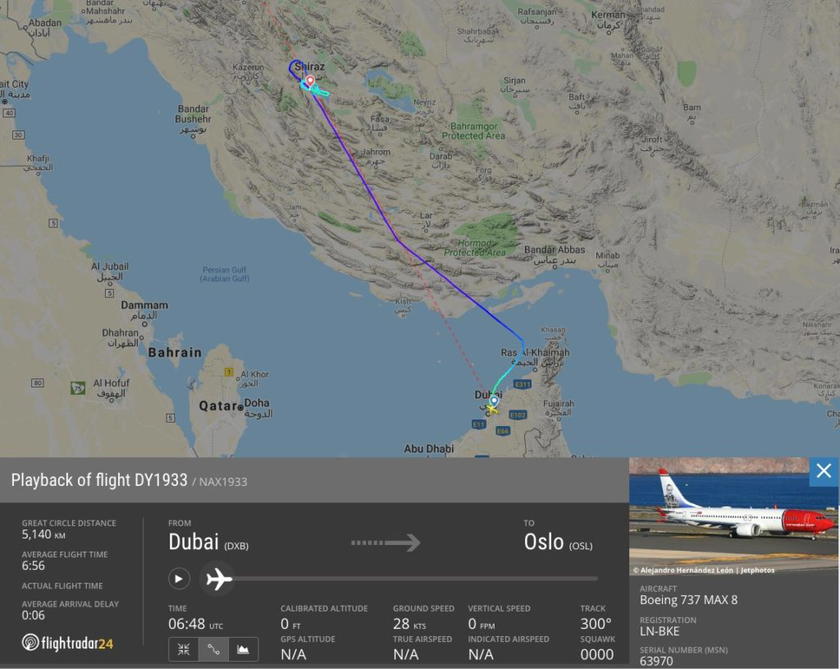
What made this interesting (and complicated) was the diplomatic situation if spare engine parts were needed to be sent to fix the aircraft from the US or Europe. This is because there are strict trade sanctions in place between these countries and Iran.

It raised several questions about what would happen to this aircraft, and several readers debated in the comments of my earlier article about the ease or difficulty of fixing this plane. Some believed it would not be a problem, and that either the sanctions did not apply to this situation, or if they did, an exception would be made because of the circumstances.

Reader Mark Frizzell yesterday posted the following comment:

Any update? Was the plane recovered from Iran?

This was a great reminder to see what has happened with the aircraft, more than two weeks after the original diversion.

So what did happen?

All passengers travelled to Oslo on a replacement aircraft that was sent from Oslo to Shiraz.

But Flightradar24 is showing the faulty 737 MAX aircraft, LN-BKE, is still on the ground in Shiraz.
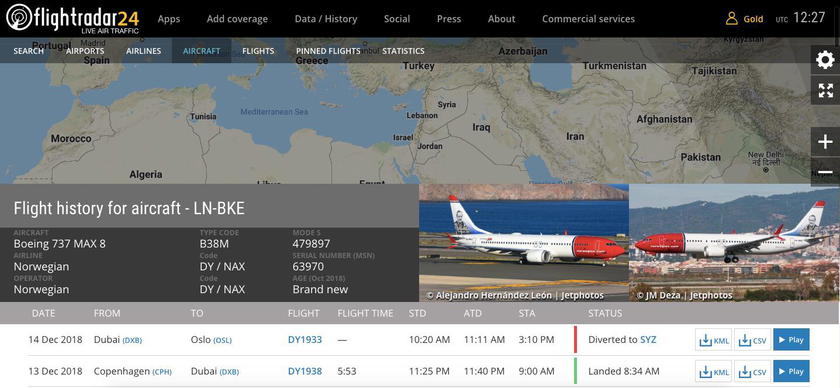
The Airliners forum believes that the engine suffered an ‘oil-associated fault,’ and the Norwegian engineers who were originally sent to Shiraz to repair the plane were unable to do so.

As a result a replacement engine needs to be sourced. The additional paperwork/red tape, because of the sanctions restrictions, are believed to be holding up the process.

https://www.instagram.com/p/Br-JX90BDo0/

Bottom line

I’ll keep an eye on what happens here — I thought they may have tried to fly the damaged aircraft (empty) to a neighbouring country, where it might be easier to source replacement parts, but that doesn’t appear to have happened.

Perhaps Norwegian didn’t think the faulty engine would be so difficult to replace?

Conversations (19)
The comments on this page have not been provided, reviewed, approved or otherwise endorsed by any advertiser, and it is not an advertiser's responsibility to ensure posts and/or questions are answered.
Comment as a member

Membership is free and takes no more information than commenting as a guest. Earn status points for good contributions, and see fewer ads as your status grows.

Type your response here.

If you'd like to participate in the discussion, please adhere to our commenting guidelines. Anyone can comment, and your email address will not be published. Register to save your unique username and earn special OMAAT reputation perks!

  1. Loading comments…
Recent Comments
The latest from the OMAAT community.

The comments on this page have not been provided, reviewed, approved or otherwise endorsed by any advertiser, and it is not an advertiser's responsibility to ensure posts and/or questions are answered.

Gordon Guest

Who was inquiring about the differences between the United States and Iran?

0
‼ 0
Kachnik Guest

Only one logical explanation, he is currently imprisoned in Iran or North Korea

0
‼ 0
nope Guest

Is there any difference between Iran and US? Let me think.... At first glance... autocratic regime without real moral standards. Ok one difference perhaps.... No dead kids in refugee camp because of dehydration in Iran.

0
‼ 0
Gordon Guest

"This is completely, utterly, and absolutely false. Single engine operations on multi engine aircraft are quite common, especially during training. In fact, pilots training for their multi-engine certification spend more time flying with one engine than both" I don't know who the freak you are, but the above is a gigantic self serving LIE. What the freak is wrong with you?

0
‼ 0
markiteight Guest

@Mike says, "Name me a twin commercial airliner verified to fly, even as ferry, on one engine." All of them. @Mike also spewed forth, "One engined Ops are simply not permissible, unless you’re in a 172, Cirrus, Piper…" This is completely, utterly, and absolutely false. Single engine operations on multi engine aircraft are quite common, especially during training. In fact, pilots training for their multi-engine certification spend more time flying with one engine than both. Nowhere in the FARs is there a regulation prohibiting the operation of only one engine on a multiengine aircraft. Finally, @Mike ate shoe leather, "Come on OMAAT, up the standards please. This is junk." Might I suggest you know WTF you're talking about before making such proclamations? Kthanksbye.

0
‼ 0

Save posts to read later

Saving posts is a member feature. Become an OMAAT member to build a reading list you can come back to from any device.

Become a member
Keep Exploring OMAAT