
With summer just around the corner, many of us are probably planning trips that involve renting cars in various locations. As more and more highways in North America move toward cashless toll systems, we can pretty much plan on two things:
- Traffic will be (somewhat) alleviated.
- Rental car companies will find a way to monetize this system, often at the expense of the consumer (read: us).
The rental car toll setup
Essentially, when you drive through a cashless toll, the monitoring system picks up on your license plate or tag number, and bills you for the cost of the toll.

This is easy enough when you are driving a personal vehicle, but when rental car companies are involved, they are the ones who pass the cost of the toll along to the consumer. Given that this presents an extra step for them and they basically have carte blanche to charge whatever they want, they will charge some sort of “convenience” or “administrative” fee. This can be as little as $2.95 per day, and as much as $25 per occurrence.
I was recently reminded of this on a trip to Denver, where their E-470 toll road charges your vehicle based on various distance intervals. On my way into town, I accidentally made a wrong turn onto the toll road. So not only did I have to pay the $2.70 for using said road, but I knew I would have to pay Budget $3.95 for opting into their electronic toll system.
And just to add insult to injury, Budget doesn’t just charge you for the days that you use the tolls, but they instead charge you for each day of the rental period. So my $2.70 toll ended up incurring me an additional $15.80 charge from Budget.
Shame. Shame. Shame.

Luckily, I knew about this going in, but only because I basically pried the information out of the agent at the desk. This is a huge money maker for rental car companies, so they’re not exactly going to go out of their way to disclose the hidden fees. Chances are, if you’ve ever been hit with one of these charges, you probably didn’t see it coming.
Question is, would I have been better off with another company?
Toll policies vary for each rental car company
Generally, rental car companies handle toll billing one of several different ways:
1) Flat rate per rental day to either opt into the program or rent a transponder
You are still responsible for all toll charges. (Avis, Budget, Firefly and Payless have an automatic opt-in system that activates the first time you drive through a cashless toll, while Alamo, Enterprise, and National offer the option of renting a transponder in areas where you can pay cash.)
2) Convenience fee for any day that you use a cashless toll
Again, you are responsible for the toll charges, but you only pay the extra fee on the day that you drive through an electronic toll (Hertz falls into this category, and Alamo, Enterprise, and National all go this route if you choose not to rent a transponder).
3) Flat rate per day that includes all tolls, which you must opt into at the time of rental
These options are typically associated with some of the lower-cost rental car providers (Dollar, Fox, Sixt, and Thrifty), and are usually paired with a straight-up extortion fee per violation if you opt out of this service and accidentally drive through a cashless toll.
4) Cost of the toll only, with no administrative fee
This is ideal, but few companies do it. (Thanks, Silvercar!)
With that in mind, let’s go through the individual policies of the major (and some minor) rental car companies (bear in mind that the posted policies are U.S.-based and may vary globally):
Advantage toll policy
Unfortunately, Advantage doesn’t exactly do a great job of disclosing their policies around tolls – which is both very frustrating and very Advantage of them. According to their website, “Customers will be charged the cash or pay-by-mail toll rate, whichever is higher, as published by the toll authority, plus a service fee per rental day or a maximum monthly fee.”
The service fee seems to vary by location, and will be charged per rental day, for up to five days maximum.
Alamo toll policy
Alamo uses HTA TollPass, and posts some of the most thorough disclosures out there. They actually go so far as to break down their policies region-by-region, but the general gist is this:
- If you drive through a toll in an area that offers cashless tolls only, you will be charged a convenience fee of $3.95 per usage day, with a maximum rate of $19.75 per rental period.
- If you choose to rent a transponder in an area where there are cash and cashless lanes, you can rent one for $3.95 per rental day, with a maximum rate of $19.75 per rental period.
There are some exceptions – for example, Chicago charges $9.99 per day to rent a transponder from airport locations – so be sure to double-check the policies for the region where you are renting.
Avis toll policy
Avis uses e-Toll, and charges $3.95 per rental day, for a maximum fee of $19.75 per rental period. So, once you drive through an electronic toll, you are automatically committed to the per-day fee. You can read their full disclosures here.
Budget toll policy
Like Avis, Budget uses the same e-Toll policy and charges the same $3.95 per rental day, for a maximum fee of $19.75 per rental period. You can read their full disclosures here.
Dollar toll policy
Dollar uses PlatePass for their toll billing, but takes a slightly different approach. Rather than charging a convenience fee, they offer an all-in daily rate that covers all tolls and associated fees. The cost “varies by tolling region,” which is usually code for “overpriced.” I can’t imagine this being a great deal, unless, say, you are commuting across multiple New York-area bridges every day. (And if you’re driving in New York City, I’m sorry for so many reasons.)
Careful, though – if you choose not to opt into the service at the time of rental and drive through a cashless toll, you will be charged the cost of the toll plus a $15 fee per occurrence, for up to $105 per rental period.
Enterprise toll policy
Enterprise uses the same service as Alamo – HTA TollPass – and has the same general policies. To recap:
- If you drive through a toll in an area that offers cashless tolls only, you will be charged a convenience fee of $3.95 per usage day, with a maximum rate of $19.75 per rental period.
- If you choose to rent a transponder in an area where there are cash and cashless lanes, you can rent one for $3.95 per rental day, with a maximum rate of $19.75 per rental period.
There are some exceptions – for example, Chicago charges $9.99 per day to rent a transponder from airport locations – so be sure to double-check the policies for the region where you are renting.
E-Z toll policy
Unfortunately, E-Z doesn’t make it very “E-Z” (sorry, but that was just too “E-Z” – okay I’m done now) to find their policies on electronic tolls. The best I could do was through this third-party site, which suggests that you can opt into their EZTOL program for a daily rate of $6.99, which includes the price of tolls.
If you choose not to opt in and drive through a cashless toll, you are stuck with a fee of $25 per violation. Yikes.
Firefly toll policy
This smaller rental car company operates in California, Illinois, and Florida, and uses PlatePass for their toll billing service. The cost of use is $4.95 per rental day, for a maximum fee of $24.75 per month.
Fox toll policy
Similar to Dollar, Fox offers the option of opting into an all-inclusive service through PlatePass that covers all tolls and convenience fees. The cost is $8.99 per day in Florida, for a maximum fee of $134.85 per rental period (yuck), or $11.49 per day in California, Washington, Colorado, and Texas, for a maximum of $172.35 per rental period (gross). For some reason, they don’t specify the cost of the service in Georgia (the only other state where the operate).
It should also be noted that if you opt out of this service, you will be charged $15 per toll violation, plus the cost of the toll, for a maximum fee of $90. Additionally, certain areas are not covered by their PlatePass service (i.e. Southern California), so you could still get hit with a “violation” fee even if you opt in.
All that to say that in many cases, you’re probably better off declining the daily fee in the first place.
Hertz toll policy
Thankfully, Hertz keeps things relatively simple and charge a flat $4.95 per day that electronic tolls are used. Unfortunately, there is no maximum per-month or per-rental-period fee.
National toll policy
Similar to Alamo and Enterprise, National uses HTA TollPass and has the same policies. If you’ve skipped through the post to this section and haven’t read through Alamo and Enterprises’s policies, here they are, one more time:
- If you drive through a toll in an area that offers cashless tolls only, you will be charged a convenience fee of $3.95 per usage day, with a maximum rate of $19.75 per rental period.
- If you choose to rent a transponder in an area where there are cash and cashless lanes, you can rent one for $3.95 per rental day, with a maximum rate of $19.75 per rental period.
There are some exceptions – for example, Chicago charges $9.99 per day to rent a transponder from airport locations – so be sure to double-check the policies for the region where you are renting.
Payless toll policy
Remarkably, Payless bucks the trend of lower-cost rental car companies charging an arm and a leg in convenience fees (relatively speaking). They use e-Toll, similar to Avis and Budget, and charge 2.95 per rental day, with a maximum fee of $14.95 per month.
Silvercar toll policy
Unlike the other players, Silvercar passes along the cost of the toll, but thankfully does not charge any additional fees.
Sixt toll policy
Oddly enough, Sixt puts on an air of transparency by offering a state-by-state and country-by-country interactive map on their website that specifies local toll charges. However, the buck seems to stop here, as they only point to the toll costs themselves without specifying the additional fees that they charge.
The best that I could find was their toll disclosure for the state of Florida, which includes an opt-in system for an all-inclusive daily rate of $7.99 (maximum of $119 per rental). If you opt out, they charge the cost of the toll plus $5 per violation. So pick your poison.
I suspect that the system is similar in other regions with cashless tolls, but I would check with the individual location just to be sure.
Thrifty toll policy
Like many of its competitors, Thrifty uses PlatePass, and charges an unspecified daily all-inclusive service that presumably varies in price by region. In the event that you drive through a cashless toll without opting into the service, you get charged the rate of the toll plus a $15.00 administrative fee per occurrence (this fee is $9.99 in Florida).
This administrative fee is capped at $90 per rental period, so again, committing the toll “violation” may still present the better value.
So, what can you do?
These charges can be absolutely infuriating, and for good reason. With more and more highways moving toward cashless tolls, and GPS systems defaulting to navigating the fastest way possible, these charges may seem inevitable. So here are a few possibilities to keep in mind:
Avoid tolls
We’ll start with the simplest one here. While this may not always be an option, it is probably your first line of defense. In some areas, this can be pretty straightforward – for example, I just know to avoid the Golden Gate Bridge and their cashless tolls if I’m driving southbound in the Bay Area. But in other areas, tolls can sneak up on you more easily (try as I might, I always find my way to Denver’s E-470).
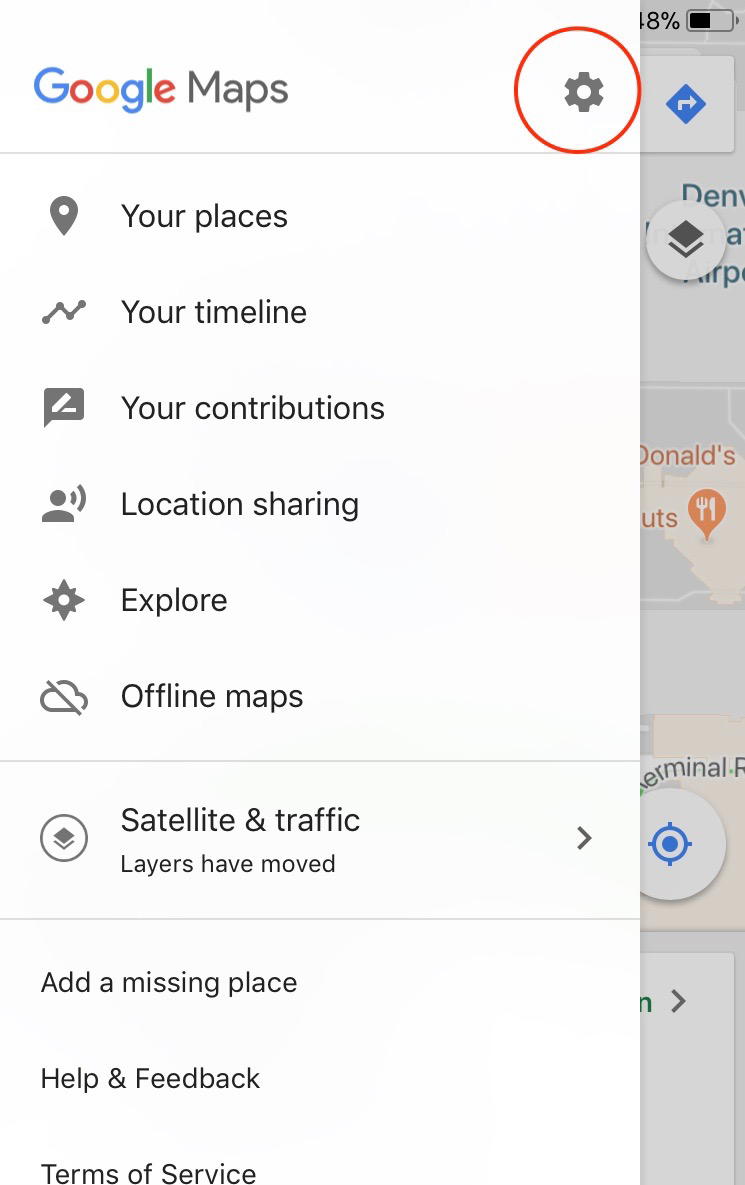
I’ve started to rely more heavily on technology again to help me here, since I’m hopeless at navigating this on my own. Google Maps doesn’t make the “avoid tolls” option as easy to find as they used to, but if you want to set up your navigation for this, start by clicking on the “Settings” icon:
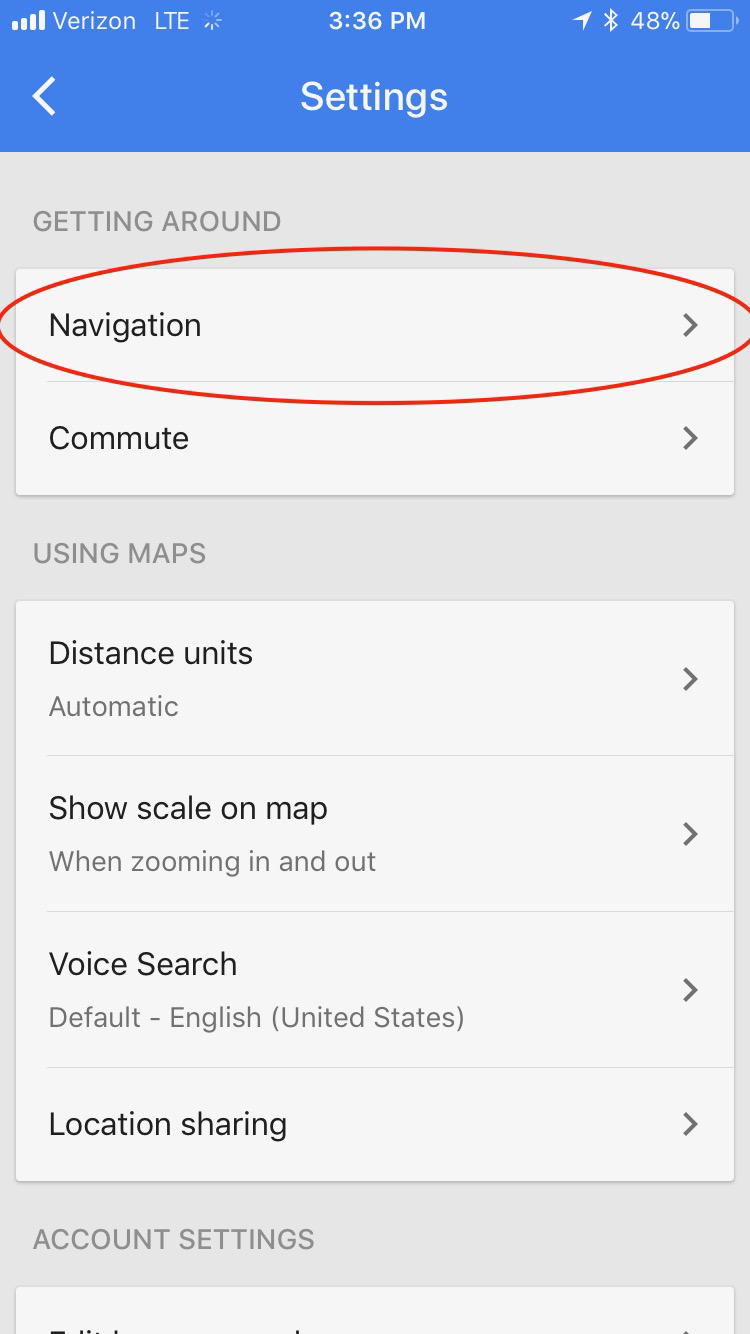
Then select “Navigation”:
And finally, turn on the “Avoid Tolls” option:
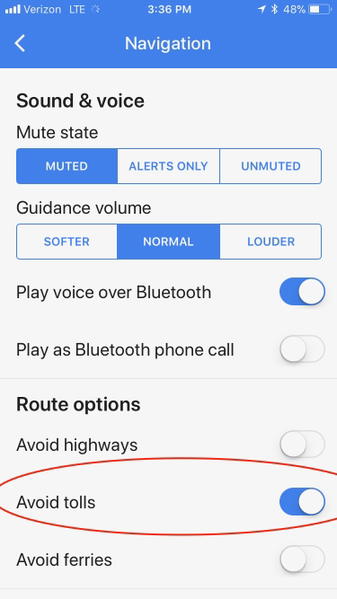
This automatically changes your default settings, so if you turn it off, you will need to turn it back on the same way every time – but hopefully this helps.
Carry cash
While Google hasn’t quite figured out the “Avoid cashless tolls” option yet, many areas still have the option for cash tolls. It should be noted that some areas, including parts of Florida, require exact change only.
I’m admittedly as allergic to cash as they come, but a few years ago I accidentally missed a cash lane in the Orlando area because I didn’t have the exact 75 cents that they required. Long story short, I missed the original bill in the mail and ended up getting hit with a $50 toll violation bill months later. I don’t think I need to break down the math on this one.
Get in front of the toll charges
In some areas, you can get in front of the rental car companies’ charges and pay the toll electronically.
For example, in Southern California you can register your rental car as soon as you have a plate number. In the Bay Area, you can make a one-time payment online if you have that “oh crap” moment and miss the last exit in Marin County – just make sure to pay within 48 hours. Washington State allows visitors to set up a short-term “Good To Go!” payment account.
Not all areas offer this, but it’s worth looking into for your choice destination.
Buy your own transponder
My EZ Pass travels around the Northeast with me, and I’ve never had a problem using it in a rental car. It’s a great catch-all that covers most states in the Northeast – although you do need to register it with a license plate, so I know this isn’t an option for everyone.
Florida is probably one of the easiest places to get scammed on toll fees, but you can buy a Sunpass online or at numerous retail locations. If you do use your personal transponder, be sure that it is visible through the windshield, and that any transponders included in the rental car are switched to the “off” position.
Again, this option isn’t available in all areas, but it is worth looking into.
Weigh the costs
You can probably get away with avoiding the Henry Hudson Bridge or the Golden Gate, but if you’re spending a week in South Florida (where the tolls are abundant) or Massachusetts (where I-90 has gone entirely cashless) I can’t imagine you want to spend your valuable time playing dodge-toll. Alamo, National, Hertz and Enterprise are all decent options since they only charge you on usage days, and Silvercar’s policy of only charging you the cost of the toll may help to offset their premium pricing.
And I can’t believe that I would ever be endorsing Payless as a standup rental car company, but their $2.95 per day fee, with a cap of $14.95, may be your best bet in some cases.
Either way, make sure you calculate the associated fees into your projected rental car costs so that you’re not hit with any surprise charges.
Dispute the charge
As I mentioned before, this is not the type of charge that will be flaunted on the front page of rental car brochures. I’m not going to advocate doing anything shady, but if you really are hit with an unexpected cost, you may be able to dispute it with the car company or the credit card on file.
You’ll probably have an easier time with, say, Enterprise than you will with Fox, but it’s worth a shot.
Bottom line
We all know that these charges are frustrating at best, and I doubt they are going away any time soon.
Hopefully by being armed with the proper information, you can at least minimize these hidden fees next time you are hit with that unexpected toll plaza.
Have you ever been hit with these “convenience” charges? How have you gotten around these extra costs?


Membership is free and takes no more information than commenting as a guest. Earn status points for good contributions, and see fewer ads as your status grows.