
With the US having implemented an electronics ban for passengers traveling nonstop to the US from Amman, Abu Dhabi, Cairo, Casablanca, Dubai, Doha, Istanbul, Jeddah, Kuwait City, and Riyadh, it’ll be interesting to see the ways in which airlines adapt to the situation. This potentially has a huge impact on the demand for travel on these airlines, as checking electronics is not only a huge waste of time (in terms of lost productivity, waiting at baggage claim, etc.), but comes with the risk of electronics being damaged or stolen.
With that in mind, Emirates is the first airline to announce a somewhat creative solution to this situation. Emirates is introducing a service that enables passengers to use their laptops and tablets until just before they board their US-bound flight. At the gate there will be security staff who will carefully package your electronics in boxes before boarding, and then you can collect them on arrival.

What I’m not sure about is:
- If the electronics will just be put on the baggage claim belt on arrival, or what exactly the system will be
- How this would differ from how the situation would otherwise be handled for U.S. bound passengers; for example, if you’re flying from India to Dubai to the US, wouldn’t they be collecting your electronics at the gate anyway?
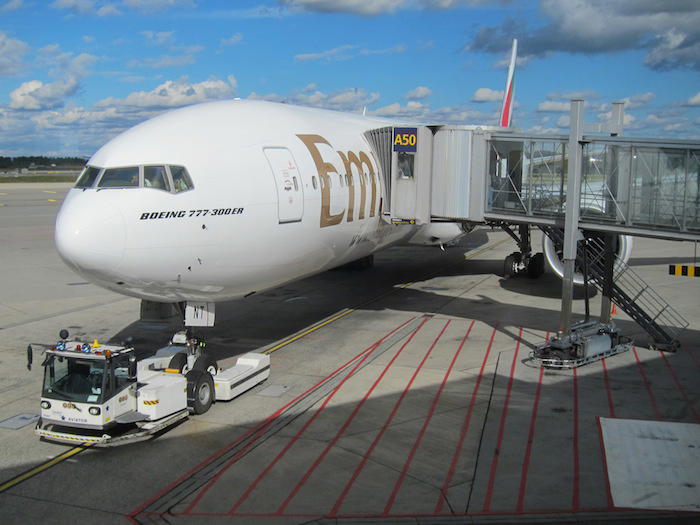
Per the Emirates press release:
Emirates customers traveling to the US via Dubai will be able to utilise their laptops and tablet devices on the first part of their journeys, and also during transit in Dubai. They must then declare and hand over their laptops, tablets, and other banned electronic devices to security staff at the gate just before boarding their US-bound flight. The devices will be carefully packed into boxes, loaded into the aircraft hold, and returned to the customer at their US destination. There will not be any charge for this service.
Passengers on US-bound flights starting their journeys in Dubai are encouraged to pack their electronic devices into their check-in luggage in the first instance, to avoid delays.
Customers should be aware that there will be a detailed search of all hand baggage on non-stop flights to the US from Dubai. They should therefore declare their devices before the search, or ensure their electronic devices are packed into their check-in luggage in the first instance.
Sir Tim Clark, President Emirates Airline said: “Our aim is to ensure compliance with the new rules, while minimising disruption to passenger flow and impact on customer experience. Our new complimentary service enables passengers, particularly those flying for business, to have the flexibility to use their devices until the last possible moment.
“Once on board they can still stay connected on their mobile phones. Our historical data shows that on Emirates’ US flights, 90% of passengers using our onboard mobile and Wi-Fi connectivity services do so via their smart phones. Only 6% connect via their laptops, and 4% via their tablets. That is not to say that other passengers are not using their devices offline, but perhaps the silver lining to this is that they can now justifiably give themselves a break from their devices, enjoy our onboard service and catch up on the latest movies, music, and TV box sets that we have on offer.”
Emirates is working to ensure that its operations comply with the latest restrictions on electronic devices in the cabin, for when the rules take effect on 25 March. Emirates will deploy extra staff at the airport to ease and assist passengers, especially in the first days of the new rules being implemented.
While it’s by no means a perfect solution, it’s certainly better than nothing, so I commend Emirates for that. I’ll be especially curious to see how this is handled in practice. How will electronics be packaged, and where can they be collected?
Does Emirates’ laptop and tablet handling service put you any more at ease about checking your electronics, or…?


Membership is free and takes no more information than commenting as a guest. Earn status points for good contributions, and see fewer ads as your status grows.