
One of the lesser-known benefits of American Airlines AAdvantage program, is their award chart where you’re not charged based on the regions you’re flying between, but rather on the total distance you’re flying. I figured I’d make an updated post about OneWorld distance based awards.
The basic rules of a distance based award are as follows:
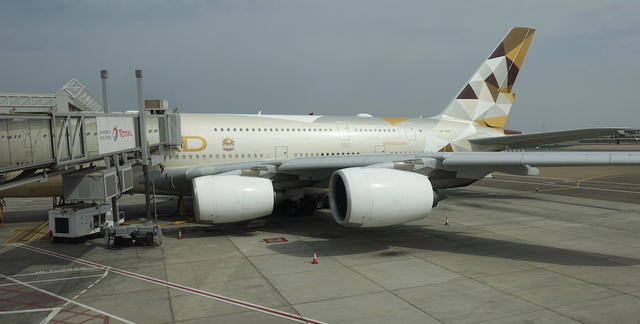
- You can only fly OneWorld airlines. American has several partner airlines that don’t belong to OneWorld, like Air Tahiti Nui, Etihad Airways, Alaska Airlines, etc. These can’t be included on a OneWorld distance based award.
- Travel has to be complete within a year of the date the ticket was issued. This means that if you issue your ticket on November 5, 2013, all segments on the itinerary need to be flown by November 5, 2014.
- You must fly at least two OneWorld airlines (other than American). In order to book a distance based award your itinerary has to include at least two different OneWorld airlines. For the purposes of airline classifications, Cathay Pacific and their affiliate Dragonair count as one airline.
- You can fly a maximum of 16 segments. You’re allowed one open jaw on a distance based award, and if you choose to have an open jaw then you can only have a total of 15 segments. A “direct” flight (meaning the same flight number with a stop, like Sydney > Los Angeles > New York on Qantas) would only count as one segment. Co-terminals wouldn’t count as an open jaw for the purpose either (in other words, flying into Tokyo Narita and out of Tokyo Haneda wouldn’t count as an open jaw for the Explorer award).
- You’re allowed one stopover and two connections per city. You can connect in a city twice and stop there once. That means you can potentially fly through the same city three times.
- You can originate and terminate the itinerary in different cities or countries. This is something I was confused about in the past, though as it turns out the itinerary doesn’t have to end in the same country travel started in. I’ll share some practical implications of that below.
- OneWorld distance based awards have to be booked by phone. While you can search award space online (and saver award space needs to be available in order to include the segment on a distance based award), the actual booking needs to be made by phone with AAdvantage.
- Once you issue the ticket you can’t make routing or airline changes. This is the biggest downside to distance based awards, really. Once the ticket is issued you can only change the dates and times of flights, but not the routing or airline. If you want to change the routing you’ll have to redeposit your award and start from scratch.
- Fuel surcharges are the same they would be on a partner award ticket. American only imposes fuel surcharges for award tickets on British Airways and Iberia. For British Airways they can be pretty hefty, upwards of $350 for a longhaul flight, while on Iberia they’re capped at under $50 for a longhaul flight, so not too bad.
Eligible OneWorld airlines:
Air Berlin, American, British Airways (including South African affiliate Comair), Cathay Pacific (including affiliate Dragonair), Finnair, Iberia, Japan Airlines, LAN, Malaysia Airlines, Qantas, Qatar Airways, Royal Jordanian, and S7.

OneWorld Explorer award chart:
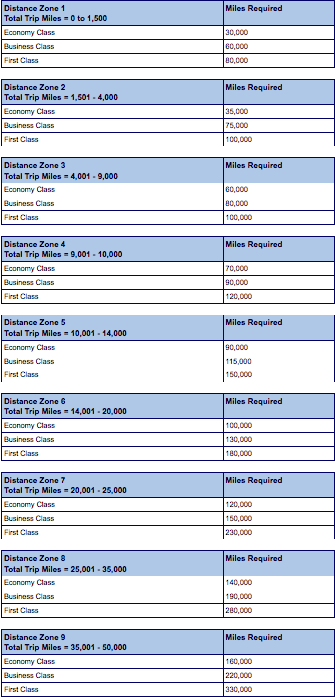
I tend to think zones 3-7 are the “sweet spots” on the chart, especially for business class. For that matter, I think you’re best off redeeming for business class on a distance based award in general.
- First class cabins aren’t offered on a vast majority of OneWorld routes, so you’d be paying the first class price for the entire itinerary even though most segments would be in business class.
- The premium for first class is rather steep. For example, on a Zone 6 award you would pay 130,000 miles in business class or 180,000 miles in first class. That’s a ~40% premium for first class, which is mildly outrageous.
- To compare, a partner award between the US and Asia, would be 67,500 miles for first class vs. 55,000 miles for business, which I find to be a more reasonable premium.
Examples of interesting OneWorld distance based awards:
Zone 3 — flying 4,001-9,000 miles (80,000 miles in business class)
Ordinarily American would charge 100,000 miles for roundtrip business class between the US and Europe, and you wouldn’t be allowed a stopover aside from your North American gateway city.
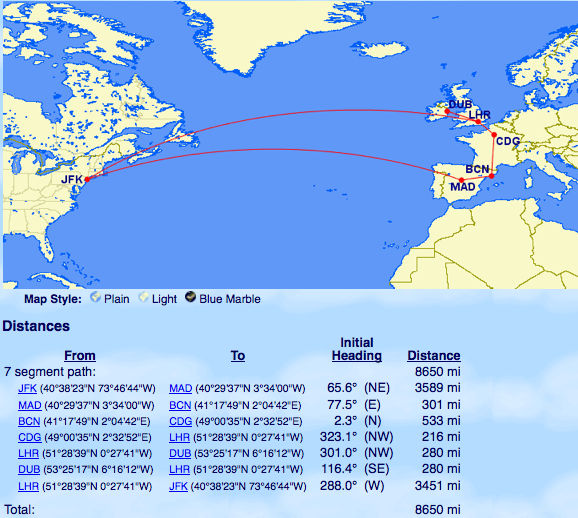
However, while keeping your itinerary under 9,000 miles, you could fly New York > Madrid > Barcelona > Paris > London > Dublin > London > New York, and stop in each city. Not only could you stop in each of those cities, but you’d save 20,000 miles.
Zone 4 — flying 9,001-10,000 miles (90,000 miles in business class)
Rule #6 above notes you can originate and terminate travel in different countries. Ultimately I think the best use of a distance based award is for (mostly) roundtrip travel, but figured I’d give a theoretical example of what you could do to stretch out a one way routing.
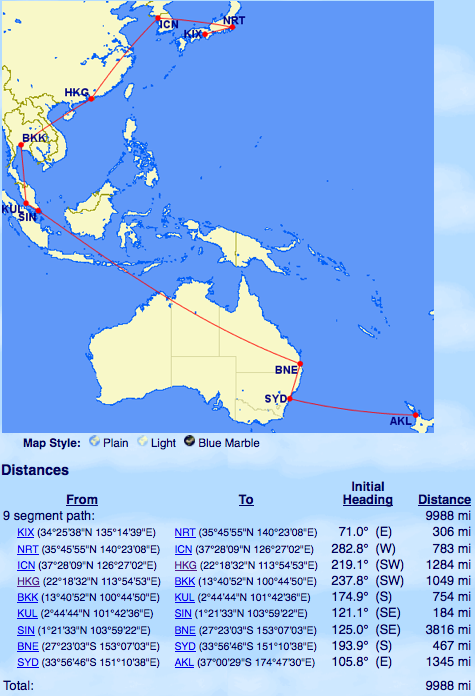
- Zone 4 on American’s distance based award chart covers travel of 9,001-10,000 miles and will run you 90,000 miles in business class.
- For that amount you could fly Osaka > Tokyo > Seoul > Hong Kong > Bangkok > Kuala Lumpur > Singapore > Brisbane > Sydney > Auckland on Japan Airlines, Cathay Pacific, and Qantas.
That’s pretty tough to beat given you can stop at each city along the way!
Zone 5 — flying 10,001-14,000 miles (115,000 miles in business class)
Ordinarily American would charge 135,000 miles for business class between the US and Middle East.
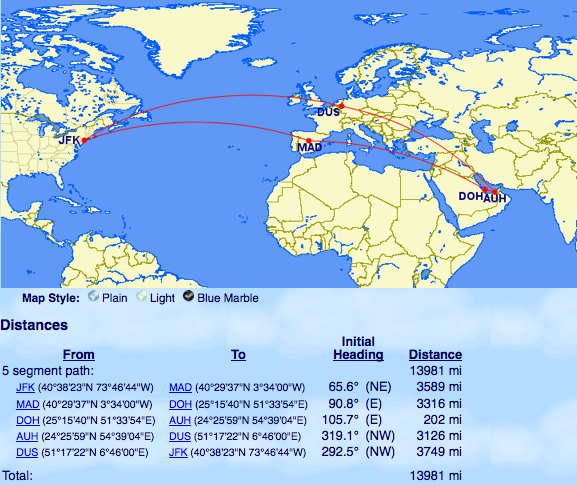
- However, since the itinerary is under 14,000 miles, you could fly New York > Madrid > Doha > Abu Dhabi > Dusseldorf > New York on Iberia, Qatar Airways, and Air Berlin, all for 115,000 miles.
- So not only can you visit four cities on one trip, but you save 20,000 miles over the normal cost for a business class redemption to the Middle East.
Zone 6 — flying 14,001-20,000 miles (130,000 miles in business class)
As I said above, ordinarily you’d pay 135,000 miles for business class to India or the Middle East.
- American charges 130,000 miles for business class for up to 20,000 miles of flying
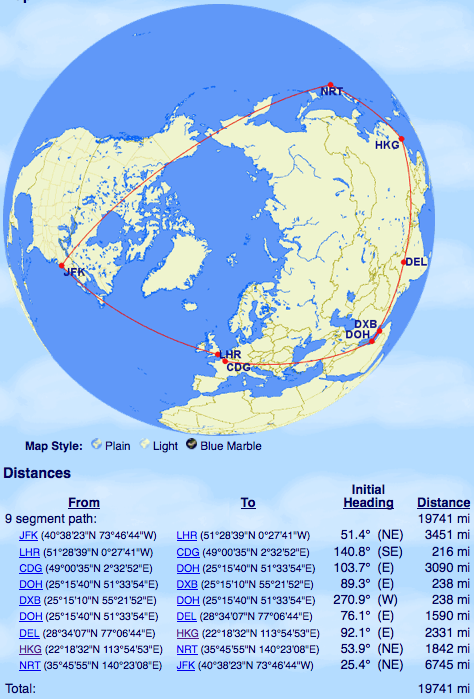
- At the Zone 6 price you could fly New York > London > Paris > Doha > Dubai > Doha > Delhi > Hong Kong > New York, on American, British Airways, Qatar Airways, Cathay Pacific, and Japan Airlines, with stops in each city.
Zone 6 — flying 14,001-20,000 miles (130,000 miles in business class)
Taking a slightly different approach to the above, assume you want to go to the Maldives.
- Again, you’d pay 135,000 miles for a business class award to the Middle East on the classic award chart
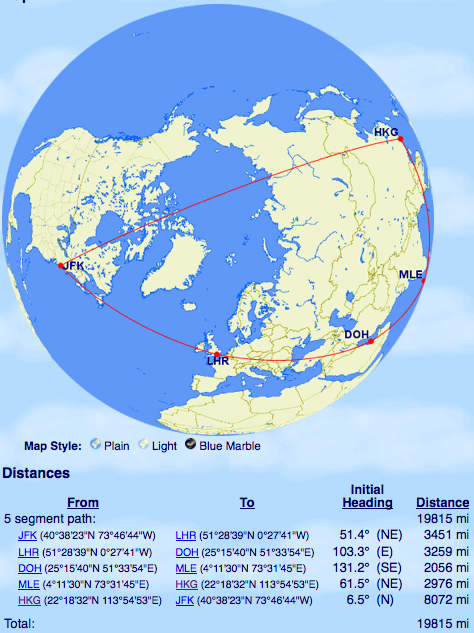
- If you flew New York > London on American, London > Doha on Qatar Airways, Doha > Male on Qatar Airways, Male > Hong Kong and Hong Kong > New York on Cathay Pacific, it would cost you just 130,000 miles in business class.
So not only do you save 5,000 miles but you have additional stops in London, Doha, and Hong Kong.
Zone 6 — flying 14,001-20,000 miles (130,000 miles in business class)
While this itinerary is rather simple compared to the others, this is a good example of using the distance-based chart to get around limited availability and American’s routing restrictions.
- If you can find direct award space direct between the US and Australia, business class will run you 125,000 miles.
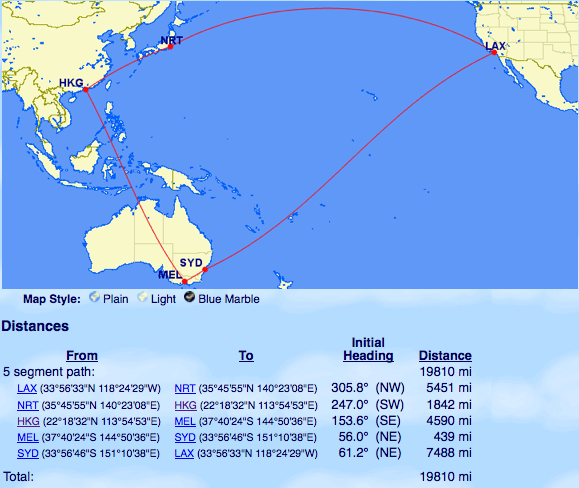
- For 5,000 additional miles you could do a distance based award for up to 20,000 miles of travel, like Los Angeles > Tokyo > Hong Kong > Melbourne > Sydney > Los Angeles on Japan Airlines, Cathay Pacific, and Qantas.
Partner awards vs. distance based awards
While there’s obviously a ton of value to American’s distance based awards, it’s worthwhile to compare them to American’s partner awards again, as each has different benefits.
As I mentioned at the beginning, American’s distance based awards are charged solely based on the number of miles flown with very limited routing rules, while American’s partner awards are charged based on the regions you’re flying between.
- With partner awards you can make date, flight, and routing changes for free.
- You can even pay a fee and change the origin or destination without having to redeposit the award.
- With distance based awards, on the other hand, you can only change the date or time of your flight, and can’t even pay a fee to change the routing or origin/destination once your reservation is ticketed.
Furthermore, with partner awards you can often include a “free” one-way on an itinerary.
- On a partner award you’re always allowed a stopover at your North American transoceanic gateway city.
- There are some restrictions in terms of the routing, but generally this means if you’re booking London > Los Angeles you can include a Los Angeles > Hawaii flight on the itinerary at no extra cost for travel on a later date.
With distance based awards, on the other hand, you can have an unlimited number of stopovers (well, as many as the 16 segments you can fly will allow).
Distance based awards really are the hidden gem on American’s award chart, and for that matter one of the best award redemption values in the industry, in my opinion.


Membership is free and takes no more information than commenting as a guest. Earn status points for good contributions, and see fewer ads as your status grows.