
For the past few months, American AAdvantage has increasingly been applying married segment logic to award tickets. This is either good or bad, depending on how you look at it. On the plus side, American does seem to be making more saver level award seats available than before. However, this award spaces comes with a lot of restrictions.
@experienceTed asked the following question on Twitter, so let me try to answer this best I can:

What is married segment availability?
Airlines take a complex approach to inventory and revenue management. They do everything they can to price discriminate against passengers so that they’re getting as much money out of each passenger as possible. There are all kinds of factors that go into this.
Airline pricing is typically based on two factors — there are the actual fares available in the market, and then the specific fare classes that are available. The fares available in the market set the range of what fares can be, while the exact fares on a particular flight are based on what fare class are available (and this is based on what kind of demand the airline forecasts there will be for the flight).
One strategy that many airlines employ is married segment availability. This means that they’re willing to make different seats available on a flight based on whether you’re connecting or not. This can be for a few different reasons, so let me give a couple of examples of that:
- An airline might only be willing to sell a certain fare bucket on a flight from San Diego to Los Angeles if it’s being booked as part of a larger itinerary; after all, the primary intent of a flight like that is to provide feed for longer flights, and they’d hate to lose out on a full fare first class booking to Hong Kong because someone booked that last seat just between San Diego and Los Angeles
- Airlines know that passengers are willing to pay a premium for a nonstop flight, so they may only be willing to make the cheaper fare classes available if you’re connecting; in other words, they know they can get more money out of you if you’re flying nonstop from Chicago to Los Angeles, while if you’re using the flight from Chicago to Los Angeles and then connecting to San Francisco on the same ticket, they may have to discount it more, since you don’t have the convenience of a nonstop
There’s a lot more that goes into this, though that’s a very brief rundown.
American’s new award ticket married segment restrictions
In the past American would typically make the same saver level award seats available no matter what kind of an itinerary you were booking. For example, if there was award availability from New York to San Francisco you could book that for the nonstop flight only, or as part of a larger itinerary.
Increasingly American is using married segment logic for saver level award seats, meaning that they’re only making award seats available as part of a connecting itinerary, and not as a nonstop.
Take the below flight from New York to San Francisco, which has no saver level economy award availability:
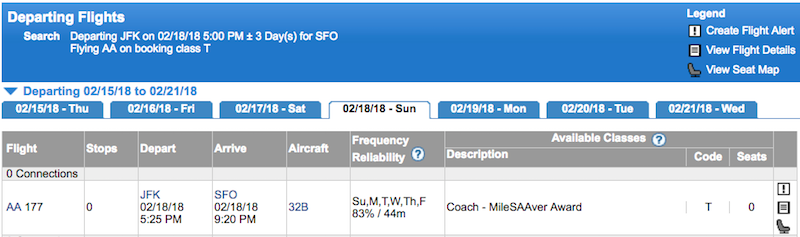
However, if you search availability from New York to Los Angeles, it returns that same routing through San Francisco, and suddenly the flight has one award seat.
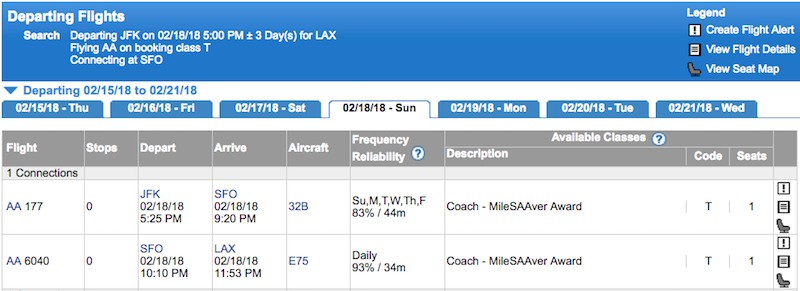
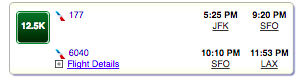
So you could pay 12,500 milles for that itinerary from New York to San Francisco to Los Angeles…
But if you wanted to redeem miles just for that same flight from New York to San Francisco nonstop, it would cost you 50,000 miles.
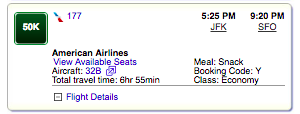
This is becoming increasingly common. American’s logic is that just as people are willing to pay extra cash for a nonstop flight, they assume people are also willing to pay extra miles for nonstop flights. This is an indirect way for American to move redemptions closer to being revenue based.
Is there any way around the married segment restriction on awards?
There are two potential ways to get around American’s married segment restriction on awards.
One is to just use hidden city ticketing (which I don’t recommend, but I’ll share in the interest of being thorough). If you want to fly from New York to San Francisco nonstop on the above flight, you could just book the routing from Los Angeles but get off the plane in San Francisco. However, be aware that:
- Hidden city ticketing violates the contract of carriage, though typically airlines won’t do anything about it unless you make a habit of it
- This doesn’t work if you’re checking bags, since they have to be checked to your final destination (this also gets tricky if you’re forced to gate check bags, as those would be gate checked to your final destination)
- You can only throw away the last segment of an itinerary, as subsequent segments will be canceled
Now let’s talk about the more straightforward and “legitimate” approach. American allows five day holds on award tickets (within a couple of weeks they often only allow one day holds), so place the cheaper itinerary on hold (in the above case, New York to San Francisco to Los Angeles). Once you’ve done so, call American and tell them you just want to end in San Francisco, and ask them to take off the second segment.
Based on my experience this should be possible, though not all agents can figure out how to do it. So this might be a case of “hang up and call again” if you don’t get the answer you want. The computer definitely seems to allow this, though not all phone agents can make it work.
Bottom line
I’m not a fan of the trend of American AAdvantage saver level award availability largely being tied to married segments. As of now this seems to mostly apply to economy awards, though I imagine we’ll continue to see this spread. On the plus side, American saver level award availability does seem to be a bit better lately. It’s by no means good, but better. So I guess we can’t be too mad, when it seems like most of the married segment availability is in excess of what was available before.
If you do run into a situation like this, I recommend trying to hold the cheaper itinerary, and then calling American and asking them to remove the segment you don’t want.
Have you dealt with American’s married segment availability on award tickets, and if so, what was your experience like?


Membership is free and takes no more information than commenting as a guest. Earn status points for good contributions, and see fewer ads as your status grows.