American Airlines’ Bizarre $16 Fares

I’m going to write about an airfare deal not because I think people should take advantage of it (quite to the contrary, they shouldn’t — stay home, people), but rather because I find this pricing strategy to be rather unusual.

With demand for travel having decreased exponentially, we’re generally seeing airlines take two pricing strategies:
  • Some airlines are more or less maintaining “normal” fares, realizing that sales won’t generate much incremental revenue at this point, since people aren’t flying
  • Some airlines are offering huge discounts on fares, I guess because demand is virtually non-existent; is this purely a competitive response to other airlines, or are they actually hoping to generate demand?

While I’ve seen a lot of low fares, American’s fares between Miami and Los Angeles are the most ridiculous I’ve seen yet. Through the end of April, American is selling one-way tickets between Miami and Los Angeles for $16. That’s right, you could fly roundtrip coast-to-coast for $32.

If you want to avoid basic economy, the fare is three times as much.
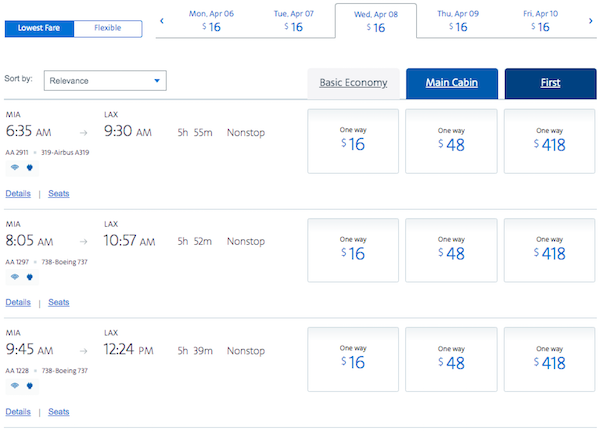
These fares are only available through the end of April, and then as of May fares skyrocket all the way up to $28.
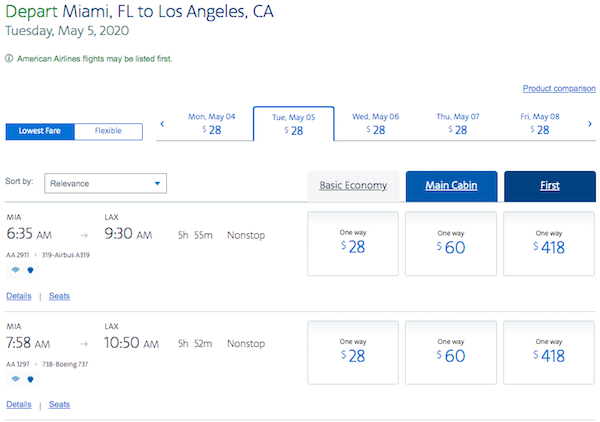
This isn’t just available for one day, but these fares are available just about every day, on most flights.
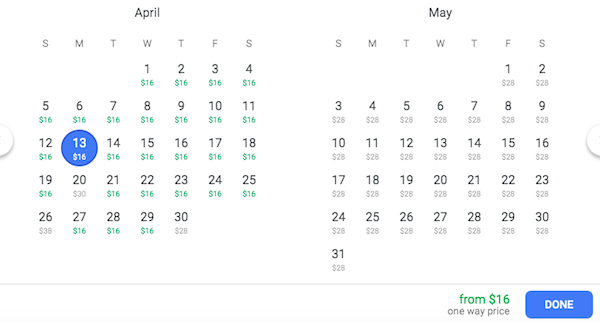
Just to further point out how low that $16 fare is, $4.50 of that is the US Passenger Facility Charge, and $5.60 is the security fee, so in reality the fare is only $5.58 (though US airlines are getting some relief with taxes, so some of that is still going to the airlines).
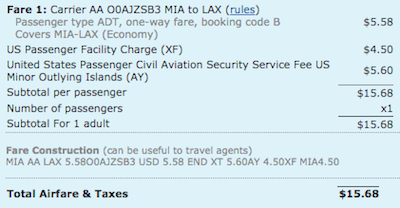
Yep, a $6 base fare with no fuel surcharges for a flight that’s about six hours…

Yeah, I get there are sometimes airfare quirks, though I can’t really wrap my head around this strategy of pricing flights this way:

  • People shouldn’t be encouraged or tempted to fly right now, for everyone’s sake
  • I’d be surprised if this fare even covers the incremental cost of carrying additional passengers

Yeah, we’ve seen a lot of fares, but American Airlines is in a different league with these fares, in my opinion. To me these ultra-low fares for April seem counterproductive…

What do you make of American’s $16 transcon fares?

Conversations (66)
The comments on this page have not been provided, reviewed, approved or otherwise endorsed by any advertiser, and it is not an advertiser's responsibility to ensure posts and/or questions are answered.
Comment as a member

Membership is free and takes no more information than commenting as a guest. Earn status points for good contributions, and see fewer ads as your status grows.

Type your response here.

If you'd like to participate in the discussion, please adhere to our commenting guidelines. Anyone can comment, and your email address will not be published. Register to save your unique username and earn special OMAAT reputation perks!

  1. Loading comments…
Recent Comments
The latest from the OMAAT community.

The comments on this page have not been provided, reviewed, approved or otherwise endorsed by any advertiser, and it is not an advertiser's responsibility to ensure posts and/or questions are answered.

Gray Guest

B6 is doing something similar (and DL isn't far behind). WN is at least keeping a floor under fares. My best guess would have been that the computers are possessed and the human fare-setters are overloaded...but there is no way in H-E-Double-Hockey-Sticks that these fares were filed as of two months ago. As to folks "risking life and limb if AA were still distance-based", I feel compelled to point out that a LOT of program cross-credits are still distance-based. If you've got a few flights on BA (for example), racking and stacking flights at those prices might actually make sense as a status run.

0
‼ 0
Lincoln Guest

@Mark Anley. That's for Air Canada's new "Cockpit Class" they've introduced. You'll be in seat A0, the Co-pilot's position.

0
‼ 0
Mark Anley Guest

Well Air Canada is staying competitive... $1000 from YYZ>YVR round-trip (economy).

0
‼ 0
Rob Guest

Potreroflyr & others If that is true, why did the Imperial College original model predict peak cases 12 to 18 months from now WITH bending the curve and now saying mid April? Put simply, several large cases came out and suggested much lower # of deaths AND countries are starting to ramp up to test for antibodies. With anti-body tests, we will know exactly which wave we are on (~10 on his original model, vs 18-21 for the Stanford, Oxford, his revised study). Stanford and Oxford both asked Governments to begin antibody studies ASAP to prove where we are once and for all and how many have immunity already. Lastly, why are none of these bend the curve studies actually putting a value on each piece of bending the curve? Some of the bend the curve part has NO economic costs (washing hands, surfaces, white collar working from home, social distancing, etc) while others literally will cost the world $20+ trillion in economic output (shutting everything down). How much do they estimate R0 is reduced by each of these?

0
‼ 0
Rob Guest

Richard - Yes, that is what the Imperial College study guy said, but his data does not suggest that. The main reason for the reduction was the increase in R0 with more assymptomatic cases. His original model needed us to bend the curve for 12-18 months. The new one was just a few weeks. You can run a basic expotential table in excel yourself. 3-4 weeks bending the R0 from 3.0 to 1.5 and then opening back up, you end up in the same place just a month later, so that can't be it, especially since about 80-90% of those that end up a vent die regardless. Regardless, the Oxford Study and Stanford studies, which ironically came out just a couple days before the Imperial College revised their estimates down by at least 96%, started at the significantly lower estimate, and Amherst college did a study of 13 experts 2 weeks ago and most expected about a quarter million deaths in the US +-150k. In short, the US media has run with the bad estimates from this thing non-stop and isn't discussing the estimates that show this will likely be the equiv of a very bad flu in terms of deaths but not catastrophic. Lastly, without doing anti-body studies, they really don't know as they have to make unknown assumptions about those with mild cases or assymptomatic all together that are not counted in the denominator. As someone that has worked with #s for a living for more than 10 years now, graduating summa cum laude with a BS in Economics and received a MBA from a T10 program, I can tell you its easy to make a model spit out whatever you want it to, especially with several unknown variables.

0
‼ 0

Save posts to read later

Saving posts is a member feature. Become an OMAAT member to build a reading list you can come back to from any device.

Become a member
Meet Ben Schlappig, OMAAT Founder
5,883,136 Miles Traveled

43,914,800 Words Written

47,187 Posts Published