
For many of us, flying is an experience we love, especially if using miles and points to make the journey as comfortable as possible. We gaze out the window at the clouds, marvel at the miracle of flight, and calm ourselves down during any turbulence, telling ourselves ‘this is perfectly normal.’
But some people have an existing fear of flying, or develop one for whatever reason.
Some people never overcome their fear of flying, so do not travel by plane. Others attend courses or seek therapy to overcome this fear (I know hypnosis has worked for some people).
But what about when flight crew develop a fear of flying?
I came across an interesting story about a pilot who developed a fear of flying, which is quite unusual.
Flybe pilot phobia
Matthew Guest was flying Q400 planes as a first officer for UK regional airline Flybe. Flybe primarily flies small turboprop planes around the UK and other points in Europe.
After seven years of flying for the airline, Mr. Guest, who is based in Birmingham, in December 2014 had a particularly ‘unsettling’ flight to Florence, which left him feeling ‘anxious to be on the plane, hot, dizzy, churning stomach.’
He reported his phobia to the airline, which suspended him as they deemed him unfit to fly. After a year away from the airline, he returned, and indicated he was keen to fly longer routes.
He initially completed flights without incident but was then scheduled to fly to Kefalonia in Greece in June 2016, which is one of Flybe’s longest routes, at about four hours.
He was also certified to fly Embraer aircraft — the Q400s do not have the legs to fly from Birmingham to Greece.
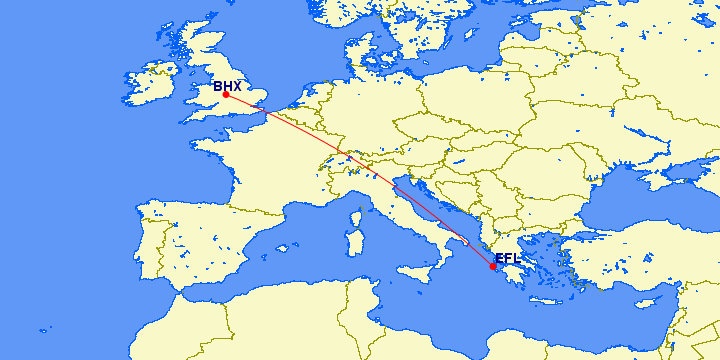
He raised his concerns about the length of the flight to the airline, which advised him to ‘read a book or do a crossword’ to pass the time.
Mr. Guest could not get over his phobia, and called in sick for the flight the night before.
He was removed from all future rosters up until the end of 2017, which is when his contract was supposed to run through. In October 2016 he was contacted by Flybe’s Chief Operating Officer, who advised:
The Company remains concerned regarding your fitness to safely fly. Due to the uncertainty of your condition we cannot as an organisation accept the risk to safety.
The medical advice containing the suggestion that your condition could return causes the Company serious concerns and Flybe are not prepared to take risks in the flight deck with people’s lives.
We are not prepared to take the risk of returning you as a Pilot on the EJet or Dash 8, so we are providing you with formal notice that we intend to terminate your employment on capability grounds.
Mr. Guest was offered an alternate role as a Flight Safety Support Officer in Exeter (so not his hometown of Birmingham), but the condition of taking this was that he would never fly as a first officer for the airline again.
The pilot has sued Flybe for unfair dismissal.
A UK court has agreed, saying that the airline should have offered Mr. Guest appropriate alternate roles while he worked through his phobia, with the real possibility of returning to flying at a later date, or at least being able to discuss his concerns with the COO who sent him the dismissal communication.
Bottom line
This is an interesting scenario. I certainly feel badly for Mr. Guest, whose livelihood relies on him being able to fly a plane, especially as his phobia developed as a result of work incidents outside of his control.
At the same time, while the airline offered him an alternate ground role, most pilots are very well paid and have very good working conditions, so have become accustomed to a certain lifestyle that can be difficult to recreate in a ground role that may not require the same level of skill flying a plane would.
There’s almost only so many ‘pilot supervisor’ or ‘pilot trainer’ roles and airline can offer for those pilots who wish to use their expertise and experience on the ground.
But the airline should not have added the stipulation to the ground role offer that he would never fly for the airline again.
How long would a pilot realistically stay with the company knowing there was that restriction? Perhaps this was Flybe’s plan to motivate Mr. Guest to leave so they did not have to deal with his phobia long term. If this is the case then Flybe is definitely in the wrong.
Mr. Guest is still hoping to return to the airline once the legal proceedings are resolved.
Do you think Flybe should have acted differently in managing a pilot with a phobia of flying?


Membership is free and takes no more information than commenting as a guest. Earn status points for good contributions, and see fewer ads as your status grows.