
It’s rare and wonderful when two of my favorite things are combined. Examples that come to mind are cookie dough and ice cream, Timothée Chalamet and Laura Dern (Little Women), and puppies and Canada (see, e.g., Labrador Retrievers).
So I was very excited when my love of board games and my passion for aviation combined in Pan Am: The Game, available at Target. I had high hopes, and for the most part, they were met. More than anything, though, I wanted something that would help recreate the joy of travel, since so many of us are stuck at home these days.

Anyone who’s spoken with me for more than a few seconds knows that I’m a board game geek. I’ve been to the world’s largest board game convention (in Essen, Germany) twice. Ben generally makes fun of this hobby (because his love of 90 Day Fiancé is *so* much cooler), while Tiffany totally gets it.
About The Game
The mechanism of Pan Am: The Game is called “worker placement.” Other examples of this type of game include Agricola and Russian Railroads, both of which I love. In worker placement games, each player has a limited number of “workers” (in Pan Am’s case, Engineers) and assigns them to certain tasks in each round. How you assign your workers affects the efficiency with which you generate profit, which in this game is used to purchase stock.
The game is themed around the early days of aviation, from Pan Am’s founding through the late 1960s. (Incidentally, Juan Trippe was 28 years old when he founded the airline. I just turned 36 and I can barely microwave a Lean Cuisine.)
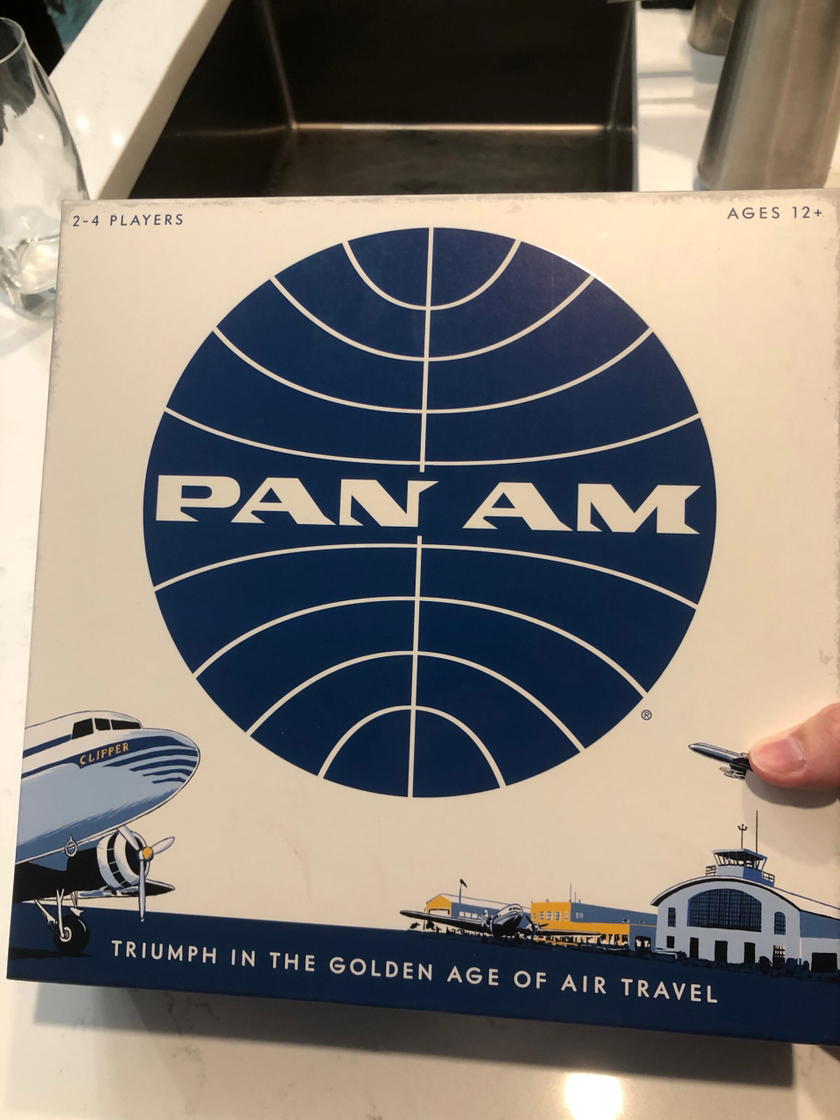
Pan Am: The Game accommodates two to four players, and is recommended for gamers 12 and older. The box says it takes 60 minutes to play, but I found that as a first-timer it took significantly longer. More on that later.
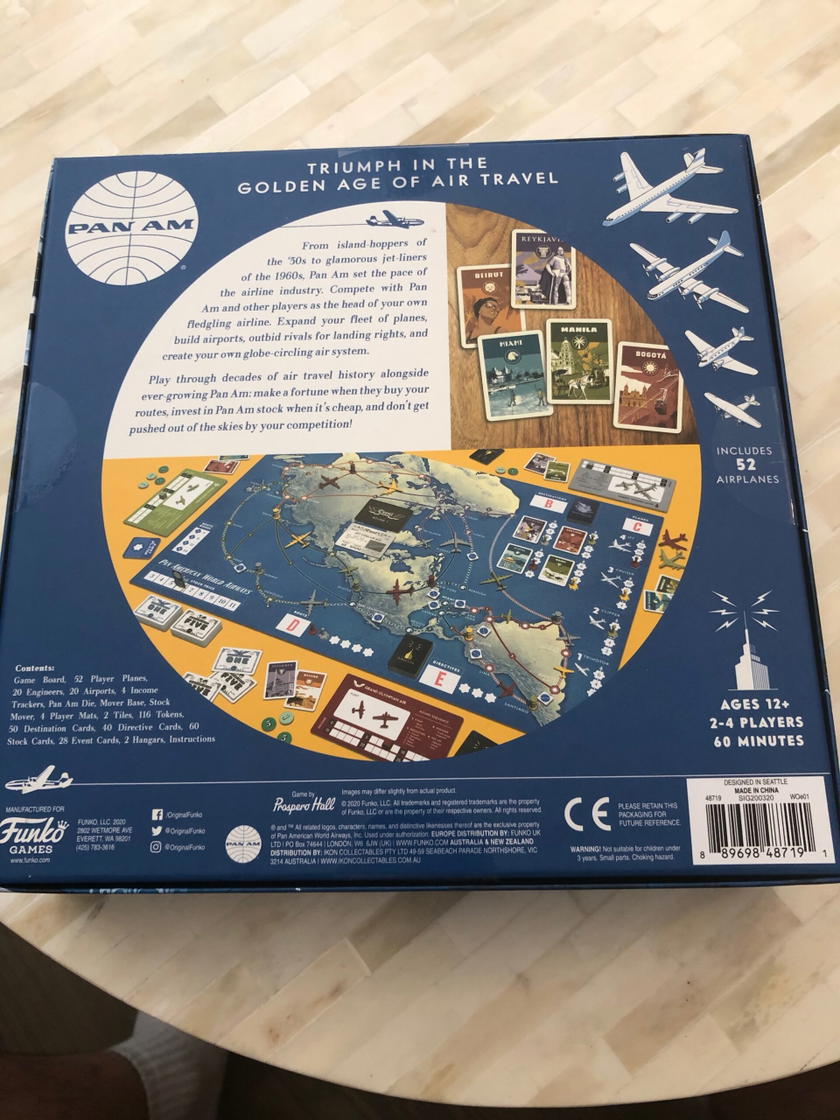
In the game, players own small (fictitious) airlines that compete against Pan Am. In short, you buy planes, claim routes, and sell the routes to Pan Am. These actions generate income, which you use to purchase Pan Am stock. The player who owns the most stock at the end of the game is the winner.
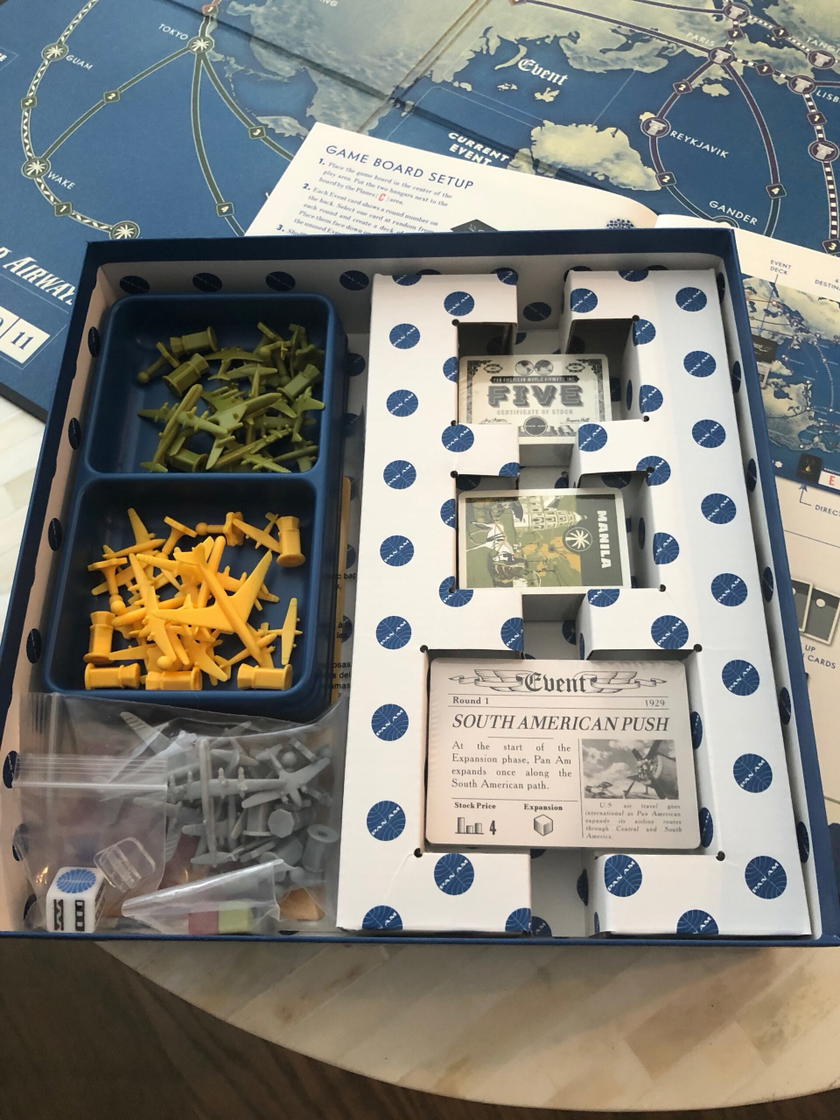
The artwork — on the box, cards, and board — is awesome. It definitely sets the scene for the nostalgic tone of the game. Especially notable are the Destination cards.

The game pieces are cool too. There are four different aircraft types: Ford Trimotors, Boeing 314 Clippers, Boeing 377 Stratocruisers, and Boeing 707 jets. They’re made of plastic, but still fun.
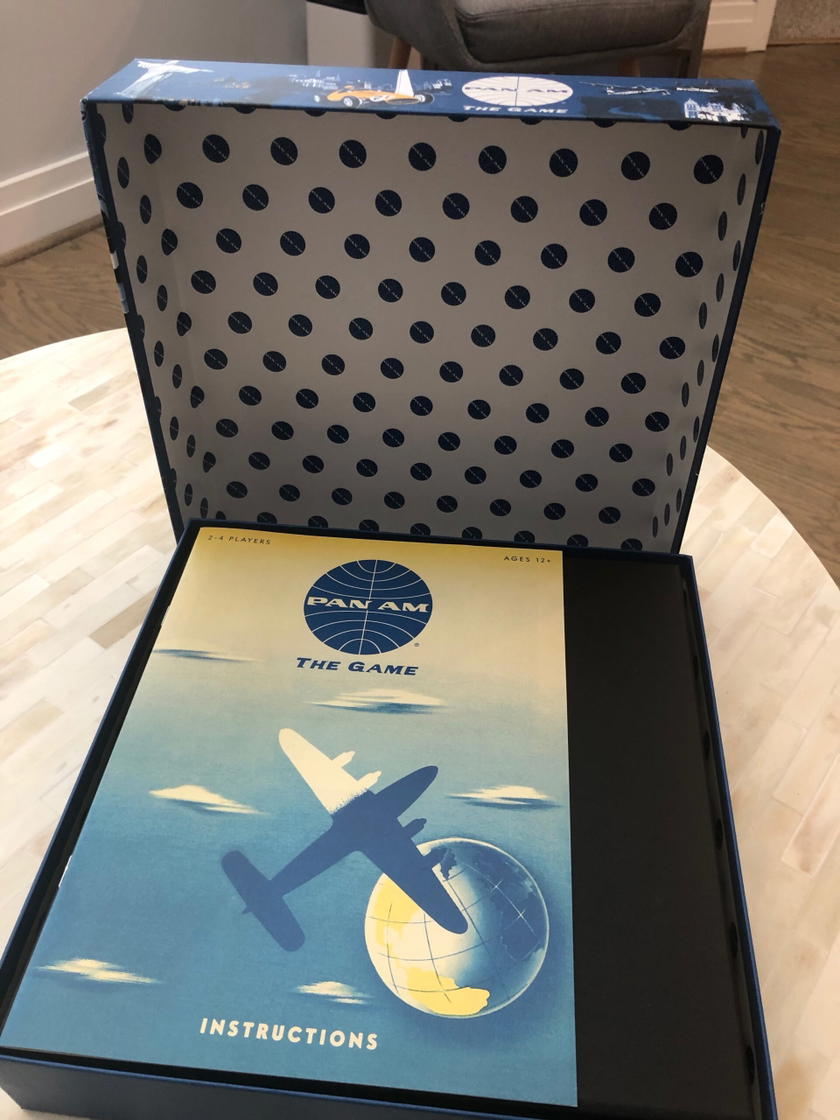
The instruction book is 16 pages long, which can be a little daunting at first. There are also some videos online that will take you through the rules, though I found that I still needed to read the book in order to understand what was going on.
Game Play
The last person to fly on a plane is supposed to go first. (At this point, I could barely remember my last plane trip — all I know is that it was in the Before Times.)
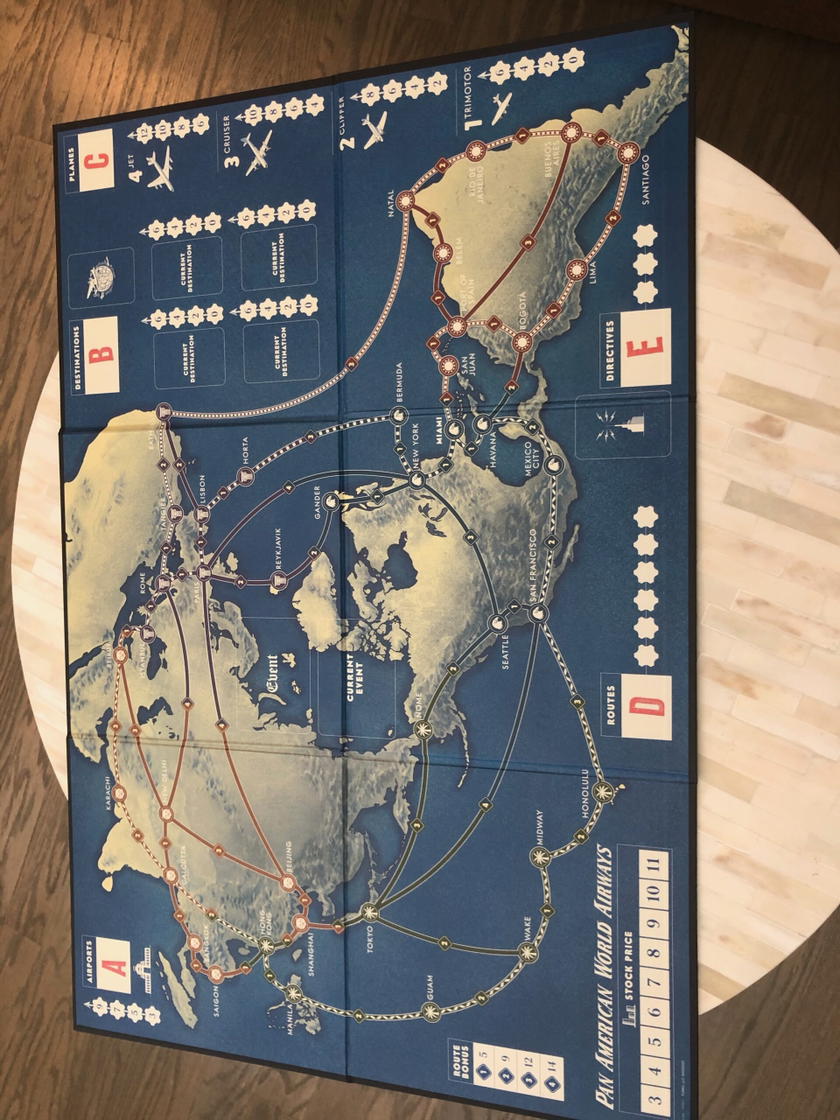
The game is divided into seven rounds, each of which has four phases. Essentially, in each round players take turns placing their Engineers until there are none left to place. You can assign Engineers to do things like acquire an airplane, claim a route, purchase an airport, or buy a Destination card (which you need in order to claim routes).
To claim a route, you must have a plane that can fly that route (the Ford Trimotor, for example, can’t be assigned to a long-haul flight) and the rights to land at airports on either end of the route (you can either buy an airport or use a Destination card for this).
Once we got the hang of it, the game proceeded pretty smoothly. I only played with one other person (thanks, COVID-19), and I suspect that the dynamics would change dramatically with more players, as there would be much more competition for routes and Engineer slots.
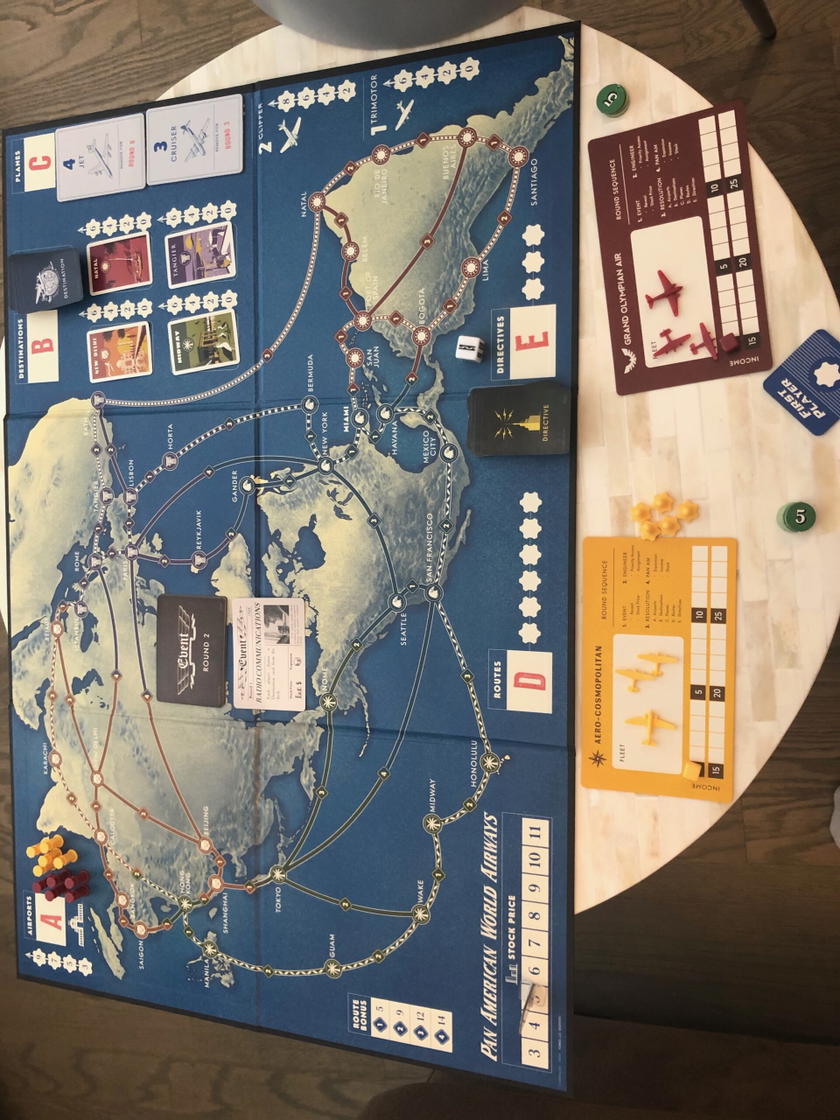
There were a few times when the rules seemed ambiguous. One example involves Directive cards. You can place an Engineer to acquire a Directive card, which gives you a special ability. Can this ability be reused, or do you only get to use it once?
Despite this, and despite it taking probably a little longer than usual to learn the rules and understand the game dynamics, I had a fun time. Overall I would say it took about 40 minutes to learn the rules and 75 minutes to play the game.
Considering that I would’ve probably otherwise occupied myself by devouring yet another pint of Ben & Jerry’s Half Baked and/or watching a few Golden Girls episodes I’ve already seen six thousand times, I consider this time well spent.
My favorite types of board games revolve around the concept of optimizing resources and outmaneuvering opponents — and this game certainly fits the bill.
Bottom Line
Is Pan Am: The Game a substitute for getting on a plane and feeling the tingle of anticipation as the engines spool up for takeoff? No. Did I feel like an airline CEO? No. (As far as I know, there is no board game yet in existence that captures the feeling of gleefully observing your passengers’ reactions as you implement baggage fees, tell them their basic economy fare entitles them to board only in Group 27 — right after registered sex offenders and Shia LaBeouf, and cut their legroom so much that even unusually tall toddlers are uncomfortable unless they pay for the exit row. But I digress.)
I found the ambiguities in the rules a little frustrating, but overall I did like this game. I would go so far as to say it’s probably the best aviation-themed board game on the market. If Monopoly is the most sophisticated board game you’ve ever played, I would probably steer clear of this one for now. But if you have the patience to learn the rules, enjoy the aviation theme, and are drawn to games with more complexity, I would recommend Pan Am.
Now, if I could get Timothée Chalamet and Laura Dern to play it with me, that would be truly amazing.


Membership is free and takes no more information than commenting as a guest. Earn status points for good contributions, and see fewer ads as your status grows.