
A tiny, remote island in the South Pacific may lose its airport. On the surface, that’s understandable, given that maintaining it requires a nine-figure investment, and only a few dozen people live on the island. However, the fight over the airport’s future goes way beyond that, as it could impact airlines around the globe. Heck, it could even impact the economics of the world’s longest flight.
Midway Atoll Airport is run down, faces uncertain future
Midway Atoll Airport (airport code MDY) is known as Henderson Field, and is a public airport located on Sand Island, in Midway Atoll, which is an unincorporated territory of the United States. This is a 2.4 square mile atoll in the North Pacific Ocean, and it’s the only island in the Hawaiian Archipelago that’s not part of the state of Hawaii. It’s around 1,300 miles northwest of Honolulu, right near the International Dateline, so it’s around the halfway point between North America and Asia.

The Midway Atoll population is tiny — around 40 people live on the atoll, primarily consisting of staff of the United States Fish and Wildlife Service (FWS), as well as contract workers.
As a result, the airport serves primarily as an emergency diversion airport for transpacific flights — there’s a 7,800-foot runway there, so it’s plenty long for a large plane to land (and to take off with limited fuel). In theory, it also provides access to the Midway Atoll National Wildlife Refuge. However, that’s only by charter, because the airport last saw commercial service nearly 25 years ago, in 2002.
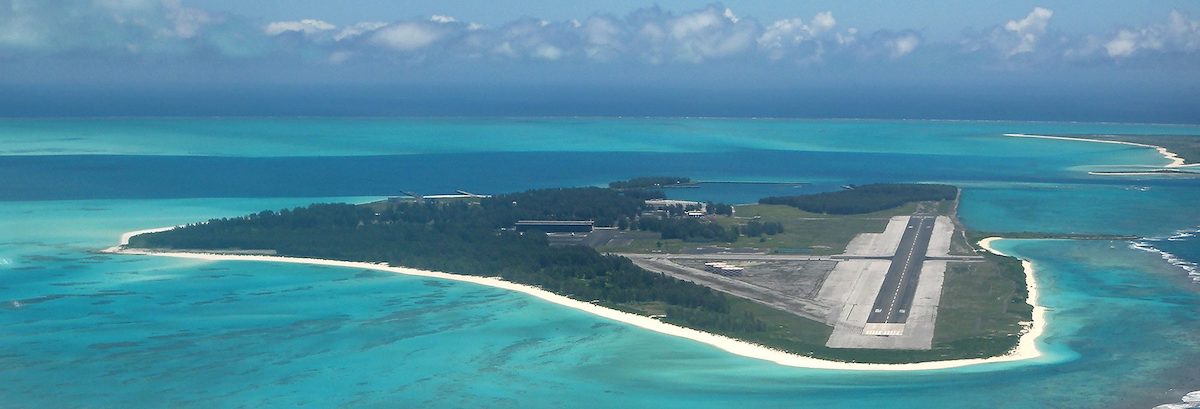
Midway Atoll Airport is a Part 139 certified airport, and it’s unique in that it’s operated by FWS, and isn’t a joint use airport. It serves a specific need in global aviation, in terms of being a diversion point for both military and commercial flights.
That brings us to the current situation, which is that the airport’s condition is deteriorating rapidly, and it’s expected that it may lose its current certification within five years, if it doesn’t get at least a $100 million investment. The Department of Transportation (DOT) is currently trying to decide on the airport’s future:
FWS is currently utilizing the FAA’s congressionally mandated $2.5 million per year in Airport Improvement Program (AIP) funds designated under the 2003 FAA Reauthorization Act to maintain MDY’s airfield infrastructure, and the FWS contributes an additional $2.6 million in annual funding to maintain minimum operational capability.
However, the funding designated is only a small portion of the airfield’s needs according to the 2021 Midway Atoll Comprehensive Master Plan. MDY’s runway is expected to reach a severe level of deterioration within the next five years. The estimated cost for major airfield rehabilitation at MDY exceeds $100 million for milling, repaving, and seawall repairs—an amount significantly higher than the annual AIP funding allocations. Additional non-airfield improvements, such as harbor upgrades to support shipment of construction materials, may also be needed.
Midway Atoll Airport closure would be issue for airlines
There’s always the risk of planes having engine failures (or other issues). As long haul aircraft increasingly have two engines (instead of three or four), they have to comply with ETOPS regulations. ETOPS stands for “Extended-range Twin-engine Operations Performance Standards.” Or jokingly, it stands for “Engines Turn Or People Swim.” 😉
There are different factors that determine a plane’s ETOPS rating, but the rating could be ETOPS 120, ETOPS 180, ETOPS 240, etc. That number represents how many minutes a plane is allowed to fly on a single engine to get to the nearest suitable diversion point. So if a plane is operating with ETOPS 120, it needs to be within 120 minutes of its nearest diversion point at all times.
That brings us to the issue here, which is perhaps best explained by the Aircraft Dispatchers Federation (ADF). They are strongly against the closure of Midway Atoll Airport, arguing it’ll impact airline operations across the Pacific, and in some cases, will require more circuitous routings. As the ADF explains:
With Russian airspace closed to U.S. carriers for the foreseeable future, every flight between the mainland or Hawaii and Japan, China, South Korea and Southeast Asia depends on a small set of mid-ocean and Aleutian airports to stay inside that limit. PMDY is the one in the middle.
Without PMDY, Pacific ETOPS coverage would rest on four airports, and the loss of any one of them, PASY above all, would open holes in the ocean that cannot be closed under ETOPS-180. Covering them would require ETOPS-207 or ETOPS-240 operations, contrary to FAA guidance, along with added equipment costs for carriers. Hawaii-to-Japan flights would fall back on Wake Island (PWAK), and beyond that on Kwajalein (PKMJ), which plays little role in Pacific ETOPS today.
The airport is not theoretical. The docket itself records 11 diversions into PMDY between 2003 and 2021; at least four in the last fifteen years were Part 121 airline flights carrying more than 800 passengers and crew combined, diverting for smoke in the cabin, a cracked windshield and low engine oil pressure.
Here’s perhaps the most interesting example of how the closure of Midway Atoll Airport could impact airlines. In 2027, Qantas will launch its “Project Sunrise” flights between Sydney (SYD) and London (LHR), which will be the world’s longest flight.
The expectation is that the westbound portion of this journey (from Sydney to London) will actually fly north from Australia toward Alaska, and then continue south from there. That optimal route relies on Midway Atoll Airport remaining a diversion point.
If Midway Atoll Airport weren’t an acceptable diversion point, Qantas claims it would need to load an extra 2,200 kilograms of fuel, and that would come with a payload penalty of over 20 passengers. The economics of ultra long haul flying are challenging in the first place, and that most definitely wouldn’t help.
As the airline explains, “compounded by ongoing geopolitical constraints on airspace availability, and the longer routings those constraints require, these impacts increase the risk to the long-term viability of Project Sunrise.”

Bottom line
The future of Midway Atoll Airport is uncertain. The airport requires $100+ million worth of upgrades in order to remain an acceptable diversion point for airlines flying across the Pacific. That’s a lot of money for an airport that doesn’t get service, but then again, the airport also serves an important function.
Yes, airlines absolutely could go without this, and a vast majority of the time, it wouldn’t even require a detour. However, for some flights, and definitely when things go wrong (including volcanic activity near Russia), this becomes a much more important airport.
I suspect that ultimately the airport will get the investment it needs to remain Part 139 compliant, but who knows how this plays out.
How do you see this Midway Atoll Airport situation playing out?




I'm curious whether any of the affected airlines are willing to kick in to support the operation?
You say “operation”. Are you referring to the children’s game made by Milton Bradley?
Really? Perhaps you should be playing a children’s game instead of commenting on a relatively serious issue that would have serious aviation safety implications across the Pacific. Just a thought.
Powerful observation. Thanks. I will not make that mistake again. Sorry.
This is certainly interesting given it's proximity to Guam and Hawaii. I located 3 diversions there since 2011. All 3 seemed like they could have turned into serious issues if not addressed.
I do think that Guam and Hawaii should be the major diversion points going forward and airlines should carry less fuel and passengers for those long flights. Mainly because those airports have hotels and facilities if overnight stays are required/crews time out. For...
This is certainly interesting given it's proximity to Guam and Hawaii. I located 3 diversions there since 2011. All 3 seemed like they could have turned into serious issues if not addressed.
I do think that Guam and Hawaii should be the major diversion points going forward and airlines should carry less fuel and passengers for those long flights. Mainly because those airports have hotels and facilities if overnight stays are required/crews time out. For those 3 diversions, they were dependent on a plane being brought in from Hawaii. Which is a lot of work in itself and certainly isn't quick. What if no plane is available and it takes 24 hours? Where in Midway would they stay? Obvious preserving life is of a much higher value but still.
You also have Majuro (PKMJ) with a similarly sized runway to Midway, but over 1400nm south, which presumably isn’t helpful on a North/South route, and it’s significantly West of HNL. Kwajalein (PKWA) is only 233nm ENE of Majuro - shorter runway but probably better facilities for holding passengers in a diversion.
MAJ is better then KWA IMHO. On a MAJ diversion you not get locked in the "secure hanger" overnight has happened at KWA before. Not that MAJ accommodations are at all good nor high enough in number to accommodate 200 guests etc. But the freedom to open your door is nice.
IIRC Midway used to have a non trivial sized hotel etc before the wildlife crew took over and stopped all visitation etc. I hope they do the right thing and keep the runway maintained.
Alonzo - Good thinking .
Well, here is an interesting thought: let the airlines relying on this airport cough up the money needed. Why should the government be on the hook for that? I see the point that the government should finance airports that are actually serviced, because they provide benefits for their respective communities. MDY however seems to exist mainly as plan B.
If you make airlines pay for it directly, you're just turning a safety net into a subscription fee. The second bean-counters start getting billed every time a route relies on Midway, they're going to start pressuring dispatchers to skate right on the edge of ETOPS limits to dodge the cost.
Like I mentioned to @EricSchmidt above, it's the same problem as the fire department. You don't want corporate finance departments doing math on whether a...
If you make airlines pay for it directly, you're just turning a safety net into a subscription fee. The second bean-counters start getting billed every time a route relies on Midway, they're going to start pressuring dispatchers to skate right on the edge of ETOPS limits to dodge the cost.
Like I mentioned to @EricSchmidt above, it's the same problem as the fire department. You don't want corporate finance departments doing math on whether a cracked windshield is worth the diversion fee. Some things just have to be funded as a public safety cost so nobody is ever tempted to gamble with 300 lives to save a buck.
Would be interesting to hear what IATA has to say about this at their upcoming World Safety & Operations Conference:
https://www.iata.org/en/events/all/wsoc/
"Why should the government be on the hook for that?"
Well, mostly because it's in the USA's best economic interests to facilitate ease of movement between points on the globe, which includes facilitating a viable Plan B for safety reasons, especially for commerce commencing or terminating in the USA. Agree that it wouldn't be unfair to ask other *nations* whose carriers rely on trans-Pac routes to chip in, but then the USA would likely need...
"Why should the government be on the hook for that?"
Well, mostly because it's in the USA's best economic interests to facilitate ease of movement between points on the globe, which includes facilitating a viable Plan B for safety reasons, especially for commerce commencing or terminating in the USA. Agree that it wouldn't be unfair to ask other *nations* whose carriers rely on trans-Pac routes to chip in, but then the USA would likely need to give up sovereignty of the (still very strategic) island, and that's likely not going to happen.
In case of a diversion the airlines pay fees It’s the US government’s responsibility here.
I wonder why the FAA ETOPS 180 route planning rule is not more challenged.
All modern wide-bodies are certified close to 300 min since the 777. Why does the FAA keeps applying an extra-conservative FAA 180 min blanket rule? If routings were calculated based on aircraft actual capabilities, the effects of Midway closure would be limited to older aircraft, namely A330ceos and 767s, the number of which, for TPAC passenger non-stops, is close to...
I wonder why the FAA ETOPS 180 route planning rule is not more challenged.
All modern wide-bodies are certified close to 300 min since the 777. Why does the FAA keeps applying an extra-conservative FAA 180 min blanket rule? If routings were calculated based on aircraft actual capabilities, the effects of Midway closure would be limited to older aircraft, namely A330ceos and 767s, the number of which, for TPAC passenger non-stops, is close to negligible.
Am I missing something here ?
I can see a strong argument for airlines that "use" this airport should pay for the upgrades. By "use," I'm suggesting airlines that would have to fly a less-efficient route if the airport loss certification. I do not expect this to occur.
Umm, Midway is really important for so many reasons; this is an essential investment for national security, as well as safe, reliable TPAC commercial aviation. How is this even a debate?
That's a shame as Midway is far closer to the Loop via the Orange Line than O'Hare Atoll. What will Southwest do with all their flights, especially when O'Hare Atoll doesn't have enough coral reefs to accommodate AA and UA's growth?
Yes, but does it benefit the Trump family? That's what "America First" means.p
Just have a big ceremony renaming it the Donald J. Trump International Airport of the Pacific. The funds will appear the next day.
MPS may be onto something...
@MPS gotta say that’s pretty solid logic!
National security comes into play during the economic warfare against threats like those coming from a hostile player like… ummm, Canada, it can’t possibly be considered when it affects, well, national security.
As a Canadian, I get your subtle sarcasm 😉. Lord knows,, Canada is certainly an aviation juggernaut in the Pacific 😉
Hey, Ben: you’ve got it right in the second paragraph, but not in the first. Midway Atoll is in the North Pacific, not the Sourh!
Isn't the question, as always, how much would the benefit be for the cost, and who should pay for it? Just like all infrastructure, insurance, and such things?
If the cost would be $100m to fix the runway, but save $500M for airlines over the life of it in saved fuel and revenue, well, clearly that would be good. But will the airlines pay? Their passengers? Or the taxpayer in general? I suppose there's an...
Isn't the question, as always, how much would the benefit be for the cost, and who should pay for it? Just like all infrastructure, insurance, and such things?
If the cost would be $100m to fix the runway, but save $500M for airlines over the life of it in saved fuel and revenue, well, clearly that would be good. But will the airlines pay? Their passengers? Or the taxpayer in general? I suppose there's an argument if it's clearly that valuable, then every aircraft using it as a diversion point should pay a fee for its upkeep.
The only flaw in the 'pay per diversion' idea is that it's like the fire department: you're not supposed to be worried about who's paying during an emergency (house fire or plane accident); you're supposed to be focused on safety, rescue, recovery, etc. Last thing you want is for an airline to be like, 'oh, yeah, sorry, corporate says that windshield is just gonna have to hold until HNL... gotta save on fees...' *300 people die needlessly*
This is what tax payers money should be going to, not blasting countries in the middle east as a PP waving contest.
Agreed; though, I'm fine with the Priority Pass contests. Let those lounges wave!
Alonzo -- Good thinking .
Let’s no forget the island has military implications. Nice listening post, emergency diversion, political footprint in the central Pacific, etc.
@Ben, thank you for embedding the video about the Delta 747 that diverted to Midway with a cracked windshield. It was interesting hearing about some of the logistics involved in dealing with the diversion.
Midway should stay open, however, the most affected airlines, such as Qantas (i.e. government entities) should contribute to the cost of keeping it open. The US has long been subsidizing others and they never give back.
1) Qantas is not a government entity. It's listed on the Australian stock exchange.
2) It's not unreasonable to expect the US government to maintain US strategic military assets. Since you mention Qantas, I would point out that the Australian Defence Force hosts over 100 joint facilities on Australian territory with the US military, so it's not like the US receives nothing in return.
3) Mechanisms to collect tax revenue directly from airlines already exist,...
1) Qantas is not a government entity. It's listed on the Australian stock exchange.
2) It's not unreasonable to expect the US government to maintain US strategic military assets. Since you mention Qantas, I would point out that the Australian Defence Force hosts over 100 joint facilities on Australian territory with the US military, so it's not like the US receives nothing in return.
3) Mechanisms to collect tax revenue directly from airlines already exist, in terms of both aviation excise taxes, and overflight fees.
Ok, and should every country demand payment in turn for maintaining diversion airports? This happens to be an American territory. But most other diversion airports globally are not. Ones that U.S. carriers might wish to use if diverting. You want everyone to start chipping in anywhere they fly over? Please, just spare me the America First thinking that is getting so old and boring.
@Antwerp there are generally fees charged for airspace access, or more specifically for navigation/ATC/etc. I have no idea how these fees are charged and allocated but it’s not totally outside the realm of reality that airlines traversing airspace using MDY as a diversion airport could be charged an extra fee for the privelege. The question is then how to make it economically viable for everyone.
I’m not taking an “America first” stance btw and I...
@Antwerp there are generally fees charged for airspace access, or more specifically for navigation/ATC/etc. I have no idea how these fees are charged and allocated but it’s not totally outside the realm of reality that airlines traversing airspace using MDY as a diversion airport could be charged an extra fee for the privelege. The question is then how to make it economically viable for everyone.
I’m not taking an “America first” stance btw and I think Fed UP is fundamentally wrong, just saying there is probably a middle road in here somewhere.
@Timtamtrak
I think Rich answered it better than I could as to your point. If we honestly want to start nickel and diming every little thing out there, well, be prepared for getting nickel and dime backed ten fold. Bottom line: When I stay in a relatives house for free I don't charge them for staying in mine later on.
So I take it you’d be happy with every road in the country charging for access? Perhaps with GPS tracking to providing the billing data.
And of course you do realise that the Airway and Airport Trust Fund already exists to collect excise from airlines and passengers to assist in the maintenance of this kind of infrastructure?
Pay taxes, get stuff - it’s pretty basic.
@Ed, although Fed UP is indeed incorrect for the reasons you outline, the question should probably be whether the fees for transoceanic flights that are using the service and relying on PMDY as a suitable diversion airport are adequate. Of course you aren’t going to make up a $100M shortfall from a handful of flights, but if the ongoing maintenance isn’t being covered by the associated fees, then changes are probably needed.
There is a contingent at the Fish and wildlife Sevice who would be thrilled to close this airport, as it suits their absolutist eco-agenda. Competing national priorities do not matter to that contingent.
As noted, this is a strategic military asset. The problem is that military aircraft will be able to use the airport longer than commercial if the facility deteriorates, so they have somewhat less urgency. And Pete has probably never heard of Midway or its strategic importance. He probably doesn't know that it was attacked as part of the Pearl Harbor attacks. Strategic then, still strategic now. There's some ballroom money that the taxpayers weren't supposed...
As noted, this is a strategic military asset. The problem is that military aircraft will be able to use the airport longer than commercial if the facility deteriorates, so they have somewhat less urgency. And Pete has probably never heard of Midway or its strategic importance. He probably doesn't know that it was attacked as part of the Pearl Harbor attacks. Strategic then, still strategic now. There's some ballroom money that the taxpayers weren't supposed to pay that could cover this cost.
Since several people have mentioned it, below is the current FAA fee schedule for overflight, which is $26.51 per 100nm per aircraft for US-controlled Oceanic airspace.
https://www.faa.gov/air_traffic/international_aviation/overflight_fees
Just for fun, this is Eurocontrol’s fee schedule for April of this year - I can’t find a more recent PDF.
https://www.eurocontrol.int/sites/default/files/2026-04/ur-2604.pdf
Divide the cost amongst the airlines who would benefit
Given the military significance of this atoll, it seems that repairing the runway would be wise.
Marginally increasing the flyover costs to partially recoup the cost seems reasonable.
Also worthwhile to remember that US tax-paying companies and individuals will receive this money, it doesn’t just disappear.
Yep, most of that cost is probably salaries for workers who bring that money back to Oahu or wherever they live. Also $100M is nothing compared to what is getting spent on the ongoing conflict in the middle east. Puts things in perspective.
Seems like a thorough dispassionate cost benefit analysis is needed. How long would the 100MM renovations last? What is the expected annual economic benefit for airlines & passengers? What is the annual savings for military operations and govt workers? If the benefits exceed the costs long term then it should be a no-brainer (and aviation taxes ought to be imposed to pay for commercial travel's share of the benefits). If alternative workarounds are cheaper even...
Seems like a thorough dispassionate cost benefit analysis is needed. How long would the 100MM renovations last? What is the expected annual economic benefit for airlines & passengers? What is the annual savings for military operations and govt workers? If the benefits exceed the costs long term then it should be a no-brainer (and aviation taxes ought to be imposed to pay for commercial travel's share of the benefits). If alternative workarounds are cheaper even over the long term then don't proceed.
How long do you think it would take to rehabilitate the runway? My guess is it would need to be closed for much of the time it’s being worked on. There are no resources on the island so everything would need to be shipped in, including workers. Depending on the scope of the work I think it could take two years to complete, maybe longer. Keeping it open is a waste of money. ETOPs operations are getting out of control. You can’t keep stretching it. Buy some A380s.
Sheesh, if we never did anything because 'it would cost money' and 'take time'... *facepalm*
If you can operate flights for two years without using MDY as an ETOPs alternate you really don’t need it.
I wish we could have a body that all airlines could contribute too that would cover for these types of things. We are talking about probably around $10 per flight that would provide significant resources to these airports. I am not suggesting some huge fee, but only those flights that fly using those rules would incur the cost. It would make the math that much easier. We have fees that airports charge for every passenger...
I wish we could have a body that all airlines could contribute too that would cover for these types of things. We are talking about probably around $10 per flight that would provide significant resources to these airports. I am not suggesting some huge fee, but only those flights that fly using those rules would incur the cost. It would make the math that much easier. We have fees that airports charge for every passenger that travels through and that works for 99% of airports, but this one airport does not have regular passengers to pay for the necessary improvements, but we all benefit at the best time to have these airports available (ie when we lose an engine traveling across the pacific). The airlines that benefit should propose this and make it happen. I am looking at you Qantas, United, Delta, American, Air New Zealand, JAL, ANA, etc
Seems easy to me. Any flight that requires Midway as a ETOPS stop gets an ETOPS fee on their ticket to offset the costs of maintaining it.
If a non ETOPS plane lands there (like a 747/A380) then simply charge the airline a $50,000 emergency landing fee for using it.
Its the FAA who is allowing aircraft makers to get these ETOPS ratings in order to sell more fuel efficient planes. So place the burden...
Seems easy to me. Any flight that requires Midway as a ETOPS stop gets an ETOPS fee on their ticket to offset the costs of maintaining it.
If a non ETOPS plane lands there (like a 747/A380) then simply charge the airline a $50,000 emergency landing fee for using it.
Its the FAA who is allowing aircraft makers to get these ETOPS ratings in order to sell more fuel efficient planes. So place the burden where it belongs.
If it is required, put the fee in the ticket. If it's not required, charge the airline for the privilege of it use when it happens.
They could make a fortune if they let the extreme travelers visit. :)
$100 million isn't a lot in comparison to other projects. I'm thinking local to my part of the world: $100 million for a gym on a military base; $220 million for a single bridge in Denali National Park in Alaska; $70-100 million for a single road interchange--not even a highway. It seems this is too strategically important to simply close down.
United filed a comment but Delta did not comment independently even though its growing Pacific operations also rely on Henderson Field to meet FAA ETOPS (Extended-range Twin-engine Operation Standards) and actually used Midway for at least one diversion. Henderson Field is an essential ETOPS alternate for United 737 "Island Hopper" flights. Island Hopper flights are an Air Micronesia/Continental/United legacy dating from the aftermath of WWII and the resulting Compact of Free Association between the U,S....
United filed a comment but Delta did not comment independently even though its growing Pacific operations also rely on Henderson Field to meet FAA ETOPS (Extended-range Twin-engine Operation Standards) and actually used Midway for at least one diversion. Henderson Field is an essential ETOPS alternate for United 737 "Island Hopper" flights. Island Hopper flights are an Air Micronesia/Continental/United legacy dating from the aftermath of WWII and the resulting Compact of Free Association between the U,S. and the Federated States of Micronesia, Palau, and the Marshall Islands.
The Island Hopper satisfies one of our Compact obligations, and United needs Midway to comply with the 180-minute-ETOPS maximum for 737s. I flew the Continental Island Hopper in a 727-100 from HNL - Johnston Island (at the time a nuclear and chemical weapons testing, storage and disposal site -- only military allowed off) - Majuro - Kwajalein - Ponape - Truk - Guam. Johnston Island would be an ideal ETOPs alternate, but it closed in 2005. Keeping Midway operational and ETOPS eligible costs substantially less than reopening the airport on Johnston Island.
The importance of trans-Pacific civilian and military air traffic is growing. The cost of $100 million seems small in relation to the ongoing savings in fuel, environmental impacts, and consumer costs and inconveniences that are outlined in responses to the FAA request, plus our Compact obligations (admittedly not a congressional priority) and even Midway's sentimental, historical and military value.
As Gary's photo shows, the military uses Henderson Field for diversions. The military does not plan flights to meet FAA range requirements. It operates under land asap policies for events like uncontained engine fires and loss of hydraulics, etc.. Having as many diversion airports as possible is important for military air operations in the Pacific. The cost of keeping a runway and certain other infrastructure operational on Midway might be shared with the military. If so, those costs should be deducted from the $100 million tab,
Midway's airport is named in honor of Maj. "Joe" Henderson, the commander of Midway-based VMSB-241. On June 4, 1942, during the opening stages of the Battle of Midway, Henderson led his inexperienced squadron in an attack on the carrier Hiryu. As he started the bombing run, Japanese Zeroes flamed his SBD Dauntless, but he continued leading the attack in his burning bomber. Henderson and his radioman/rear gunner were the first Marine air-combat losses during the battle. Henderson must have been very highly regarded because two months later the vital and hotly contested airstrip on Guadalcanal, now Honiara International (HIR), was also named in his honor.
The Battle of Midway was one of the most important naval battles in U.S. history. It turned the tide of WWII in the Pacific. Given Midway's important economic, safety, historical and sentimental value, it would be a shame to let the airport rot and be forgotten along with hundreds of missing Midway heroes who rest on the bottom of the sea.