
Lufthansa has just announced plans to introduce “real” business class seats on some of its narrow body planes, and that’s a really exciting development, given the typical business class standard on narrow body aircraft in Europe!
Interestingly, this is a concept that was initially trialed on Lufthansa Group low cost subsidiary Eurowings, and we knew at the time it was being used as a test for a more widespread implementation across the airline group. I’m delighted to see this become more widespread, and I hope this is just the start of a bigger trend.
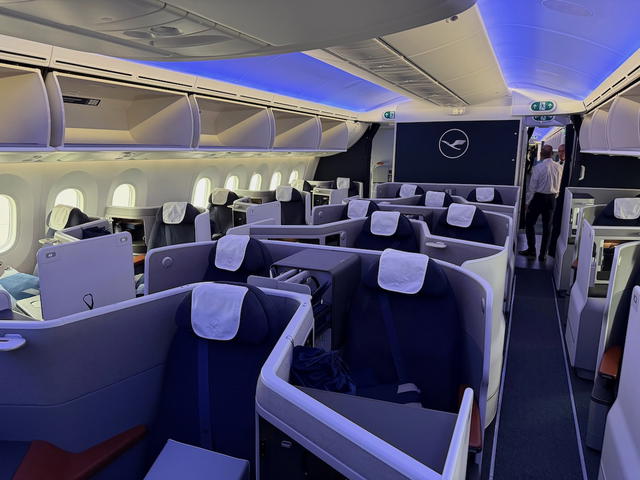
Six Lufthansa A320s get recliner business class seats
Lufthansa has revealed that it will expand its premium offering on short and medium haul routes. With the introduction of the new Premium Business Seat, passengers will get more personal space than they’re used to on short haul aircraft.
Historically, business class on Airbus A320-family aircraft has consisted of standard economy seats with a blocked middle. So that means with the 3-3 layout, four seats were only sold per row. What’s happening is that the first three rows on some aircraft are being replaced with two rows of recliner seats, meaning the per-seat footprint is around 50% bigger than in standard business class.
At launch, the new Lufthansa Premium Business Seat will be available on six Airbus A320 aircraft (and these planes will also be equipped with Starlink). The seat will feature significantly more space, with nearly one meter of legroom, plus extra recline. This doesn’t replace the standard business class product, but instead, is an upsell option.
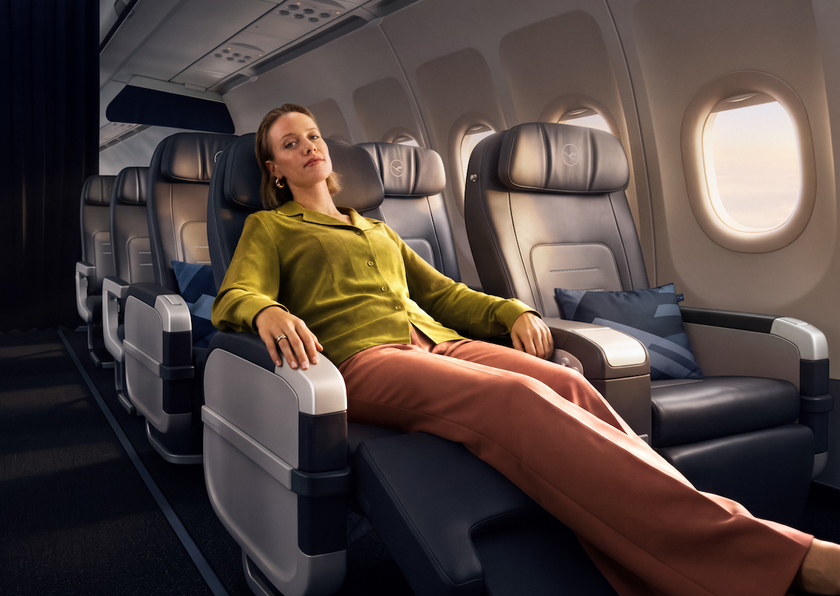
This new product is now available for sale for flights as of March 1, 2027, on routes between Frankfurt (FRA) and Athens (ATH), Cairo (CAI), and Nice (NCE). However, the first plane with the seats will already be in service as of December 16, 2026, and as of February 2027, it’ll be deployed on the above routes (but tickets are only on sale as of March as of now).
If a flight has this product available, you’ll see the “Premium Business Seat” designator during the booking process.
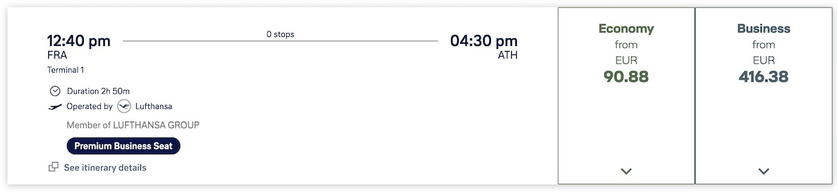
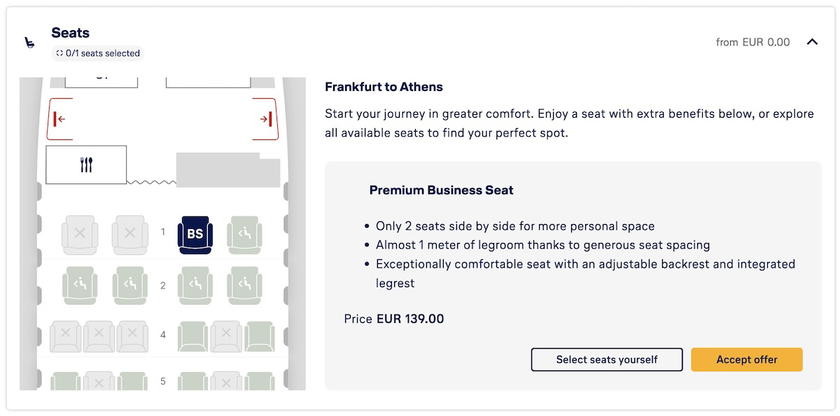
The process of actually booking a Premium Business Seat is essentially an upgrade cost on top of the standard business class fare. For example, looking at a Frankfurt to Athens route, I see an upgrade cost of €139, which frankly seems quite reasonable for a flight of this length.
Lufthansa is for the time being describing this as a commercial test, with the aim of examining demand for additional comfort on these routes, and the results will form the basis for deciding whether to expand the offering.
I love this concept, and this is the way to go about it
You’ll see many people refer to short haul business class in Europe as a “scam” (I don’t agree, but people say that), and they’re shocked to find economy seats with blocked middles. Admittedly product standards differ vastly around the globe.
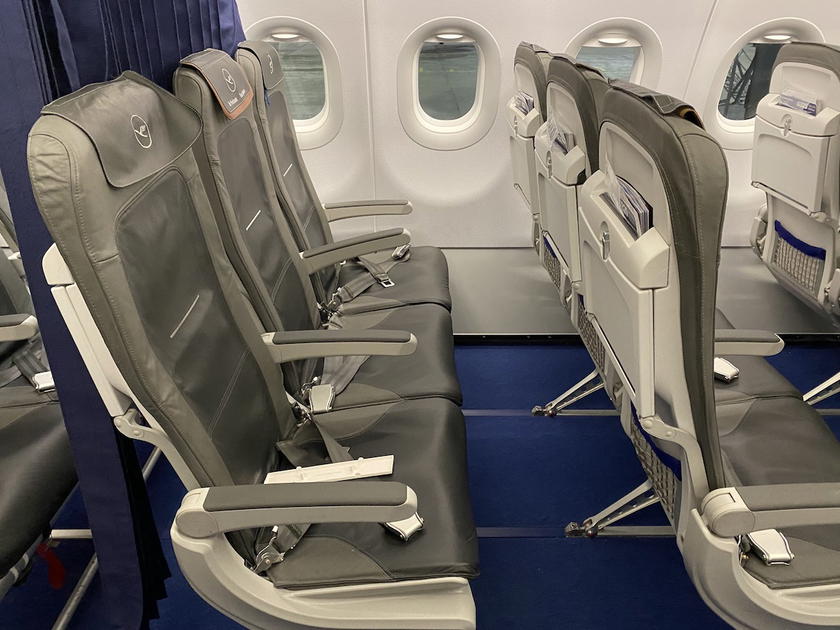
The reason that airlines in Europe can get away with this product is threefold:
- Competitively, offering something better isn’t needed, since the blocked middle seat concept is the standard, so nobody is pushing the competition to do better; it’s the same reason that lounge access isn’t a perk for most domestic flights within the United States
- The blocked middle seat concept gives airlines huge flexibility in terms of changing the size of the business class cabin based on demand, and that’s useful; business class demand is different on a Monday morning to London than on a Sunday morning to Sarajevo
- Most flights within Europe are really short, so on a 30-60 minute flight, odds are that most people wouldn’t pay a meaningful premium for a better seat
Keep in mind that most of the network carriers in Europe don’t make much money on short haul flights (or even lose a lot of money), given high costs and fierce competition from ultra low cost carriers.
With that in mind, I think Lufthansa is going about this exactly right:
- A product like this has to be offered as an upgrade over the standard business class product for those willing to pay, given that the average business class passenger may not necessarily be willing to pay more for this, and may not choose Lufthansa because of this
- If you put the product on the right routes — and Athens and Nice in summer definitely seem like the right markets — there’s going to be demand for this
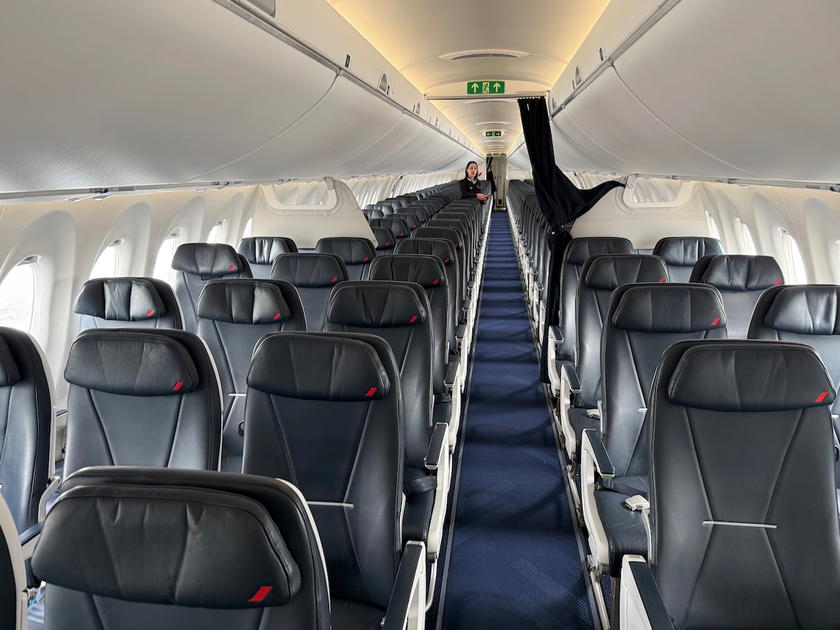
I’d love to see more airlines introduce something similar. In particular, Air France, as Europe’s most premium airline, seems best positioned to do this, and could do it with very little opportunity cost. Why?
- Air France’s primary short haul aircraft in Europe is the A220, where seats are in a 2-3 configuration; the airline only sells three business class seats per row (one seat on the side with two seats, and two seats on the side with three seats)
- Air France could replace those seats with a 2-2 layout, so you’d actually potentially be looking at getting four business class seats per row, rather than three
- Admittedly the extra pitch would counteract that a bit, but if you assume that three rows would be replaced with two rows, you’d be going from nine seats to eight seats, which is a tiny reduction
Honestly, if I were Air France, I’d just introduce this throughout the A220 fleet, and it would be a major point of differentiation, competitively. No airline could do it as efficiently as Air France, and every A220 flight has at least two rows of business class, so the opportunity cost is minimal.
Bottom line
Lufthansa will be introducing “real” business class seats on a subfleet of its Airbus A320s. As of the spring of 2027, expect these planes to be flying from Frankfurt to Athens, Cairo, and Nice. This Premium Business Seat concept will complement the existing business class, and will be available as a buy-up for business class passengers.
I’m very happy to finally see some more comfort on flights within Europe, and I imagine this will prove successful. If it doesn’t, I suspect it would be due to a lack of people knowing about this, rather than there not actually being demand.
What do you make of the Lufthansa Premium Business Seat concept?


Membership is free and takes no more information than commenting as a guest. Earn status points for good contributions, and see fewer ads as your status grows.