

In late 2025, Korean Air announced plans to introduce free Starlink Wi-Fi. While many airlines have committed to the service, there’s perhaps no major global airline that needs it more than Korean Air, given the state of the carrier’s Wi-Fi up until now. Along those lines, there’s a great update, as the rollout will start shortly, and is expected to be completed by the end of 2027.
In this post:
Starlink coming to Korean Air, Asiana, Jin Air, Air Busan, and Air Seoul
Korean Air, alongside Asiana Airlines, Jin Air, Air Busan, and Air Seoul, plan to introduce free Starlink Wi-Fi to their entire fleets. While the announcement came last year, there was quite the gap between that and the first plane being fitted with the service.
That brings us to the positive news, as Korean Air will be “turning on” Starlink for the first time as of September 15, 2026, with plans for all Korean Air and ex-Asiana planes to have the service by the end of 2027 (the Asiana brand will disappear as of December 2026).
The service is initially debuting on four wide body aircraft — specifically, three Airbus A350-900s and one Boeing 777-300ER. These planes will be deployed on medium and long haul routes across the Americas, Europe, and Southeast Asia, as well as on key short haul routes.
Starlink is known for its high speed, low latency broadband internet, and the service will be offered gate to gate. Starlink Wi-Fi will allow for live streaming, productivity similar to on the ground (with high upload and download speeds), gaming, e-commerce, and more. If you ask me, it’s a passenger experience game changer.
As is the case with many airlines, voice and video calls are being restricted to “maintain cabin comfort” (which I’d consider to be good news). The airline notes how it’s the first carrier in East Asia to offer Starlink.
Here’s how a Korean Air spokesperson describes the Starlink rollout:
“Connectivity is an essential part of the travel experience, and with Starlink, our customers will stay connected with fast and seamless internet. As Korea’s flag carrier and a leading global airline, we are committed to upgrading our services and infrastructure to deliver an elevated passenger journey as we strive to become the world’s most loved airline.”
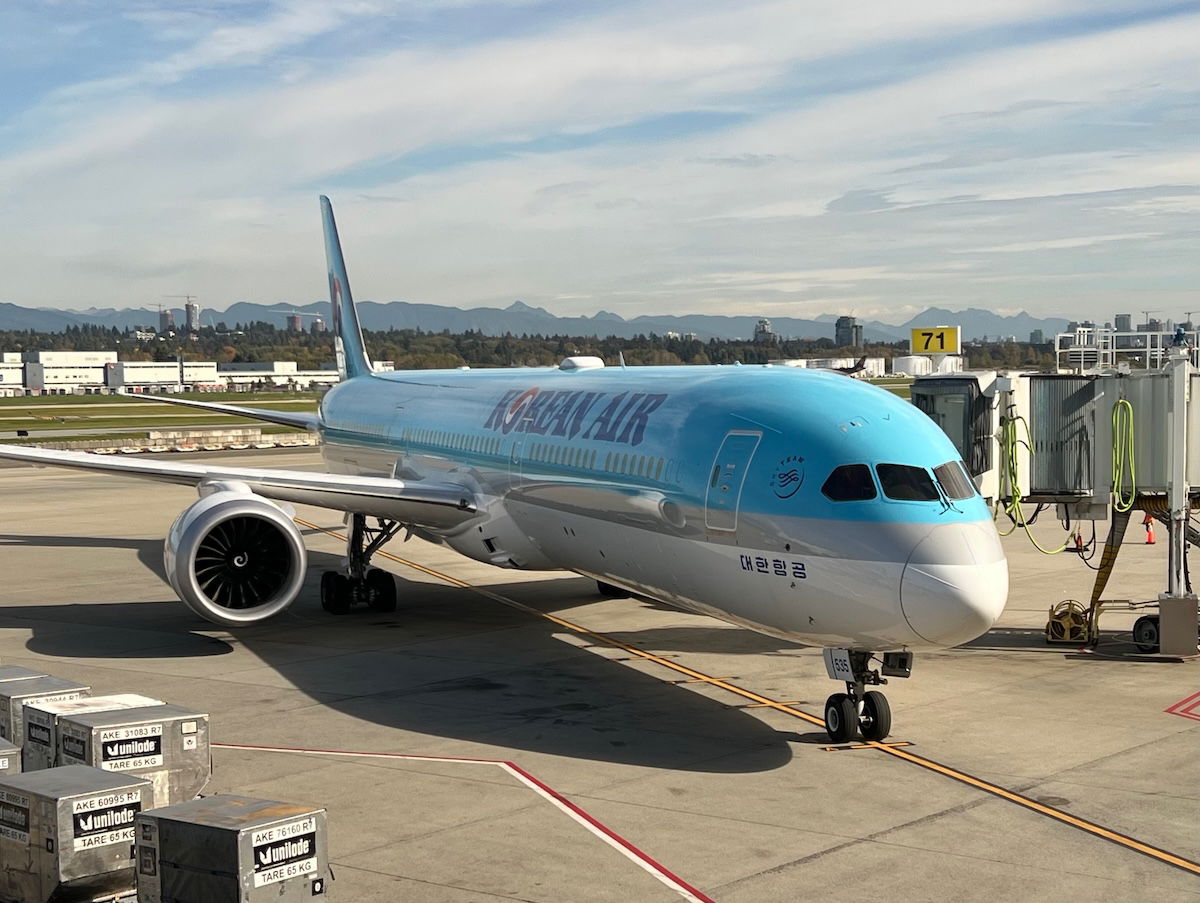
This is massively good news for Korean Air passengers
South Korea is one of the most technologically advanced countries in the world, yet until 2023, Korean Air didn’t have inflight Wi-Fi on any aircraft. Over the past few years, we’ve seen the service progressively introduced on some planes, but it’s still only available on a small percentage of the fleet.
So to see Korean Air go from no Wi-Fi at all, to Starlink Wi-Fi, is a hugely positive development. When Emirates announced it would introduce Starlink Wi-Fi just weeks before Korean Air did, I said at the time that it was the most positive Starlink announcement to date from a large international airline, since the carrier is going from the painfully slow OnAir system, to Starlink. However, Korean Air has Emirates beat, since the airline has no Wi-Fi at all on a vast majority of its planes.
For those curious about why Korean Air didn’t even start to introduce Wi-Fi until a few years ago, there’s an interesting answer. Back in 2016, Korean Air’s Senior Innovation Technology Officer was asked how content and entertainment expectations change for people when they travel, and here’s how that was answered:
“I believe that passengers have similar expectations for in-flight and on-ground content and connectivity options. For example, in Korea, the wireless infrastructure is so advanced (significantly faster than the US average) that in-flight Internet services based on existing commercial satellite technology would be disappointing to them. That is a primary reason why Korean Air has not implemented in-flight Internet.”
The explanation was essentially that Korean Air didn’t offer inflight Wi-Fi because the speeds would’ve been too disappointing to Koreans, who are otherwise used to cutting edge technology. Fortunately with Starlink, that’s no longer the case.
Bottom line
Korean Air, along with Asiana Airlines, Jin Air, Air Busan, and Air Seoul, plan to introduce free Starlink Wi-Fi throughout their fleets. The service will be made available on four wide body Korean Air aircraft as of September 15, 2026, and is expected to be installed across the Korean Air and ex-Asiana fleets by the end of 2027.
It’s amazing to think that just three years ago, Korean Air didn’t have Wi-Fi on any planes, and even now, most aircraft still don’t have Wi-Fi. So to go from no Wi-Fi to Starlink Wi-Fi will be great news for passengers.
What do you make of Korean Air’s Starlink announcement?




A lot of the KE improvements have been held up by the merger, so that's why you're seeing a flood of overdue updates across the airline
This is pretty significant, Asian airlines are so far behind the curve on their wifi offerings.
Many of them still have the dated model of fixed data caps like 100MB per flight or something ridiculous, while still charging $39.95 for it.
Technology is one area that Asian airlines generally do not excel in.
That, and absolutely horrid frequent flier programs that absolutely kill all your progress at 36 months.
Saving for that half-million mile redemption? Better get it done within 35 months, because after that, you're screwed.
Worst thing about Asian loyalty programs, and they almost all do it. I'd say it's even worse than Euro business class, as a horrible-but-pervasive concept.
I flew KE last week and thought Starlink was the standard. Used it and was great!
That explanation about not offering WiFi makes sense. I worked at a major airline’s WiFi team before and a consistent feedback from FAs based on customer sentiment is that they’d rather have no WiFi than bad WiFi.
And here's American Airlines charging $18 for 2 hours or $24 for a flight pass on international. Outrageous
$24 on AA? That's a deal. Long-haul is usually $35.
I'm more curious on what aircraft Korean will inherit from Asiana aside from the A350s. Some of the A330s are still young so they'll fit in just fine and having the same engine manufacturer makes things easier. And while the neos are still relatively new, does it make sense for them to add another engine type?
Asiana has ample a321, a330, a350, a380, and 777, nearly 70 total in service, and nearly 30 ordered, so who knows what will be the post-merger outcome, but plenty of aircraft to go around.
Jin Air and the what would be Air Premia competition can take more planes.
Hanjin Group already owns Korean and Jin. Kumho owns Asiana, Air Busan, and Air Seoul; there is talk of Jin, Busan, and Seoul to merge into a new LLC. Among the other independent carriers, Jeju (owned by Aekyung) is the largest (about 40 aircraft), but, still dealing with the tragic aftermath of JJA2216. T'way has like 30+ aircraft and is attempting to add a330s, which is interesting (maybe they'll benefit from the Korean-Asiana merger). Air...
Hanjin Group already owns Korean and Jin. Kumho owns Asiana, Air Busan, and Air Seoul; there is talk of Jin, Busan, and Seoul to merge into a new LLC. Among the other independent carriers, Jeju (owned by Aekyung) is the largest (about 40 aircraft), but, still dealing with the tragic aftermath of JJA2216. T'way has like 30+ aircraft and is attempting to add a330s, which is interesting (maybe they'll benefit from the Korean-Asiana merger). Air Premia has under 10 aircraft in-total (all wide-body), and mostly to N. America, LAX, EWR, SFO, HNL, IAD (2026). I really like South Korea, generally, and their airlines, specifically, so I hope they do well, regardless.
No more excuse to disappear because I'm flying KE and they have no wifi anymore.
This plus the bibimbap with extra gochujang while upstairs on their 748 hits just right.