

Big picture, the cost of airfare has remained reasonable over the decades, as flying has been democratized thanks to the competitive landscape. However, admittedly there are some fluctuations, and we’re seeing one of those right now.
About a month ago I covered how data showed just how much airfare has increased in recent times. We’ve now see inflation data published for May 2026, and the situation has gotten worse, as we’ve seen the biggest single month jump in airfare in four years.
Statistics on how the cost of airline tickets is increasing
The United States Bureau of Labor Statistics has just published its latest consumer price index summary, showing how the cost of various goods has changed over time. The single biggest year-over-year increase we’re seeing is for airfare, which is up 26.7% compared to 12 months ago.
It goes without saying that this is a massive increase. Just to look at the numbers, the value for May 2026 was 260.319, while the value for May 2026 was 329.824 (these aren’t dollars, but instead, index values relative to 1982-1984, where the period is set to an index of 100).
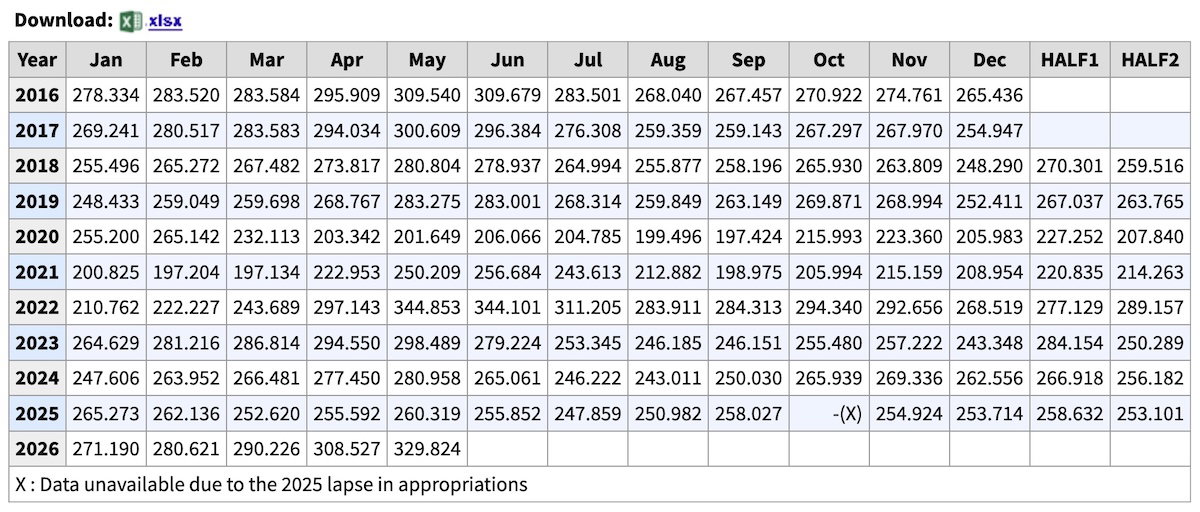
If you prefer to see this in a graph, below you can see the fluctuations over the past 10 years.
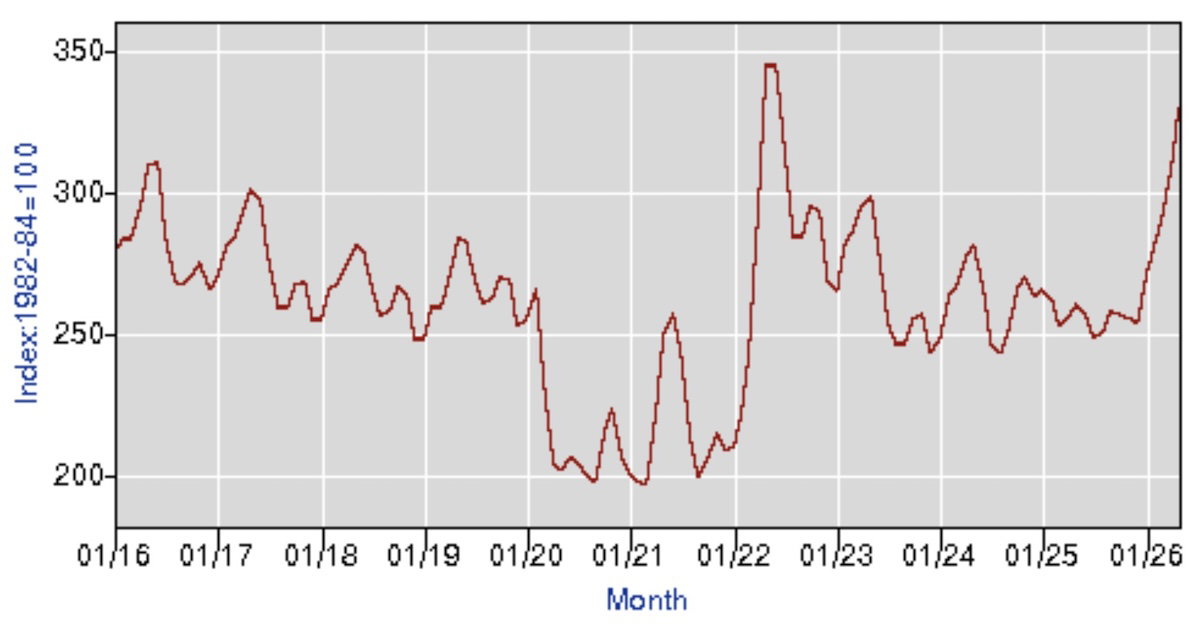
As you can see, we’ve particularly seen an increase in airfare in the first five months of 2026:
- Between April and December 2025, airfare actually decreased, from a value of 255.592 to a value of 253.714
- We started 2026 with a value of 253.714, and over just five months, we’ve seen the value go to 329.824
- The situation is actually worse than the 26.7% increase over 12 months, as airfare has increased 30.0% over the past five months
Here’s how the methodology for determining this data is described:
Eligible for pricing are all regularly scheduled domestic and international commercial airline trips on certified carriers departing from each city in the CPI sample. For the selected cities that do not have a qualifying airport, the nearest city with a qualifying airport is designated as the city of departure.
Prices include all applicable taxes for both domestic and international travel. Fuel surcharges, airport, security, and baggage fees are also included. Eighty percent of quotes in the CPI sample are designated to include a checked bag on the flight. Whether a given quote is assigned a bag is randomly determined at quote initiation. The CPI only tracks the price of the first piece of checked luggage. The price of carry-on bags and any additional checked luggage are not tracked.
What can we make of these rapid airfare increases?
It goes without saying that the conflict with Iran has caused jet fuel prices to skyrocket. While the cost of airline tickets isn’t typically correlated that closely to the cost of actually transporting people (given the elasticity of demand), airlines have done an impressive job (from their perspective) raising fares to offset those increases. That’s particularly true of the legacy carriers.
But what I find interesting here is that the cost of airfare already started to increase drastically before that. Admittedly there’s some seasonal element to this, but still, these increases are material.
Everyone talks about the K-shaped economy, and that’s true in the airline industry more than anywhere. Premium demand seems to be insatiable, while airlines are having a harder time filling economy seats. Of course Spirit’s recent liquidation also won’t help with keeping airfare affordable, though those ticket costs were subsidized by shareholders and investors for far too long, so it just wasn’t sustainable.
United management has been very clear that they plan to keep around higher fares as much as possible even when oil prices decrease. As United CEO Scott Kirby recently admitted on an earnings call:
“Certainly, the longer this lasts, the higher the probability goes that the pricing increases hold. And we probably won’t hold 100% if we normalize as I told the team earlier today, and it’s just my guess that if things went back to mid-February normal, I think we get to keep 20% of the price increase next year. I think that’s going to move towards 80%. And every day, it’s ticking up longer as this goes on.”
But we also have Transportation Secretary Sean Duffy gaslighting consumers, claiming that high jet fuel prices will make tickets cheaper in the long run. Oh, and he says that all while United (which is promising investors to keep fares higher) is sponsoring his patriotic road trip.
Bottom line
The cost of airfare in the United States has increased 30% in the past five months. Obviously high oil prices partly fit into that, but the trend already started before the conflict with Iran (though that’s at least partly attributed to holiday travel).
The airline business is tough, and it’s understandable that airlines have to recoup some of the increased oil prices. However, airlines insist they plan to keep around these higher fares even when oil prices drop.
Usually I think people are a little dramatic about how expensive airfare is, because adjusted for inflation, it’s quite reasonable, big picture. Still, the increases at the moment are drastic, and there’s reason to be concerned. That’s especially true when you consider that only a small number of airlines are doing well, while others are suffering.
What do you make of this data about the increase in airfare costs?




Hop a ride on air force one
True fact: those that support the wars imposed by the Taco actually do not travel but stay in their small bubble so it has little impact on them. They can continue with their incest breeding.
and it is beyond incredible the number of people that think others support this war when there is clear evidence of their disapproval of this endless, costly war.
some are driven by emotions and ideologies and intelligence and reasoning are clearly non-existent for them.
Walter Mitty Dunn posts …. “and” “and” “and” …. Clearly English grammar is “Non-existent for HIM.
You idiot! You dare to correct someone's grammar by issuing a post full of poorly-formatted, grammatically questionable, inconsequential drivel? You limey bugger! You are trying (yet failing miserably) to properly utilize the ellipsis. You randomly capitalize words (such as "Non", which is missing the closing quotation mark!) I think the phrase: Clearly English grammar is "Non-existent for HIM, applies to one and only one individual here: YOU! Inconsequential dog! Now be quiet!!!! COCKNEY!!!!!!
You idiot! You dare to correct someone's grammar by issuing a post full of poorly-formatted, grammatically questionable, inconsequential drivel? You limey bugger! You are trying (yet failing miserably) to properly utilize the ellipsis. You randomly capitalize words (such as "Non", which is missing the closing quotation mark!) I think the phrase: Clearly English grammar is "Non-existent for HIM, applies to one and only one individual here: YOU! Inconsequential dog! Now be quiet!!!! COCKNEY!!!!!!
Jessica, Jessica, darlink, I really must thank you for brightening up this wet and grey day in the Old Country. I do hope you are enjoying fairer weather in the colonies.
Your post is an excellent example of the language used by the Shiela’s, who worked the bars and brothels of Bugis Street, Singapore, last century. I am still chuckling at the thought of you, smoke bellowing from your ears in rage while composing your...
Jessica, Jessica, darlink, I really must thank you for brightening up this wet and grey day in the Old Country. I do hope you are enjoying fairer weather in the colonies.
Your post is an excellent example of the language used by the Shiela’s, who worked the bars and brothels of Bugis Street, Singapore, last century. I am still chuckling at the thought of you, smoke bellowing from your ears in rage while composing your post. You have made my day, thanks again Shiela.
I must add that you and Walter Mitty Dunn are tailor made for each other. He will never be accused of having a broad knowledge of aviation, while you can rest assured that with such a foul mouth on you, nobody will ever accuse you of being a lady, yes? Xxxxx
This is a provoked or choice of war with Iran. It is neither a conflict nor a military intervention. Kudos to Ben as his said article was picked up by Vox via below link. The article also provides five other links. The first link is Ben's said post in the news not on a travel forum.
https://www.vox.com/videos/490730/how-the-war-in-iran-could-end-affordable-air-travel
We are discussing how the Iran war affects airfare. But we overlook the far reaching negative wrath fall...
This is a provoked or choice of war with Iran. It is neither a conflict nor a military intervention. Kudos to Ben as his said article was picked up by Vox via below link. The article also provides five other links. The first link is Ben's said post in the news not on a travel forum.
https://www.vox.com/videos/490730/how-the-war-in-iran-could-end-affordable-air-travel
We are discussing how the Iran war affects airfare. But we overlook the far reaching negative wrath fall on third world residents. The Iran war should remove any doubts about how the US president and Israeli PM destabilize the world and plunge the global economies into the free fall. Two psychotic war criminals.
https://www.vox.com/politics/491389/food-fuel-price-shocks-instability-protests-riots
This is American stuff. Trump is crucifying the US traveller. How about travel in other parts of the world? I was recently able to get two Qatar Airways business class tickets for a little bit over the price I paid for the equivalent Etihad product from April 2025. Those Etihad tickets were quite a bit higher than the QR tickets I bought in 2024.
Umm, you’re ‘cool’ with risking it through Doha these days? I mean, Ben did it in April, but I’m not sure I’d wanna take the risk anytime soon, and I’ve been through Hamad International loads of times before the war escalated…
Fuel sure I get it. What about the massive pay raises for pilots and FAs? A factor conveniently avoided?
Let’s see the MAGA mouth breathing incels try to spin this one.
cough cough. Tim, why does your supreme leader think 30% inflation in airfare is ok?
effective annual inflation in airfare at... ~70%?
Market forces MaxPower. The planes are still full. That is all that matters. Air travel is a discretionary expense. If you can't afford it don't go.
Oh, Retired Gambler, classic reductive libertarian tropes... air travel isn't a luxury discretionary hobby; it's critical transportation running on taxpayer-funded infrastructure. Inevitably, when these massive corporations come begging for the next round of bailouts, I hope we actually ensure robust consumer protections (like an EU261) are included as a stipulation. Otherwise, we're just privatizing profits and socializing losses.
@gambler
I'm not the one who campaigned on inflation brought on by a combination of the last administration's policies and Trump's own "spend now, pay later" policies during covid.
Friends, look below at George and Tim, they already tried (and failed).
from the beginning of this conflict, I said that fuel would increase and stay up - and precisely nowhere have I ever said this was a good thing.
Not sure how you can attach any political spin or affiliation to that - or even try.
War is messy and this one won't be over soon - also which I have repeatedly said.
"any political spin" ... Tim, the guy campaigned on "no new wars" then started a "new war." Increased energy costs are directly tied to said "war." C'mon.
Feel free to show us the ballot which you think I voted on
Tim, deflect on here all you want. It's this administration's broken campaign promises and macroeconomic consequences that matter, not your personal ballot history.
are you really now going to deny your past maga posts, Tim?
you are a slimy little rascal, I'll give you that... whenever it's an uncomfortable past thing you've supported, you just pretend like you've never been a big maga guy...
Mini MaxPower, after making a total fool of himself as he got badly beaten up by Tim Dunn and 1990 in the comments, is at it again. He tried to lie and went away with a major case of Depression. Now he’s throwing money at ME, looking for forgiveness! Sad!
Icarus, I don’t see MaxPower making fools of anyone but Mr. Dunn. Besides, there's only ‘three ways to do things: the right way, the wrong way, and the Max Power way!’
feel free to post my MAGA posts.
I am a free market capitalist.
Don't confuse my dislike for socialism as a political bent.
Socialism? Like, the military, interstate highways, and fire departments? Huh, odd things to dislike, but you do you…
you don't understand the difference between taxpayer funded and socialism.
I just spent two hours doing "free" landings at airports - but I can assure you I paid for it when we filled up at the end of the flight.
"I am a free market capitalist."
says the guy that probably wrote close to 2,000 paragraphs defending tariffs last year...
UA "The Dummy" NYC has totally lost it and presents as a "LOSER"! Instead of composing a valid argument comprised of critical thinking, intellectual excellence, and expert analysis, he delivers a poorly thought-out, moronic and imbecilic load of CRAP!!!! Such asinine statements including accusations of "involuntary celebacy", "oral breathing", and "falsification of information", all while presenting a grand total of exactly ZERO sources is a reflection of extremely low intellectual, horrendously low self-esteem, and a...
UA "The Dummy" NYC has totally lost it and presents as a "LOSER"! Instead of composing a valid argument comprised of critical thinking, intellectual excellence, and expert analysis, he delivers a poorly thought-out, moronic and imbecilic load of CRAP!!!! Such asinine statements including accusations of "involuntary celebacy", "oral breathing", and "falsification of information", all while presenting a grand total of exactly ZERO sources is a reflection of extremely low intellectual, horrendously low self-esteem, and a VERY SMALL BRAIN.
Rod, was that a satire? Because it read exactly like one of Trump’s 3AM Truth Social screeds…
19"The Dingus Maximus"90, a total loser, is being decimated by people all over OMAAT, especially since they know and admire the many GREAT people that comment for, and with, me. They are very “INTELLIGENT” and, likewise, very “STRONG.” "The Dingus" has been hit so hard that he was forced to issue an apology, but his apology is worthless. I’ve known him a long time. He’s a bad guy, with major character flaws. He’s also very...
19"The Dingus Maximus"90, a total loser, is being decimated by people all over OMAAT, especially since they know and admire the many GREAT people that comment for, and with, me. They are very “INTELLIGENT” and, likewise, very “STRONG.” "The Dingus" has been hit so hard that he was forced to issue an apology, but his apology is worthless. I’ve known him a long time. He’s a bad guy, with major character flaws. He’s also very weak and insecure, and will do and say anything for publicity. He was a staunch supporter of Crazy Timothea "Tom" "The Deuce" Dunce during his or her failed Campaign to support Delta, and is now a supporter of Mini MaxPower, but that’s only because I don’t take his many phone calls anymore - Just don’t have the time or inclination to do so. He can never recover from the horrible statement he made yesterday about many wonderful and likewise revered people alongside United, but he is going to have to try, because what he said was totally unacceptable!
wow...
who knows what lunacy came over Rod & Icarus but they sound a lot like how Tim posts when he's black out...
More money for the executive suite .
Airlines operate on razor thin margins and in the US the US5 (including AS/HA) are buffeted by cc income. The others are trying to make a go of it by finding underserved routes, operating those 2-4 times a week and keeping costs, including cost of customer service uber low.
Despite what @1990 types from his mother's basement there is no excess to absorb increased fuel costs. Turns out flying complicated, hundred million dollar machines across the sky is expensive.
thank you. Airlines will start updating guidance for the quarter - which is 80% over and some airlines including AS is ready to provide annual guidance.
Fuel costs are not going down which means most airlines will have very small profits; IATA estimates the global industry will have a 2% profit margin at best.
AS is paying the highest fuel prices of US airlnes and still trying to integrate HA. DL is, by far in...
thank you. Airlines will start updating guidance for the quarter - which is 80% over and some airlines including AS is ready to provide annual guidance.
Fuel costs are not going down which means most airlines will have very small profits; IATA estimates the global industry will have a 2% profit margin at best.
AS is paying the highest fuel prices of US airlnes and still trying to integrate HA. DL is, by far in the best position because of its refinery and strong non-transportation revenue including Amex. The fact that some people mock DL and me for highlighting those realities show that they can't escape the fact that DL has made some very good decisiosn over the years and will use its financial strength to further grow, including its recently announced plans over the Pacific and on the west coast.
The US airline industry is largely mature and it will be even harder to grow w/ high fuel prices. Stronger competitors will work harder to take out weaker competitors and gain share - but there is still huge pushback against the big 3 getting any larger and I don't expect that WN will fare much better.
and high salaries are by far the biggest drag on airline finances and the reason why the big 4 - led by DL - are putting so much pressure on smaller airlines.
The irony is delicious, George. Yesterday you were cheering on WestJet to crush its competition by denying them a level playing field (check the tape!), but today we’re supposed to weep for the legacy carriers because fuel is expensive? Give me a break.
And Tim, calling frontline salaries a 'drag' while praising Delta's Amex-subsidized financials tells us everything. The legacy carriers aren't struggling on 'razor-thin' margins; they are aggressively leveraging an oligopoly. When United’s own...
The irony is delicious, George. Yesterday you were cheering on WestJet to crush its competition by denying them a level playing field (check the tape!), but today we’re supposed to weep for the legacy carriers because fuel is expensive? Give me a break.
And Tim, calling frontline salaries a 'drag' while praising Delta's Amex-subsidized financials tells us everything. The legacy carriers aren't struggling on 'razor-thin' margins; they are aggressively leveraging an oligopoly. When United’s own CEO openly brags about keeping 80% of these fare hikes even after oil prices drop, it’s not a margin crisis...it’s greedflation! They're squeezing out the ULCCs, like Spirit, and now consumers and workers are paying the price for a broken deregulated system.
Wayne, being very serious now.
Your arguments and conclusions laid out in your post starting: “thank you. Airlines will start”. might well be perfectly valid, however, they are extremely poorly explained. Many of your ideas might be able to coexist, but, you do not explain exactly how.
You are being assertive in your posts rather than explicit, as such it becomes extremely difficult to follow your arguments. It would be far easier to...
Wayne, being very serious now.
Your arguments and conclusions laid out in your post starting: “thank you. Airlines will start”. might well be perfectly valid, however, they are extremely poorly explained. Many of your ideas might be able to coexist, but, you do not explain exactly how.
You are being assertive in your posts rather than explicit, as such it becomes extremely difficult to follow your arguments. It would be far easier to dismiss your arguments out of hand because of your inability to provide logical reasoning. I believe that you expect too much from your readers and assume that genuine questions are being critical.
I would much rather learn from you than argue, however, it take two to tango!
happy to "dance with you"
feel free to let me know which parts of my post you don't agree with or think needs further explanation - which certainly could have been requested in far less than the 100 words you typed.
warmly,
Tim (not Wayne)
but thanks for being semi-serious
Now this time Walter, I really am being very serious …. You might well be willing to dance with me, however, I prefer my dance partners to be ladies and not old has-beens sacked by a second rate U.S. airline like Delta.
I make no apologies for playing you like a the old trout you present to the world. Bye Walter Mitty, you are no pilot and a very poor author of airline industry analysis.
First, you’ll notice that dance is in quotation marks
Second, just think how much bigger your world if you believe the truth rather than what you want it to be
But then, maybe there won’t be any opportunities to trash somebody if you focus on the truth - so that may be the real issue here
Tim, is it possible Guest and Diamond are two different people? (I think you started this 'dance' with one, and now the other is now taking you for a ride.)
So, Walter Mitty Dunn, you want an encore, I will be only too happy to oblige. One is always willing to assist those less well endowed with knowledge.
It is proven that you have little to no knowledge of how to construct a sentence in English, never mind a paragraph or missive. Therefore, your misuse of quotation marks is easily dismissed as simply your ignorance of the English language and grammar.
You consistently start a...
So, Walter Mitty Dunn, you want an encore, I will be only too happy to oblige. One is always willing to assist those less well endowed with knowledge.
It is proven that you have little to no knowledge of how to construct a sentence in English, never mind a paragraph or missive. Therefore, your misuse of quotation marks is easily dismissed as simply your ignorance of the English language and grammar.
You consistently start a sentence with a lower case letter. Now that has to be a deliberate act, which displays an incomprehension of English grammar. Much like calling a passenger airline a compressed air tube, eg, Delta Air Lines, instead of Delta Airlines, get the picture now?
Much more of a faux pas, is your constant insistence upon starting a sentence or paragraph with the word ‘And’. Then you completely misunderstand how to construct a sentence without multiple use of that word ’and’. The word ‘and’ should only be used once in any sentence. It is used as final breathing pause before the end of a given sentence. There is no need to place a comma before the word ‘and’, as the correct use of the word indicates a natural breathing point. The inclusion of the comma is simply an American affectation.
I know Walter, ‘one cannot teach an old dog new tricks’. In your case you old sock, that phrase is 100% correct. You are nothing more than a stubborn old has been, with an outlook on life narrower than a dull torch beam. You display little to no knowledge of anything outside of the Big3. Your comprehension of the world wide aviation industry is minimal. One knows that you are no aviator and there are doubts that you have ever boarded any aircraft other than a Delta offering.
So Walter Mitty Dunn, what do you actually know about the Airline Industry which exists outside of GA airspace? Clearly very little and yet you pontificate as if you are a world authority. Some of the readers of this blog may well be impressed by the volume of your posts, however, the majority are simply laughing at you Walter.
You will be pleased to note that one is thoroughly bored with our verbal intercourse and will leave you to your click generator duties. Yes, Walter Mitty Dunn, generating clicks is the only use for such a boring old fart!
Is Sean Duffy exceptionally stupid, a fat orange Nazi fellator, or both?
Every time he opens his mouth, a combination of lies and pubes come flying out of his mouth.
Willy, that ‘guest’ is not me.
While lesser airlines continue to whine about "fuel costs," "airspace closures," and "basic economic reality," Delta Air Lines has announced that the Iran conflict is expected to increase annual profits by approximately $847 trillion, according to analysts who were last seen laughing uncontrollably.
"Many people assume higher fuel prices hurt airlines," explained Delta Chief Economist Dr. Tim Deucey Dunce. "What they fail to understand is that Delta benefits from all events. Good events. Bad events....
While lesser airlines continue to whine about "fuel costs," "airspace closures," and "basic economic reality," Delta Air Lines has announced that the Iran conflict is expected to increase annual profits by approximately $847 trillion, according to analysts who were last seen laughing uncontrollably.
"Many people assume higher fuel prices hurt airlines," explained Delta Chief Economist Dr. Tim Deucey Dunce. "What they fail to understand is that Delta benefits from all events. Good events. Bad events. Neutral events. Events that have not yet happened. We recently posted a strong quarter due to favorable cloud formations over Nebraska."
Industry observers note that jet fuel prices have indeed risen sharply during the conflict.
However, Delta's proprietary business model allegedly converts rising fuel prices into shareholder value through a complex process involving:
* Charging more.
* Continuing to charge more.
* Charging even more than that.
* Selling a "Fuel Appreciation Surcharge Surcharge."
* Charging passengers a "Congratulations On Finding A Seat" fee.
The airline has reportedly informed investors that every $1 increase in fuel costs results in:
* A $14 increase in fares.
* A $37 increase in premium cabin fares.
* A $92 increase in checked baggage fees.
* A $6,000 increase in the CEO's annual yacht budget.
Wall Street analysts have revised Delta's 2026 earnings forecast from "very good" to 'mathematically impossible."
One report projected that if the conflict continues for another six months:
* Delta's market capitalization could exceed global GDP.
* The airline will acquire three continents.
* The state of Georgia will become a wholly owned subsidiary.
* The moon will be rebranded "Delta SkyMoon™."
"People keep asking if higher fuel costs hurt Delta," said one aviation analyst. "That's outdated thinking. Delta benefits from high fuel prices. Delta benefits from low fuel prices. Delta benefits from stable fuel prices. Frankly, if fuel became free tomorrow, Delta would probably announce a special dividend."
Meanwhile, rival carriers have announced fare increases to offset higher costs.
Delta, however, has taken a different approach.
"We are pleased to announce our new strategic initiative," the airline said in a statement. "We will raise fares because fuel is expensive. If fuel becomes cheaper, we will raise fares because demand is strong. If demand weakens, we will raise fares to maintain yields. If neither occurs, we will raise fares to preserve consistency."
At press time, Delta stock had risen 4,700%, the CEO had been declared Emperor of Aviation, and economists were attempting to determine whether the airline now controlled the laws of physics.
LMAO!!!!!
This wins the internet for today. I take my hat off to you, sir.
Exceptional!
"No new wars..."
"Just two more weeks..."
*facepalm*
I'm glad you are covering this, Ben.
wages are not keeping up w/ even core inflation, let alone airfare inflation. The premium travel market is strong because the stock market continues to do very well which means alot of Americans are spending money they socked away years ago and which has done very well.
Many people don't appreciate how the current Middle East war is going to reshape not only the US' role in...
I'm glad you are covering this, Ben.
wages are not keeping up w/ even core inflation, let alone airfare inflation. The premium travel market is strong because the stock market continues to do very well which means alot of Americans are spending money they socked away years ago and which has done very well.
Many people don't appreciate how the current Middle East war is going to reshape not only the US' role in the world as the largest oil producer but an increasingly reliable supplier including of jet fuel to Europe and even parts of Asia - along w/ other petroleum products.
the counter to all of this is that rapidly increasing airfares - which have been fueled by NK's demise and the certainty that B6 can't survive into 2027 withough some sort of restructuring - will result in more and more government oversight and interference with the big 3 and esp. DL and UA. There is and will be ZERO appetite to allow either to acquire any more access to major airports as long as there is even a shred of evidence that a lower cost airline will step up to fill the gap.
UA's dreams of gaining access to JFK while touting that it is the largest airline in NYC could not be on shakier ground.
Not signs of a healthy economy, Tim. Unchecked corporate greed and extreme wealth inequity has led us astray. The deregulated market is failing consumers, which is why we need baseline passenger protections (like an EU261). Of course, had we actually embraced renewables and electrified ground-based transit years ago (instead of ceding a lot of ground to China), we wouldn't be held hostage as much by a volatile oil market right now... (even if our 'dear...
Not signs of a healthy economy, Tim. Unchecked corporate greed and extreme wealth inequity has led us astray. The deregulated market is failing consumers, which is why we need baseline passenger protections (like an EU261). Of course, had we actually embraced renewables and electrified ground-based transit years ago (instead of ceding a lot of ground to China), we wouldn't be held hostage as much by a volatile oil market right now... (even if our 'dear leader' decides to start new forever-wars.) Sure, some of this affects DL and UA (and NYC), but it much bigger.
first, I commend you for being able to engage in discussion w/ someone that you disagree with and do it civilly and without name-calling.
It speaks volumes about most of the other people that disagree and about you what you can do that they cannot.
second, the middle class is a relatively young development in the course of human civilization; it didn't exist for much of humanity and certainly not in pre-democracy periods and it...
first, I commend you for being able to engage in discussion w/ someone that you disagree with and do it civilly and without name-calling.
It speaks volumes about most of the other people that disagree and about you what you can do that they cannot.
second, the middle class is a relatively young development in the course of human civilization; it didn't exist for much of humanity and certainly not in pre-democracy periods and it still doesn't exist anywhere near to the same degree in most of the developing world as it exists in developed countries including Europe, parts of Asia, and the US and parts of Latin America.
third, investment income and wealth is a real and legitimate source of economic power; there is nothing that blocks people in most democracies from investing in financial markets.
but it takes discipline to not spend all you have and put money away. there are many young people that have decent investment accounts and will have the wealth and income that is fueling the huge premium travel boom in the west now.
next, China is one of the few large countries w/ a large number of million plus resident cities that has a viable nationwide rail system and that is partly because it is so much newer and they have no respect for personal property. India has some rail. Brazil has virtually none. the US made the decision during WWII - before the jet age - to build intercity transportation around highways and airports/airlines. Keep in mind that most of Europe was heavily bombed during WWII so they had a chance to start over w/ rail; the US did not. It is still not terribly common to use rail in Europe for distances over 500 miles in part because air travel is superior. The majority of US air travel is for distances over 1000 miles; trains are simply not viable for those trips.
and finally, as much as some would like to eliminate fossil fuels, there is no viable alternative to reliably power a modern global economy that involves people moving around their hometowns and the world and doing what they want at all hours of the day and night.
The US economy is delivering for some people but it does more for more people than for just about any other country.
as Ben accurately notes, the US economy is K shaped and there is more than enough demand to support strong air travel spending for the "half" that has the means to keep 4 strong nationwide carriers going along w/ a certain amount of low cost/ultra low cost carriers.
Walter, to us mere mortals your second missive starting (first I commend you) reads like load of disconnected observations rather than supporting any evidence for your argument.
Each of your statements are debatable and because you do not explicitly defend them, the logic feels like a series of assertions rather than a tightly connected argument.
Is that why Delta fired you?
"first, I commend you for being able to engage in discussion w/ someone that you disagree with and do it civilly and without name-calling."
aka. Please don't bring my relevant known past on the internet . I prefer to pretend I haven't been an idiot for 15 years... lol
Tell us, Tim. Were you not WorldTraveller and ATLMillion100M (or however you put those words together)?
Wayne, from your missive one concludes that it is best read as an informed opinion piece from someone who follows the airline industry, not as a neutral factual analysis.
I would only offer you 5 out of 10, for content, accuracy of the information and presentation. Do try harder next time, yes?
Wayne, from your missive one concludes that it is best read as an informed opinion piece from someone who follows the airline industry, not as a neutral factual analysis.
I would only offer you 5 out of 10, for content, accuracy of the information and presentation. Do try harder next time, yes?
I post this again because Ben is allowing the gremlins to misappropriate logins once more.
Wayne, from your missive one concludes that it is best read as an informed opinion piece from someone who follows the airline industry, not as a neutral factual analysis.
I would only offer you 5 out of 10, for content, accuracy of the information and presentation. Do try harder next time, yes?
Timmy D’s boy Agent Orange driving insane inflation increases and he somehow can’t point out the elephant in the room.
No wonder he’s a fired mediocre DL chump!
It is supply and demand. They can price their product at whatever price they believe people will pay. If they are right keep raising the price until you get pushback. These aren't charities, they should maximize revenue and profit. If people don't fly prices will go down. No airline is obligated to offer a "cheap" price just so you can fly - if you can't afford it that is your problem, not theirs.
I completely agree, there are too many poor people who fly anyway. Look at all those viral videos of people misbehaving, it's always poor people who are better staying in their trailers.
@ Retired Gambler -- I hear you, I don't think anyone is disagreeing with that premise? Airlines are businesses, and they can charge whatever people are willing to pay. But a 30% increase in five months hits a lot of consumers hard.
Maybe. But planes are still full. I would expect this trend to continue until they hit an inflection point and demand starts to roll back.
Retired Gambler... Oof, sane-washing Trump's insanity, moving-goal posts, and false equivalences, yet again. (You would not be saying any of that if it was a Democrat in the White House...)
@1990 - I am first and foremost a free market capitalist. I would make the same comments regarding businesses and pricing regardless of whom is in office. As @David mentioned, until there is pushback and airlines (or any other business) suffer as a result of their prices there is absolutely no incentive to reduce them. If anything, as Disney proves year after year, just keep raising them - people will whine but will still pay....
@1990 - I am first and foremost a free market capitalist. I would make the same comments regarding businesses and pricing regardless of whom is in office. As @David mentioned, until there is pushback and airlines (or any other business) suffer as a result of their prices there is absolutely no incentive to reduce them. If anything, as Disney proves year after year, just keep raising them - people will whine but will still pay. Or it could be like Las Vegas (a city I love and know well). People complain about prices and "nickel and diming". Yes visitor traffic is slightly down but casino profits are up. What that means is the town really doesn't want or need to low end cheapskate looking for a "deal" - they want visitors with assets that have no problem spending for the experience.
Retired Gambler, reports are Trump just gave Iran $3 billion… makes the whole ‘pallets of cash’ gripe seem quaint.
As for ‘free markets,’ that’s naive; commercial aviation is not a vacuum; while prices are not regulated like before 1978, there’s still a lot of regulation here, as there should be sensible guardrails for this essential industry (and others). The delicate balance between capital, labor, and consumers is getting waaay out of whack, not just...
Retired Gambler, reports are Trump just gave Iran $3 billion… makes the whole ‘pallets of cash’ gripe seem quaint.
As for ‘free markets,’ that’s naive; commercial aviation is not a vacuum; while prices are not regulated like before 1978, there’s still a lot of regulation here, as there should be sensible guardrails for this essential industry (and others). The delicate balance between capital, labor, and consumers is getting waaay out of whack, not just with airlines, but in all sorts of fields. Reforms are overdue. Might take some time, and may have to get even worse before it gets better, but I think we’ll see those changes, inevitably. During the next bailout, for instance, there’d better be stipulations for actual consumer protections like an EU261. Yes, my favorite.
Why do you even read his stupid comments? I learned early on that he and a few others are a waste of time. If you read 1990 and his crazy buddies (we all know who the worst offenders are) for entertainment purposes, I guess that’s ok, but why engage with him and his ilk if you’re trying to be serious.
Gambler, when the airlines inevitably come begging for yet another bailout, all I ask is that we, the taxpayers, include a stipulation for actual consumer protections, like an EU261 equivalent. Because, you know, we’re not gonna “let them fail” (especially if it’s US3 asking). So, let’s get real, and actually prepare for that instead of pretending this is purely ‘free’ market in a vacuum.
Poor people don't deserve to live in Trump's world, good riddance, they're too lazy to make money anyway.
I would say, "you forgot the '/s'..." but I think you actually meant it, which tells us all we need to know about you... *smh*
endlessly funny how Trump has responded to the cost of living crisis by enacting tariffs and launching another pointless Middle East war, sending prices soaring. Just the worst possible response imaginable lmao
Midterms in 146 days. If eligible, please vote accordingly.
“If eligible”. That will be litigated for months after the midterms. My two cats, not yet US citizens, are registered Independents. They have not told me who they are going to vote for yet.
Dan, you'd better get your pussies in-line!