

Fuel planning is an important part of the job that dispatchers and pilots perform before a flight can depart. It’s not just about having enough fuel to get to the destination, but also about having reserves if there’s bad weather enroute, if a diversion is needed, etc.
I tend to keep a closer eye on Miami International Airport (MIA) than most, given that it’s my home airport. Along those lines, the airport’s longest flight declared an emergency this morning, with some interesting circumstances…
Emirates 777 has fuel emergency after two go arounds
Emirates flight EK213 operates from Dubai (DXB) to Miami (MIA). The 7,845-mile flight is flown by a Boeing 777-300ER. Today, Sunday, May 17, 2026, the flight was scheduled to depart at 2:15AM local time and arrive at 10:00AM local time, with a total block time of 15hr45min (there’s a time change of eight hours).
This is a very long flight under normal circumstances. On top of that, at the moment, flights are in some cases taking detours to avoid certain airspace in the Middle East, potentially adding to flight time.
If you look at the Flightradar24 map for today’s flight, you might think this looks like any other Dubai to Miami flight. However, the flight ended up spending over 17hr15min in the air, to the point that the pilots had to declare an emergency.
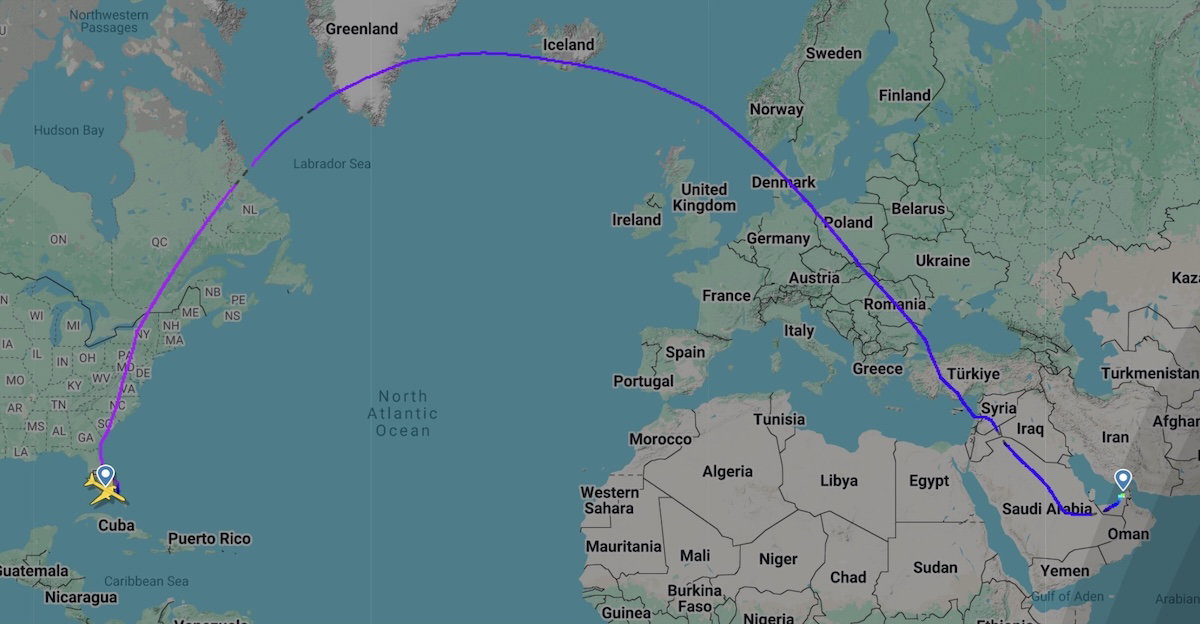
What exactly went wrong? Well, the plane started off making great time, and the flight took off at 1:47AM, a staggering 28 minutes ahead of the scheduled 2:15AM departure time. Obviously headwinds were especially strong today, because around 16 hours after takeoff, the plane only found itself over Orlando, still at its cruising altitude, but ready to start its approach.
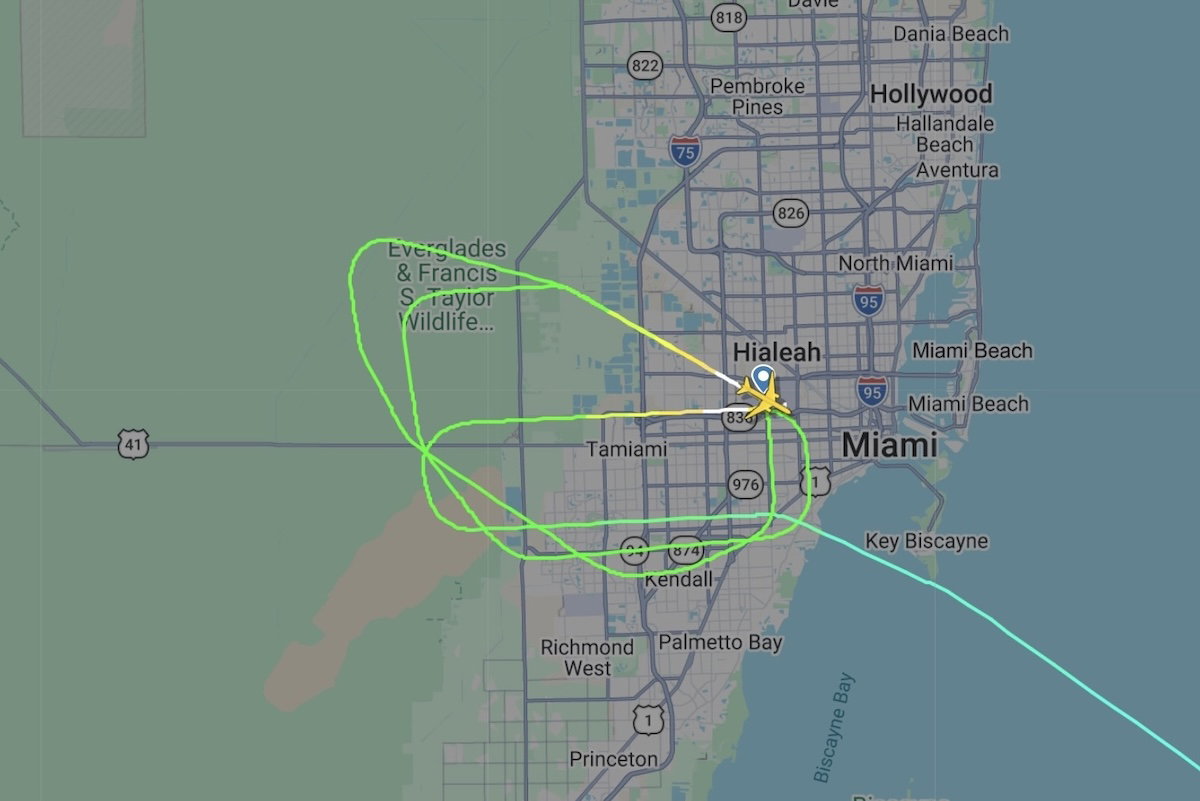
Unfortunately weather in Miami wasn’t good at all this morning, so the plane first had to take a rather roundabout approach to runway 9.
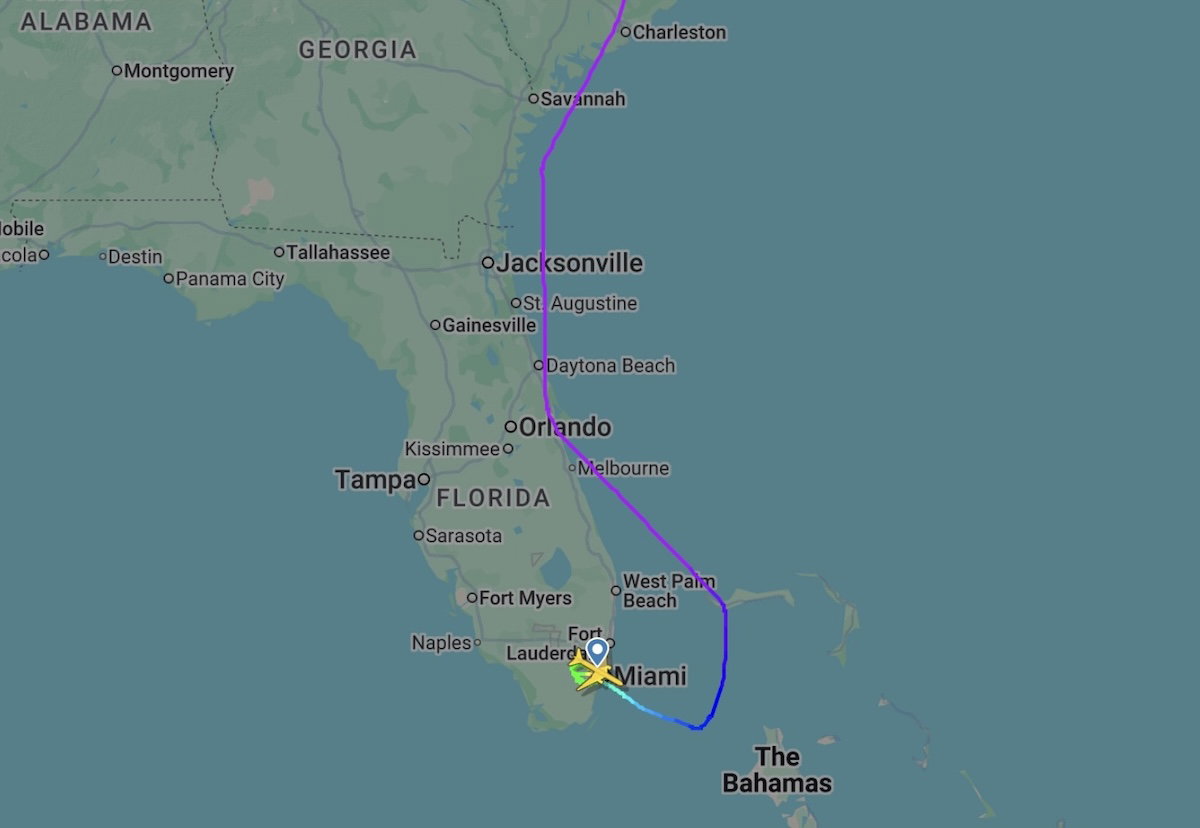
Unfortunately due to low visibility and wind shear, the plane had to perform a go around. At this point, the Emirates pilots requested to divert to Fort Lauderdale (FLL). However, the controller told them that the weather was still better for runway 12 at Miami. So the pilots informed the controller that they were declaring minimum fuel, and requested an approach for runway 12.
Unfortunately that approach also had to be called off at the last minute, because another aircraft was on the runway, and didn’t vacate it fast enough.
At this point, the pilots declared emergency fuel, which gives the plane top priority for landing. This included a “mayday, mayday, mayday” call, which is the most serious emergency a pilot can declare. The pilots finally managed to land on their third attempt.
They touched down at 11:08AM, over an hour after the scheduled arrival time, despite taking off from Dubai around half an hour early.
You can listen to the air traffic control audio for yourself below.
Just how serious was this Emirates fuel emergency?
On the surface it’s a bit puzzling that this got to the point of being a fuel emergency. Obviously this is a long flight in the first place, but the fact that they declared low fuel after one go around, and a fuel emergency after two go arounds, suggests they burned more fuel enroute than they were expecting to. They only had a slight detour on the approach after passing Orlando, but nothing massive.
For those curious about how these terms are defined, according to the Federal Aviation Administration (FAA), here’s how minimum fuel is defined:
Indicates that an aircraft’s fuel supply has reached a state where, upon reaching the destination, it can accept little or no delay. This is not an emergency situation but merely indicates an emergency situation is possible should any undue delay occur.
Meanwhile here’s how emergency fuel is defined:
The point at which, in the judgment of the pilot-in-command, it is necessary to proceed directly to the airport of intended landing due to low fuel. Declaration of a fuel emergency is an explicit statement that priority handling by ATC is both required and expected.
For context, generally aircraft must carry enough fuel to reach their destination, navigate to a planned alternative airport, and then still have a “final reserve,” which typically has to be enough for around 45 minutes of flight time at a specific holding speed and altitude.
In this case, it was 20 minutes from when the first landing attempt was made, to when the pilots declared emergency fuel. So yeah, that suggests more fuel was burned up until that point than expected.
Bottom line
An Emirates Boeing 777 flying from Dubai to Miami today had a much longer than usual flight, which lasted a full 17hr16min, well over an hour longer than usual. It seems headwinds might’ve been stronger than planned, then there was a slight detour over the Atlantic, and then the plane had two go arounds, before successfully landing on the third attempt.
The pilots declared emergency fuel, which is a serious call to make, and gives the plane immediate landing priority (along with a lot of paperwork on the ground). One wonders with how much fuel the plane actually landed.
What do you make of this Emirates 777 emergency fuel situation?




The crew was going to be out of duty time wherever they landed. They’re weren’t going to let some springtime TRWs keep them from landing in MIA.
Monday morning quarterbacking, sure- but it seems to me if a pilot knows he's already burnt far more fuel than planned and is likely to face adverse conditions when trying to land, the only responsible thing to do is to add an impromptu tech stop.
ATL would have been the place to do this. QR already operates there and it's roughly an hour out from MIA. No reason a current MIA weather report couldn't...
Monday morning quarterbacking, sure- but it seems to me if a pilot knows he's already burnt far more fuel than planned and is likely to face adverse conditions when trying to land, the only responsible thing to do is to add an impromptu tech stop.
ATL would have been the place to do this. QR already operates there and it's roughly an hour out from MIA. No reason a current MIA weather report couldn't have been secured while near ATL. If there's any foreseeable scenario where available fuel could become an issue (multiple go-arounds, field closure due to storm, etc), put her down and fuel up! Yes, the airline may lose money on the flight by having two takeoffs instead of one. But it's still the only way to go.
Edit: Meant Emirates not QR. (I think I associate QR with MIA foul-ups, thinking of that time they did a mid-field takeoff, hit runway lights and the end fo the runway, and flew all the way to DOH with a hole in the fuselage.)
Emirates has no ATL presence but it still would seem to be the best decision point, vs flying down to MCO where they do operate from.
When you no longer have the reserves needed at your destination, it should be mandatory to land at the nearest your Aircraft type capable airport.
In this case no latter than Orlando and probably Atlanta.
They u knew they had used more fuel than planned and they knew the destination as well as the general area airports had weather.
Clown show. We are this close, what could possibly go wrong, go wrong, go wrong
The 10/11pm arrival bank and 01/02am departure bank is the busiest of DXB. 80% of EK DXB pax are connecting. If you are traveling between Miami and Bangladesh or Perth and Warsaw what do you care what time it is when your connection time is as long as it’s only 1-3 hrs total.
Wrong reply! When they overflew MCO they had their final reserve, plus alt fuel, plus a few tons extra/contingency…… there would be nothing out of the ordinary at that point in time
I see many people here in the comments section have no clue how flight planning and dispatch work and also don't understand how inflight fuel management works.
Fist thing to be considered:
Did the weather forecast when they received their flight plan in DXB (usually 1-2h before EOBT) showed bad weather on their estimated arrival time in MIA? This definitely impacts the amount of fuel to be loaded. Was there bad weather forecasted? Did...
I see many people here in the comments section have no clue how flight planning and dispatch work and also don't understand how inflight fuel management works.
Fist thing to be considered:
Did the weather forecast when they received their flight plan in DXB (usually 1-2h before EOBT) showed bad weather on their estimated arrival time in MIA? This definitely impacts the amount of fuel to be loaded. Was there bad weather forecasted? Did the dispatcher include extra fuel for that? If not, why? If yes, how much?
Point number 2:
The B77W definitely takes off at the Maximum Takeoff Weight from DXB to MIA. Bear in mind now in Mid-May temperatures are already mid to high thirties degrees Celsius in Dubai. This has a significant impact on airplane performance and consequently on payload. If the pilots wanted to carry more fuel than what was given by the dispatcher this means they would have to offload cargo and/or passengers. They need a very good reason for that since it impacts the profitability of the flight. Read point number one to understand if they had a good justification to load more fuel than what was given.
Point number 3:
The flight does not necessarily goes exactly as the flight plan. Pilots might not get the flight levels they want, which means higher fuel consumption. Sometimes you get it, sometimes you don't. We don't know if they managed to climb to their desired flight levels throughout the flight and how much this impacted the fuel consumption.
Winds can also be stronger than forecasted which increases the flight time and consequently the consumption. We don't know if that was the case. These unpredicted situations make you burn any extra fuel you loaded and/or the contingency fuel.
Point number 4:
You don't just divert to "top off" somewhere unless you have a reason to do so. If your FMC is showing you are arriving at the destination above the planned required you don't divert. You continue until the destination and if the weather there is bad then you work your options: hold waiting for improvement, try to shoot an approach, or divert. How was the weather on arrival? Were other aircraft landing or only Emirates was the unlucky one? For what reason wouldn't they try an approach if they had the fuel for that and other aircraft apparently were landing?
Point number 5:
It seems their alternate was FLL, which is basically next to MIA, so less fuel is needed to be loaded compared to an alternate like MCO or TPA. Normally if bad weather like thunderstorms and so are affecting MIA it's quite likely it will also affect FLL. Why was FLL chosen as alternate? Read again point number one to understand if the weather forecast showed bad weather or not and the decision making behind the alternate/extra fuel to be loaded.
Point number 6:
When they did the first go around they immediately requested to alternate to FLL, which means that they basically only had fuel for one go around and alternate by the time they stared shooting the approach to MIA. Bear in mind they had a longer arrival routing for runway 09 probably due to weather, so it made them burn more fuel.
Tower informed them the weather for runway 12 was better than FLL, so this impacted decision making. The pilots probably decided to cancel FLL as an alternate and use the fuel that would be used to go there to shoot a second approach to MIA, this time to runway 12.
Murphy's law made the aircraft ahead of them not vacate in time and forced a second go around. A go around burns a lot of fuel. Two go arounds burn even more.
Basically they had no more options. After the second go around they entered the final reserve fuel (which is 30min for commercial part 121 aircraft and not 45min as stated by Ben), so a mayday fuel was declared, they got priority and landed safely.
Since a mayday was declared and they landed below the final reserve an investigation is needed and all those points I wrote above will be analyzed to understand how they got into that situation. Case closed.
combining all of these points, weather can change well into a long flight - it can change much faster than that.
You have to be prepared for the possibility of deteriorating weather including a potential diversion.
the EK flight took a less direct approach into MIA on the first attempt but 3 total attempts should not have led to a fuel emergency.
I'd be interested to hear what you think will be the outcome...
combining all of these points, weather can change well into a long flight - it can change much faster than that.
You have to be prepared for the possibility of deteriorating weather including a potential diversion.
the EK flight took a less direct approach into MIA on the first attempt but 3 total attempts should not have led to a fuel emergency.
I'd be interested to hear what you think will be the outcome of this. The FAA isn't keen on seeing airlines declare fuel emergencies.
I see a lot of what iffs.
Per Tim, the reality is you make the right decisions on departure per the flight, that is basic flight 090.
Then you ADJUST as the flight progresses. You DO NOT wait until on final and going around to think, oh yea, this is not so good.
You assume the worst not the best.
You track your destination weather and compare it to what has ACTUALLY happened...
I see a lot of what iffs.
Per Tim, the reality is you make the right decisions on departure per the flight, that is basic flight 090.
Then you ADJUST as the flight progresses. You DO NOT wait until on final and going around to think, oh yea, this is not so good.
You assume the worst not the best.
You track your destination weather and compare it to what has ACTUALLY happened on and to your flight.
You make a prudent decision BEFORE you are in a coffin corner.
All the rules and regs do not replace a pilots brain. He is PIC and he has been given absolute authority, FOR A REASON.
I have those issues of we got low on fuel I do not care why, MIA is not looking good, FLL is not looking good, I am putting her down in ATLANTA!
That is how a GOOD pilot thinks and operates.
The airport forecast is usually made by a meteorologist from the local airport/area, so it's supposed to be as precise as a forecast can be (which is never 100%).
We know some places are more reliable than others. The quality of information provided varies throughout the world, but in general the forecasts are pretty reliable. Weather can indeed change, but pilots have to make decisions based on the information available and on their experience....
The airport forecast is usually made by a meteorologist from the local airport/area, so it's supposed to be as precise as a forecast can be (which is never 100%).
We know some places are more reliable than others. The quality of information provided varies throughout the world, but in general the forecasts are pretty reliable. Weather can indeed change, but pilots have to make decisions based on the information available and on their experience. Offloading pax/cargo to add extra fuel just because you think the weather might change (when the forecast does not show thunderstorms/fog/strong winds/etc) would probably have resulted in a call from the office requesting explanations.
We might see some recommendations here and there from the investigation, but I believe there won't be any negative consequences for the pilots or the airline. Had they landed on a second approach this would have been a non-event. The second go-around was an unlucky situation.
And yes, two go arounds + long vectors/holding can make an airplane go into mayday fuel depending on the situation. This might have been exactly one of them.
If you are accusing others of having “no clue” and “no understanding”, you should make sure you get your own comment 100% right. Instead, you’re lecturing us on Dubai temperatures in May and are not even taking into account that the flight departed in the middle of the night.
A lot of blah blah, very little substance.
I woud strongly recommend you to check the temperatures in Dubai at night in May. It can easily be around 30°C.
Sure, but you wrote mid to high thirties, which is 10 degrees more than what it was in the night of flight departure.
You have used the term “final reserve fuel” at least twice in your comments. Maybe you could explain what that is. I don’t know if Emirates operates under rules similar to FAR 121 flight rules, but airlines that do, must carry 30 minutes of fuel, plus ten percent of their “enroute burn”, as reserve fuel. A point to remember about reserve fuel is you are required to be released with it but you are not required to land with it.
Final Rsv Fuel at EK is 30 minutes
I don’t believe final fuel reserves factor in go around. The reserves are intended for planes to have contingency if they need to enter a holding pattern or divert to an alternate airport. I think those are typically computed for 45 minutes of flying at 10K feet.
When an aircraft has to go around they burn through the reserve much quicker. So they may have had 45 minutes of extra fuel when they began...
I don’t believe final fuel reserves factor in go around. The reserves are intended for planes to have contingency if they need to enter a holding pattern or divert to an alternate airport. I think those are typically computed for 45 minutes of flying at 10K feet.
When an aircraft has to go around they burn through the reserve much quicker. So they may have had 45 minutes of extra fuel when they began their approach into MIA but with 2x go arounds they burned through the extra fuel quicker.
The real failure here is ATC did not appropriately plan sufficient approach separation or provide clear instructions to the aircraft in front to exit from the runway expeditiously.
Final Reserve at EK is referring to 30 minutes, just a different nomenclature.
Burning more fuel enroute should have triggered questioning of whether they should have diverted before they headed for S. Florida and known bad weather.
While the FAA has specific meanings that are associated with the use of each type of fuel declaration, there is no specific number attached to when those terms have to be used.
The FAA will investigate (already has) but it is unlikely that there will be any action taken although...
Burning more fuel enroute should have triggered questioning of whether they should have diverted before they headed for S. Florida and known bad weather.
While the FAA has specific meanings that are associated with the use of each type of fuel declaration, there is no specific number attached to when those terms have to be used.
The FAA will investigate (already has) but it is unlikely that there will be any action taken although hopefully it does trigger a replay of the scenario at EK's pilot training facilities.
I could see unexpected headwinds and the less direct path combined burning through their reserve fuel. They probably reasonably expected some landing priority (a heavy flight after that many hours should get priority), tho it's concerning that it got to the mayday level before being able to land.
The pilot made a decision. After headwinds, weather and not wanting another delay, I would trust their judgement. Unusual yes, but also understandable
Couple of pilots at an Idaho air show made some decisions today, too. Judgment questionable.
an air show pilot had the combined knowledge of a full flight deck after 17 hours? Apples and oranges.
Humans flying commercial.
Humans flying military.
Comparing humans and humans.
It's comparable.
Both are obsolete.
Eskimo always makes a great case to back his claim that humans are obsolete... by only ever writing the same few words over and over like a broken record.
@JoePro
then squabbling with himself via other usernames that all write in the same (strange) cadence, while all making the exact same grammatical errors.
Ross, those four got so lucky. Ejected just in-time. Glad they made it.
Maybe airlines are flying w less fuel reserves?
Probably, thanks to the war with Iran… but it could have just been TDS… ThunDerStorms.
The direct mileage is 7843, and the route would take you over southern France. Which is how this flight operated the previous Sunday, arriving in 16 hours and 3 minutes after 8,179 miles (planned was 8,072).
In comparison, this Sunday’s flight covered 8,954 miles after being planned for only 8,583. It flew over Denmark, Iceland and Greenland. The maximum range of a 777ER is about 8,500 miles. So is this a case of a full...
The direct mileage is 7843, and the route would take you over southern France. Which is how this flight operated the previous Sunday, arriving in 16 hours and 3 minutes after 8,179 miles (planned was 8,072).
In comparison, this Sunday’s flight covered 8,954 miles after being planned for only 8,583. It flew over Denmark, Iceland and Greenland. The maximum range of a 777ER is about 8,500 miles. So is this a case of a full tank, and pilots who didn’t want to stop in Gander for fuel?
This is the flight that continues on to Bogota. It always leaves an hour early. If you have a 2:15am flight, what else is there to do in Dubai but show up early? The lounge is probably closed.
The EK Lounge in DXB is open 24/7. You obviously haven’t been there. DXB is as busy in the night as it is during the day, maybe even more so, and offers every possible diversion a huge international hub can offer. Nothing is closed at night in the Emirates Terminal.
So obviously, they're boarding an hour early to clear out the lounge and make room for others. I wonder how many flights leave so early, to save lounge expenses?
The 10/11pm arrival bank and 01/02am departure bank is the busiest of DXB. 80% of EK DXB pax are connecting. If you are traveling between Miami and Bangladesh or Perth and Warsaw what do you care what time it is when your connection time is as long as it’s only 1-3 hrs total.
This raises so many questions:
1. If you're taking an atypical routing on a flight that could easily be considered "ultra-longhaul," why do you not have a re-dispatch point planned (where you decide if you have sufficient fuel reserves to continue within required minima?) Most ULH operating airlines do that.
2. If they DID have a re-dispatch planned, then why didn't they recognize higher-than-expected fuel burn at that point?
3. Yes weather can change rapidly...
This raises so many questions:
1. If you're taking an atypical routing on a flight that could easily be considered "ultra-longhaul," why do you not have a re-dispatch point planned (where you decide if you have sufficient fuel reserves to continue within required minima?) Most ULH operating airlines do that.
2. If they DID have a re-dispatch planned, then why didn't they recognize higher-than-expected fuel burn at that point?
3. Yes weather can change rapidly in south Florida, but there's no way they didn't know about the high probability of inclement weather, at least an hour or two ahead of time. Why didn't they factor that into their decision to continue?
Granted, there's a lot of information not yet public/known, and these are all questions based on speculation. But it really seems like they had get-there-itis, and passed on a number of decent airfields (including one they already serve: Orlando) who could've topped them off, and prevented this.
I'm sure Sir Tim's people will be having a not-fun convo with these pilots, in very short order.
Emirates, operating under the UAE GCAA's regulations, is subject to different rules than US flagged and certified carriers. They have a lower fuel contingency requirement for one (roughly half) and a lot of it is left up to if the aircraft commander believes they can make destination and still have their final reserve fuel remaining. UAE does not have the system of licensed aircraft dispatchers sharing equal responsibility (and liability) for flight planning as US...
Emirates, operating under the UAE GCAA's regulations, is subject to different rules than US flagged and certified carriers. They have a lower fuel contingency requirement for one (roughly half) and a lot of it is left up to if the aircraft commander believes they can make destination and still have their final reserve fuel remaining. UAE does not have the system of licensed aircraft dispatchers sharing equal responsibility (and liability) for flight planning as US carriers. They are essentially flight followers and provide assistance and flight planning for the aircraft commander. UAE aircraft commander has all the authority versus in the US really you've got a dispatcher who has to sign off on the flight too and could ground it.
As far as the Mayday call, that's actually a specific requirement of GCAA regulations if remaining fuel drops below final reserve fuel before they estimate they could safely land.
CAR-OPS 1.375 In-flight fuel management
(3) The commander shall declare an emergency “MAYDAY MAYDAY MAYDAY FUEL“ when calculated usable
fuel on landing, at the nearest adequate aerodrome where a safe landing can be performed, is less than
final reserve fuel.
I had a weird experience on a United regional (Emb 170) recently where they made one (1) go around due to fog and then diverted "due to only having fuel for one landing attempt" (pilot announcement). Maybe this is a thing now.
Not necessarily as a result of fuel prices. There’s a million factors where an aircraft might only have min fuel to the destination, after an unsuccessful approach, they need to proceed to their alternate since they’re at the min diversion fuel.
Even if extra fuel was loaded, it could have been burned up with a taxi, deice, stronger headwinds, a longer approach. If the crew hits their min diversion fuel, they can’t just keep doing approaches in hopes they can land.
Q: Why would they go from Dubai to Miami ? A: To flee NYC .
All are welcome in NYC. And if you don’t wanna be here, that’s fine, too.
Also, if you see something, say something.
It must be infuriating when a long haul heavily loaded plane trying to get it down for the 2nd time is forced to go around by a smaller plane ahead who didn't vacate the runway soon enough. You would think both ATC and the plane ahead would try to provide sufficient spacing to have this well out of the way before the critical moments.
I wonder if they are just really struggling with shortages in Dubai due to the war and them recently attacking Iran
Maybe? But they would not underfuel a plane below what is legally required because of this.
Highly unlikely; more likely is that UAE has a glut of oil because it can't get them out to buyers due to the blockade.