
On February 17, 2025, we saw a shocking accident, whereby a Delta Connection CRJ-900 (operated by Endeavor Air) crashed while landing at Toronto Pearson Airport (YYZ). The plane flipped over on landing and lost a wing, in what can only be described as a horrifying accident.
The good news is that all 80 people onboard survived, which is a testament to just how far aviation safety has come. One of the things that makes aviation so safe is that we learn from every accident. Along those lines, a preliminary report has just been published regarding this accident.
TSB of Canada publishes Delta CRJ-900 accident report
The Transportation Safety Board of Canada (TSB) has today published its preliminary report into the Endeavor Air accident. Note that this report doesn’t provide any conclusions, but instead, shares a progress update and outlines the facts that have been gathered so far. As usual, a final report for an accident typically takes months, or even years. The TSB also emphasizes that accidents rarely stem from a single cause.
What do we know about the final seconds of the flight? At the time of the accident, winds were at an angle of 270 degrees (the runway was at an angle of 230 degrees), at 28 knots, gusting to 35 knots. With that in mind, here are some aircraft performance details:
- 14 seconds before touchdown, the aircraft descended through 153 feet and wind gusts picked up, so the pilot flying reduced thrust from 64% to 43%
- Four seconds before touchdown, when the aircraft descended through 50 feet, the rate of descent increased from 672 feet per minute to 1,114 feet per minute
- Three seconds before touchdown, the enhanced ground proximity warning system (EGPWS) had a “sink rate” alert, indicating a high rate of descent, with the aircraft’s descent rate staying at around 1,100 feet per minute; furthermore, the plane started banking more to the right due to winds, with a 4.7 degree bank
- Two seconds before touchdown, the plane’s bank angle to the right increased, to 5.9 degrees
- Less than one second before touchdown, the plane had an indicated airspeed of 134 knots, a ground speed of 111 knots, a bank angle of 7.1 degrees to the right, and a rate of descent of 1,110 feet per minute
The plane touched down at a bank angle of 7.5 degrees to the right, and 3g vertical acceleration, and a rate of descent of approximately 1,098 feet per minute. This landing was so rough that the right main landing gear fractured, the landing gear folded into the retracted position, the wing root fractured between the fuselage and the landing gear, and the wing detached from the fuselage.
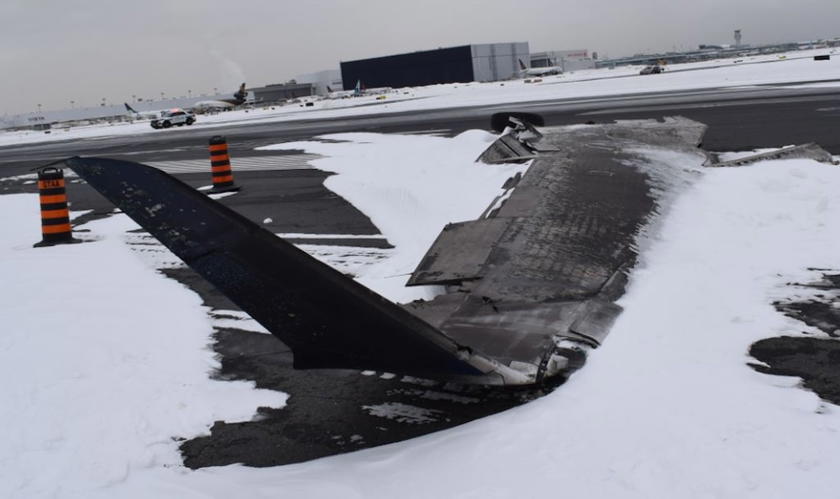
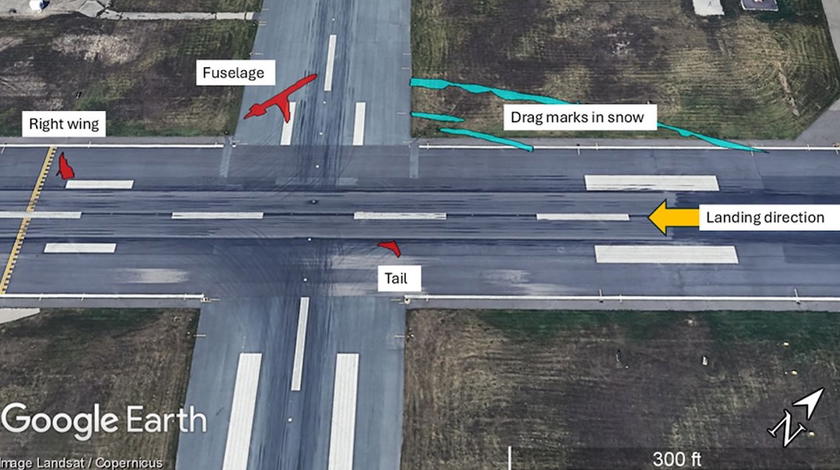
It’s pretty wild how far the plane slid. The initial impact was 420 feet past the runway 23 threshold. The aircraft came to a rest inverted on runway 15L, approximately 1,800 feet beyond the thresholds, and about 75 feet to the right of the runway edge. A large portion of the tail section was found on the runway, around 1,680 feet from the threshold, and 235 feet from the main wreckage. The right wing came to a rest around 215 feet beyond the main wreckage.
So, what do we know about the two pilots?
- The captain had been at Endeavor Air since 2007, and is also a simulator instructor at the airline, having a total of 3,570 flight hours, including 764 hours on this aircraft type; this was his first flight in seven days, as he had otherwise worked as an instructor for three days over the past week
- The first officer had been at Endeavor Air since January 2024, and had a total of 1,422 hours, including 419 hours on this aircraft type; this was her second flight of the day, and her last day of a five-day trip
As the investigation continues, here are the 11 things that the TSB will be focused on:
- Metallurgical examination of the wing structure
- Certification (landing gear and wing structure)
- Evacuation / egress procedures
- Flight deck door structure and design
- Landing techniques, hard landings, and pilot training
- Cabin obstructions and impediments once inverted
- Flight deck secondary egress route
- Organizational and management factors
- Flight attendant training
- Coordination in emergencies
- ARFF and emergency medical technician actions after accident
Let’s see what a final report reveals
While there are typically several factors that contribute to accidents, one of the primary questions here is why the plane had such a steep descent in the seconds before landing. Obviously it was gusty, but if you’re not able to stabilize an approach, that’s when a go around would ordinarily be performed.
So what caused such a steep descent, and why wasn’t a go around performed? These details should be revealed in subsequent reports. Of course a couple of things stand out about the pilots:
- The captain had been at the airline for 18 years, though it sounds like he spent most of the time instructing in simulators, since 3,570 flight hours isn’t a lot for a pilot who has been flying for that long
- Conversely, the first officer was junior, and at the very low end of the hours needed to be an airline pilot
The first officer was the one flying this segment, so of course some people will immediately say “DEI.” Is it possible that pilot error caused this? It’s absolutely a possibility, and experience matters. Is there any indication that the first officer failed tests more than other pilots, or got any sort of shortcuts because of her gender? I haven’t seen anything suggesting that.
So for now we just have some more details about the facts of the case, but we don’t yet have a conclusion…
Bottom line
The preliminary accident report has been published regarding the Endeavor Air CRJ-900 that crashed in Toronto, operating on behalf of Delta Connection. This mainly summarizes the basic facts of the case, including that the plane had an alarming descent rate in the seconds before touchdown, and then landed while banking to the right.
The combination of the high rate of descent and bank angle caused the gear to collapse, which ultimately caused the plane to flip over. Why the plane had such an unsteady approach remains to be seen…
What do you make of the preliminary accident report from the TSB of Canada?


Membership is free and takes no more information than commenting as a guest. Earn status points for good contributions, and see fewer ads as your status grows.