American Flight Diverts After Service Dog Bites Passenger

Talk about an uncomfortable reason for a diversion…

American Eagle jet diverts to Colorado Springs over dog bite

This incident happened on Tuesday, April 15, 2025, and involves American flight AA4980, scheduled to operate from Provo (PVU) to Dallas Fort Worth (DFW). The flight was operated by a SkyWest CRJ-700 with the registration code N767SK, on behalf of American Eagle.
The flight took off at 2:02PM local time, and climbed up to 37,000 feet. The first hour of the flight was routine, as the plane flew southeast over Utah, Colorado, and New Mexico. However, the aircraft then made a sharp turn to the left, and diverted to Colorado Springs (COS). It touched down there at 3:28PM, just under 90 minutes after it first departed Provo.
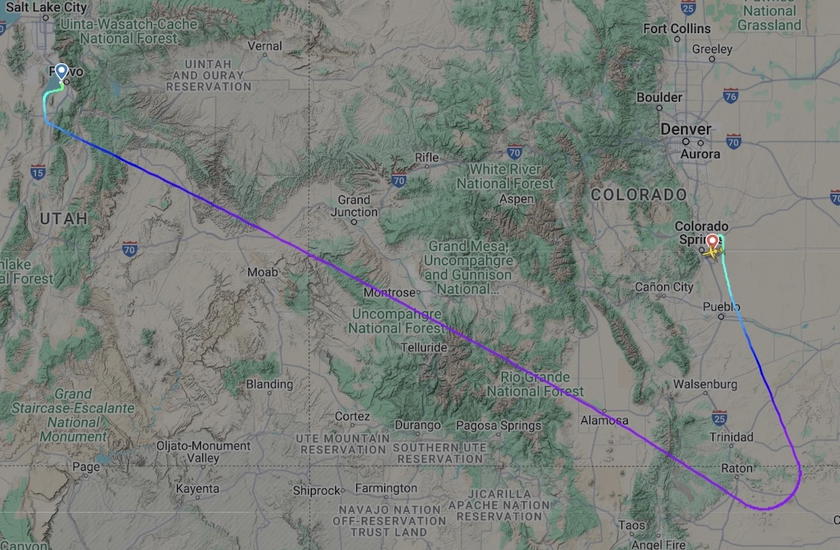
The American Eagle flight that diverted to Colorado Springs

The plane spent a bit over an hour on the ground in Colorado Springs, so that a patient could be transported from the airport to a local hospital due to the dog bite. It’s not known how serious the injury was.

After a little over an hour on the ground, the plane once again continued to Dallas Fort Worth. It took off at 4:39PM, and landed there at 7:31PM, just under 2.5 hours behind the scheduled 5:05PM arrival.
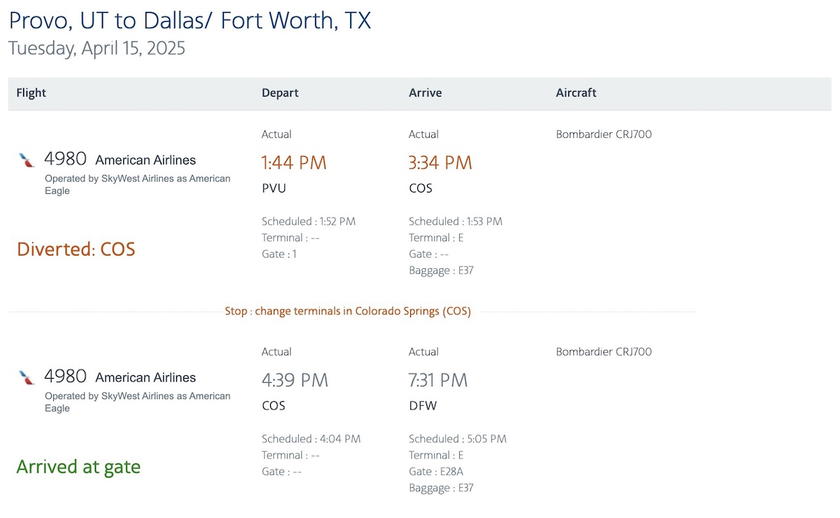
Flight status for AA4980

This is a terrible situation all-around

First and foremost, I hope that the person who was injured makes a speedy recovery. I hope the injury wasn’t that serious (in terms of having a long term impact), and it was simply that they weren’t equipped to handle this well onboard the flight.

Dogs on planes have been a contentious topic in the United States for years. Back in the day, we had the concept of “emotional support animals,” whereby people could self-certify that they needed to travel with animals in the cabin for emotional support reasons (as the name suggests). While that loophole was closed, it was replaced by another one, which is that people can now self-certify that they need psychiatric service animals. This is a similar concept, except there are more limits on animal types and breeds.

So a lot of dogs flying around in cabins aren’t actually traditional service dogs that are performing specific functions (like for the visually impaired), but instead, are psychiatric service animals.

Generally when a dog misbehaves and bites someone on a plane, it’s not a formally trained service animal, but rather, a self-certified psychiatric service animal.

As a dog lover, I feel kind of bad for dogs being put into this situation:

  • Flying must be really stressful for dogs, and they’re in a confined environment, potentially very close to strangers
  • The whole reason we see this psychiatric service animal concept to begin with is because the lack of humane options that airlines provide for transporting dogs and other pets, as live animals really shouldn’t be put in the cargo hold

Bottom line

An American flight from Provo to Dallas diverted to Colorado Springs, after a service dog bit another passenger, requiring hospitalization. The plane spent a bit over an hour on the ground, and ultimately landed in Dallas around 2.5 hours behind schedule.

What do you make of this American diversion?

Conversations (111)
The comments on this page have not been provided, reviewed, approved or otherwise endorsed by any advertiser, and it is not an advertiser's responsibility to ensure posts and/or questions are answered.
Comment as a member

Membership is free and takes no more information than commenting as a guest. Earn status points for good contributions, and see fewer ads as your status grows.

Type your response here.

If you'd like to participate in the discussion, please adhere to our commenting guidelines. Anyone can comment, and your email address will not be published. Register to save your unique username and earn special OMAAT reputation perks!

  1. Loading comments…
Recent Comments
The latest from the OMAAT community.

The comments on this page have not been provided, reviewed, approved or otherwise endorsed by any advertiser, and it is not an advertiser's responsibility to ensure posts and/or questions are answered.

Just Katie Guest

I have a service dog (not emotional support or psychiatric support animal). She is well trained and sits quietly on the flight where she's supposed to sit. I'm not selfish because I take her with me on all trips. It's selfish for people to think we should leave them behind when it pertains to medical assistance. Emotional support animals are totally different and unfortunately aren't always trained for anything. If it's a dog that can bite and break skin then it should be required to have a muzzle (unless this interferes with task required).

0
‼ 0
Jonathan Landon Guest

Your article is a tangled bramble of apparently sincere but only half-understood ideas about service dogs and the Air Carrier Access Act. Emotional support animals are still a "thing" under federal law, (Fair Housing Act, and to a limited extent, the "workplace reasonable accommodation" provisions of the Americans with Disabilities Act). Emotional support animals provide emotional support and comfort to a person with a disability by doing natural behaviors. They are not trained to perform specific tasks related to the person's disability. Emotional support animals do not have the same access protections as service dogs in businesses, restaurants, etc. They are now excluded from the Air Carrier Access Act, which only extends access protection to *service dogs.* Service animals are individually trained to perform tasks that assist a person who has a disability -- whether the disability medical or psychiatric/psychological. For example, a service dog may recognize when a person is dissociating (disconnected from present reality) and nudge, paw at, jump on, or bark at the person to bring the person back to awareness of the present. The Americans with Disabilities Act recognizes task-trained service dogs and miniature horses as service animals. State laws may recognize other species, such as cats or monkeys. Because they have "hands", monkeys can be very useful to people with quadriplegia. The Air Carrier Access Act now only recognizes dogs as service animals, so you won't see mini-horses, peacocks, etc. flying as service animals. Emotional support animals of any species and service animals that aren't dogs fly as pets, subject to all the rules and fees that apply to pets. Contrary to your statement, however there are *no* restrictions on the breeds of dogs that may be trained as service animals or travel on aircraft as service animals. Businesses (including airlines) cannot use the size of an dog or stereotypes about the breeds reputation as a reason to exclude a service dog. Generally, a service dog can only be excluded from a flight due to crew or agents observing misbehavior, such as aggressive or out-of-control behavior. Your article mentions that psychiatric service dogs may be self-certified by their owners, but glosses over the fact that *all* service dogs are self-identified by affidavits from their owners for air travel. There is no mandatory, governmental service dog testing, licensing, certification, registration, etc. for *any* service dog, for *any* kind of disability. Should there be? I'm not opening that can of worms. Fact is that for now, there isn't. There are solid reasons why Congress has not established such certification programs and has forbidden state and local governments from establishing mandatory service dog registries. There are also strong arguments in favor of such registries. For the purposes of air travel, disabled people are not required to disclose the nature of their disabilities. Therefore the Department of Transportation forms do not ask whether the dog is a "psychiatric service dog", or a "medical service dog". The forms only ask what work or tasks the dog does. It is entirely possible to describe those tasks in ways that don't disclose the nature of the disability. So, no, travelers don't "self-certify" that they have psychiatric service dogs. Please fact-check your information and be more precise when you write about disability rights and the laws that regulate them.

0
‼ 0
Brigit woodworth Guest

Please do more research before you write an article like this. ADA doesn’t require professionally trained service dogs. You can owner train them. While yes people fake their ESAs as service dogs. There is such thing as a psychiatric service dog not ESA. Just because it’s not professionally trained/and or “self certified” doesn’t mean it is a fake service dog. Written by an actual handler of a psychiatric service dog in training

0
‼ 0
Marielena Guest

Psychiatric service dogs are a thing. It’s gross that because you as the author don’t understand it that you trivialize it and dismiss it as something inherently fraudulent.

0
‼ 0
Elaine Guest

Put simply this dog was not trained properly - either by the owner or other. I have a PSD and I trained him myself and anyone around town will tell you Bear is VERY well behaved. I wouldn't take him out in public if I thought he would bite someone,I guess I would be a homebody still as he has allowed me to get out in public . He doesn't even bark unless you have his toy. SO PLEASE don't put all self trained service dogs in the same category. SOME of us take it quite seriously.

0
‼ 0

Save posts to read later

Saving posts is a member feature. Become an OMAAT member to build a reading list you can come back to from any device.

Become a member
Meet Ben Schlappig, OMAAT Founder
5,883,136 Miles Traveled

43,914,800 Words Written

47,187 Posts Published