

Let me start this post by stating that I very much respect the work that flight attendants do. I think (for the most part) they work hard and have difficult jobs. I certainly wouldn’t last a week dealing with the traveling public.
That being said, I think most people can agree that US airlines don’t have a reputation for having the best or most consistent service. There are lots of incredible flight attendants who do their best and try to deliver a great experience. More often than not, though, they do so because it’s the type of person they are, and the fact that they take pride in what they do. It’s not because of any mandate from the company, or any punishment for non-compliance.
At best, I think service at US airlines can be described as consistently inconsistent, while acknowledging that service levels are different across airlines. Anyway, why is service on US airlines so inconsistent? It’s an interesting topic, so let me share what I’d consider to be the major factors, in no particular order…
Airlines don’t have true onboard managers
US airlines have lead flight attendants, though in reality these are flight attendants who are paid a couple of extra dollars per hour to make announcements and do the paperwork. These aren’t management employees, they don’t have the ability to really evaluate or discipline other crew, etc.
Personally I think this is an issue, and you’ll find that most of the airlines globally that are regarded for good service have a lead flight attendant who is actually empowered to discipline crew, deal with customer complaints in a constructive way, evaluate the performance of the rest of the crew, etc.
Essentially at US airlines, flight attendants are completely unsupervised while on the plane. No one is really in charge, and I think having a true “lead” flight attendant who is chosen based on merit could help create an atmosphere where service would be better and more consistent.
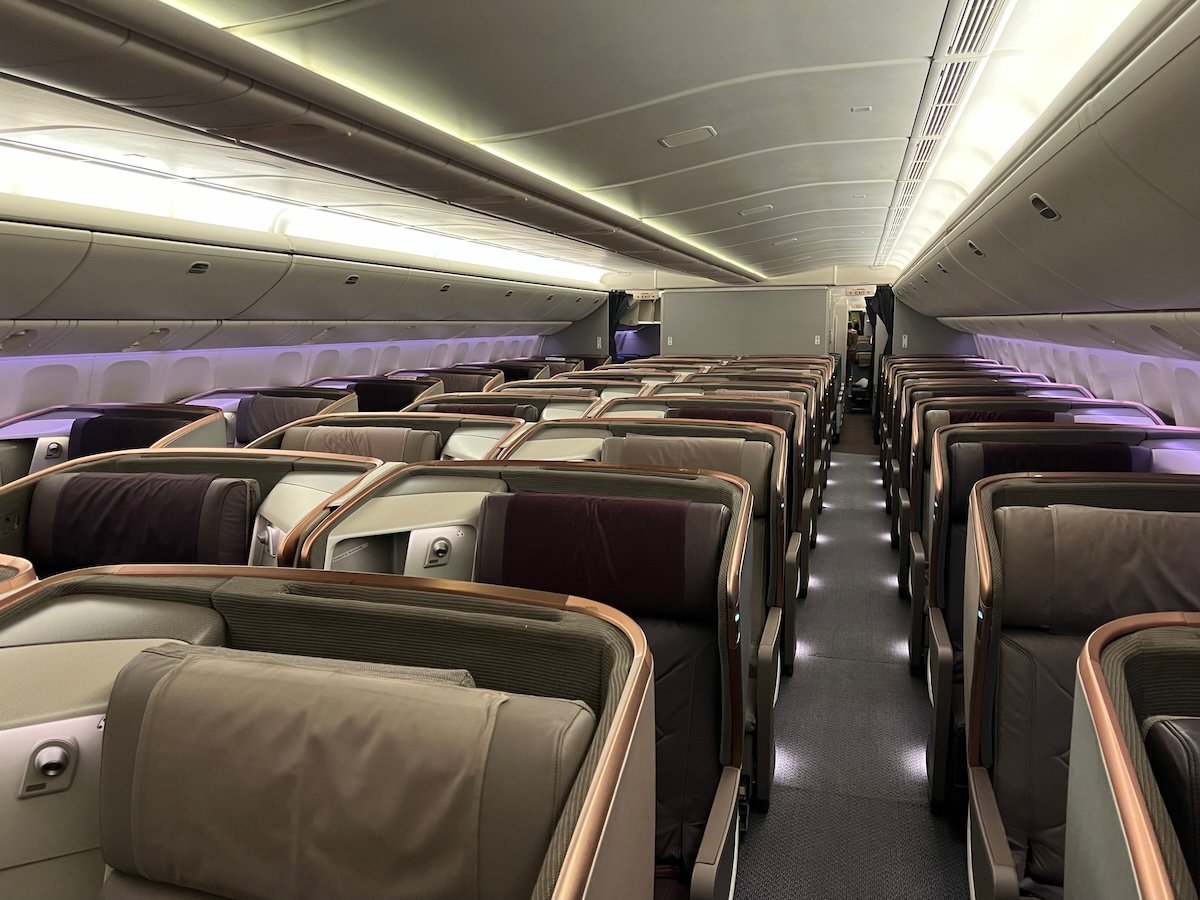
The US lacks service culture for non-tipped roles
I think the most fundamental reason that service at US airlines is so inconsistent is because our country really doesn’t have a service culture. Despite our obsession with fake smiles and always asking people how they’re doing, we’re not a particularly hospitable country. When there’s good service in the US, it’s almost always for tipped positions (which is highly transactional), and obviously flight attendants don’t fit into that category.
This is of course true across society, and the most obvious reason for lackluster service at US airlines. I mean, just compare going to a 7-Eleven in Japan vs. the United States. It’s a totally different experience in every way.
The same is true of hotels. Even luxury hotels in the US generally don’t have service that compares to what you’d find in countries in Southeast Asia, and even in some European countries, like France.
Safety and service are viewed as mutually exclusive
I value the safety training that flight attendants at US airlines have. When you look at the amazing job that flight attendants have consistently done in emergency evacuations, you can’t help but have respect for them. However, there’s another side to this. Since 9/11, it sure feels like some flight attendants view safety and service as being mutually exclusive.
We don’t need to be reminded that “flight attendants are here primarily for your safety.” That should be a given. I understand that the most important function that flight attendants perform is safety, even though they dedicate 90% of their time to service. It would be like a cruise ship crew telling you that their primary job is safety, and using that as an excuse for providing less service.
So for some (though certainly not all) flight attendants, it sure seems like safety is being used as an excuse for providing subpar service, since they don’t view service as their primary role.
Management & unions have toxic relationships
Personally I don’t think that unions or management are exclusively to blame for service issues. For example, Southwest has a flight attendant union but is known for great service, while Delta doesn’t have a flight attendant union, but I don’t necessarily think the airline has better service than Southwest does.
From my perspective, there have been hostile relationships between management and unions for decades, and much of that is understandable, given what the industry has been through. The goals of management and the employees haven’t been aligned, and that’s a major issue, and is partly to blame for the lack of purpose that so many employees have.
This is an area where you’ll notice significant differences between airlines, though. For example, Delta employees are generally aligned with the company’s goals, in no small part thanks to the company’s lucrative profit sharing scheme. At American, meanwhile, employees aren’t at all aligned with the company’s goals, since the company can’t even seem to decide what its goals are.
There aren’t enough performance based evaluations
Personally I’m strongly opposed to crews being able to bid for positions solely based on their seniority. While I’m all for rewarding long term employees who are dedicated to the company, it seems silly to make that the only basis off of which they decide whether someone can work first or business class, get a desirable route, etc.
In much of the rest of the world, working in premium cabins is a promotion, and it’s something that flight attendants specifically have to apply for. In most situations, that’s not the case in the United States.
The issue is that there’s no real manager onboard to evaluate crews, so it’s tough to select them based on merit. This is something else that could be solved by having a true onboard manager. Flight attendants working premium cabins or desirable routes should get those routes at least partly because of how good they are, and not solely based on how long they’ve been at the company.
Low staffing levels take their toll on service
Another reason that service on US airlines often isn’t great is due to the staffing levels. All too often, US airlines simply staff their flights at FAA minimums, or on long haul flights, just above that.
It’s quite a contrast to airlines like Emirates and Singapore Airlines, where staffing is typically way above minimums. It goes without saying that it’s hard to provide great service when you’re spread so thin. It limits the ability for flight attendants to interact with passengers and try to be more personable, while still keeping up the service pace.
Bottom line
There are a lot of factors contributing to service issues at US airlines, and the inconsistency we see. I think the most fundamental issue is that flight attendants really have no supervisors onboard aircraft, so once the door closes, there’s little accountability in terms of service levels.
Admittedly that’s one of only multiple issues with service. There’s also the low staffing levels, toxic relationships between employees and management, and more.
I appreciate all the flight attendants who go above and beyond to take care of passengers, and their hard work doesn’t go unnoticed (at least by me!).
Why do you think service at US airlines is inconsistent and often not good?




I was recently on a flight (American-based carrier name redacted) where a flight attendant noted in conversation to another airline employee who was deadheading, "Our flight attendants' union is so powerful that I could light this aircraft on fire and have no disciplinary action taken against me." She then noted that this was not necessarily the case with other US-carriers.
Not much incentive to deliver exceptional customer experience, no?
For your information , working “premium cabins “ is not desirable by most flight attendants in the United States. That is more often junior positions, because it is more work and it makes no difference in pay. The lead / purser gets a few dollars more per hour, but it is insignificant. Flight attendants have personal pride and they are aware that customers have high expectations that are often not met by the service standard...
For your information , working “premium cabins “ is not desirable by most flight attendants in the United States. That is more often junior positions, because it is more work and it makes no difference in pay. The lead / purser gets a few dollars more per hour, but it is insignificant. Flight attendants have personal pride and they are aware that customers have high expectations that are often not met by the service standard and elements provided by the airline.
On a domestic route / short international route four splits of sparkling wine are provided for up to 20 seats, just to give an example .. and that has to last predeparture service and service in the air.
I have noticed that you had written about this a few times in the past , and the way to seem to be doing check rides is a little obsessive.
I think that attributing lack of service to a USA cultural issue lets people off the hook. After all they did seek out the job that they are poorly performing. The culture problem seems to be by company. Just rank and compare the cost facing culture of American, Alaska, Delta, JetBlue and Southwest. A very different culture of service all hired from the same US workforce pool.
Having flight attendants who are older and fatter certainly doesn't help. You can't tell me they are they for their safety when half of them can barely waddle down the aisles without greasing their hips first.
However, I rarely see anyone address what I believe is the core issue: customer service on many U.S. airlines has declined alongside with the overall quality of women in the USA and many other western countries.
The USA3 all have similar wide body staffing. There are inflight pursers onboard their international wide body trips yet they completely lack the authority of QF SQ AF LH EK, etc. pursers.
AA and UA have 16 cabin jump seats on their 777-300 yet staff 11 and 12 respectively. Emirates staffs with 16. Go figure.
AA is increasing the seat/pax count on their reconfigured 77-3 by reducing the YC seat recline and legroom by one...
The USA3 all have similar wide body staffing. There are inflight pursers onboard their international wide body trips yet they completely lack the authority of QF SQ AF LH EK, etc. pursers.
AA and UA have 16 cabin jump seats on their 777-300 yet staff 11 and 12 respectively. Emirates staffs with 16. Go figure.
AA is increasing the seat/pax count on their reconfigured 77-3 by reducing the YC seat recline and legroom by one inch. Yet the staffing with remain at 11 crew. The toilet count drops from 11 to 9. An airplane to 100% avoid.
AA’s new 787-9 has 14 jump seats yet staffs Asia/Europe trips with only 9 cabin crew. Emirates staffs with 14. Go figure.
Avoid the USA 3 like a plague.
A
It is simple to learn from others. Middle East and Asian airlines tend not to have many of the problems and entitlement issues that seem to be a regular occurance on US carriers.
God forbid anything interrupt the flight-long gossip sessions in the galley (often at full volume when long-haul passengers are trying to sleep). I recently flew UA ATH-IAD in J and heard the purser say to an FA, "oh, thanks for reminding me [to put the bread for the second service in the oven]. Otherwise, we'd get talking about our dogs and forget entirely." Not that they had ceased talking about other things during the previous...
God forbid anything interrupt the flight-long gossip sessions in the galley (often at full volume when long-haul passengers are trying to sleep). I recently flew UA ATH-IAD in J and heard the purser say to an FA, "oh, thanks for reminding me [to put the bread for the second service in the oven]. Otherwise, we'd get talking about our dogs and forget entirely." Not that they had ceased talking about other things during the previous three hours, or passed through the cabin even to check on passengers during that time.
The chatter is annoying, but if you want something just use the call bell.
Just try that on AA!
The headline for this post should start with Six Lame Excuses…
the US have almost no service culture. anyone who only provides service when theyre paid (ie 'tip') shouldnt be in the jon in the first place.
tipping should be illegal, its basically bribary to get extras.
IMO part of the reason has to also be that Americans have a different idea of what "good service" can be, and the line between "good service" and "too casual" can be clouded. When I have a great flight attendant on US airlines, I can casually chat with them about anything. In the galley, if they're just hanging out I can say hi and get into a conversation and leave feeling pretty happy. However, at...
IMO part of the reason has to also be that Americans have a different idea of what "good service" can be, and the line between "good service" and "too casual" can be clouded. When I have a great flight attendant on US airlines, I can casually chat with them about anything. In the galley, if they're just hanging out I can say hi and get into a conversation and leave feeling pretty happy. However, at times on US airlines "bad service" seems like a bad interpretation of "good service" where flight attendants are casual but not warm.
On Asian airlines, flight attendants sometimes disperse as if they're not meant to exist outside of helping passengers. Service is rigidly structured to the point where "good service" can be written in a manual. Honestly speaking as someone who grew up in South Korea I don't prefer this, as I enjoy socializing and learning about other people. However, I know many do prefer this kind of service.
I can't speak for other country's airlines, but it also 'helps' on Korean airlines that Korean culture really emphasizes rank, so the most senior flight attendant is seen very differently on a Korean airline compared to the most senior flight attendant on an American airline.
I know plenty of flight attendants who are active in their unions, and happy to write up other employees for inappropriate behavior.
One systemic issue that isn't called out here is the wages.
A person getting paid barely enough to get by, is going to put in effort barely enough to get by their job, this is a phenomenon we see all over the US, minimum wage cashiers, waitstaff, etc. FAs are also in the same position.
Believe it or not, even fast food restaurants like McDonald's had good service in the 60s because you could work at those places and get a decent wage.
What we are missing here are solutions (or proposed solutions).
- We cannot increase staffing levels. Where will the money come from to pay the extra crew member?
- A designated purser (CSD, OBL, etc.) can help, but there are horror stories about cruel and backstabbing leaders, especially at Emirates.
- Labor relations have been a problem with airlines for decades. And labor disputes are common at European carriers known for better...
What we are missing here are solutions (or proposed solutions).
- We cannot increase staffing levels. Where will the money come from to pay the extra crew member?
- A designated purser (CSD, OBL, etc.) can help, but there are horror stories about cruel and backstabbing leaders, especially at Emirates.
- Labor relations have been a problem with airlines for decades. And labor disputes are common at European carriers known for better inflight service.
The best ideas I have are:
- Emphasise operational reliability, including clean and functional cabins. This will make everyone happy (crew and passengers).
- Formal or informal mentorship systems. If there cannot be a reliable purser or inflight supervision, maybe newer crews deserve a buddy system of sorts--even if it's just by text or FaceTime. New teachers, new nurses are strongly encouraged to have these formal and information connections.
- Crew training is abbreviated, and it's strongly focused on safety and security. There is minimal attention to interpersonal skills and strategies. This is left to on-the-job training. Okay, we have to live with that. But maybe some sort of mentorship connections can substitute for missing training experiences.
- Focus on calm. Airports and airplanes are extraordinarily stressful. Passengers absorb the stress from frazzled crews who lack any tools to manage all the anxiety and chaos. And a calm cabin is a safe cabin. Just a couple of hours of flight attendant training should be devoted to low-intervention strategies. How to cope with, frustrated COWORKERS as well as passengers. De-escalation but not just with a level 4 emergency or intoxication. We are talking about low-intensity interventions.
- Focus on language. I still have trouble understanding many elements of American culture. But Americans seem to love jargon, rules, oddly distanced terms. The more human language, less distancing, less 'enforcement' style is the key. Flight attendants can inform, not enforce. So use more effective strategies. A hurried snap, "Seatbelts! MA'AM! MA'AM. MA'AM! I'm not going to ask you again." No. Stop, kneel, eye contact. "Hi. We're just about to take off. Let's see what we need to do here..." Collaborative, calm, but firm. We've all seen it done well. But nobody is teaching or reminding crews to do this.
The language is so deliberately intimidating with the idea that 'nobody will listen otherwise.' I don't think so. 'Ladies and gentlemen, this is an ACTIVE TAXIWAY, and the CAPTAIN...' What? You'll have to repeat grade 7? Write an essay? No. Put the phone down. If it's safe, stand up and go and talk to the passengers who are standing up or who are not buckled in. 'Hi. Here's the situation. I know we're not moving right now. I know it's frustrating for us too.'
I'm convinced that there can be JOY in being a crewmember. It can mean epic people-watching, seeing new places, meeting interesting people, helping an anxious or disabled traveller. But it seems like we've boiled it down to selling credit cards and barking announcements about 'unwanted behaviour.' This is a reversible trajectory. Maybe, just for a moment, the airlines could experiment with a calmer, quieter, more effective atmosphere.
We must be traveling on different airlines - I have been doing about 70-90 (sometimes as many as 120) domestic US segments a year for the past decade and I can probably count on 1 hand the times that I had a negative experience with a FA. The few times that they are not "cheerleaders" serving the customers, if you are nice and smile back to them, the will return the kindness and at least...
We must be traveling on different airlines - I have been doing about 70-90 (sometimes as many as 120) domestic US segments a year for the past decade and I can probably count on 1 hand the times that I had a negative experience with a FA. The few times that they are not "cheerleaders" serving the customers, if you are nice and smile back to them, the will return the kindness and at least say "sorry, having a rough day". The lack of empathy for a low-paying difficult customer facing job probably reflects a little of you get what you give in return
The same reasoning can be applied to Canadian airlines. For example, the service at Air Canada is consistently inconsistent, whether you fly in business, premium eco or economy. It comes down to the FA’s personality and traits when you’re given good service. Unfortunately, there are no service standards like in Europe or Asia
Air Canada has its problems, but the fact that FAs do a full beverage and snack service on 787s in J on the YYZ-YUL segment tells you everything you need to know. It's not uncommon for FAs on US carriers to stay seated the whole flight on A319s on similar routes, and provide no service in J unless you proactively ask for it.
I agree. I have been impressed with the F/a's on AC even on the short YYZ-YUL-YOW runs. Compared to US carriers on similar stage length ? no contest.
Because the passengers are inconsistent , often bad .
Again, people want better but they do not want to pay for it. The number of people I see on travel sites that believed that if Spirit just lowered fares they'd still be in business is just staggering.
Moreover, most customer service is becoming self service, self search. Figure out what you want and usually someone will accommodate you (assuming you're asking for something reasonable and allowable), if anything to get you out of their face.
Seeing as it's already commonplace to tip barpersons at US lounges with complimentary drinks and no table service, I find it pretty surprising that Americans still refrain from tipping flight attendants who will at least bring the food and drink to their seat.
Ultimately the biggest problem in my experience is a lack of respect. It's a transatlantic red eye, these business passengers have spent a lot of money so they can sleep, let's keep the galley lights on full brightness, chat loudly, play videos on our phones. I don't fly American carriers much these days, but I think I've had more experiences on United where crew were loud and disruptive than I've had on every other airline...
Ultimately the biggest problem in my experience is a lack of respect. It's a transatlantic red eye, these business passengers have spent a lot of money so they can sleep, let's keep the galley lights on full brightness, chat loudly, play videos on our phones. I don't fly American carriers much these days, but I think I've had more experiences on United where crew were loud and disruptive than I've had on every other airline combined, and that includes multiple flights on Egyptair.
At least if you go to the galley on Egyptair they'll smile, get you a drink, and apologise for being noisy. Say anything to a United crew member and they'll look at you with disgust, and continue as they were.
"I mean, just compare going to a 7-Eleven in Japan vs. the United States. It’s a totally different experience in every way."
Could you please expand on this statement?
do you really need this explained lol. they might as well be different planets
You aren't likely to be robbed at gunpoint by a bunch of minorities in Japan for one. Pretty incredible what a racially homogeneous society will do for you.
Not sure if I agree with all these. I think the issue is Senority getting priority route selection. Hence all the senior FAs who select all the long haul international flights - choose them so they they don't have to work very much. They serve the first meal quickly and then spend most of the rest of a 6 to 16 hour flight doing very little until the last 1 hour of the flight. They...
Not sure if I agree with all these. I think the issue is Senority getting priority route selection. Hence all the senior FAs who select all the long haul international flights - choose them so they they don't have to work very much. They serve the first meal quickly and then spend most of the rest of a 6 to 16 hour flight doing very little until the last 1 hour of the flight. They keep their personal phones connected to WiFI and check them frequently and keep them on a charger. Then they get more days off. Newly hired FA tend to provide the best service. Now there are some exceptions - but this is what I observe.
I kinda agree with you. There are some senior FAs who do good jobs. The newbies are happy to get their dream job, been through training so its a new experience. Once the newbies get some time in the air, they are similar to the more senior attendants. Since there is no penalty of being a bad FA, you see more and more doing it. A lot of FAs don't even do the basic, I...
I kinda agree with you. There are some senior FAs who do good jobs. The newbies are happy to get their dream job, been through training so its a new experience. Once the newbies get some time in the air, they are similar to the more senior attendants. Since there is no penalty of being a bad FA, you see more and more doing it. A lot of FAs don't even do the basic, I see in 1st class / Business class, there is no pre-departure drink, the food prep is lazy and undercooked / overcooked. It's one thing that the C-Suite needs to fix. I was in Polaris on one of the initial flights between SFO and IAH. I asked for champagne / mimosa, flight attendant said that they would look into it, never came back. I had to go and ask the FA and she said that they were out. Didn't even try. Also had an issue with the shoulder strapped seat belt, alerted the FAs when getting off the plane and they stated that I wasn't injured so no reason to even report it or bother on it. This was on the new 787-9 and the FAs were acting like this in Polaris, you would have thought that the cream of the crop would have been on these flights for the better overall customer experience because you would have bloggers and influencers that would speak about the service.
The US is a much less food centered culture than Europe, Asia and to a certain degree Latin America and Africa. Even personal invitations are different. In the US you will be invited to the house and, eventually, there will be some drinks and if you stay long enough some food. In Europe and Asia you will be invited FOR dinner, i.e., you get there, get some cocktails and then a full dinner starts. In...
The US is a much less food centered culture than Europe, Asia and to a certain degree Latin America and Africa. Even personal invitations are different. In the US you will be invited to the house and, eventually, there will be some drinks and if you stay long enough some food. In Europe and Asia you will be invited FOR dinner, i.e., you get there, get some cocktails and then a full dinner starts. In Europe it is likely to get a three to five course dinner prepared by the hosts, which never happened to me in the US.
This is also how it feels on board of planes: For airlines like AF, IB, AZ, LX the meal service is key part of the entertainment. Airlines in the US believe that the IFE System the key entertainment.
Management first. Each large airline is aiming to maximise profits. But the way the C-suite sets it up, it simply doesn't value good service.
A not small factor is being US based - all flights originate in US. FA pay isn't really high. The discrepancy in US is far higher than Asia or Europe. You get whay you pay for. And that dollar does further in non-US locations.
Age and weight is also a factor....
Management first. Each large airline is aiming to maximise profits. But the way the C-suite sets it up, it simply doesn't value good service.
A not small factor is being US based - all flights originate in US. FA pay isn't really high. The discrepancy in US is far higher than Asia or Europe. You get whay you pay for. And that dollar does further in non-US locations.
Age and weight is also a factor. Not for my enjoyment as passanger, but US FA's certainly strike me on average as older and larger. For various reasons. It does make effort more difficult, especially when your management chain doesn't really encourage it.
US airlines are providers of transportation.
You don't go to Starbucks and expect to be transported to Chicago while you wait for your latte.
Why then have expectations of service when you get to your destination safely and relatively on time?
Flight attendants are there for your safety, PERIOD. Not safety first, then service. SAFETY. Only safety. That's all.
Why then have expectations of service when you get to your destination safely and relatively on time?
I guess in order to compete with non US airlines? I can't think of any airline that does not make safety a priority but a close second is service.
For example at QANTAS they are taught 'safety first, service always'.
Then perhaps US carriers should advertise based on safety, and nothing else. Truth in advertising, right? Stop showing smiling FAs providing an extra pillow, or pouring wine.
Show them holding zip ties, and/or shouting "JUMP! JUMP! JUMP! JUMP! JUMP!" at the top of an escape slide, and/or pulling out a fire extinguisher to put out the flames coming out of a carry-on whose lithium batter caught fire.
Because by your logic, that's all they should...
Then perhaps US carriers should advertise based on safety, and nothing else. Truth in advertising, right? Stop showing smiling FAs providing an extra pillow, or pouring wine.
Show them holding zip ties, and/or shouting "JUMP! JUMP! JUMP! JUMP! JUMP!" at the top of an escape slide, and/or pulling out a fire extinguisher to put out the flames coming out of a carry-on whose lithium batter caught fire.
Because by your logic, that's all they should be providing. And that's why so many of us will choose SQ, EK, AF, NH, and the like for our international flights.
@Sean M.
I appreciate the industry knowledge you usually bring to the comments sections, but I disagree with you here. Airlines have a long history of providing food and beverage service, and have long competed on that as a reason to fly them over the competition. That is not mutually exclusive to safety, and I'm struggling to find an example where service actually compromised safety in an emergency. If every major airline around the...
@Sean M.
I appreciate the industry knowledge you usually bring to the comments sections, but I disagree with you here. Airlines have a long history of providing food and beverage service, and have long competed on that as a reason to fly them over the competition. That is not mutually exclusive to safety, and I'm struggling to find an example where service actually compromised safety in an emergency. If every major airline around the globe can provide better in-flight service to passengers without compromising their primary function of safety why can't US airlines do the same? It's not like the FAs are making me safer by playing on their phones in the galley.
Ok, I think my tongue in cheek sarcasm was totally lost here. Which probably says a lot that anyone could think this was a valid viewpoint to begin with.
My apologies for misreading Sean, the sarcasm was not apparent.
Then maybe they shouldn’t serve food and drinks at all. Perhaps a small buffet and bar can be set up by ground staff where the galley is and passengers can help themselves and the clean up afterwards.
Ugh.
I shan’t be on your airline!
I've often wondered why FAs serve food or drink. Doesn't it distract from their 100% focus on safety? A kind FA is definitely a unsafe FA. I'm just waiting for an expose on the distractions caused by meal service.
Are staffing levels different at DL vs AA or UA?
Ever flown Eithad, Emirates or Qatar airlines? They have a head flight attendant on any flight. Any issues you got they address. Domestic Airlines are are often compared to themselves. So we take Delta vs United. Take a Qatar Airways business class and it makes the very best out of USA look like a joke.
It is them that any comparison should be made. Throw in Japan Airlines or Nippon Airways as well.
Nearly every non US airline has an onboard manger.
The job of a flight attendant is among one of the worst customer facing ones out there. Passengers are often entitled, rude, and the entire flying experience, largely the fault of an industry that can only make money charging fees rather than actually carrying passengers, has made it even worse. America does not have a culture of service. Its culture is one of greed and individuality over a common good. All of the other reasons...
The job of a flight attendant is among one of the worst customer facing ones out there. Passengers are often entitled, rude, and the entire flying experience, largely the fault of an industry that can only make money charging fees rather than actually carrying passengers, has made it even worse. America does not have a culture of service. Its culture is one of greed and individuality over a common good. All of the other reasons you laid out in your piece hold true. The folksy, battle axes wearing their myriad of pins from angry employees to their favorite causes typify all that is wrong with the country.
“greed and individuality over a common good”
And yet… the shills on here bootlick for their beloved for-profit corporations over workers and consumers, day in, day out.
Never mind the fact that said corporations would feel every single one of them to the woodchipper with or without reason.
"...an industry that can only make money charging fees..."
No, they make money through their frequent flyer programs and credit cards.
Bingo. Banks with wings!
I'd add age to that. Old Betty-the-biddy, who's been doing it since before Deregulation, doesn't have the same incentive to be perky and servile, that some bright-eyed 20 something who's just getting started, has.
US carriers have a lot of Bettys, on those premium routes.
Oh, so just ageism?
"Oh, so just ageism?"
Yes. And?
That is such B. S.! While LH is our preferred carrier, first for preferred routes. Then, it's for FA's. On long haul, ae are appreciative of senior FA's. All we meet are courteous and friendly.
And I can say this having just flown a long haul, the day after a strike. This FA has 40 in. And she so wants to see LH improve. Wouldn't even take free shot at Spohr. And, at then of...
That is such B. S.! While LH is our preferred carrier, first for preferred routes. Then, it's for FA's. On long haul, ae are appreciative of senior FA's. All we meet are courteous and friendly.
And I can say this having just flown a long haul, the day after a strike. This FA has 40 in. And she so wants to see LH improve. Wouldn't even take free shot at Spohr. And, at then of the flight, she wrote Avery long thank you letter to each of us. In English for me and in German for my Finnish wife who speaks German.
Rag on all you want about older FA's. It's mostly ageism.
"While LH is our preferred carrier, first for preferred routes. Then, it's for FA's."
I mean, good for you... you want a cookie?
What incentive does a 20 something have to provide a good service that the older crew member doesn't?
If promotions and pay increases are based solely on time at the company and there are no performance tests to weed out the weaker performers or pay high performers more surely the only incentive anyone has is to do the bare minimum to remain employed, regardless of age?
Rain, having and meeting standards doesn’t seem like a bad thing, at all. However, everyone’s subjective expectation of what is ‘above and beyond,’ is likely limited by management and financials, not the ‘effort’ of individual crew members. If AF has champagne and caviar, but DL only has ‘sparkling wine’ and Biscoff, there’s no ‘incentive’ that’s going to change your disappointment.
If Betty worked for airlines before deregulation she remembers when airlines competed on quality not price.
She might actually have better customer service skills.
"she remembers when airlines competed on quality not price"
And anyone who actually flew in at era would realize what a romanticized joke that is, for anything that wasn't a premium transcon leading into an international connection.
No one was "competing on quality" for your 2-stop DC9 milk-run from Memphis to Orlando via Mobile and Pensacola, which left you smelling like the ass-end of an ashtray by the time you were there.
"...doesn't have the same incentive to be perky and servile..."
You may want to look up the definition of "servile" - I do not think it means what you think it means.
"I do not think it means what you think it means."
Why would you (incorrectly) assume that?