

Atmos Rewards is the loyalty program of Alaska Airlines and Hawaiian Airlines, and there are lots of things that make the scheme unique and compelling. Among other things, it’s possible to earn elite status with credit card spending, in a pretty lucrative way. In this post, I’d like to go over the details of that, as it can potentially be done pretty efficiently, more so than with any other US frequent flyer program, I’d argue.
In this post:
Earn Atmos Rewards elite status with credit cards
The major US carriers generate a large percentage of their profits from their loyalty programs. That’s ultimately good for consumers, since in a way, our airfare is being subsidized by credit card companies.
Nowadays it’s possible to earn elite status exclusively through credit card spending with all of the “big three” US carriers:
- American AAdvantage has the Loyalty Points system, whereby you can earn any published elite tier exclusively through credit card spending
- Delta SkyMiles has the Medallion Qualifying Dollars system, whereby you can earn any published elite tier exclusively through credit card spending
- United MileagePlus has the Premier Qualifying Points system, whereby you can earn any published elite tier exclusively through credit card spending
We’re now also seeing Alaska offering elite status through credit card spending, and that has really been taken to the next level in recent times. With that in mind, let’s go over the opportunities to earn elite status with the Atmos Rewards co-branded Bank of America credit cards.
Let me emphasize that the number of status points that you earn is based on the number of dollars spent, and not based on the number of points earned per dollar spent. In other words, for the purposes of earning status points, it doesn’t matter whether you’re spending in a category eligible for bonus points.
Earn one Atmos Rewards status point per $2 spent
If you’re looking to earn Atmos Rewards elite status through credit card spending, the Atmos™ Rewards Summit Visa Infinite® Credit Card (review) is the card you’re going to want to have. It offers one status point for every $2 spent, with no caps, and that’s the best rate at which you can earn status points with credit card spending. Furthermore, the card offers a boost of 10,000 status points annually on your card anniversary.
There are lots of reasons to get this $395 annual fee card, as it offers excellent ongoing value, including 3x points on all foreign purchases, the ability to earn Global Companion Awards, free points sharing with others, waived partner award booking fees, and more.
This is a card I’ve applied for, and it’s one that many people should be eligible for. If nothing else, the card is worth getting for the excellent welcome bonus plus the ongoing perks just for being a cardmember.

Earn one Atmos Rewards status point per $3 spent
The Atmos™ Rewards Ascent Visa Signature® credit card (review) and Atmos™ Rewards Visa Signature® Business Card (review) are the mid-range Atmos Rewards cards in this portfolio. They offer one status point for every $3 spent, with no caps.
The personal card has a $95 annual fee, while the business card has a minimum of a $95 annual fee ($70 for the company, and $25 per card). There are several reasons to consider picking up these cards, including the ability to earn a $99 companion fare.
Obviously if you’re largely going to be pursuing elite status through credit card spending, then you ideally won’t want to use these cards, given that you earn status at a faster pace with the Atmos Rewards Summit Card.
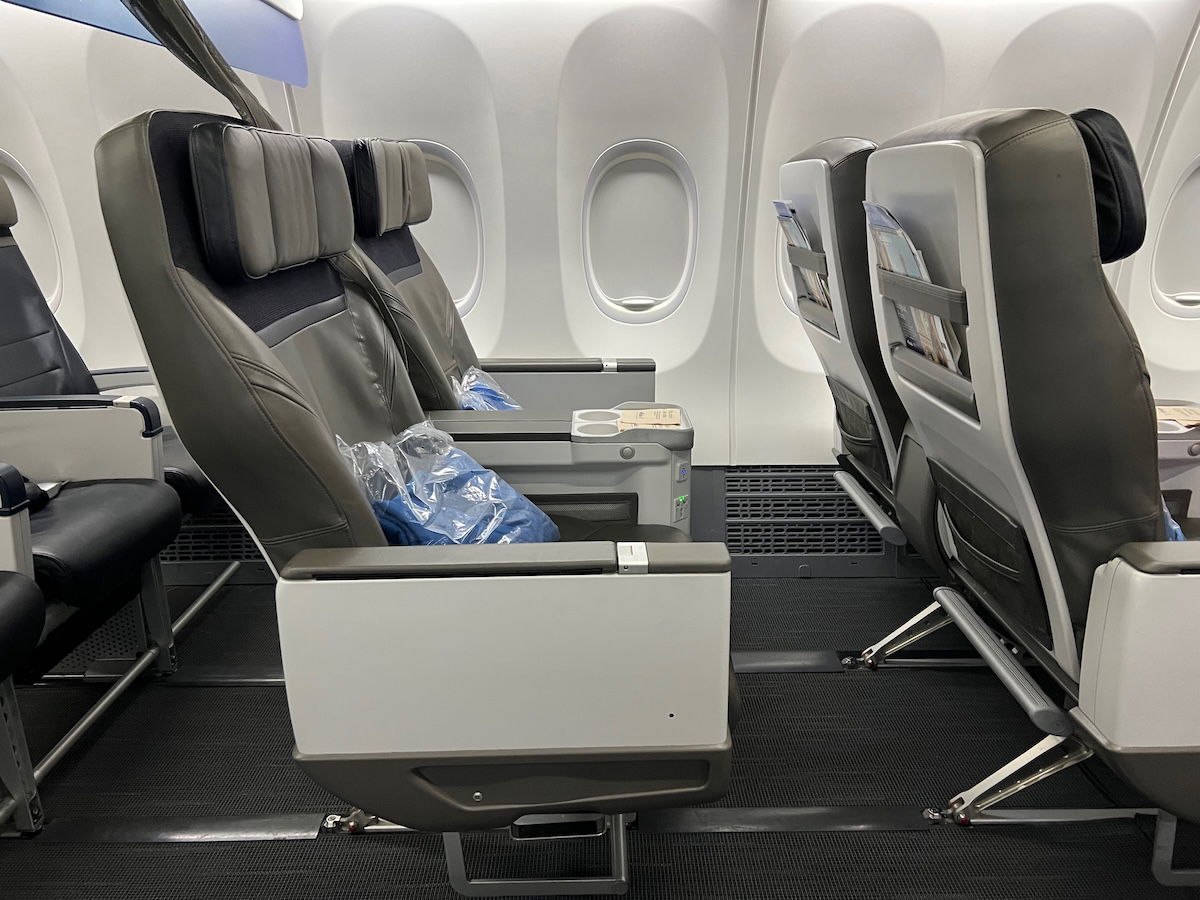
Is it worth earning Atmos Rewards status with spending?
How do I view the value proposition of spending toward Atmos Rewards status? As I see it, it doesn’t make much sense in isolation, but rather it makes sense as part of a much larger credit card strategy. As a reminder, Atmos Rewards has four elite tiers, with the following annual elite qualification requirements for 2026 (this is in addition to the milestone perks program, which offers even more benefits):
- Atmos Silver (oneworld Ruby) requires 20,000 status points
- Atmos Gold (oneworld Sapphire) requires 40,000 status points
- Atmos Platinum (oneworld Emerald) requires 80,000 status points
- Atmos Titanium (oneworld Emerald) requires 135,000 status points
To state the obvious, if you’re serious about earning elite status through credit card spending, you’ll want to use the Atmos Rewards Summit Card, given that it earns status points at the fastest pace.
Based on 2026 qualification requirements, and factoring in the 10,000 status points bonus on the anniversary of the Atmos Rewards Summit Card, you’d need to spend $60,000 to earn Atmos Gold (which gets you oneworld Sapphire status), while you’d need to spend $140,000 to earn Atmos Platinum (which gets you oneworld Emerald status).
On the surface, that’s not actually that exciting, though I think there are two things that potentially make this more interesting than you’d assume at first glance.
First of all, Atmos Rewards counts award flights toward elite status, at the rate of one status point per mile flown, regardless of which airline or class of service. This assumes you use Atmos Rewards points, and have your Atmos Rewards number on the reservation.
That’s incredibly compelling, since it means you’re rewarded not only when you earn points through credit card spending, but also when you go to redeem those points. This presents a pretty awesome opportunity to earn elite status through a combination of credit card spending and redeeming points, which is something you won’t find to be possible with many programs.
Second of all, what makes earning Atmos Rewards elite status with credit card spending compelling is how efficiently you can do this. With American AAdvantage, Delta SkyMiles, and United MileagePlus, I’d argue that there’s a material opportunity cost to earning elite status through spending. That’s because the cards don’t otherwise earn points or offer additional perks at an efficient rate, so you’re forgoing quite some rewards by using those cards.
That’s not the case with Atmos Rewards, though, in my opinion. The Atmos Rewards Summit Card offers 3x points on foreign purchases and on dining, and that’s before the 10% Bank of America relationship bonus you can earn, boosting rewards to 3.3x points per dollar spent in eligible categories. Those are also really valuable points you’re earning.
On top of that, if you spend $60,000 on the card in a cardmember year, you can earn a 100,000-point Global Companion Award. So I’d argue that spending $60,000 on the card is a sweet spot. On an ongoing basis, spending that amount would you earn 40,000 status points (accounting for the 10,000 status points you get just for having the card).
That’s enough for oneworld Sapphire status, which is pretty awesome. Then when you actually redeem points you earn more status points, which could pretty easily boost you to oneworld Emerald status. I’d say this could even be a good strategy for those who primarily fly with American.
While I’m not suggesting everyone should go for elite status with Atmos Rewards, I do think this is the most compelling case to be made for spending your way to elite status with a US airline, in terms of lack of opportunity cost of spending. I really like the “oneworld Sapphire with credit card spending, and then oneworld Emerald with award flights and other activity” approach.
Also keep in mind that Alaska Atmos Rewards and Bilt have a partnership, letting you earn up to 3x points on your rent payment with the card, in exchange for a 3% fee. Not only is that an attractive cost at which to acquire Atmos Rewards points, but that can also help you earn status and other threshold bonuses.

Bottom line
The Atmos Rewards program allows members to earn status points with credit card spending. With the Atmos Rewards Ascent Card and Atmos Rewards Business Card, you can earn one status point for every $3 spent, while with the Atmos Rewards Summit Card, you can earn one status point for every $2 spent, plus you can receive an anniversary boost of 10,000 status points just for having the card.
While it’s not for everyone, I do think there’s a case to be made for partly qualifying for elite status through spending on the Atmos Rewards Summit Card, given the other incentives to spend money on the card. I’d consider this to be the lowest opportunity cost way to earn airline elite status with credit card spending, so that’s great.
Where do you stand on the ability to earn elite status with Atmos Rewards’ credit cards?




Ben, you and the others are WAY UNDERVALUING this deal. The sweet spot is an almost 5 point return on each dollar spent to the $60,000 sweet spot. First, I get the 3.3% with my Bank of America account bonus. Then on top of that when I spend 60,000 in a year, I get a 100,000 point companion pass for ANOTHER 1.67% return. Do the math, that’s 4.97%! You can’t get that on any other card that I know of.
Earning 3.3x with BofA relationship is not accurate. It's 3.1x because the extra 10% is on base spend only.
Hmm. Good catch, if so. Many of us have been saying 3.3x … uh oh. We wish it were so!
There you are 1990/Ben, it is no good trying to make a comeback by hiding in the CC articles. Have you been avoiding me while you were in Manila, did you have a nice trip? …. :-)
It is 3.3x
For example, last month for my acrd:
Base: 2561
Foreign purchase: 4514
Alaska purchase bonus: 239
Total: 7314
Relationship bonus: 734 (~10% of total including bonuses)
The atmos app doesn’t work so I can’t even use my 145,000 miles. Called the help line and the wait was 1:05. Ridiculous.
Ben, the analysis on "opportunity cost" here is fundamentally flawed because it ignores the actual product yield. You are advocating for locking up $60k of liquidity on a co-brand card for a carrier that still thinks "streaming to your own device" is an acceptable hard product in 2026. Delta’s MQD model is superior precisely because it is harder to game. It filters for High-Value Customers (HVCs) who actually contribute to the airline's CASM-adjusted margins, rather...
Ben, the analysis on "opportunity cost" here is fundamentally flawed because it ignores the actual product yield. You are advocating for locking up $60k of liquidity on a co-brand card for a carrier that still thinks "streaming to your own device" is an acceptable hard product in 2026. Delta’s MQD model is superior precisely because it is harder to game. It filters for High-Value Customers (HVCs) who actually contribute to the airline's CASM-adjusted margins, rather than credit card churners looking for outsized value on phantom partner availability. While Atmos members are fighting for upgrade scraps on 737-900ERs with worn-out interiors, Delta is vertically integrating the premium experience with the A321neo domestic F product and bespoke Delta One Suites...
Atmos is essentially diluting their elite pool by selling status for 1 point per $2, creating an inflated liability on their balance sheet that they will inevitably have to devalue. SkyMiles might be "worth less" per point to a hobbyist, but they are a stable currency backed by the highest TRASM (Total Revenue per Available Seat Mile) in the industry. I'd rather earn currency on an airline that can actually afford to invest in dispatch reliability and seatback IFE than chase "sweet spots" on a glorified regional bus service.
Lmao is this a bit?? Tim has some serious competition
jfc shut down this pointslop
you aren't 'locking up liquidity'
“you aren't 'locking up liquidity'”
He doesn’t know what “vertically integrating” is, either. Or “phantom availability.”
Word salad with no point.
Is it possible to be embarrassed for somebody we don’t even know?
When I refer to "locking up liquidity," I am talking about the opportunity cost of capital. Funneling $60k of OpEx through a card earning a highly volatile, inflationary currency (Atmos points) rather than a liquid cash-back vehicle yielding a guaranteed 2.65% or putting that working capital into short-term yield instruments is a failure of allocation. You are effectively paying a premium for status on a regional carrier.
As for "vertical integration"—Delta Flight Products. Look it...
When I refer to "locking up liquidity," I am talking about the opportunity cost of capital. Funneling $60k of OpEx through a card earning a highly volatile, inflationary currency (Atmos points) rather than a liquid cash-back vehicle yielding a guaranteed 2.65% or putting that working capital into short-term yield instruments is a failure of allocation. You are effectively paying a premium for status on a regional carrier.
As for "vertical integration"—Delta Flight Products. Look it up. Delta is the only US carrier that designs and manufactures its own cabin interiors and IFE systems in-house, rather than buying off-the-shelf Recaro ironing boards like Alaska. That is the literal definition of vertical control over the supply chain and hard product.
I suggest you stick to the "Beginner's Guide" section until you understand the difference between hobbyist points hacking and actual business strategy.
It is 3.3%. My last statement consists entirely of foreign transactions and the math checks out - if yours is different, follow up with BofA
It is 3.3%. My last statement consists entirely of foreign transactions and the math checks out - if yours is different, follow up with BofA
Correct. I just verified the same 3.3% received on my last statement.
You guys are underestimating this deal. The sweet spot is an almost 5 point return on dollars. First I get the 3.3% with my Bank of America account bonus. Then on top of that when I spend 60,000 in a year, I get a 100,000 point companion pass for ANOTHER 1.67% return. Do the math, that’s 4.97%! You can’t get that on any other card that I know of.
The 10% relationship bonus is for the initial 1%, not the whole 3%, so it is 3.1% on foreign transactions. This is being reflected on my statements.