Amex Is Reducing Merchant Fees — What Does That Mean For Consumers?

Amex has announced an interesting change in strategy that may have some long term effects for both merchants and consumers. Historically Amex has tried to position themselves as the premium card issuer, and as a result they’ve typically had higher merchant fees than other issuers. There are all kinds of merchant contracts that are negotiated based on a variety of factors, so this wasn’t true across the board, though as a general rule of thumb it was.

Amex’s logic has been that their average cardmemember is higher income and spends more, and as a result merchants should be willing to pay a little bit extra to have Amex cards accepted at their business. Some businesses buy into that, and others don’t — Amex lags behind their competitors when it comes to acceptance. This is true in the US to some degree, though it’s especially evident outside the US, where it’s common for Amex cards not to be accepted.
Amex knows they’re losing volume with this strategy, though they’ve historically believed that their superior margins make up for that.

It looks like the card issuer may soon be taking a new strategy, under the leadership of their new CEO. American Express is hoping to close the acceptance gap between their cards and Visa & Mastercard, and they plan to do that by decreasing merchant fees by the greatest amount they’ve done in nearly two decades. The Financial Times reports that Amex plans to lower their average merchant fees by 5-6 basis points, to 2.37% (this is an average, so many small businesses will still pay more, while big businesses will often pay less).

This is all according to an investor day presentation last week, where they outlined their new strategy. Here’s the chart Amex uses to compare their acceptance to that of Visa and Mastercard, as well as how card acceptance has changed between 2013 and 2017:
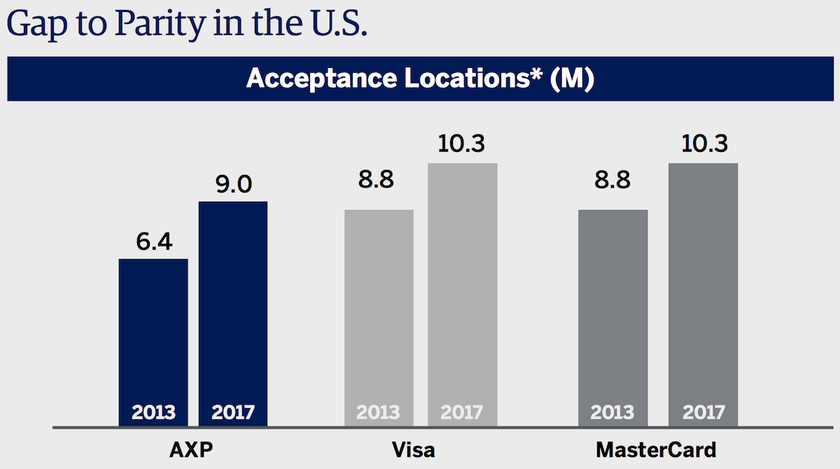
As you can see, over the past four years they’ve increased acceptance by about 40%, and they’re hoping to close the gap with their competitors.

The natural question is whether Amex reducing merchant fees means that we could see a reduction of benefits on their cards. Their strategy here is to decrease margins but increase transactions, so long term they think this strategy will be more profitable for them. However, it’s a gamble, and we don’t know for sure if it will pay off.

My general inclination is that this won’t lead to a reduction in benefits on Amex cards. That’s because ultimately Amex’s decision to provide benefits isn’t driven by their merchant fees (at least not directly), but rather by their need to compete with Chase, Citi, etc. We’ve seen Amex make their cards more competitive lately in response to what their competitors are doing, and they didn’t raise merchant fees as a result.

Perhaps short term there may be some impact, as groups are encouraged to cost cut to improve Amex’s short term performance, but long term that’s not a way to compete.

So we’ll have to see how this plays out, though personally I’m not too worried. I welcome anything they can do to improve card acceptance.

What’s your take on Amex reducing merchant fees?

Conversations (21)
The comments on this page have not been provided, reviewed, approved or otherwise endorsed by any advertiser, and it is not an advertiser's responsibility to ensure posts and/or questions are answered.
Comment as a member

Membership is free and takes no more information than commenting as a guest. Earn status points for good contributions, and see fewer ads as your status grows.

Type your response here.

If you'd like to participate in the discussion, please adhere to our commenting guidelines. Anyone can comment, and your email address will not be published. Register to save your unique username and earn special OMAAT reputation perks!

  1. Loading comments…
Recent Comments
The latest from the OMAAT community.

The comments on this page have not been provided, reviewed, approved or otherwise endorsed by any advertiser, and it is not an advertiser's responsibility to ensure posts and/or questions are answered.

Alan Guest

Mastercard and Visa in Europe are now at interchange rates of 0.3% (albeit small shops will be charged more once payment processor fees are taken into account) so Amex are going to have to go a long way to remain competitive!

0
‼ 0
Taylor New Member

@Daniel - You are right, if you are holding an Amex you most likely do also have a VISA or Mastercard as well. I do also carry my LH Mastercard but the earning rate is such crap that I try not to use it unless I really need to do so. I can of course say that I have walked into a place who doesn't take Amex and have used my Mastercard instead but to @Callum's point, I have also avoided certain restaurants or shops becuase they don't accept it and instead either purchased online or went to the shop that did. Sure they may not be loosing tons of business but they are loosing some.

0
‼ 0
Callum Guest

Daniel - You don't need to imagine, you've just been told that they do it... Personally, if I like 2 places equally and 1 doesn't take Amex I will go to the one that accepts Amex. Sometimes the only card I have on me is an Amex as well. If no-one else did that, logically no shop in the world would accept Amex - what would be the point?

0
‼ 0
nick New Member

As a small business owner of Four Retail units I would like to point out a few things: 1. While technologies like Square (and others) have made it easy and cost effective for smaller businesses to use AMEX (and discover) there is one BIG thing noted in the fine print. They can charge up to four percent (in California) for rewards cards; for example most rewards cards with Visa Signature, MasterCard world Elite, and AMEX Gold will generally be charged at a higher rate. So the new move in return may reduce fees for smaller businesses. 2. Card acceptance does MATTER. A lot of customers want points or cashback, and on many occasions I used to hear "why dont you accept AMEX." To know I hear "sweet you accept AMEX, ill come in more often. (as a Moot point when i went from sole prop to incorporated I found a Merchant services provider that would charge me 1.35% on ALL debit and credit cards (Including VISA, MC, AMEX,Discover) on inserted chip cards. 3. People have to pay for points. In the day and age of points and rewards schemes, its usually the merchant who pays for all of this. I am not a Safeway, Kroger, or Whole Foods who can pay that much for people to use credit cards. Especially for Low margin items like Tobacco, (on most cases we make 75 cents on ten dollars of tobacco sold. So the 15 cent Merchant fees comes out of my profit, and realistically taking away from my small profits. So we have now introduced cash and non cash prices to make up for it. People bitch and complain, and want to report us to the city for enacting a charge, however it is hard to sustain without surcharging. 4. However, as a merchant, AMEX is the best to deal with, it just really is. With AMEX, Fraud department being so tight, I never see disputed transactions or chargebacks. My biggest quarrel with VISA and MasterCard has been that chargebacks are so easy to do so; VISA and MasterCard have rules that restrict us from matching signatures or IDing people. We get around that now by stating that the State Board of Equalization and Alcohol Beverage Control require us to match ID for credit cards, to make sure the person stated on the card is in fact above age. So from my perspective AMEX wins in the customer service and fraud prevention department. 5. While AMEX charges might still be higher than VISA/MC, the reduction in fees for some businesses may help acquire more customers. It is not always a fair assumption to assume that people with more lucrative cards will be your best customers, because I have seen people with some really nice cards and vehicles complain about paying for bags in California As a consumer, the seduction and awe of having AMEX aside. I still prefer it to my Chase and Citi cards portfolio. Yes I think its cheap that when I travel internationally I dont get bonus points for eating out etc but the service and reliability is MUCH MUCH better. I think with the new management team, they will segment the market. Before, AMEX was not easily attainable, but with the shifting market make-up they are going to have to target each segment of the market differently. So while banks and card processors tap into the market with products like sapphire reserve, the luxury black card, US banks Visa Infinte card, AMEX needs to chase a mass market. I forecast that AMEX is now in customer acquisition mode; acquiring more merchants that will accept AMEX, and Offering more Unique AMEX products for a broader market.

0
‼ 0
Paolo Diamond

They must be doing ok in the US but in Asia and Australia Amex is just about dead in the water. I used to use it for everything but in the past 10 years we've seen imposts of 3% on many transactions as merchants try to recoup costs. Just about the only place it works ok is in the supermarkets ( no surcharge). With a significant annual fee, crazy transaction fees and limited acceptance, Amex simply isn't worth it in this region.

0
‼ 0

Save posts to read later

Saving posts is a member feature. Become an OMAAT member to build a reading list you can come back to from any device.

Become a member
Meet Ben Schlappig, OMAAT Founder
5,883,136 Miles Traveled

43,914,800 Words Written

47,187 Posts Published