
South Korea’s Asiana Airlines is addressing a recent inflight incident with an interesting precautionary measure…
Basics of the recent Asiana Airlines exit row incident
Last Friday, an Asiana Airbus A321 operated a rather eventful flight between Jeju (CJU) and Daegu (TAE). The short 205-mile flight was routine, until the approach, when a passenger decided to open the emergency exit door, shortly before touchdown, while the plane was at an altitude of under 1,000 feet.
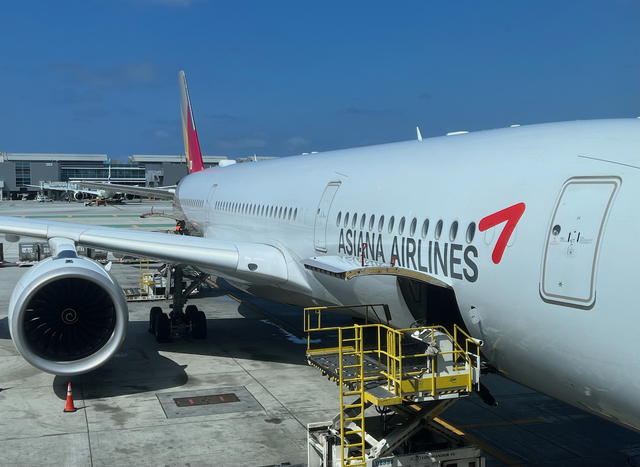
The man then tried to exit the aircraft, though was restrained by other passengers. The man now faces up to 10 years in jail. He had reportedly told police that he was under a lot of stress after recently losing his job, and he opened the door because he wanted to get off the plane quickly and was feeling suffocated.
While there’s lots of wild stuff that happens on planes, incidents like this are incredibly rare. When planes are at cruising altitude, it’s not possible to open the emergency exit, given the pressure difference between the inside and outside of the cabin. So something like this could only happen at a low altitude, and only on select jets (since some planes have a safety system whereby exit doors can’t be opened until a plane is on the ground).
I suppose there’s some fear that there might now be a copycat of this incident, which is leading Asiana to take action…
Asiana Airlines will stop assigning certain exit row seats
As reported by Al Jazeera, Asiana has revealed that it will no longer seat passengers at certain exit row seats on the Airbus A321. Specifically, on Airbus A321s, seats 26A and 31A (depending on the exact configuration) can no longer be assigned. Asiana describes this as a safety precaution, and this measure will apply even if a flight is full.
What makes these seats special? Well, these are the window seats located at the third sets of emergency exit doors. However, unlike the other emergency exit doors, there are no flight attendant jumpseats in this area, meaning that no flight attendant can actively be monitoring this situation during takeoff and landing.
On the one hand, I can appreciate why Asiana would want to make a change that would minimize the odds of something like this happening in the future. On the other hand, I’m not sure this will actually accomplish a whole lot. After all, there’s nothing preventing anyone else from trying to open the emergency exit door, including the person seated 18″ away, in the middle seat.
I mean, even if there were a flight attendant jumpseat there, presumably some passengers could overpower the flight attendant and open the exit, if that was their goal.
Asiana crews are going to have some awkward explaining to do to passengers. I imagine the person seated in the middle seat in the exit row may think they won the lottery when they see an empty window seat, and will politely ask if they can switch to the window seat. Of course they’ll then be denied. If they ask why they can’t sit in the window seat, will the flight attendant explain “so you don’t open the exit and try to jump out,” or…?
Bottom line
Asiana Airlines has stopped assigning select exit row seats on Airbus A321s, after a passenger tried to open the emergency exit door and jump out shortly before the plane landed. I can appreciate that the airline wants to avoid a similar copycat event in the future, though I’m not sure this will actually accomplish a whole lot?
What do you make of Asiana’s new exit row seating policy?


Membership is free and takes no more information than commenting as a guest. Earn status points for good contributions, and see fewer ads as your status grows.