

WestJet has been caught red-handed lying about flight cancelations in order to avoid paying passengers government mandated compensation. Or at least the situation is so bad that the airline is even refusing to provide Canada’s biggest broadcaster a plausible explanation for why it’s doing what it’s doing (thanks to Jack for flagging this)…
WestJet swapping planes to avoid paying compensation
In 2019, Canada introduced the Air Passenger Protection Regulations (APPR), which includes a provision for passengers to be paid cash compensation in the event that their flight is significantly delayed or canceled. The thing is, unlike in the European Union, Canada specifically excludes disruptions due to unforeseen maintenance as being eligible for compensation.
In theory I can appreciate the logic for this carve-out, but as I pointed out when these new protections were introduced, there was no way the airlines weren’t going to use this to their advantage.
That brings us to a fascinating CBC News investigation, which was released this week. On March 2, 2026, a Canadian couple were scheduled to return from their vacation in Mexico, flying from Los Cabos (SJD) to Calgary (YYC) with WestJet. Their flight was canceled at the last minute, so they only made it home 16 hours later than planned.
Upon returning home, the couple submitted a compensation claim with the airline, only to be denied, using the maintenance excuse:
Upon review of your reservation, we are unable to approve the claim for compensation as the most significant reason for the flight interruption was due to unplanned aircraft maintenance and was required for safety purposes.
There’s only one little issue with this explanation:
- The website FlightStats (which uses information provided by airlines) showed the flight as being canceled at 8:11PM the evening before, and at exactly the same time (also 8:11PM), it showed the tail number for the flight as being changed from C-FAJA to C-GUDH
- C-FAJA, the plane initially scheduled for the flight, ended up flying to Cancun (CUN) and remained in service (what happened to the maintenance issue?), while C-GUDH, the plane that was swapped in, hadn’t flown since February 28 due to maintenance, and ended up being grounded for around a week
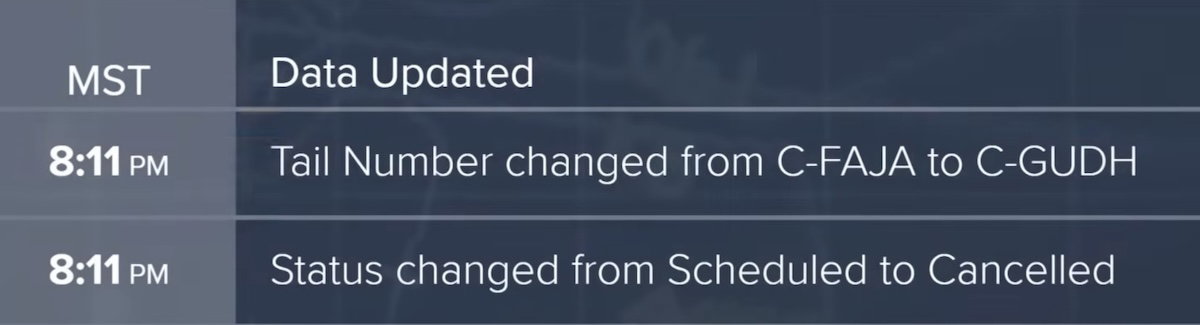
In other words, it would appear that when WestJet decided it wanted to cancel the flight, it swapped in a broken aircraft that was in maintenance, so that it could blame the cancellation on maintenance. CBC News investigated 34 other cases where exactly the same thing happened, where a tail number was swapped to a “broken” aircraft, and then within minutes (or even the same minute), the flight was canceled.
You might think “well, maybe there’s more to the story, let’s give the airline a chance to respond.” CBC News reports that the airline refused to directly address their questions and claims (despite being Canada’s largest broadcaster), and instead, simply said that “planes are sometimes reassigned to minimize the impact of disruptions.”
Right, it’s absolutely true that planes are sometimes reassigned to minimize the impact of disruptions, but that shouldn’t mean the airline can’t pay compensation to those passengers who were initially scheduled to be on the plane.
I can’t say I’m surprised to see this happening
The airline industry is a tough business, and I understand airlines want to do everything they can to avoid paying out cash compensation. I imagine WestJet is hardly alone in acting this way.
I’ve written about my fights with American over EC261 compensation, and how the airline outright lies, direct contradicting its own flight notes. And even when I specifically provided them documentation proving their lie, they still doubled down. Quite frankly, I probably only got this resolved because I have a blog, and it shouldn’t be this way.
My point is to say that airlines outright lying about these things is way too common. When Canada introduced consumer protections but excluded maintenance, I figured that there would be a bit of a challenge with holding airlines accountable.
Canadian regulators really need to look into this, because even if it has become normalized, it’s not okay. If the law says that only unforeseen maintenance can be used as an excuse, then swapping a flight to a plane that has been grounded for days doesn’t seem to fit that bill, in my opinion.
Bottom line
Canada requires airlines to pay cash compensation for flight cancellations, assuming the flight isn’t canceled due to unforeseen maintenance issues. From the time that these regulations were introduced, I assumed airlines wouldn’t be very honest about it, and WestJet has now been pretty clearly caught engaging in some unethical behavior.
The airline has denied many compensation claims due to unforeseen maintenance, but an investigation revealed the trick the airline is using in many of these situations. Essentially, the airline swaps in a broken aircraft at the last minute when it’s preparing to cancel a flight, so it can use the maintenance excuse.
What do you make of this WestJet practice? Is there any other logical explanation you can come up with here?




We booked our August 2026 flight way back before the current Iranian problems! Now looking at all booking sites our flight has been cancelled, there are seats on a flight the day before and a day after, however on speaking to Customer Services we are still booked on our original flight and there is no notification on the flight being cancelled. We paid for a flexible ticket, enabling us to change flights free o charge....
We booked our August 2026 flight way back before the current Iranian problems! Now looking at all booking sites our flight has been cancelled, there are seats on a flight the day before and a day after, however on speaking to Customer Services we are still booked on our original flight and there is no notification on the flight being cancelled. We paid for a flexible ticket, enabling us to change flights free o charge. However if we did that now we would have to pay at the very least CAD1000 each extra! Our only choice is to wait, it is imperative that one of us gets there on the booked date due to a very important appointment!
It can be a bit of a grey area. I was on an EasyJet flight that was delayed by about 7 hours due to weather according to them.
The flight was being operated by a legacy A321 at the limit of its range and was fully loaded so the captain wanted more fuel margin due to a sandstorm and had to add a fuel stop. This ended up causing a massive delay.
So...
It can be a bit of a grey area. I was on an EasyJet flight that was delayed by about 7 hours due to weather according to them.
The flight was being operated by a legacy A321 at the limit of its range and was fully loaded so the captain wanted more fuel margin due to a sandstorm and had to add a fuel stop. This ended up causing a massive delay.
So was the delay weather or a poor choice of aircraft? In the end I just didn’t have the energy to start an EU261 row with them. I will just avoid EasyJet in future
This is happening all the time Air Canada is worse
I have never been a fan of WestJet since it began. When service expanded to include Eastern markets I did a complete check on the fare structure and concluded that to attract passengers in Central Canada WestJet low balled the fares significantly so that fares passing through Calgary to holiday destinations were often significantly lower than the same plane from Calgary to the same destination.
So not surprised at all with this report. I...
I have never been a fan of WestJet since it began. When service expanded to include Eastern markets I did a complete check on the fare structure and concluded that to attract passengers in Central Canada WestJet low balled the fares significantly so that fares passing through Calgary to holiday destinations were often significantly lower than the same plane from Calgary to the same destination.
So not surprised at all with this report. I had a re-routed flight one time that involved a WS flight segment. They denied awarding rewards for the segment even though I had an appropriate membership.
Don’t fly WorstJet.
Ben, you had a separate post about why low cost airlines are popular in Europe but haven't really taken off in the US. In my view, protections like EU 261 or its UK equivalent make a massive difference here. Ryanair or Wizzair may be penny pinching and charging for everything, but they're ultimately accountable if something goes wrong. It's extremely easy to go to a small claims court, CEDR or just use one of the...
Ben, you had a separate post about why low cost airlines are popular in Europe but haven't really taken off in the US. In my view, protections like EU 261 or its UK equivalent make a massive difference here. Ryanair or Wizzair may be penny pinching and charging for everything, but they're ultimately accountable if something goes wrong. It's extremely easy to go to a small claims court, CEDR or just use one of the companies that will pursue the claim for you for a 20-30% cut.
YES!!
Ultimately, rules like EU/UK261 and Canada's APPR make for more reliable operations. The incentive is for airlines to properly maintain aircraft, staff appropriately, and keep schedule, within reason.
We need something like this in the USA. Our carriers already comply with these rules overseas. Time for them to be accountable at home, too.
Nothing will change as a result of this investigation. There is no accountability, therefore no incentive for airlines to follow regulations in Canada. Moreover, the regulations themselves are written (by design) so that compensation is never actually due, regardless of reason for cancellation. Compensation is never actually paid in Canada.
That’s right, the current regulations in Canada could have been written by the airlines themselves. Why on earth should they not be held accountable for maintenance issues? In all seriousness they argued at the time that they might operate not flight worthy planes if they were held accountable for maintenance. The government of the day caved in instead of calling their bluff. Canada isn’t a serious country when it comes to these issues.
It's time for the media / bloggers to write about the possible failure of westjets maintenence program, sine they do not discover these safety defects untill the last possible moment. Clearly Transport canada should conduct a full review of all maintenence records for this carrier.
Wanna bet that the Alberta independence movement gets a big donation within the next couple of days?
AC is also terrible. My solution is always to take them to Court where they come running asking to pay.
If this story is true hire a lawyer. This is what we get in a world of agos and AI. It tells some mid level manager how much they can pay out in a week or a month. When the airline hits the limit the manager fearing a dress down gets "creative."
Agreed, actually. Need to fight back. Sue, if needed. We must actually enforce consumer protections, not just let corporations lie and steal from us. Didn't expect George, of all people, to come around in-favor of consumers, but I'll take the win!
Huge fan of EU/UK 261 and Canada's APPR. Sure, these programs could be further streamlined and improved. However, the fact is that the US has nothing. We deserve better in the US.
The reality that 'Canada specifically excludes disruptions due to unforeseen maintenance as being eligible for compensation' is a major loophole which WestJet is trying to exploit. That said, the burden should be on the airline, not the passengers, to prove that the...
Huge fan of EU/UK 261 and Canada's APPR. Sure, these programs could be further streamlined and improved. However, the fact is that the US has nothing. We deserve better in the US.
The reality that 'Canada specifically excludes disruptions due to unforeseen maintenance as being eligible for compensation' is a major loophole which WestJet is trying to exploit. That said, the burden should be on the airline, not the passengers, to prove that the defense to claims is valid.
We have the railroad labor act, which is a much stronger consumer protection.
No, the RLA is not a consumer protection law at all (it's a labor/mediation law). The existing US equivalent to EU261 is 'DOT rules,' but they do not include compensation for delays caused by maintenance, staffing, etc. DOT rules, like EU261, require partial refunds or rebookings, within 7 days if used a credit card, but no compensation like in EU/UK/Canada.
That said, you are not wrong to remind others of how other industries, historically,...
No, the RLA is not a consumer protection law at all (it's a labor/mediation law). The existing US equivalent to EU261 is 'DOT rules,' but they do not include compensation for delays caused by maintenance, staffing, etc. DOT rules, like EU261, require partial refunds or rebookings, within 7 days if used a credit card, but no compensation like in EU/UK/Canada.
That said, you are not wrong to remind others of how other industries, historically, abused their passengers, whether it was the railroads during the 1st Gilded Age (late 1800s, early 1900s) and the ocealiners (before we had jets crossing oceans). We can and should learn.
Unrelated to WestJet, but whenever I've had delays, cancellations or baggage issues with AC, they gave me everything that was required by law without putting a fight. Maybe I've been lucky. I've only flown WestJet once but after seeing this I'll actively avoid it.
I've received compensation from Air Canada as well; no issues; no hassle; relatively efficient, too. Hopefully these issues with WestJet are indeed limited.
The question really is whether the plane that was swapped in was on scheduled or unscheduled maintenance. If the former, then clearly it's not unexpected. If the latter then the question of compensation arises.
And the issue is how much spare capacity does the regulator want Canadian carriers to have - spare capacity which costs money and raises fares. Any individual breakdown may be unexpected, but you do expect a certain level of breakdowns over...
The question really is whether the plane that was swapped in was on scheduled or unscheduled maintenance. If the former, then clearly it's not unexpected. If the latter then the question of compensation arises.
And the issue is how much spare capacity does the regulator want Canadian carriers to have - spare capacity which costs money and raises fares. Any individual breakdown may be unexpected, but you do expect a certain level of breakdowns over the course of time. It would be easy to have, say, 10% spare planes locked and loaded at each hub but it would be woefully expensive. If that's what the regulator wants, then fine but it needs to be explained to the public that they're paying for it.
This is called fraud. Time for some massive fines.
Air Canada invented this fraud a long time ago.
I'm not sure I consider this to be unethical.
Let's simplify the situation by saying that the airline has two flights due to departing at 7pm, and it discovers at 5pm that one of the two planes intended to fly these routes has a mechanical issue.
If it doesn't swap the tail numbers, then it clearly owes no compensation to the delayed passengers.
Let's now say that WestJet decide to swap the planes. Are we...
I'm not sure I consider this to be unethical.
Let's simplify the situation by saying that the airline has two flights due to departing at 7pm, and it discovers at 5pm that one of the two planes intended to fly these routes has a mechanical issue.
If it doesn't swap the tail numbers, then it clearly owes no compensation to the delayed passengers.
Let's now say that WestJet decide to swap the planes. Are we really going to say that they owe compensation to the delayed passengers - in effect, that WestJet don't get to decide that, for operational reasons, it makes more sense for e.g. the flight with higher load to be the one that takes place?
To my mind, the two questions here are:
a) Does a plane being out of action for a week count as "unforeseen maintenance"; and, if so,
b) should there be a requirement to switch the tail numbers no later than, say, 24 hours before scheduled take-off?
In making changes to the rotation, the reason for cxl turns from mechanical to commercial.
Commercial interests will often align with passenger interests and commonsense.
Say you have two flights scheduled to depart at roughly the same time, on similar aircraft. One is to be at full capacity and covers a route that only operates once per week, while the other is part full and covers a route that operates several times per day. Should the airline really face punishment for cancelling the latter flight instead of the former?
?? The aircraft they swapped in had *already* been in maintenance for 4 days!
Albert: I raised the question in my initial reply of whether there should be a limit on how long a plane could be out for "unforeseen" maintenance, or how late the swap could be made in the circumstances.
Daniel: The reason for *a* cxl was mechanical.
I'm shocked to seemingly be in a minority of one on this. Besides it being completely unreasonable to expect airlines to effectively be unable to decide which routes...
Albert: I raised the question in my initial reply of whether there should be a limit on how long a plane could be out for "unforeseen" maintenance, or how late the swap could be made in the circumstances.
Daniel: The reason for *a* cxl was mechanical.
I'm shocked to seemingly be in a minority of one on this. Besides it being completely unreasonable to expect airlines to effectively be unable to decide which routes run in these circumstances - and, of course, there will be knock-on effects on later flights caused by the location of the working plane - it also strikes me as completely unworkable.
What if an airline swapped the planes for another reason - say, a 787-9 and 787-8 are swapped due to unusually high ticket sales for one flight - but one of the planes happens to be out of action? Are we now going to have a legal case regarding whether the swap was justified by reasons unrelated to the maintenance? What if the airline claim that a swap happened shortly prior to a maintenance issue being discovered? It would be chaos.
In summary: should compensation be owed because the maintenance was no longer "unforeseen"? Perhaps. Should compensation be owed because WestJet chose to prioritise one route over another? Clearly not.