

The National Transportation Safety Board (NTSB) has just released its preliminary report about that bizarre accident we saw roughly a month ago, where a United jet struck a light pole (which in turn struck a truck) on the New Jersey Turnpike, and it highlights just how avoidable this incident was…
Cause of the United Boeing 767 approach accident at Newark
On May 3, 2026, a United Boeing 767-400ER was landing on runway 29 at Newark Airport (EWR), after a flight from Venice (VCE). This runway is right up against the New Jersey Turnpike (I-95), and somehow the plane came in too low, to the point that it struck a light pole, which in turn, struck a truck (initially the belief was that the plane directly struck the truck, but that wasn’t the case, per the report).
While there was damage to the aircraft, and also major damage to the truck, this could’ve been so much worse, because at least no one was seriously inured. If the plane had come in just feet lower, this could’ve been a catastrophe.
What we knew is that it was a gusty day, and that runway 29 is short, so it’s understandable that pilots would want to touch down as early as possible to avoid a runway overrun. However, that of course doesn’t in any way explain why the plane hit something on the interstate.
So, what actually happened? Well, all signs point toward the pilots just not following best practices. For what it’s worth, the captain was flying this sector, and he had a lot of experience, with over 16,000 hours.
Runways have Precision Approach Path Indicator (PAPI) lights, which are the four lights to the side of the runway, that are either red or white, and they’re supposed to help pilots maintain the right glideslope. The ideal descent profile is two white lights and two red lights — if you have more red, you’re too low, while if you have more white, you’re too high.
In this case, during the approach briefing, the captain indicated he wanted to fly the approach with three reds and one white, given the short length of the runway. So he intentionally wanted to fly in a bit low. However, the actual data shows that starting at around 4,500 feet, the plane was flying with four reds the entire time, rather than three reds and one white. So he didn’t actually fly the approach the way he said he would.
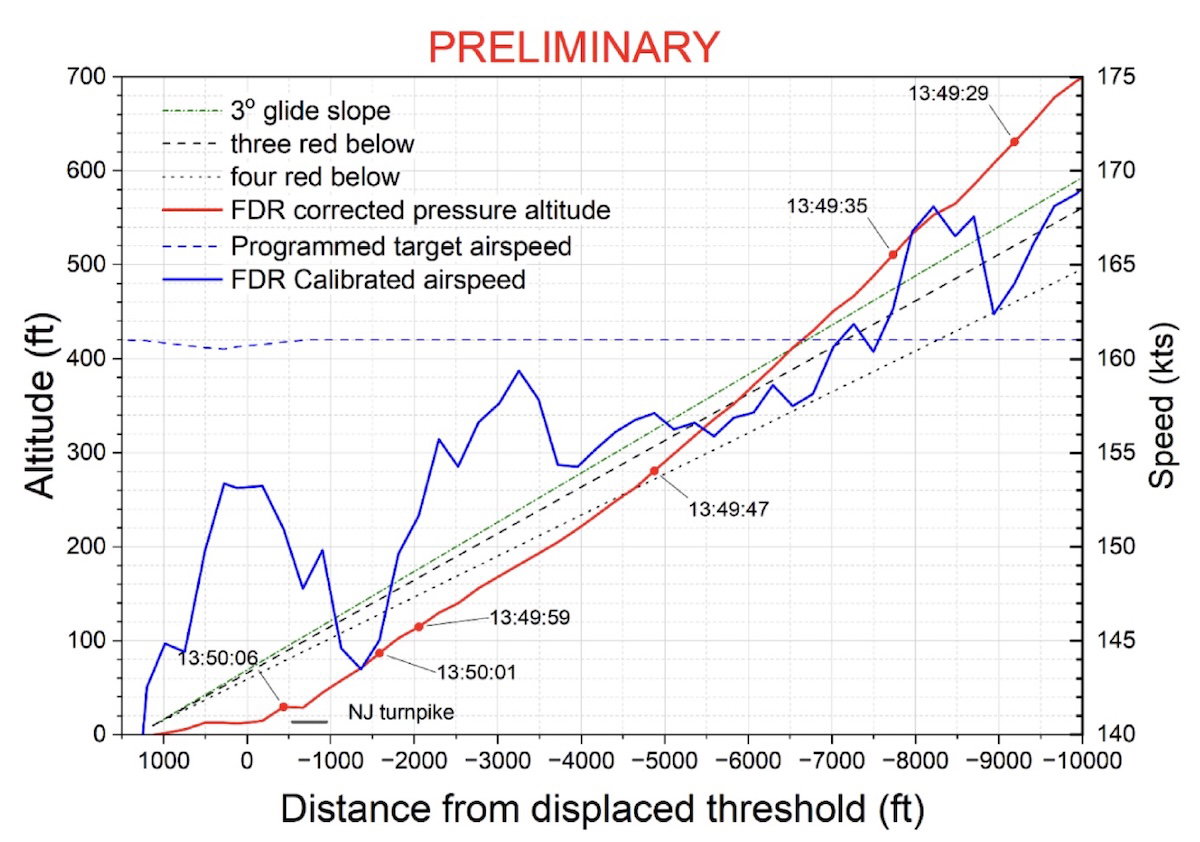
According to the first officer (who was the pilot monitoring), at an altitude of around 500 feet and within half a mile of landing, he recalled saying that he stated “hey you are slow,” followed moments later by saying “you are still slow and a little low.” In response to that, the captain claims he looked outside and “thought we were low,” however, since they were about to touch down, he didn’t have time to process the information in time to get a go around callout verbalized.
The captain explained that he turned off the autopilot at just under 900 feet. He said he “got fast” while he turned the airplane into the headwind, and pulled back the power levers to compensate, all while the airplane shortly returned to a stable airspeed, even though the wind gusts were producing “moderate turbulence.”
Was this get-there-itis, deference to the captain, or what?
The preliminary report only shares the details of the incident, but doesn’t actually come to a conclusion as to the cause (not that there’s much mystery here, as there were no mechanical issues with the plane).
Of course hindsight is 20/20, but aviation operates under a system of best practices, and erring on the side of caution. The idea is that either the captain or first officer can call a go around if they feel it’s not stable, in order to prioritize safety above all else.
So suffice it to say that this didn’t happen here. For one, the plane was coming in too low most of the way, and due to the gusts, the captain also seemed to be “wresting” the plane down a bit at the last minute, though he still decided at 500 feet that the approach was stable (was it really, if they were so low?).
But it’s concerning that the first officer told him twice that he was too slow, and once that he was too low, yet no go around was called. This sure seems like a situation that may come down to two factors:
- The much less experienced first officer perhaps not wanting to speak up to the captain, as it sounds like he should’ve called a go around; I think Nathan Fielder would have a thing to say about that, and one has to imagine if roles were reversed and the first officer were flying, the captain might’ve called a go around as the pilot monitoring
- They just completed a transatlantic flight and were probably tired and just wanted to get home, so it’s possible that get-there-itis played into it as well; this is essentially a plan continuation bias, a psychological condition where a person irrationally pushes to complete a journey despite red flags or unsafe conditions
Or I dunno, maybe it was all just DEI…
Bottom line
The NTSB has released its initial report into the landing accident that happened at Newark Airport roughly a month ago, involving a United Boeing 767, where it struck a light pole on the New Jersey Turnpike, which in turn struck a truck.
According to the report, the plane was coming in too low starting at an altitude of 4,500 feet, but not much was done to correct that. Then shortly before landing, the first officer pointed out twice how the plane was flying too slow, and once how it was flying too low, but they continued with the approach.
Of course in hindsight it’s obvious that a go around should’ve happened, but for whatever reason, that didn’t happen…
What do you make of the report on this United 767 landing incident?




Not mentioned in Ben's original commentary is that UA has runway specific procedures for runway 29 at EWR.
It specifically says that pilots should not attempt to land any sooner than 1000 feet down the runway and ideally between 1000 and 1500 feet down the runway.
Nearly all US runways have 1000 foot markers which make it very easy to gauge the location of 1000 feet.
Also, the CA and FO were both...
Not mentioned in Ben's original commentary is that UA has runway specific procedures for runway 29 at EWR.
It specifically says that pilots should not attempt to land any sooner than 1000 feet down the runway and ideally between 1000 and 1500 feet down the runway.
Nearly all US runways have 1000 foot markers which make it very easy to gauge the location of 1000 feet.
Also, the CA and FO were both fairly low time in their seats on the 757/767; UA operates the 757/763 and 764 as one category. The pilots were originally supposed to fly a 757 flight to SNN but were switched to VCE and the 764. While the 757 and 763 are fairly "sporty" in their handling, the 764 is far less so.
those that continue to struggle to grasp the concept need only look at the CA's thought pattern - captured in the prelimimary report - that he needed to land at the threshold because of the short runway. The aircraft crossed tthe threshold at just 6 feet which meant it was far too low over the adjacent roadway. UA specifically had previously addressed the technique to fly this approach, clearly indicating that there are pilots that want to try to their own technique.
The aircraft is still on the ground at EWR, undoubtedly to fix the holes in the fuselage.
One is unsure what is worse; reading the dangerously, delusional and demented comments posted under the “Tim Dunn” login, or, the fact that Ben, is allowing this situation to continue.
Enough has to be enough from this truly Walter Mitty character. It has been allowed to continue well beyond being a joke. Enough of your tolerance is enough Ben.
Shut up Aero, you’re not the Blog Police.
…. and you are Ronnie darlink? Xxxx
the joke is that you and your alter ego flip back and forth between your registered and unregistered accounts so you can have a conversation w/ yourself.
Meanwhile, the tragedy is that some can't see that runway 29 is a high risk approach to EWR with just 6725 feet of runway and a touchdown zone that is mere feet from a major roadway (or motorway as real Brits - not you- call it)
when captains...
the joke is that you and your alter ego flip back and forth between your registered and unregistered accounts so you can have a conversation w/ yourself.
Meanwhile, the tragedy is that some can't see that runway 29 is a high risk approach to EWR with just 6725 feet of runway and a touchdown zone that is mere feet from a major roadway (or motorway as real Brits - not you- call it)
when captains decide they are going to sit it down quick and ignore their FO's that they are low and slow, disaster is waiting to happen.
UA and this captain were very lucky that day
“The joke is” Walter, that the internet is a magnificent tool for drilling down into the truth of most situations. Is that not so “Mr Peanut”? Or do you lean towards “worldtraveller”? Perhaps you prefer to be recognised as the more recent Walter Mitty character who posts under the Tim Dunn login herein?
In 2011 at Lilburn, GA, it is recorded that Tim Dunn, was Mayor Pro-Tem. On March the 1st, 2020, Tim Dunn became...
“The joke is” Walter, that the internet is a magnificent tool for drilling down into the truth of most situations. Is that not so “Mr Peanut”? Or do you lean towards “worldtraveller”? Perhaps you prefer to be recognised as the more recent Walter Mitty character who posts under the Tim Dunn login herein?
In 2011 at Lilburn, GA, it is recorded that Tim Dunn, was Mayor Pro-Tem. On March the 1st, 2020, Tim Dunn became Mayor. He was Mayor until 2024 …. ring any bells Walter?
It can also be noted by ‘joking’ around on the internet that Tim Dunn, was employed by Delta Airlines, for 30 years. His job title before his sacking was “Analyst”. MaxPower, posted online, on the 4th of October, 2023:
“When Tim was still on airliners.net before he was banned, plenty of Delta employees confirmed he was fired, not retired, from delta”.
So not a pilot then Timmy, just a Walter Mitty wannabe pilot, yes? The joke is on you, old sock …. it is worth remembering that “he who laughs last is worth three in the bush”.
Need I post more jokes?
I do hope you don't freelance as a lawyer.
Your "evidence" is as pathetic as Max' mental processing capabilities.
Thank you for this opportunity to reply Wayne …. please rest assured that I will make a far more informed lawyer than you do while presenting to be a pilot.
As for your ‘dig’ at Max, from this viewpoint it is you who displays “Pathetic mental processing capabilities”.
Hey Ben, the plane had 4 reds at 4500ft DISTANCE, not altitude.... Look at the graph man!
being a mile out and at 4 reds highlights how bad the approach was.
thank you for reinforcing it.
at 4500 feet of altitude it would be doubtful that any approach light system would show 4 reds. I give Ben credit for trying to understand and learn but I am quite sure he is not a pilot
Neither are you, you oafish lout
Sounds like United was negligent… pay up.
Pay who, and for what?
Don't play dumb. At fault airline (United) to anyone damaged (truck, company, driver, injuries.)
If the bakery truck driver questions why the wheel hit his windshield , perhaps the airline industry will respond that trucks are not supposed to bump into planes .
"Or I dunno, maybe it was all just DEI…"
Sassy Ben is the BEST Ben. Please keep it up!
Good point calling out it might be DEI since it's United. Although it's not very likely they would admit this was one of their race-based hires.
You're not familiar with sarcasm, are you?
Makes sense. Racists aren't known for sophistication, and that includes their senses(?) of humor.
Perhaps Ben’s statement is actually veridical irony. But you’re probably not familiar with that.
Sei , yep veridical irony .
TravelinWilly ... Sei wrote "might" . Please read his post again , and inform yourself of "veridical irony" .
Not DEI. It was a Captain on one of the highest paying (i.e. most senior) planes. So not a recent new-hire when United pushed the DEI narrative in 2020-2024.
I know a guy that was hired in 2020/2021 and became a B767 captain in 2025.
thank you for covering this, Ben.
This simply highlights that EWR is a very challenging airport that is being used by UA far beyond what it can safely support.
The FO did what he was supposed to do and the CA was not aggressive enough to fix the problem.
The FAA and UA are going to pin this on the pilots as pilot error; it is indeed possible to fly this approach perfectly but it...
thank you for covering this, Ben.
This simply highlights that EWR is a very challenging airport that is being used by UA far beyond what it can safely support.
The FO did what he was supposed to do and the CA was not aggressive enough to fix the problem.
The FAA and UA are going to pin this on the pilots as pilot error; it is indeed possible to fly this approach perfectly but it is high risk.
The alternative is simply not to push as much traffic through EWR as is happening now esp. widebodies.
And let's keep in mind that UA is asking the FAA to have some of the flight timings that B6 and NK are not intending to use. Beyond the competitive issues involved, the real question is whether EWR simply needs to have fewer flights than was happening w/ B6 and NK there and if the number of existing flights needs to be better spread among carriers not named United and their regional affiliates.
Walter Mitty Dunn posts: “It is indeed possible to fly this approach perfectly but it is high risk”.
How would he know?
He stayed at a Holiday Inn Express.
Quoting Tim Dunn:
„I hope you didn't break any bones jumping to your premature conclusions“
I am somewhat sorry for trolling you (i.e. Tim)…
@ Tim Dunn -- We're waiting to learn which EWR-LAX frequencies UA operates with 737-900ERs, please!! These are the important details!
I sincerely hope that you are not holding your breath for an answer Eskimo. Walter is showing his truly ignoramus character by pretending that people are not asking him questions.
He posted yesterday that he was using WiFi mid Atlantic, I’m still waiting for him to tell me what Airline, Flight No, Seat No, etc. He will not respond because he is not bright enough to make up an answer. Perhaps he was in...
I sincerely hope that you are not holding your breath for an answer Eskimo. Walter is showing his truly ignoramus character by pretending that people are not asking him questions.
He posted yesterday that he was using WiFi mid Atlantic, I’m still waiting for him to tell me what Airline, Flight No, Seat No, etc. He will not respond because he is not bright enough to make up an answer. Perhaps he was in cargo.
This morning Jeeves reported that my perimeter security was not breached, therefore, one is hopeful that the aircraft upon which he stowed away has overflown the UK …. :-)
the obvious answer is that many aircraft including a number of UA widebodies have successfully flown this approach and done so without taking out stuff on the ground.
The fact that this flight did not complete a successful and uneventful landing does not change that it is the exception not the rule.
But it is also clear that EWR is running well beyond what it can handle and the only way to push traffic through...
the obvious answer is that many aircraft including a number of UA widebodies have successfully flown this approach and done so without taking out stuff on the ground.
The fact that this flight did not complete a successful and uneventful landing does not change that it is the exception not the rule.
But it is also clear that EWR is running well beyond what it can handle and the only way to push traffic through is to use the crosswind runway for landings including widebodies as this one did.
and this approach for widebodies is risky because of the short runway and the proximity of the runway threshold to the highway.
The captain thought he could intentionally keep it low and come out ok - and he clearly miscalculated. The only question is how many other UA pilots have thought the same thing whether they acted on them or not.
The rest of the rambling from aero is the typical incoherent drivel that flows from his keyboard
Nah, it's just to remind him of how full of sh*t he is.
Life would have been much easier for him if he just accept that he made a mistake and own it.
Eskimo, after reading all of the post on this incident report, by your mate Walter Mitty Dunn, one is minded to agree “How full of sh*t he is”.
He is definitely no pilot, or, certainly not one who I would allow to ‘fly me to the moon’ as song goes ….
This didn't have anything to do with "pushing" too many flights into EWR. It had everything to do with a widebody crew, accustomed to long, straight in final approaches, getting several runway changes due to strong, gusty crosswinds and ending up flying a curving approach to a short-final lineup they rarely got to do. And not going around when the approach got unstable.
It was about the proficiency of the Captain with that type of...
This didn't have anything to do with "pushing" too many flights into EWR. It had everything to do with a widebody crew, accustomed to long, straight in final approaches, getting several runway changes due to strong, gusty crosswinds and ending up flying a curving approach to a short-final lineup they rarely got to do. And not going around when the approach got unstable.
It was about the proficiency of the Captain with that type of approach, and the assumption that he could salvage it, and not about the capacity of the airport.
To try to push the narrative that flights need to be reduced in EWR for safety, based on this accident, would be like saying ATL should have schedules reduced to not exceed the rate they could manage when a thunderstorm occasionally passes through. Who would think that's a good idea?
Nice try, though, to attempt to advocate that reducing United's international footprint in the NY area is needed for "safety". Maybe that's the only way Delta can compete with them.
EWR ATC does everything it could to push capacity through the airport.
Many widebody pilots do reject landings on the crosswind runway.
The approach is high risk and the captain admitted as much by saying he intended to fly low to get on the ground.
DL competes by spreading its operation over 2 airports which have far more capacity than EWR.
the entire notion of how great a single airport hub in NYC...
EWR ATC does everything it could to push capacity through the airport.
Many widebody pilots do reject landings on the crosswind runway.
The approach is high risk and the captain admitted as much by saying he intended to fly low to get on the ground.
DL competes by spreading its operation over 2 airports which have far more capacity than EWR.
the entire notion of how great a single airport hub in NYC has been proven faulty over and over again.
and since you want to make it competitive, only UA was led by an executive team that wasn't smart enough to realize the value of staying in all 3 airports.
and now UA is going to have to fight to get even a tiny share of the JFK market by sucking up w/ one carrier (who might realize how stupid it is to let the fox in the henhouse) while there are still 2 other larger carriers at JFK that UA has to contend with.
after all, you have spouted how much you expect the competition to fight back at LAX - as do I - but you somehow aren't willing to consider that UA faces a much steeper hill at JFK.
Walter Mitty Dunn, that post in response to Pilot Paul, is yet another example of how, as Eskimo says, “Full of sh*t” you are. No pilot I know would ever make such a public display of themselves the way you do. Clearly you know absolutely nothing about flying and little more about commercial aviation beyond your Delta Airlines indoctrinated rhetoric.
If you represent the world of the aviation geeks, then I never want to...
Walter Mitty Dunn, that post in response to Pilot Paul, is yet another example of how, as Eskimo says, “Full of sh*t” you are. No pilot I know would ever make such a public display of themselves the way you do. Clearly you know absolutely nothing about flying and little more about commercial aviation beyond your Delta Airlines indoctrinated rhetoric.
If you represent the world of the aviation geeks, then I never want to suffer the insult of being called one. You certainly well deserve all of the criticism bestowed upon you by the other commenters herein.
To think that I once felt sorry for you Walter. However, after learning the error of my ways, I join many others in seeing you for what you really are ….
Tim this is truly one of your most idiotic takes (saying a lot).
How exactly would less flights into EWR change anything related to this incident. The short runway has been used for landings during specific weather conditions for decades. It has absolutely nothing to do with excess capacity. They can cut 10,000 flights and may sitll need to utilize that runway.
But sure, anything to allow you to parrot one of your 10 lines...
Tim this is truly one of your most idiotic takes (saying a lot).
How exactly would less flights into EWR change anything related to this incident. The short runway has been used for landings during specific weather conditions for decades. It has absolutely nothing to do with excess capacity. They can cut 10,000 flights and may sitll need to utilize that runway.
But sure, anything to allow you to parrot one of your 10 lines about why DL is great and UA sucks. Good job.
then it is settled.
A UA captain screwed up.
and EWR can continue to push traffic onto a runway that is too short and too close to the freeway - because this is UA's hub and UA clearly has an outstanding track record of matching their schedules to airport capacity at their hub airports. /s
yes, let's just throw the sucker under the bus - or in this case under the landing gear of the 764 just as it takes out the truck's windshield
Again, the use of the short runway has nothing to do with capacity or number of flights.
Its about wind conditions. Over the years many widebodies landed on it fine, from MD-11s to B747s to A340s to B77Es to many more.
But of course, let's just make up reasons to shit on UA.
BLAST!
My mistake, sorry.
Ben, please check Bottom Line second paragraph wording?