
Southwest Airlines can’t seem to stay out of the news when it comes to concerning incidents lately, from a scary go around in Hawaii, to a dangerously low approach in Oklahoma City, to an inflight Dutch roll. Well, we can now add yet another incident to the list, as flagged by @xJonNYC.
Southwest 737 uses closed runway in Portland, Maine
This incident happened on Tuesday, June 25, 2024, and involves Southwest flight WN4805, scheduled to operate at 5:40AM from Portland, Maine (PWM), to Baltimore, Maryland (BWI). The flight was operated by a 19-year-old Boeing 737-700 with the registration code N7861J.
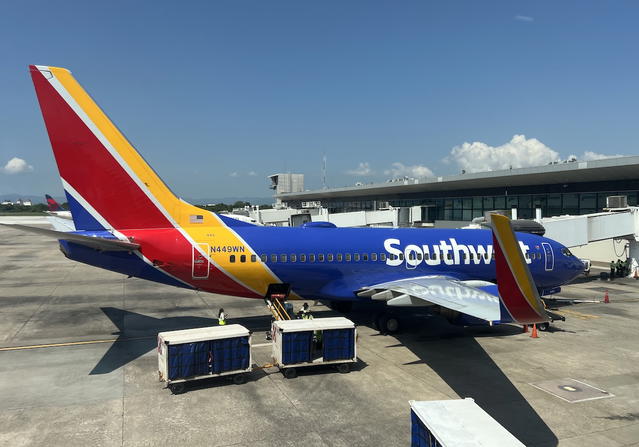
The air traffic control tower at the airport doesn’t open until 5:45AM. However, planes can still take off before then, just by stating their intentions on the CTAF (Common Traffic Advisory Frequency). So pilots are supposed to report that they’re taxiing, entering the runway, etc., so that other pilots can plan accordingly.
There are two major issues with this incident. First of all, the Southwest jet wasn’t on the CTAF when it departed, so it wasn’t communicating with other aircraft at the airport. This is of course a serious safety issue.
It appears that the pilots were talking to Boston center, which provides clearance and instructions for once the plane takes off. However, they weren’t on the CTAF, despite the fact that this is the standard procedure, not to mention that there were other aircraft movements on the ground at the same time.
But here’s the much bigger issue. The jet took off at 5:42AM from runway 29, even though the runway was closed at the time. There was a ground services vehicle on the runway, which even advised on the CTAF that the runway was closed, and told planes to stay clear. Since the Southwest 737 jet wasn’t on the frequency, it didn’t hear this, so took off despite that warning.
Prior to flying, pilots are supposed to review the NOTAMs (Notice to Airmen, or Notice to Air Mission) for an airport, and the NOTAMs for the airport made it clear that that runway 11/29 was closed until 5:45AM, except for taxiing and crossing the runway.
Some might not think that it’s a big deal to take off from a closed runway just a few minutes early, but precision matters. And in this case it also mattered because there was a vehicle on the runway at the time performing work.
Below you can see the excellent VASAviation recreation of what happened.
I wanted to specifically highlight how once the plane was airborne, Boston center confronted Southwest about departing without clearance:
Air traffic controller: “Southwest 4805, Boston.”
Southwest pilot: “Yes, go ahead.”
Air traffic controller: “Just trying to check, did you depart runway 29?”
Southwest pilot: “We did depart on 29.”
Air traffic controller: “Okay, that runway was closed.”
Southwest pilot: “I thought it opened at :45. There’s no markings there anywhere.”
Air traffic controller: “Right, it did open at :45, but you departed at :42.”
Southwest pilot: “That’s not what we were showing, but okay.”
The pilot comes across as a completely dismissive jerk, in my opinion. And I also highly doubt that the pilots specifically thought they were taking off at 5:45AM, since pilots track time very closely.
What a confusing, reckless incident
As of now, there are more questions than answers. What we do know with certainty is that the plane took off on a closed runway, and the pilots weren’t following NOTAMs. That’s a big no-no. Then the pilots also didn’t communicate on the frequency, which is yet another major problem.
We also know that a plane was on the runway when the jet was preparing to depart, but fortunately the driver noticed the plane, and immediately vacated the runway.
Taking off on a closed runway, all while not being on the correct frequency, is simply reckless. Obviously mistakes happen, but the rate of incidents we’ve seen lately at Southwest raises some questions as to what’s going on.
It’s one thing if the pilots had “just” ignored the NOTAM, or if they had “just” not communicated on the common frequency. But to take off on a closed runway while not communicating with others at the airport? That’s a big problem…
This is now being investigated by the FAA, and I’m curious to see what comes of this.
Bottom line
A Southwest Airlines Boeing 737 took off from a closed runway in Portland, Maine, while not even communicating on the traffic frequency. The plane took off a few minutes before the tower opened for the morning, which there’s nothing wrong with. The issue is the lack of communication from pilots, plus their sloppiness with not reviewing the NOTAMs prior to departing.
For the increased scrutiny we’ve seen at the FAA regarding United Airlines, it seems like maybe Southwest Airlines needs a little more oversight as well…
What do you make of this Southwest Boeing 737 incident in Portland, Maine?


Membership is free and takes no more information than commenting as a guest. Earn status points for good contributions, and see fewer ads as your status grows.