
In August 2025, we saw the launch of Atmos Rewards, the new loyalty program of Alaska Airlines and Hawaiian Airlines. At the time, the program announced how it would eventually introduce the “choose how you earn” feature, whereby Atmos Rewards members can choose to earn points based on distance flown, price paid, or segments flown.
Well, the wait for this feature is now over — the new system for earning points launches as of January 1, 2027, and you can make your selection as of today (October 1, 2026). Let’s go over all the details, and talk about which points earning option is the best. Separately, I’ve covered how Atmos Rewards will introduce a cool new “communities” concept, and also plans to partner with more transferable points currencies.
Atmos Rewards offering three points earning methods
We’ve seen so many airline loyalty programs go from awarding points based on distance flown to awarding points based on price paid. In most cases, this has resulted in a reduction in points earning, especially for those who don’t typically book very expensive fares.
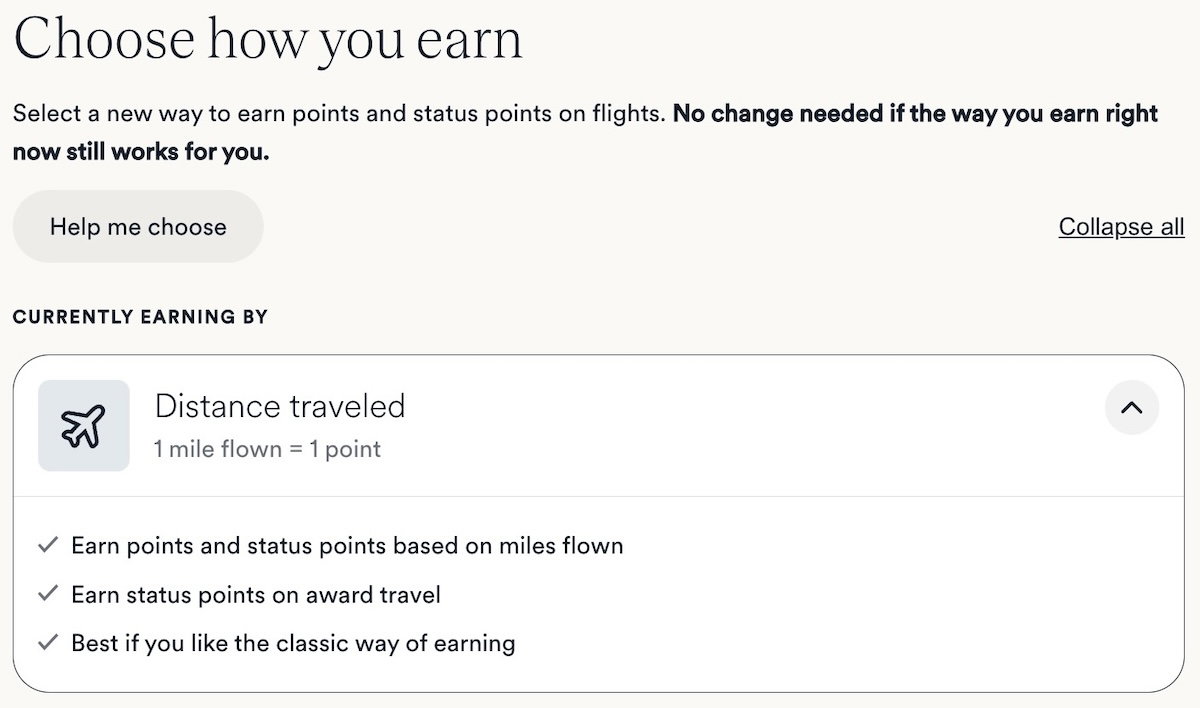
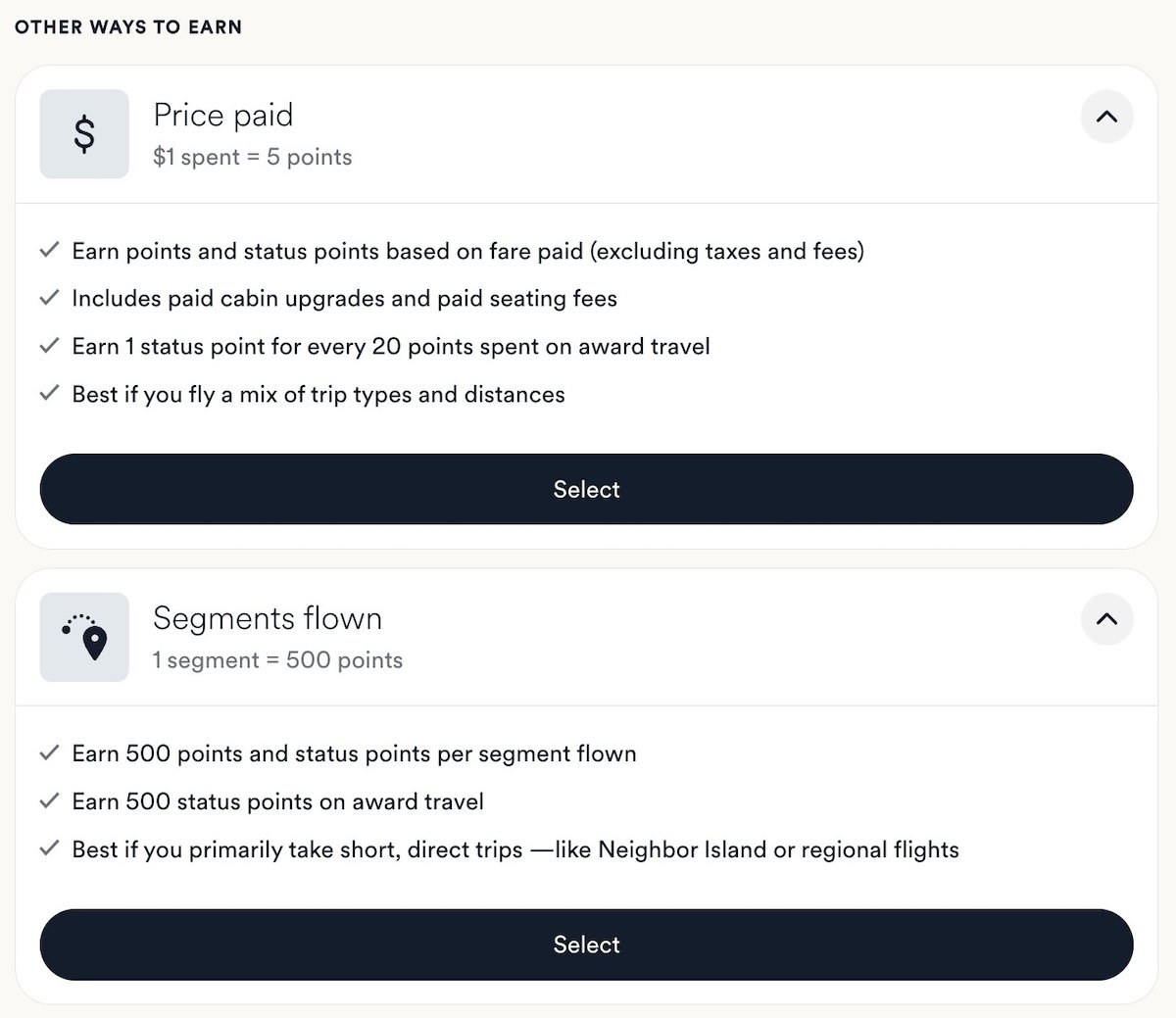
Atmos Rewards (and Mileage Plan, as it was previously known) has long been committed to continuing to award points based on distance flown. However, the program is giving members more choice. With the new Atmos Rewards “choose how you earn” system, members can elect to earn points (both redeemable points and status points) based on distance flown, dollars spent, or segments flown. Specifically:
- If you earn based on distance traveled, you’ll earn one point per mile flown; note that if you select this option, you’ll no longer earn class of service bonuses or a minimum of 500 points per segment
- If you earn based on price paid, you’ll earn five points per dollar spent (including carrier imposed surcharges, but excluding taxes and fees); with this method, paid upgrades and seat fees also earn points and status points, and you’ll earn one status point for every 20 points you redeem toward award flights
- If you earn based on segments flown, you’ll earn a flat 500 points per segment, for both revenue and award travel

Note that regardless of which option you select, you’ll continue to earn elite bonuses of 25-150% based on points earned. Furthermore, this system in no way impacts how members earn status points for credit card spending, as that’s remaining unchanged. As a reminder, Atmos Rewards elite requirements are as follows, and remain unchanged:
- Silver status requires 20,000 status points
- Gold status requires 40,000 status points
- Platinum status requires 80,000 status points
- Titanium status requires 135,000 status points
Atmos Rewards members can now indicate which points earning style they prefer at this link:
- Current Atmos Rewards members who do not make a selection will continue to earn based on distance flown
- Future Atmos Rewards members who join the program as of 2027 will default to earning based on price paid
- All Atmos Rewards members can change their earning choice once per calendar year for future travel
One other thing worth mentioning is that if you choose to be rewarded based on price paid, this only applies to flights on Alaska, Hawaiian, and American, and as well as partner flights booked directly through Alaska or Hawaiian.
If you book any partner airline other than American directly through the partner site, you’d earn according to the partner earn rate chart. That’s because Atmos Rewards doesn’t necessarily have the fare information for all partner tickets, when booked directly with the partner.
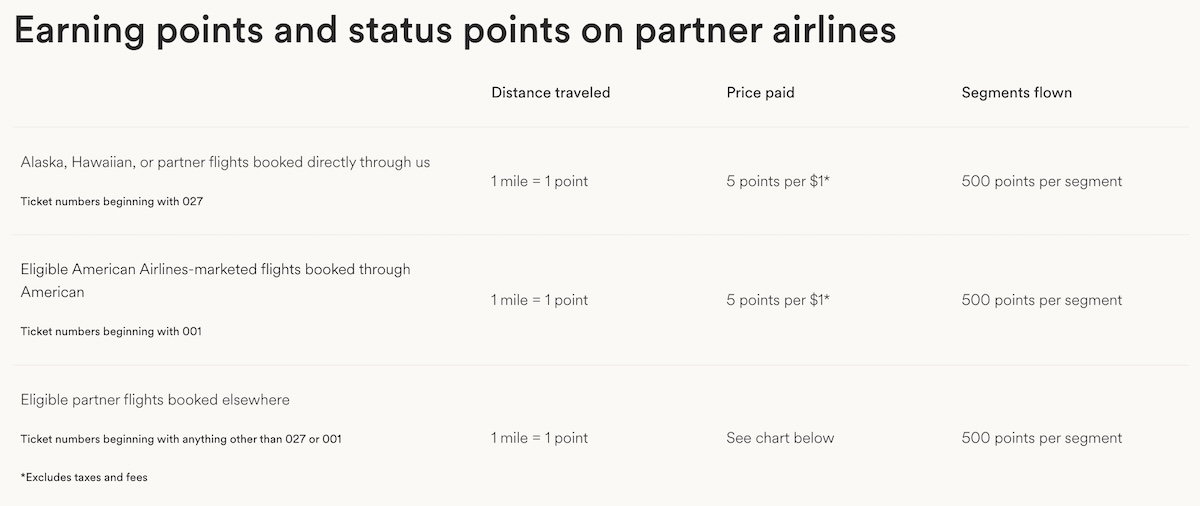
This is where Atmos Rewards is getting sneaky. We knew that the program would improve points earning rates for premium cabin tickets on partner airlines when booked directly with those airlines. That will be implemented as of January 1, 2027, though the catch is that you’ll only get the better earnings rates (shown in the below chart) if you choose to earn points based on price paid rather than based on distance flown. Otherwise you’ll earn one point per flown mile.
In other words, premium cabin partner tickets will be significantly more rewarding if you choose the price paid method rather than the distance flown method.

Which Atmos Rewards points earning option is best?
I commend Atmos Rewards for adding this kind of choice, as we’ve never seen a program offer so much flexibility. Admittedly, there is some downside for those who choose to continue to earn points based on distance flown, as there will no longer be a minimum number of points earned per segment; there will also no longer be class of service bonuses, and premium tickets on partner airlines won’t be as lucrative.
Those changes are negative, and not awarding a class of service strikes me as being rather counterproductive in terms of trying to encourage people to buy more expensive fares.
Which of the points earning options is best? Let me start by saying that the segment method of earning points only makes sense if you frequently book very inexpensive short haul tickets, like inter-island Hawaii flights. I imagine that covers only a very small percentage of people (especially OMAAT readers, who tend to travel globally), so I won’t analyze that too much further.
Between earning points based on distance flown and earning points based on price paid, which is better? When you compare the math on distance based earning and revenue based earning, the breakeven point is essentially when you’re spending more than 20 cents per flown mile. Just to give a breakeven example, say you have a one-way transcontinental flight that covers a distance of 2,500 miles and costs $500:
- With distance based points earning, you’d earn 2,500 miles
- With revenue based points earning, you’d earn 2,500 miles
A majority of passengers spend an average of under 20 cents per mile (Alaska’s average passenger revenue per available seat mile is around 15 cents — admittedly not every seat is occupied, but even when you factor that in, the average person is paying under 20 cents per mile), so I tend to think the old system continues to make the most sense for a lot of people.
The three exceptions are that purchased upgrades earn rewards under the revenue based system, but wouldn’t earn you additional points under the distance based system. Furthermore, if you frequently buy premium cabin tickets, the lack of class of service bonuses under the new distance based system is less than ideal, as that applies not only on Alaska and Hawaiian, but also for travel on partner airlines.

Bottom line
Atmos Rewards is giving members the option of three different ways to earn points. With this, members can choose to earn points based on distance flown, dollars spent, or segments flown. Members can now set their earnings preference, and it’ll then apply for flights as of January 1, 2027.
I think the segment based earning option will make sense for very few people. So the choice comes down to whether you want to earn based on distance flown or price paid. In theory, the breakeven point is if you’re spending an average of 20 cents per flown mile, though that doesn’t factor in seat fees and upgrades (which are only rewarded based on the price paid system), as well as frequent premium travel on partner airlines (which is more rewarding under the price paid model).
I do have to say, it sure feels like there’s a Bilt Cash-level of complexity to this system, in terms of understanding all the nuance. Of course I get it, but I also do this for a living. But for the average person, this could be hard to follow.
What do you make of the new Atmos Rewards points earning options?





"I should also mention that Atmos Rewards promised to improve points earning rates for premium cabin tickets on partner airlines when booked directly with those airlines."
But will Alaska bump up earn rates for premium cabins on Alaska metal or when booked with Alaska?
you highlight a very clear loophole in why you should not pay for J class on AS...but AS ticketed and partner operated J class fares are insanely high to get the 250 percent....so they should just put everything long haul J to 250 percent.
Again, Alaska knocking it out of the park, lately. See, this is actually giving consumers a choice (not the fake 'choice' of unbundling fares, but really just charging more, like DL and UA have done recently, even for business class. Lame.) I'm glad they're keeping distance-based; and that even point redemptions on partners earn status with AS. That was a very pleasant surprise when I flew JFK-EZE in F on AA metal (before they retired 773 F cabin) using AS.
Does the cost paid include seat upgrade? I’ve got a 200 mile flight I bought with points, then paid $80 for a seat upgrade. Which option is best in this case? Thx and yay Alaska!
@ Tm -- Yep, if you choose the revenue based model, then seat upgrade fees do earn you points (both redeemable points and status points).
yes. it does.
Ive been hearing anecdotes that J class partner ticketed and operated are now posting at 250percent..but others not.
I have a BA J class ticket later in October.....would love to have clarity on when this actually starts.....
What’s the bonus for elites and business fares if one chooses points per dollar?? Under the current scheme, 99.9 % of the people including business travelers will get more points and status miles with distance than ticket value.
This is just a stop gap until they fully switch to revenue based.
@ Davisson -- The elite bonuses are the same across methods, while there's not really the concept of class of service bonuses anymore.
Is the 500 mile minimum going away if you choose distance?
@ AZ ATMOS -- Yep, unfortunately it is.
Ben, I'm curious on your take for how award trips and status points via the BoA Alaska Summit and Ascent credit cards might affect the distance vs. spend method to earn status.
@ rww -- I would say it shouldn't materially change things. The status points earning on the credit card is the same, regardless of the method you choose. Meanwhile for award flights it comes down to whether one would be better off earning one status point per flown mile, or one status point for every 20 points redeemed. Looking at most of my saver level award redemptions, the math is more favorable for the distance...
@ rww -- I would say it shouldn't materially change things. The status points earning on the credit card is the same, regardless of the method you choose. Meanwhile for award flights it comes down to whether one would be better off earning one status point per flown mile, or one status point for every 20 points redeemed. Looking at most of my saver level award redemptions, the math is more favorable for the distance based system, even when redeeming for premium cabin tickets.
Note that Alaska previously confirmed that distance-based earning will not receive any class of service bonus. So if you fly transcon or similar in J, you wouldn't get any bonus vs if you had flown economy.
Also, they said when they announced initially that paid for seat assignment and class-of-service upgrades will earn points under the revenue-based option.
@ clb -- You're right, I forgot to include that in the post, so I just added it. Thanks!
"A majority of passengers spend an average of under 20 cents per mile (Alaska’s average passenger revenue per available seat mile is around 15 cents), so I tend to think the old system continues to make the most sense for a vast majority of people."
does this math hold up, though? that's *available* seat mile, and not all seats are occupied, which means that those empty seat miles are subsidized by the seats actually occupied...
"A majority of passengers spend an average of under 20 cents per mile (Alaska’s average passenger revenue per available seat mile is around 15 cents), so I tend to think the old system continues to make the most sense for a vast majority of people."
does this math hold up, though? that's *available* seat mile, and not all seats are occupied, which means that those empty seat miles are subsidized by the seats actually occupied by pax, which would seem to suggest that those ticket sales are at something of a higher cost basis than the average seat mile revenue in order to balance out the empty seats which earn zero cents per mile
@ digital_notmad -- That's a totally valid point. We're still talking about an average load factor of 80%+, so on *average* people will come out ahead with the distance based system. I guess everyone will have to crunch the numbers for themselves, based on their own situation.
It'd be useful to know what the plan is for Saver fares. This seems to have been left out of the conversation even though main cabin fares are considerably more expensive.
Are they going to provide tracking for all methods of status qualification before we have to choose? It would be helpful to understand where things shake out this year in order to assess whats the best method for next year.
@Lucky, which is better for long-haul J + domestic Y travelers? On the one hand, fare-based could be better, since a $4k (pre-tax/fee) 5k mile r/t ticket would net 20k vs 10k. But, given AS's small long-haul network (and seemingly subpar product), it might be better to choose distance-based and buy partner J directly for 250%, while maximizing awards and domestic AS Y. Any "losses" from occasional domestic F or upgrade purchases would be minor. Thoughts?
Buuuuut, as I read the the article the class bonus, it 250% for J purchases will no longer be offered. So, it seems Status points are only earned for miles flown no mater where you sit or how much you pay!!
What about Saver Fare purchases???
Still questions needing answers!
@GLCTraveler, while I agree they need to answer A LOT of questions, they seem to be pretty clear on the partner earnings (at least for now). International F/J on partners will earn 250% when booked directly with the partner.
From the FAQs (https://www.alaskaair.com/atmosrewards/content/faq/2026-updates), which they may change: "Partner flights booked direct with partners will continue to earn a percentage of flown miles if either the distance or ticket price earning method is chosen, or will...
@GLCTraveler, while I agree they need to answer A LOT of questions, they seem to be pretty clear on the partner earnings (at least for now). International F/J on partners will earn 250% when booked directly with the partner.
From the FAQs (https://www.alaskaair.com/atmosrewards/content/faq/2026-updates), which they may change: "Partner flights booked direct with partners will continue to earn a percentage of flown miles if either the distance or ticket price earning method is chosen, or will earn 500 points per segment if the segment earning method is chosen."
One thing I'm curious about is a partner-booked, AS flight. For example, if you book BA JFK-LHR and AS LHR-SEA on BA.com or JL LAX-HND & AS NRT-SEA on jal.co.jp, what would the AS flights earn under the different choices?
@Tennen for your case, which is similar to my case, I'd say price based is at least worth much more consideration, if not an outright nobrainer.
I may have some paid domestic Y in us on AS or AA too so I'd sacrifice earning on those to earn 30-50k redeemable and status miles each time I fly partner J l/h. atmos Titanium could be had w/ about 3-4 of those plus some nominal domestic us...
@Tennen for your case, which is similar to my case, I'd say price based is at least worth much more consideration, if not an outright nobrainer.
I may have some paid domestic Y in us on AS or AA too so I'd sacrifice earning on those to earn 30-50k redeemable and status miles each time I fly partner J l/h. atmos Titanium could be had w/ about 3-4 of those plus some nominal domestic us travel, which fits what I'd want to credit to atmos. I suppose the specifics of the l/h routes one may really matter much more for the math than what this article has implied.
Though this system is different to what AA, UA, and DL offer, for a particular type of user, it's certainly not worse.
I'm totally ok with a program that doesn't offer widespread international partner award availability but offers excellent domestic award availability at great rates, which DL and UA definitely don't, often even with status and cc. The more atmos allows easy accrual of far more points though (transfers from cc partners are biggest risk by far) , the more downside risk there is to this availability for the customer.
How will the revenue method work with partners? Will AS be able to see the fare details of tickets booked on partner airlines?
In the article it says this will be for flights post Jan 1st. I have a trip already book for next April. Will the points I earn off of it be based on what my selection is at the time I purchased the tickets. Since I purchased these tickets months ago will I get distance flown or if I switch to points per $ spent will I earn it based on the price I paid?
...In the article it says this will be for flights post Jan 1st. I have a trip already book for next April. Will the points I earn off of it be based on what my selection is at the time I purchased the tickets. Since I purchased these tickets months ago will I get distance flown or if I switch to points per $ spent will I earn it based on the price I paid?
I know for any new bookings it would be based on my selection just not sure how it works for flights already booked. For the first year knowing this could have a huge impact on what I end up selecting.
Thanks
@Jeff W., I'd imagine that ticketing date won't matter. IME, when airlines change earnings structures, the flight date is usually the decider. So, if you change to $ before April, that's how your flights will be calculated.
Thanks,
That was my initial thinking as well.
How is this more "flexible"???????????????
The current program offer basically all 3 without you having to choose. That's called flexible.
The new program forces you to choose 1 of 3 routes. The only people who benefit are those traveling on company dime and always pay full fares. Everyone else loses. Everyone else get a lot less flexibility
That's also by far and away the worst by-segment earning in the aviation industry requiring 40 segments for silver and 80 for gold. It's insane how bad it is
One additional point that I want to point out is that selecting earn-by-price does not give you an edge in earning the Million Miler status, which is still distance based. Million Miler status plays a critical role in complementary first-class upgrades, and with the lie-flat seats on 737s being rolled out next year, this will only become more valuation.
Just seen this on the Atmos Rewards Update page regarding the enhanced status points rates for partners:
“New partner earn rate
We're making it even more rewarding to fly Business and First Class when you book directly with our partner airlines. Based on your feedback, we're boosting earning rates, beginning when choice earn launches later in 2026.”
I take this as confirmation that the new rates will be effective as of 1 Jan.
Ben-
Do companion passes also accrue status miles via the same 1 point per 20 point rate?
Ben, on balance I’d say these changes are positive. Though the lack of class of service bonuses if selecting distance-based earning is not ideal at all.
The announcement that was missing that I think we’ve been waiting for for a long time is mixed partner itineraries. As things currently stand, there are only a limited number of routes where an itinerary on multiple partners is bookable via AS. If you want to fly a...
Ben, on balance I’d say these changes are positive. Though the lack of class of service bonuses if selecting distance-based earning is not ideal at all.
The announcement that was missing that I think we’ve been waiting for for a long time is mixed partner itineraries. As things currently stand, there are only a limited number of routes where an itinerary on multiple partners is bookable via AS. If you want to fly a multi-partner journey all on one ticket, you’re better off booking via American. Personally, I am a big fan of Atmos but this has long been a downside of the program, and I think you should call them out over it.
These changes suck. Bye, bye Alaska.
If you're primarily redeeming Atmos points for travel rather than cash (big spenders on Atmos CCs or transfers from Bilt), the status point hit is pretty severe on the Price Paid option compared to Distance:
Ex: 1-700 Distance band starts at 4500 mi; 4500/20 = 225 status pts
2101-3500 band (US transcon, west coast to Hawaii) starts at 12,500; 12500/20 = 875 status pts
How does one even know how many miles a specific flight is? Miles flown isn’t readily available information from my experience.
http://www.gcmap.com
Has anyone looked at the Help Me Choose feature that shows how much you would have earned through August 31 under the 3 different earning methods? It shows I would've earned more points under Price Paid but the points calculated for Distance Travelled isn't right so the recommendation seems to be based on inaccurate numbers.
I note that Basic Economy and Saver fares are not eligible to earn points.
Source: https://www.alaskaair.com/content/earn-points/choose-how-you-earn?int=Atmos_WEB_2027Updates_borealis-large-promo-card6||choose-how-you-earn-on-flights_v3
Someone signing up for distance-based earning could be in for a shock if it turns out their cheap economy tickets are zero-earning.
When flying a partner airline, how do you know whether your fare counts as "basic economy"?
https://www.alaskaair.com/atmosrewards/content/legal/terms/airline-partner-eligible-flight-ranges
This page says, "Saver, Basic and Light fares" are zero-earn. The airline I fly most often with in economy is...
I note that Basic Economy and Saver fares are not eligible to earn points.
Source: https://www.alaskaair.com/content/earn-points/choose-how-you-earn?int=Atmos_WEB_2027Updates_borealis-large-promo-card6||choose-how-you-earn-on-flights_v3
Someone signing up for distance-based earning could be in for a shock if it turns out their cheap economy tickets are zero-earning.
When flying a partner airline, how do you know whether your fare counts as "basic economy"?
https://www.alaskaair.com/atmosrewards/content/legal/terms/airline-partner-eligible-flight-ranges
This page says, "Saver, Basic and Light fares" are zero-earn. The airline I fly most often with in economy is Cathay Pacific, so I tried to work out which fares would earn with Atmos.
Cross-referencing against Cathay's own site - that page appears to indicate that fare classes S, N, Q and O are zero-earning. However, Cathay switched to using fare families a while back, so you can buy:
- An "Economy Light" ticket in fare class Y, or;
- An "Economy Flex" ticket in fare classes S, N, Q and O.
Presumably one of the above would earn with Atmos, and the other wouldn't? I'm not sure whether to trust the written rules or the chart!
Meanwhile, I believe Qatar's fare class W indicates "Economy Lite", but that one is listed in the chart!