
Malaysian ultra low cost carrier AirAsia has just placed an order for the Airbus A220. Not only does it represent a major departure from the carrier’s historical approach to fleet planning, but it’s also the biggest-ever single order for this aircraft.
AirAsia will add 160-seat Airbus A220-300 to fleet
AirAsia has placed a firm order for 150 Airbus A220-300 aircraft, with deliveries expected to begin in 2028. The purchase agreement is the largest single firm order placed for the A220, and propels the program beyond the 1,000 firm order milestone, which is major.
It’s also worth noting that AirAsia is the launch customer for the high density version of the A220-300. The plane is otherwise certified for up to 149 seats, but by adding an extra overwing exit, the capacity can be increased to 160 seats. Note that this high density A220-300 is different from the stretched A220-500 concept, which Airbus is seriously considering.
As it’s described, the A220 will play a key role with AirAsia’s network across ASEAN and into Central Asia, freeing up larger aircraft to fly longer routes. Here’s how AirAsia CEO Tony Fernandes describes this order:
“We have built AirAsia by making bold decisions at the right moment, not the easiest moment. This order reflects our long-term discipline and the scale of our ambitions. The A220 unlocks new markets and routes and brings us closer to building the world’s first true low-cost network carrier. Our partnership with Airbus spans more than two decades and has been central to everything we have achieved. Today is another milestone in that journey, and there are many more to come.”
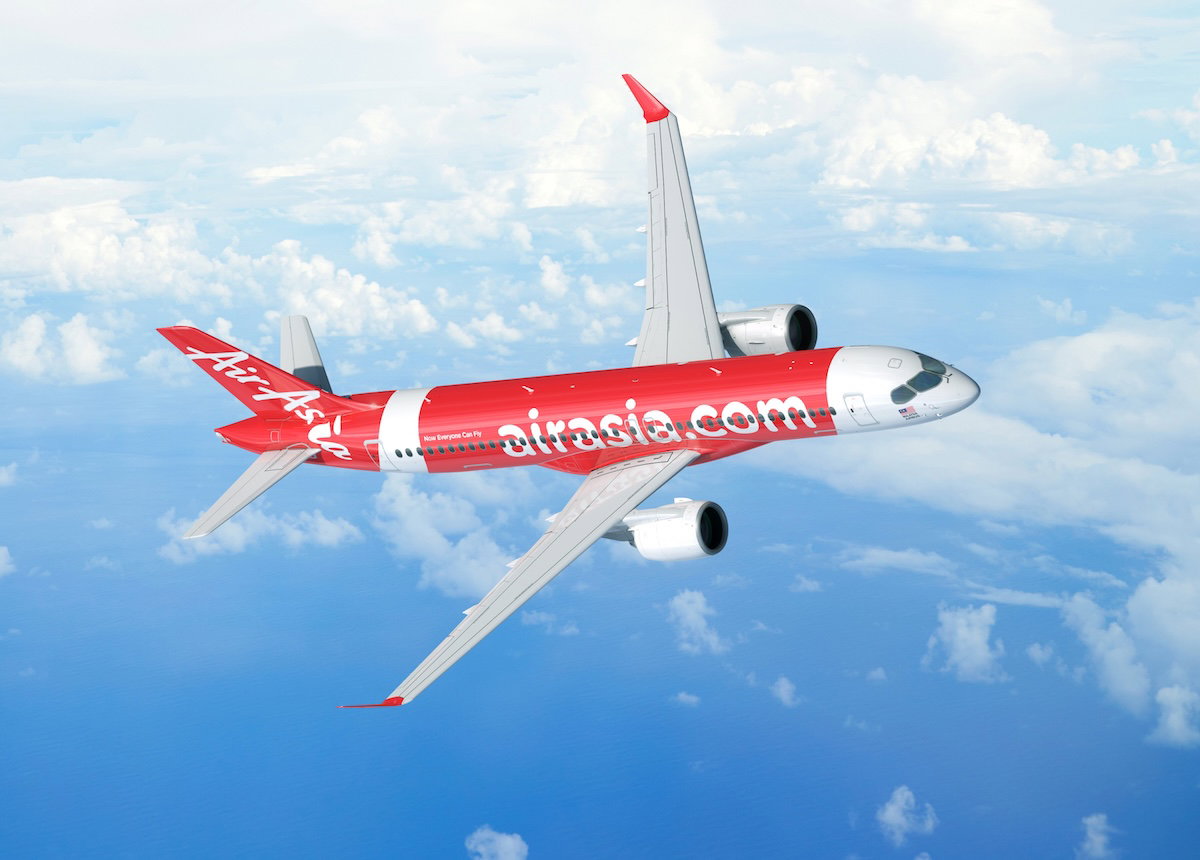
How the Airbus A220 will fit into AirAsia’s fleet
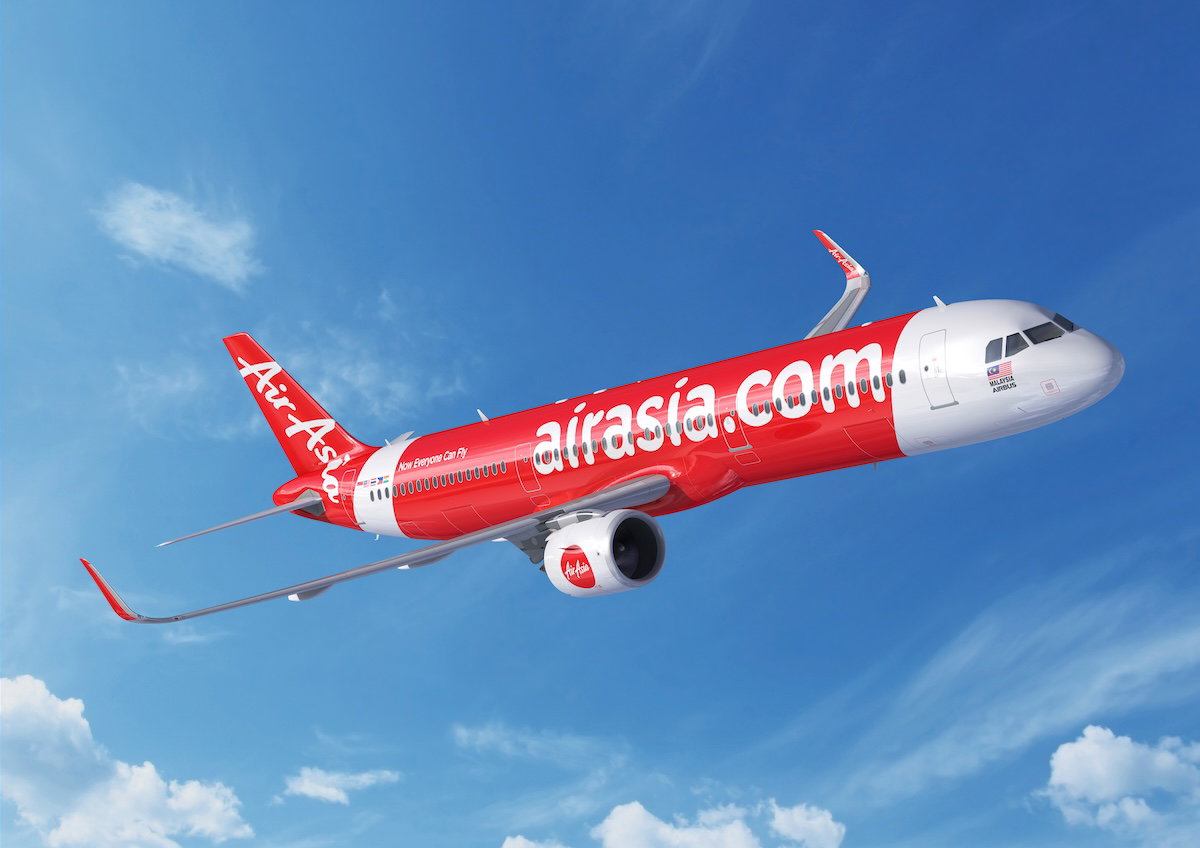
The fleet of AirAsia’s Malaysia subsidiary otherwise consists primarily of Airbus A320-family aircraft, including both the classic (ceo) and next generation (neo) versions. For example, the airline has over 400 A321 aircraft on order, between the A321neo, A321LR, and A321XLR. At least initially, those planes are all going to be configured with 236 people, in a one-cabin configuration.
Presumably these A220s will over time replace some of the classic A320s, which have 180 seats. So that fleet replacement does represent a capacity downgrade on a per-aircraft basis, though I imagine the total number of frames will be greater. You also can’t argue with the operating costs of the A220, especially with so many seats.
So while many airlines hesitate to introduce a new type of aircraft when they benefit from fleet commonality, it’s clear that AirAsia has the ability to scale multiple fleets, in a way where they can all be operated efficiently.
Given AirAsia’s size and what a good customer of Airbus it has been, I imagine the airline got a great deal on these aircraft. It’s understandable that for its long term fleet growth, the airline also wants something smaller than the 236-seat A321neos. If you don’t need the range of the A320neo, there’s a lot of merit to the A220-300, given the lower cost per frame, lower operating costs, etc.
This is also a massive win for Airbus, because up until now, the A220 hasn’t been particularly popular with ultra low cost carriers (with some exceptions, like Breeze, which is more of a “value” airline than an ultra low cost one).
Bottom line
AirAsia has announced a firm order for 150 Airbus A220-300s, with deliveries expected as of 2028. AirAsia will be the launch customer for the high density version of the A220-300, which can have up to 160 seats (thanks to an extra emergency exit). Congrats to AirAsia and Airbus, this is a good development all-around.
What do you make of AirAsia’s A220 order?




I’m curious. Would all this be new, or would they for example be taking ex-EgyptAir A220s and have those retrofitted for faster delivery?
New. Built in Mirabel. At the announcement Mr. Fernandes prodded Airbus to come up with the stretched version.
It is widely reported on the right side of the pond that the aircraft will be assembled in the Mirabel assembly plant and not Mobile.
@ Ray -- I believe these are all newly built frames. And given that these are for the higher density version, it's also more efficient to just build these from scratch, rather than to retrofit.
Read between the lines.
AirAsia is now overcapacity.
Tony Fernandes can't fill his A320 anymore.
AirAsia seems to have pulled a reverse NK in those markets.
While US carriers introduce basic fares to compete, Asian LCC seems to get more expensive.
Watch as they attempt 3-3 seat configuration... (usually 2-3).
I wonder if this means Airbus made a breakthrough with the time on wing problems with the A220 engines
I can't see AirAsia ordering otherwise, they're not a business model that could cope with it?
Pratt and Whitney has developed fixes for all of the Geared Turbofan engines; it is just a matter of getting enough parts built to fix defective in-service and grounded engines while Airbus continues to sell new GTF powered airplanes.
One can always tell when Walter Mitty uses a ‘cut and paste’ article for its posts. The paragraph is grammatically correct and it starts off with an uppercase letter. When making up its own rhetoric it fails miserably to apply any rules.
this is a big win for Airbus and its efforts to make the A220 a high volume plane.
It also appears that Air Asia is cancelling A330NEO orders so it is not all new orders coming to Airbus.
And a big win for Canada as these will be built in Quebec! Elbows up and wings out!
Neil, to be correct, one should say “Assembled” in Quebec.
U.S. customers aircraft are “Assembled” in Alabama.
Of course the proletariat of the ORD mentality, would not appreciate such nuances. Bears of very little brain seldom do.
Pretty amazing commitment given all the issues the A220 is having with the PW Geared Turbofan engines. I recall reading a full 20% of the existing fleet was grounded 6 months ago. They must have received incredible terms from Airbus/PW and/or some kinds of assurances of a fix.
That engine problem has been identified and solved. By the time Air Asia takes delivery of their airframes it won't be an issue.
Crap plane for a crap airline.
Worst poster here and that is saying something.
Whether you’re an insufferable troll or an actual psycho, the world will be a better place when you’re dead.
I'm both, Poo-Doof. And the only time you show up is to insult me. Nice to be living in your terrifying skull for free.
Not sure about the first half, but the second half is correct.
ORD hates any aircraft not manufactured by Boing (typo intentional). I'd never fly with Air Asia, but I've flown on the A220 many times and they're actually great.
Totally disagree, I've only had good experiences (punctuality, service attitude, food, price) with AirAsia for two decades. Much better than my experiences with crap US airlines
Same
So, you're a cheapskate loser living in some 3rd world shithole country. Your parents must be so proud of their illigitimate offspring!
Wow, you must be american
160 is an interesting number of pax. It means you have to have 4 cabin crew rather than 3, but you only gain revenues when you are over 150 seats sold. So you're locked into higher costs on every flight for a small upside on a few flights. I am sure TF knows his numbers though. I am curious if Airbus confirms the A220-500 in the next year or so and AirAsia switches a whole bunch of orders to that, perhaps as launch customer.
Fwiw labour costs are much lower in Malaysia and Air Asia tends to churn though young FAs instead of having them stay and build seniority (like most LCCs in the region), so the calculation / weighting of staffing costs would be different from a legacy carrier with an unionized workforce.
There are multiple airlines that have 160 seats on a plane and face the same issue and yet decide that it is worth it.
Just curious what you think should be the marginal number of seats added above each increment of 50 (which requires an FA) to justify adding those extra seats.
"High Density" is stupid .
160 seats on an A220? Meanwhile SQ is planning a 132-seater A350. It's all good; I'd rather take a brand new A220 than a turboprop or an old 737 in SE Asia any day!
I don't know what your point being except how little you know or can think.
Because
1. SQ is not LCC
2. The 132 seat is the ULR which would never overlap A220 or AirAsia in any route.
3. AirAsia doesn't fly turboprop or 737.
I used to live in SE Asia; I obviously don't need your pointers. I'm just comparing two obvious extremes in density - where's the suggestion that they overlap in service or that these two airlines compete? Also my two statements are not related. Yes; a dense new A220 is still better than any other LCC (or even some mainlines) that fly turboprops and old 737s.
Trey, your writing is clumsy and poorly-constructed. Eskimo is not the only person who struggled to make sense of what point(s) you were trying to make. Maybe dwell on that instead of being defensive?
Total monthly earnings typically range from approximately RM3,500 to RM5,000 (USD 800 to USD 1,100) for most AirAsia crew members on regular schedules. Their actual base pay is very low.
I bet the fourth FA to allow for "extra" ten passengers on board won't break the bank.
Delta flies 157 seat A320 and 160 seat B737-800
AA flies 155 seat A321XLR (it will require at least 5 to 6 FA minimum, 2 extra for business class suite plus 4 for total passenger count)
UA will fly 160 seat A321NEO, (will require similar FA counts with American A321XLR unless UA doesn't put doors in business class.
You had me until high density. If you review a regular space coach seat I may revise my opinion after your review.
Flying a ULCC with only one middle seat per row is fantastic. Air Asia is a ULCC, but it hardly feels like one, and with this this aircraft, that's even more true.
With 28" pitch on AirAsia, Jerry must be 4' tall. Or 120cm to those in Asia to hardly feel like ULCC.
Yeah, but AF flies this with 148 with a 30" pitch. The need three more rows. So, what will be the pitch then.
Air Asia is the airline where I was served a hot meal on my SIN-KUL one hour flight.