

Consumers don’t often think about the economics of how hotels are reimbursed when loyalty program members redeem point for a stay. That brings us to an interesting post on Reddit, where a Hilton employee is asking if they should report their hotel to Hilton corporate for a fraudulent scheme they’re running to get paid more for award stays.
This is something we’ve seen time and time again over the years, and it sure seems to me like it should be easy enough for the hotel groups to spot and control.
How hotels fraudulently increase award reimbursement rates
I’ve written in the past about the economics of hotel points redemptions, and specifically, how hotels are paid when members redeem points. While the exact reimbursement policies differ by program, here’s the general concept:
- When a hotel isn’t full, the loyalty program compensates the hotel at a pre-determined rate that’s above the marginal cost of accommodating a guest, but hardly lucrative for the hotel
- When a hotel is full (think 95%+ occupancy, but the exact threshold varies), the loyalty program compensates the hotel at close to the average daily rate, in recognition of the fact that the room may have otherwise been sold to a guest paying with cash
In other words, if hotels have a lot of guests redeeming points, they also have a big incentive to have very high occupancy. I’m making up numbers here, but let’s use a 100-room hotel as an example, and let’s say the threshold to get higher reimbursement is 95% occupancy:
- If 20 rooms are booked with points and the hotel is at 94% occupancy, the hotel may only be reimbursed $50 per award room (so $1,000 total)
- If 20 rooms are booked with points and the hotel is at 95% occupancy, the hotel may be reimbursed $200 per award room (so $4,000 total)
As you can see, this can make a big difference in terms of economics. That brings us to an interesting Reddit post flagged by View from the Wing, where someone who claims to be a Hilton employee writes the following:
My hotel has been putting in fake reservations for the last few years during the summer months (June-August) if we are close to 95 percent occupancy but not quite there. They will ask night audit to check them in then 0 out the rate after the night audit is ran and checked them out. The purpose of these “threshold” reservations is to supposedly get Hilton to reimburse a higher amount for rooms staying on Hilton Honors points. They’ve been doing it for years is my understanding. Isn’t this fraud? Could it and should it be reported?
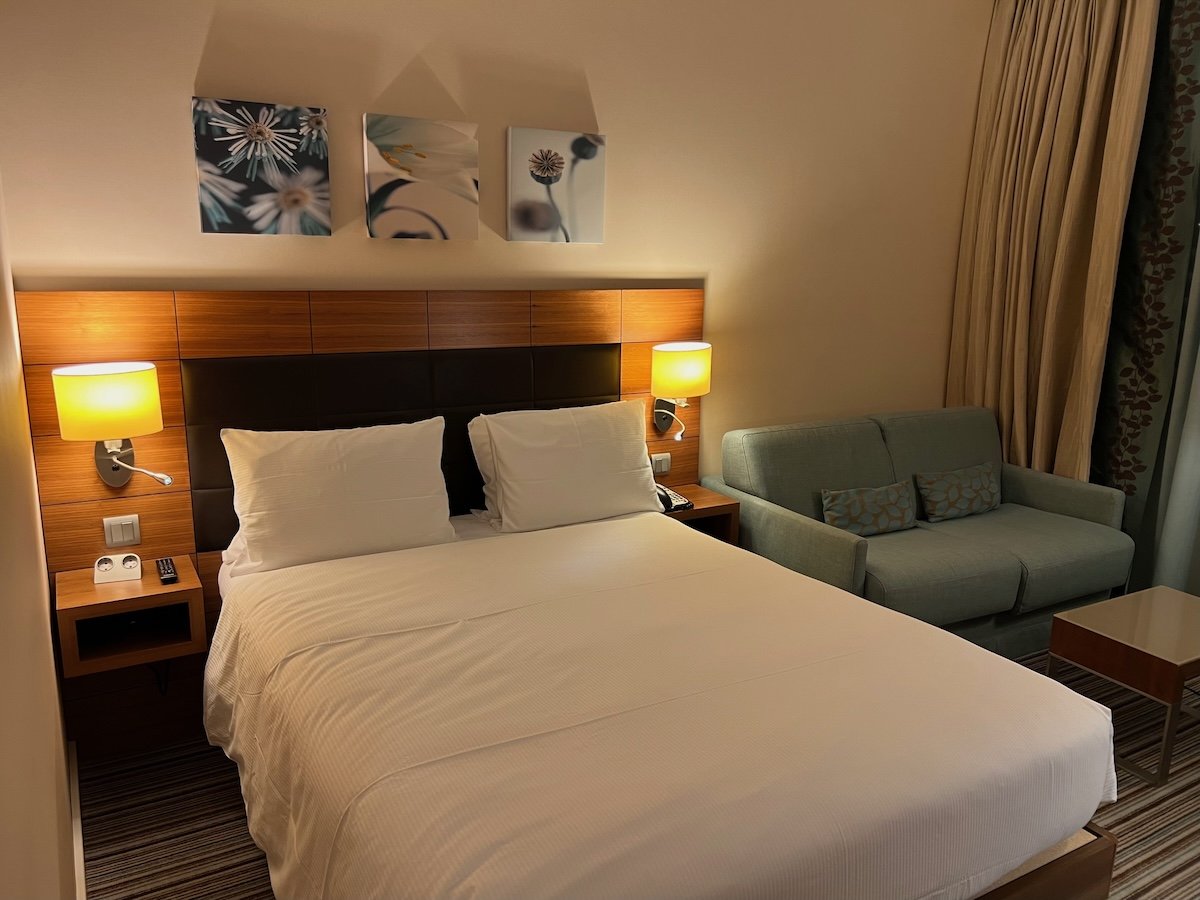
Occupancy “gaming” is a common hotel practice
Hotels belonging to major loyalty programs are focused on that 95% occupancy threshold (or whatever the magic number is for their hotel group), especially if they get a lot of award redemptions. There are lots of ways to legitimately increase occupancy at the last minute.
For example, maybe if a hotel is running occupancy just under 95%, they might discount rooms on the day of arrival significantly, or try to sell them through an online travel agency at a huge discount, just to get to the higher reimbursement level. That’s legitimate, and there’s nothing wrong with that.
However, what’s described above is of course fraud, and isn’t okay. It impacts the economics of the loyalty program, and also impacts members, since hotels with higher reimbursement rates will also cost a lot more when redeeming points (since redemption rates reflect costs to the program more than anything else).
Perhaps the most public version of this case goes back to 2013, when Starwood sued Le Parker Meridien Palm Springs for fraudulent award reimbursement, as the hotel was accused of receiving over $1 million in fraudulent reimbursements, by falsifying records.
Both Le Parker Meridien New York and Palm Springs ended up leaving Starwood in 2017, in part due to the bad blood over this — Parker Palm Springs remains fully independent, while the New York property turned into the Thompson.
Quite honestly, I’m surprised that the major hotel groups don’t have more sophisticated systems to investigate this. After all, it seems easy enough to figure out which hotels just barely pass the 95% occupancy threshold regularly, and then see a lot of last minute bookings with folios that show a zero dollar rate.
It’s worth mentioning that reimbursement for award stays is a point of contention between hotel owners and the larger hotel groups nowadays, given the other ways that loyalty programs are centrally being monetized. The frustration is that points are no longer just issued as a reward for hotel stays, but increasingly, they’re being sold to banks and more. The hotel loyalty programs get the upside of that, while the individual hotels are stuck accommodating guests with very low reimbursement rates a majority of the time.

Bottom line
Reimbursement for hotel award stays is an interesting topic, since the amount that hotels are reimbursed differs widely based on occupancy levels. Hotels that have a large percentage of rooms booked with points have a huge incentive to get occupancy numbers higher, so they reach the maximum reimbursement thresholds.
There are legitimate ways hotels can increase occupancy at the last minute, like lowering rates or selling some rooms through online travel agencies at a steep discount. But then there are the illegitimate ways that’s sometimes done, like checking in fake guests. One Hilton employee is claiming that this is going on at their property, and they’re wondering if they should report that to Hilton corporate.
What do you make of this hotel award reimbursement occupancy threshold, and the games some hotels play?




I have worked for a different chain - and the reimbursement for stays paid for with points was usually 50% unless the hotel is more or less fully booked (dont remember the exact percentage). This was a programme with fixed monetary redemption value per point.
So in some cases, especially when someone decided to use their points on dates where rooms were cheap in the first place, the reimbursement for points was significantly less than...
I have worked for a different chain - and the reimbursement for stays paid for with points was usually 50% unless the hotel is more or less fully booked (dont remember the exact percentage). This was a programme with fixed monetary redemption value per point.
So in some cases, especially when someone decided to use their points on dates where rooms were cheap in the first place, the reimbursement for points was significantly less than the cost to turn the room around.
"Gambling" the system didnt occur to my knowledge, but I dont see why the properties shouldnt be allowed to push their occupancy (i.e. via last minute promos or the like) in case this benefits them one way or another.
Like any business, if there is a way to do it, they will. And it appears the hotel companies turn a blind eye for this practice. So it will continue.
Unless… we actually enforce laws against scamming consumers…
Easy to prevent this: corporate should provide cash rewards to hotel employees who report this fraud.
Most hotel employees aren't paid enough to not collect a 50K reward for information that exposes cheating hotels - but 50K isn't a lot of cash compared to the losses incurred to corporate by repeated fake reservations.
I used to work at a Hyatt which was thecl crew hotel for a major international airline. The contract stipulated that when occupancy exceeded 85% then the hotel had the right to charge the airline for the rooms booked for the crew arriving on the following day's early morning flight. The General Manager at the time aggressively pushed us to create dummy reservations on many nights when we were way below 85% occupancy, just so...
I used to work at a Hyatt which was thecl crew hotel for a major international airline. The contract stipulated that when occupancy exceeded 85% then the hotel had the right to charge the airline for the rooms booked for the crew arriving on the following day's early morning flight. The General Manager at the time aggressively pushed us to create dummy reservations on many nights when we were way below 85% occupancy, just so that we could bill the airline for these rooms. Over the years, the airline would have paid millions of dollars for all these extra room nights that they should not have paid for. Sad and unprincipled of the GM, and what a terrible example of dishonesty to set for staff. Looking back, I wish that I had notified the airline discreetly of this.
This why you have Auditors and Corporate Investigators. They should be doing their jobs more effectively.Fines and other penalties should be levied on the said hotels. Almost All Indian Franchise owners are Guilty of that. Inspectors should also look at the Low end Hotels of Running "Hore" Houses.
They also do fraud on Hilton daily credit that gold/diamond members have. I stayed at a Tapestry in SF, and when I checked the receipt I found out false restaurant transactions they put there for the purpose of redeeming the 15$ credit per day. I reported that to Hilton but nothing heard from them.
Sounds like a managed hotel.
They just need to bring back Priceline's name your own price feature so hotels have a reliable and legitimate way to sell unfilled rooms at the last minute. Before 2015 or so when they gradually got rid of it, I stayed at hundreds of nice hotels, many 3 and 4 star ones, for $30-55 a night. It made travel affordable. Those were the good old days. No loyalty program nonsense needed!
I disagree with your comments, "The hotel loyalty programs get the upside of that, while the individual hotels are stuck accommodating guests with very low reimbursement rates a majority of the time." While that might be true, it really comes with the territory of being in a major hotel chain and the hotel benefits from brand recognition and chain affiliation, being a part of a global loyalty program that can drive up sales, etc..
It is an easy fix. Just reimburse marginally below the lowest rate checked in on a given night when occupancy is at or above 95%. If they are building fake bookings (and checking them in) at $0, then the hotel gets $0 for all their redemptions that night. if the hotel puts any other dollar amount, they are then messing up their books (and probably committing other fraud-type crimes)
I don't understand what the problem is. Maybe the individual hotels don't understand the basics of Microeconomics. If the marginal revenue received for one additional "award" room is greater than the marginal cost for them to accommodate this guest, it is always worth their while to have this room occupied. The argument that the average room rate would be much higher than this doesn't hold, because obviously they haven't been able to sell that room...
I don't understand what the problem is. Maybe the individual hotels don't understand the basics of Microeconomics. If the marginal revenue received for one additional "award" room is greater than the marginal cost for them to accommodate this guest, it is always worth their while to have this room occupied. The argument that the average room rate would be much higher than this doesn't hold, because obviously they haven't been able to sell that room at that rate and if they didn't accept the "award" reservation, the room would otherwise have stayed empty.
I don't think. that there is any valid argument saying that the guests who booked on points would otherwise have booked for the cash rate, if no award rooms were available. Because then you could start arguing how many bookings they wouldn't have got in the first place, if they didn't have an attractive loyalty program.
I can see that with the described reimbursement system, the incentive for cheating is there, but I don't see why they would really risk that, as the system doesn't actually cost them anything in real terms.
@ CapitalMike -- "I don't think. that there is any valid argument saying that the guests who booked on points would otherwise have booked for the cash rate, if no award rooms were available."
I think the argument is even simpler than that. Regardless of whether or not there's award availability, many of us consider redemption values before deciding whether to pay cash or redeem points.
Let's say you value Hilton Honors points at 0.5...
@ CapitalMike -- "I don't think. that there is any valid argument saying that the guests who booked on points would otherwise have booked for the cash rate, if no award rooms were available."
I think the argument is even simpler than that. Regardless of whether or not there's award availability, many of us consider redemption values before deciding whether to pay cash or redeem points.
Let's say you value Hilton Honors points at 0.5 cents each, and a hotel costs $250 or 50,000 points. While I might say that's a "breakeven" redemption value (it's a little more nuanced than that), from the hotel's perspective, the difference in revenue is potentially massive.
The issue, as hotels see it, is that loyalty programs have increasingly been used to generate profits for the company centrally, which wasn't the case as much a decade or two ago.
Cleaning and servicing a room costs money. The AC costs money, power costs money, the soap, coffee pods etc all cost money.
The incremental costs all add up. Margins declining mean loans can default.
This doesn’t excuse fraud but the cost per guest at higher end properties, think resorts, can be much more than the point redemption even at the 90-95% threshold.
That says nothing about the loss of F&B revenue.
...Cleaning and servicing a room costs money. The AC costs money, power costs money, the soap, coffee pods etc all cost money.
The incremental costs all add up. Margins declining mean loans can default.
This doesn’t excuse fraud but the cost per guest at higher end properties, think resorts, can be much more than the point redemption even at the 90-95% threshold.
That says nothing about the loss of F&B revenue.
Does this justify fraud, of course not. These hotels should be punished severely.
You don’t seem to understand the marginal revenue vs. marginal cost concept either.
Of course the things you mention cost money. Ben wrote “ When a hotel isn’t full, the loyalty program compensates the hotel at a pre-determined rate that’s above the marginal cost of accommodating a guest”, so these costs would already be part of the equation.
I think what surprises me is that they're so blatant about it. Like, wouldn't be /that/ hard for an owner to arrange with some friends to book a deep discount room on those nights (reimbursing them via some other expensable mechanism), would it? And good luck to Corporate proving that John Smith *didn't* stay the night on most of those nights...
The issue is having a cliff-edge - iIt would make more sense to have reimbursement rates be a smoother increasing function of occupancy rate.
I wonder how much of this originates from programmes being set up when hotel groups owned, or at least operated, the hotels, with intra-group profit allocation rules which then became contractual rules with third parties.
At least at Hyatt, why wouldn't hotels upgrade existing award (or paid) bookings out of the standard room bucket to create more low-priced awards and improve occupancy?
Also, curious how rooms offline for maintenance are handled. Seems as though removing a few unsold rooms from inventory for maintenance would be the easiest way to inflate occupancy without setting off red flags.
At Hyatt, some owners are too busy playing hide-and-seek with "standard" room space.
It's a bit more complicated as you may desire to keep your best suites available for meeting planners. Ideally your presidential suite is occupied entirely by VIPs and meeting planners. So it should be roughly the same guidelines as Concierge Key at American Airlines as a few people may have substantial decisions on overall bookings at your hotel.
The perversity here is if you are at $300/night ADR at 82% occupancy you may have an...
It's a bit more complicated as you may desire to keep your best suites available for meeting planners. Ideally your presidential suite is occupied entirely by VIPs and meeting planners. So it should be roughly the same guidelines as Concierge Key at American Airlines as a few people may have substantial decisions on overall bookings at your hotel.
The perversity here is if you are at $300/night ADR at 82% occupancy you may have an incentive to book at lower rates close in to push to 95% occupancy.
I don't think the quotes person is a Hilton employee but one of a franchisee.
The scheme sounds possible and absolute is fraud.
I've never understood why hotels don't allow more reward reservations to get to increased occupancy to hit the threashold. Often close into booking reward rooms are pulled from inventory as "they're close to full" wouldn't it be logical to encourage that reward redemption
They do, but corporate owner of the loyalty program has set the award night prices in points so affiliated hotel can’t do one-off award nights fire sales by driving down to very low award night prices in points even with hotel programs that have dynamic pricing.
I’d rather have a discounted Kayak/Expedia customer than a points customer at our resort properties. The total revenue (F&B, activities, etc) is significantly higher than points customers. Granted in busy season we are well above thresholds but points customers are generally the lowest rev yet highest cost customer.
Roger,
That doesn't surprise me, but thanks for the perspective. There's a difference between "shopping for a deal" people and "I must maximize my value" people. The latter get joy from the process of spending so little, while the former are often working with a fixed budget where a lower room rate will cause them to spend more on F&B (i.e. if they have $2500 to spend on vacation, they are going to spend it...
Roger,
That doesn't surprise me, but thanks for the perspective. There's a difference between "shopping for a deal" people and "I must maximize my value" people. The latter get joy from the process of spending so little, while the former are often working with a fixed budget where a lower room rate will cause them to spend more on F&B (i.e. if they have $2500 to spend on vacation, they are going to spend it somehow).
This is one of the reasons I really like having a cash budget when we mix points into the equation, or even better, just using the points to make it so we don't have to worry about a budget -- we can just buy what we want on site. But the points influencer ecosystem speaks yes of this. "You can travel for free" will get a lot more views than "you can use points to have a nicer experience on a similar budget."
Brent -
You nailed it. Having started in the consulting world maximizing points in the early aughts to moving into the hotel business (I love the concept of an amazing stay as much as Ben) it’s been really striking to see what’s happened with points at both lower end overnight/business hotels ,where we started, to the higher end resorts where we play now.
The problem for consumers and the hotel owners /operators is the...
Brent -
You nailed it. Having started in the consulting world maximizing points in the early aughts to moving into the hotel business (I love the concept of an amazing stay as much as Ben) it’s been really striking to see what’s happened with points at both lower end overnight/business hotels ,where we started, to the higher end resorts where we play now.
The problem for consumers and the hotel owners /operators is the ability for the hotel brands to create so much revenue from selling points to CCs and marketing it as selling an experience. If you’re a shareholder of the big brands it’s great, if not then it’s been downstream pain for everyone else in the industry.
What are the high costs associated with points customers?